Anti-crisis policy: choosing the strong side
6 170 29
Anti-crisis policy: choosing the strong side
"Sheep" with a fuel oil tender


Publications about Russia's economic problems clearly display a pronounced bias toward hypercriticism—everything is bad, everything will fall apart, and so on. Proponents of this approach, albeit implicitly, somehow believe that all it takes is exaggeration, panic, and hysteria, for the problems to magically resolve themselves. Or that, just as magically, some "solvers" will appear who will resolve these problems.


Yelling and screaming have never solved a single problem, and, in fact, proponents of hypercriticism often, and I believe often intentionally, hinder the development of an effective anti-crisis strategy by shouting at anyone who starts looking for some kind of advantage in the current situation: “Nothing good can happen!” “Everything is lost!” and so on.

What I like about the Soviet economic experience is that it included numerous moments of struggle with various crises and difficulties, during which approaches to effective anti-crisis strategies were developed that can be generalized and developed into a theory. Specifically, this approach employed a method that could be called "the strength-based approach," which can be used to overcome any economic crisis that arose.
Let's look at this using the example of using petroleum fuel to solve the fuel crisis of the 1920s.

The forest is the head of everything


The fuel crisis occurred when, in the spring of 1918, Soviet Russia suddenly lost almost all its mineral fuel. Yes, as a result of the Brest-Litovsk Treaty, under which German troops occupied Ukraine and the Donbas region—the main source of coal—in March-April 1918. In late July 1918, when the Council of People's Commissars (Sovnarkom) government in Baku fell and power passed to the British-aligned Central Caspian, oil supplies also ceased.

Large cities, industrial centers and railways of the RSFSR were left without fuel supplies.

Of course, there were reserves and stockpiles, there was the Moscow region coal basin (in 1917 it produced about 700 thousand tons, and in 1918-1919 production fell to 380-400 thousand tons), there was smuggling, but all this did not provide even the minimum fuel needs.

The situation was absolutely critical, enough to drive today's hypercritics into hysteria, to the point of unconsciousness. The Bolsheviks, however, in addition to the most obvious measures of centralizing fuel reserves and distributing them at the infamous Main Fuel Office of the Supreme Council of the National Economy, quickly discovered the one remaining strength, despite all the losses: firewood.

Firstly, most of the territory of the RSFSR in 1918-1919 was covered by forest. Only the south, where the fighting took place, had sparsely forested areas.

Secondly, logging did not require complex technical equipment, but it did require taking into account the labor costs of harvesting, transporting and sawing firewood and supplying firewood harvesters with food rations.

Third, a specific system for firewood procurement was developed, taking into account the proximity of procurement areas to cities, railways, and rivers; a system for the accumulation and distribution of firewood reserves was developed in accordance with the instructions of the Main Fuel Directorate and the priorities of consumers.

Fourth, unsaleable wood was used. Wooden houses, outbuildings, and fences were dismantled for firewood, especially in Petrograd. In 1920, the Palotop Main Directorate was established, responsible for collecting dead wood, brushwood, and pine cones from forests—incidentally, 1 billion poods in 1920.
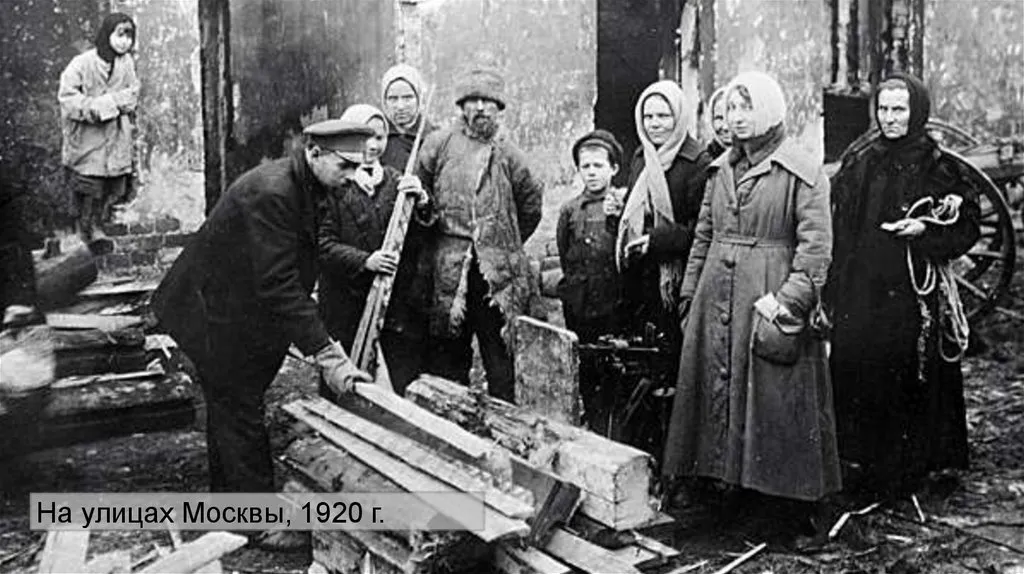

This is roughly how Moscow residents were supplied with firewood at the peak of the fuel crisis.

A particular advantage was that, although firewood was the worst fuel for steam locomotives, the railways could nevertheless run on self-supplied firewood.

Firewood remained the main fuel for a long time, even after the end of the Civil War, which, however, led to the fact that in many areas logging areas were cut down for 15-20 years in advance or more, and to the depletion of local forest resources.

Turning to oil


After the Donbass was captured by the Red Army at the end of December 1919, and Baku was captured by the Red Army and local Bolsheviks practically bloodlessly on April 28, 1920, the preconditions for resolving the fuel crisis arose.

However, at this point, an interesting temporary shift occurred in favor of oil over coal. Oil proved to be the Soviet economy's strength at the time. The Baku oil fields, of course, suffered from the war and the British occupation. In 1920, oil production fell to 2,9 million tons and continued to decline to 2,4 million tons in 1921. But then there was a rapid recovery: 2,9 million tons in 1922, 3,5 million tons in 1923, and 4,2 million tons in 1924. By 1928, production had reached 7,7 million tons.

However, the situation with Donetsk coal was much worse. In 1920, production fell to 4,5 million tons (Donetsk coal consumption in 1913 was 25,3 million tons), with the basin's own consumption accounting for 27% of production. Recovery in production was slow: 5,4 million tons in 1921, 6,3 million tons in 1922, 8,1 million tons in 1923, and 11,8 million tons in 1924. Only in 1927 did Donbas exceed pre-war production levels.

If we exclude the basin's own needs for lighting, drainage, lifting, and similar needs, then Donbass supplied coal:

1920 - 3,2 million tons
1921 - 3,9 million tons
1922 - 5,4 million tons
1923 - 7 million tons
1924 - 10,2 million tons
1927 - 28,2 million tons.

As we can see, the first three years after the end of the Civil War were very bad, and Donetsk coal provided from 12 to 21% of the 1913 consumption level, which was considered normal in those years.

Therefore, much of the 1920s was marked by the increased use of oil and various petroleum products, primarily kerosene and fuel oil. They were used in all areas, from industry and railways to household lighting and cooking. It was during these years that the famous primus stove appeared, partially saving on firewood and coal in cities.

Fuel oil on railways


Fuel oil played a huge role in providing railways with fuel and in resolving the fuel crisis. It's worth noting here that a relatively little-known aspect of the issue is that before the Revolution, a significant portion of the steam locomotive fleet ran on fuel oil. Thomas Urquhart, an engineer at the Gryazi-Tsaritsyn Railway, built and commissioned the first fuel oil locomotive in 1874. In 1904, 5500 fuel oil locomotives, or 40% of the fleet, were in operation. Then, by 1913, the share of fuel oil locomotives had dropped to 25% of the fleet (to 5200 locomotives) due to a sharp rise in fuel oil prices, as well as increased coal production and a decline in coal prices. However, in 1913, the railways consumed approximately 3,3 million tons of fuel oil and petroleum residues. Coal was on the rise because it became cheap at the time, but fuel oil dominated on the roads of the Caucasus and Central Asia.

Before the war, an infrastructure for supplying steam locomotives with fuel oil was built, and despite cutbacks, it remained in place. Along the mainlines served by oil-fired locomotives, systems were built for storing and draining the fuel oil into tenders equipped with steam heaters.

Steam locomotives were easily converted from coal to fuel oil or wood, and vice versa. For example, to convert to fuel oil, a fuel oil tank, usually box-shaped but sometimes cylindrical, was installed in the tender in place of the coal pit. A fuel oil pipeline was connected to the firebox. A system was installed to heat the tank and supply live steam to the injectors—they were steam-oil injectors, in which fuel oil atomization was provided by steam. The tender typically held 7 to 13 tons of fuel oil, which provided a range of 100-150 km. Steam locomotives of the "Shch," "Ch," and "O" series, as well as the Swedish "E" series, were converted to fuel oil.
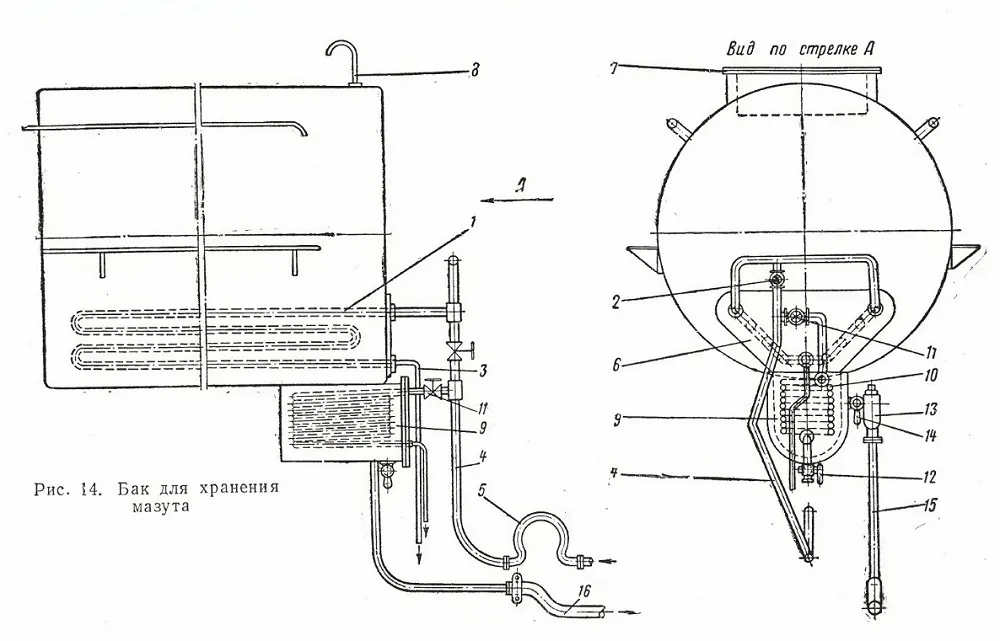

Drawing of a fuel oil tank in a locomotive tender

In the 1920s, fuel-oil locomotives served almost the entire Transcaucasian, North Caucasian, Tashkent, Central Asian, and Yekaterininskaya (or Krivoy Rog) railways. They also served certain lines of the October Railway (passenger and express trains), the southern and eastern branches of the Moscow-Kazan Railway, and the Ryazan-Ural, Samara-Zlatoust, and Syzran-Vyazemskaya railways—all along the Volga region.
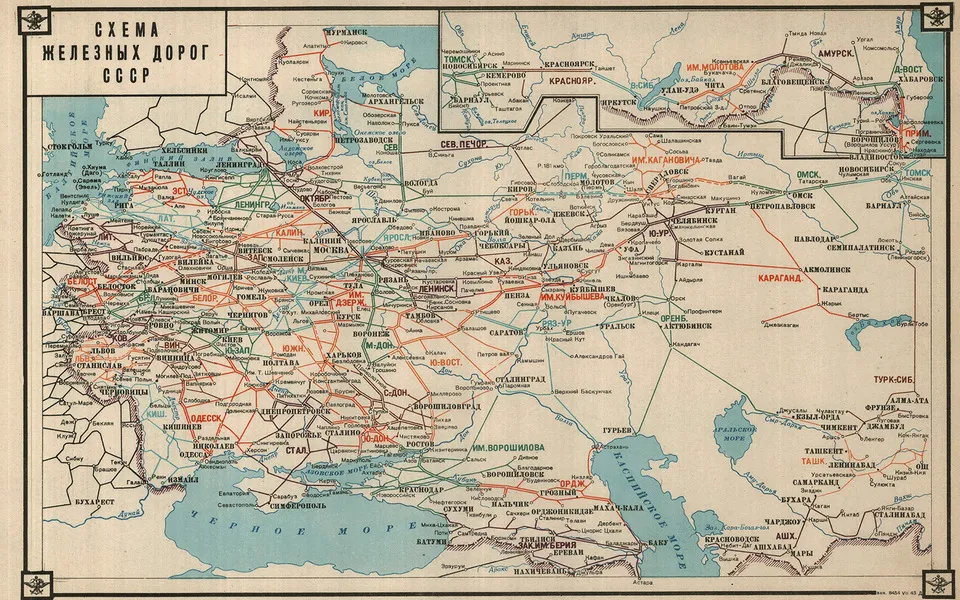

Map of the USSR railways

Fuel oil was used primarily in the south, where the fuel source was close, and also in the Volga region, where fuel oil was delivered by river tankers, mainly to Saratov and Samara.

Of course, fuel oil had its advantages. Fuel oil consumption was 40% lower than that of high-quality coal. Tender loading took just 10 minutes, compared to 40 minutes for coal loading. Oil loading facilities were much simpler and more economical than coal depots, especially if tender coal loading was done manually. Furthermore, while a coal-fired locomotive consumed up to 5% of its fuel on starting and maintaining steam, an oil-fired locomotive quickly built up steam, started up in 30 minutes, and when stationary, the fuel oil supply to the firebox could be reduced to a minimum, allowing for just a light fire. The labor-intensive and time-consuming process of ash pan cleaning was also eliminated.
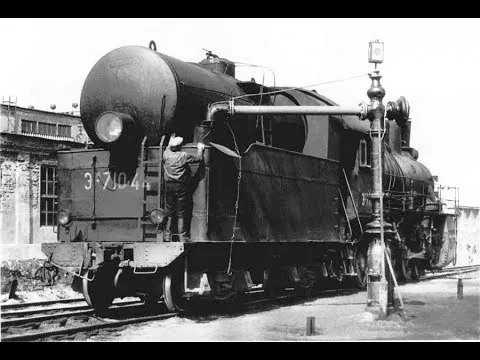

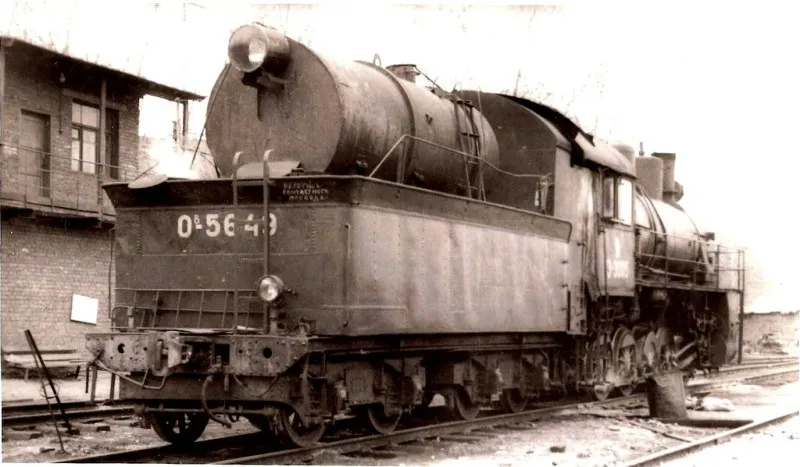
Very few photographs of oil-fired steam locomotives survive. This photo shows an "E" series steam locomotive filling its tender with water; the water tank is located beneath the oil tank.

Overall, fuel oil reduced the cost of transporting a ton of cargo by 25-30%. Boiler capacity increased by 15-20%.
But running on fuel oil was a real art. If the engineer increased speed, the assistant engineer had to immediately add fuel oil and steam to the burner, otherwise the steam pressure in the boiler would drop rapidly. The fuel oil had to be heated constantly, but not above 80 degrees Celsius, otherwise the fuel oil would boil, the pumps would supply it intermittently, and the locomotive would begin to cough. To clear the fire tubes of thick soot, the assistant engineer would throw a scoop of dry quartz sand through the firebox inspection window into the burner flame; the sand would scrape off the soot, which would be carried up the stack. The assistant engineer had to keep an eye on the water, since a lack of water on an oil-fired locomotive would very quickly lead to a burnout of the firebox ceiling and could lead to a boiler explosion. In general, the hot torch of the injector, up to 1500-1600 degrees, quickly and significantly wore out the steam locomotive, which required frequent repairs of the firebox and fire tubes.

So, oil-fired locomotives had their advantages and disadvantages.

Without fuel oil there is no bread, meat, cotton...


Now, why fuel oil? There are obvious and non-obvious aspects here.

The first is obvious. There was too little coal. In 1921, the People's Commissariat of Railways consumed 2,6 million tons of coal (66% of Donbas production), while coal accounted for only 27,2% of the total fuel. The railways ran primarily on wood.

[Center]
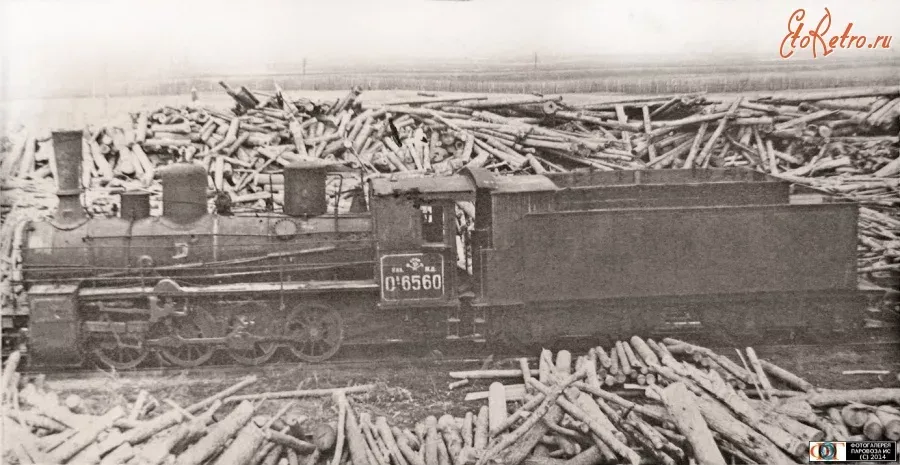
Although the supply of firewood to the railways sometimes led to the collapse of stations[/ Center
In 1922, the People's Commissariat of Railways consumed 3,2 million tons of coal (59,2% of production), with a coal share of 36,2%. In 1923, railways used 4,8 million tons (68,5% of production), with a coal share of over 51%. In 1927, when the decision was made to sharply reduce fuel oil consumption by the People's Commissariat of Railways, a number of railways were converted to coal, and the design of fuel oil-powered locomotives was even banned, railways consumed 8,9 million tons (31,5% of production).

It should be taken into account that in the early 1920s, when the enrichment plants in the Donbass were not operating, the coal supplied to the railways was whatever was available, often with 20-30% ash content and an admixture of waste rock.

The second is less obvious. If we look at the region served by fuel oil-fired steam locomotives, we see that, with the exception of the special needs of the October Railway, fuel oil-fired locomotives served the South, the Volga region, the Northern Caucasus, Transcaucasia, and Central Asia—regions either almost completely devoid of forests or with extremely limited forest resources. There simply wasn't enough firewood to power the steam locomotives. Due to the obvious shortage of coal, coupled with its poor quality, oil was the only alternative fuel for steam locomotives in these regions.

This region, served by oil-fired locomotives, accounted for up to 80% of the grain harvest, especially wheat, up to 45% of meat, 100% of cotton, as well as up to 70% of coal, up to 60% of steel, up to 25% of nitrogen fertilizers, and 100% of oil and petroleum products. Yes, coal and oil were transported primarily on oil!

Thus, it's perfectly clear that without oil-fired locomotives, it would have been impossible to ensure the very existence, let alone the rapid development, of the Soviet economy. Incidentally, I've never read about this factor in any book on transport economics or Soviet economics in general.

Fuel oil-fired steam locomotives, figuratively speaking, had reached the end of their service life. Before the war, they were used in the North Caucasus, Transcaucasia, and Central Asia. After the war, with the restoration of transportation and the emergence of a new source of fuel oil in Bashkiria, the Kuibyshev Railway, parts of the South Ural, Ryazan-Ural, Moscow-Ryazan, and Moscow-Kursk Railways, as well as the October Railway for passenger service and the Baltic Railway for some of its steam locomotives, switched to fuel oil in the 1940s and 1950s. In 1956, the decision was made to build diesel locomotives, and after that, oil-fired steam locomotive traction began to decline, practically disappearing by 1975.

This is the "strength-based approach," one of its most striking examples. A strength is an element that can be relied upon to resolve an economic crisis. To leverage it, it must first be identified, as it may be little known, known only to a few specialists, or even undervalued.
29 comments
Information
Dear reader, to leave comments on the publication, you must sign in.
  1. + 11
    25 May 2026 04: 13
    A very interesting article. I don't recall anything about oil-fired locomotives, although I've heard of oil-fired steam turbines.
    But the beginning of the article, which does not touch on the technical and organizational aspects, to put it mildly, has little connection with current reality.

    They often deliberately hinder the development of an effective anti-crisis strategy by shouting at anyone who starts looking for some kind of advantage in the current situation: "Nothing good can happen!", "Everything is lost!" and so on.

    Good-natured, but completely untrue, "news" from the field is far worse than panicked cries. At least because the cries force people to pay attention to the problem and turn to specialists, or at least to people with understanding who are at least aware of the strengths and weaknesses.
    A strength is an element that can be relied upon to resolve an economic crisis. To capitalize on it, it must first be identified, as it may be little known, known only to a few specialists, or even undervalued.
    1. +4
      25 May 2026 16: 49
      Vladimir.
      A very interesting article. I don't recall anything about oil-fired locomotives, although I've heard of oil-fired steam turbines.

      Dmitry (Author)
      In order to use it, it must first be identified, because it may be little known, known only to narrow specialists, or underestimated.

      In the Middle and Southern Urals, not only trains ran on fuel oil along the main lines of the Ural-Ryazan, South Ural, Kuibyshev and Gorky railways, but also open-hearth furnaces, rolling mills, thermal power plants and even boiler houses.
      The mass transition to natural gas dragged on until 2000.
      Steelmakers believe that metal welded with fuel oil is better than with gas, although both are inferior to similar metal welded with coal.
      1. 0
        26 May 2026 06: 57
        Quote: Kote pane Kohanka
        but open-hearth furnaces, rolling mills, thermal power plants and even boiler houses were also in operation.

        And which of the above is a steam locomotive?
  2. +3
    25 May 2026 04: 22
    So now problem solving is entrusted to "effective" managers, and not to specialists, of whom there are fewer and fewer.
    1. +3
      25 May 2026 05: 47
      Quote: andr327
      So now problem solving is entrusted to "effective" managers, and not to specialists, of whom there are fewer and fewer.

      And that's not even the problem, but rather that today's managers have a very limited outlook, which prevents them from even knowing about specialists, and instead confuses them with "crooks." This is without even considering the reliability of signals from the field.
  3. +6
    25 May 2026 04: 36
    The main problem is that both steam boilers and internal combustion engines are designed for a specific fuel type. Steam locomotives were designed for coal, and when they were converted to fuel oil or pure oil, they failed, as noted in the article. The calorific value of fuel oil or oil is higher than that of coal, depending on the coal grade. Generally, fuel oil is certainly easier to operate than coal. Fuel oil is still used in the navy; for example, the aircraft carrier Kuznetsov uses it. However, the Indians, on another aircraft carrier transferred to them by ours, switched to diesel, which has a higher calorific value than fuel oil, more complete combustion, and cleaner emissions. hi
    I forgot to write that the price of fuel oil and diesel is higher than the price of coal.
    1. +1
      25 May 2026 05: 15
      I forgot to mention that the price of fuel oil and diesel fuel is higher than the price of coal.
      - It depends on how you count, if you use the market method where the main goal is to EARN, then yes...
    2. +2
      25 May 2026 08: 53
      Quote: V.
      It's true that the Indians switched to diesel fuel on the aircraft carrier they received from us, which has a higher calorific value than fuel oil, more complete combustion, and cleaner exhaust.

      After converting boilers from fuel oil to diesel fuel before handing over the Vikramaditya (the former Russian aircraft carrier Admiral Gorshkov) to the Indians, several boilers (three, four, or even seven) burned out during testing. Officially, the insulation, converted to asbestos brick, crumbled due to boiler overheating. Perhaps due to the higher-calorific fuel, citing the inferiority of firebrick is ridiculous, unless they really messed things up and used insulating brick, which floats and is used as a second layer after the firebrick, instead of the firebrick.
  4. +2
    25 May 2026 06: 07
    The author mentions hypercriticism in the article, shouting and screaming that everything is bad and that it's hindering the government's work. Yes, such criticism hinders work, but criticism is necessary, and constructive criticism is needed—calm, to the point. Why is it so easy to criticize the government now? Because there are so many non-professionals in areas where well-trained people are needed, for example, in aviation, agriculture, healthcare, the economic and banking sectors. People have been unable to solve important problems for the country for decades; even at the front, we can't win quickly compared to the Red Army, the Soviet Army. The more senior leaders defend themselves against criticism, the worse things get in the country. Even in areas where everything can be solved without leaving the office, such as inflation and mortgages. hi
    1. +1
      25 May 2026 06: 40
      Having a professional in the right place is good, but professionalism isn't the only deciding factor. If you recall the first Soviet government, how many industry professionals were there? Dzerzhinsky and Kaganovich had never had any connection with railways, yet a system was built, the remnants of which still carry trains today.
  5. -5
    25 May 2026 07: 27
    The Bolsheviks quickly discovered the one remaining strength, despite all the losses: firewood.
    Yeah, the drivers and the townspeople were waiting for valuable instructions from the Bolsheviks, because firewood had never been known in Rus' before them. lol

    The author is silent, but I will remind you that it was the "craftsmen" Bolsheviks who led to the fuel and all other crises - before them, Russia's industrial production grew-even in the conditions of the Great War.

    It took 10 years and the capitalist NEP to reach the level of 1913, i.e. 10 years of development were lost
    1. +2
      25 May 2026 12: 32
      Once again, the ugly Bolsheviks forced steam locomotives to run on fuel oil. laughing
      1. +1
        26 May 2026 10: 37
        Quote: Jager
        Once again, the ugly Bolsheviks forced steam locomotives to run on fuel oil. laughing

        Really? And the article says that the damned Tsarism did this, and the Bolsheviks only "continued and deepened it."
    2. +2
      25 May 2026 16: 31
      Once again, the mournful songs of the baker... and who owned the main production and industries in Russia??? Ah... it's awkward to say...
    3. +3
      25 May 2026 18: 53
      Quote: Olgovich
      It took 10 years and the capitalist NEP to reach the level of 1913, i.e. 10 years of development were lost

      You'll agree that Russia is not unique in this regard. Whether we like it or not, any radical social upheaval sets the economy back years, even decades.
      And here, not only were the beneficiaries of social upheaval changing, but also the adoption of a new economic ideology, as yet unknown to anyone, as the basis for further development. More precisely, no one understood anything about economics in the new ideology; everything grew "on the fly," hence the enormous number of mistakes and stupidities that cost the people a huge price...
      1. 0
        19 June 2026 00: 05
        no one understood anything about economics in the new ideology, everything grew "on the fly",

        Incidentally, this very ideology grew out of economics. The problem is that the new economy faced challenges that were very difficult to predict.
    4. 0
      26 May 2026 13: 41
      Quote: Olgovich
      Yeah, the drivers and the townspeople were waiting for valuable instructions from the Bolsheviks, because firewood had never been known in Rus' before them.

      The Reds usually quickly procured firewood for steam locomotives, river fleets, and city heating, as Ostrovsky vividly described in his book "How the Steel Was Tempered." But the Whites were stumped by firewood procurement. They waited for Churchill to deliver cardiff from Britain. In the Moscow region, the Bolsheviks widely organized peat extraction and briquetting—a fuel with a higher calorific value than firewood. The plot of the communist book "How the Steel Was Tempered" and the communist film "The Communist" revolve around firewood procurement and how communists and non-communists approached it.
      1. -1
        27 May 2026 10: 43
        Quote: gsev
        The Reds usually quickly prepared firewood for steam locomotives, river flotillas, and heating cities

        The film "Officers to the Rescue." The Reds demolished the wooden quarters of the capitals, burning furniture and books.
        Quote: gsev
        as Ostrovsky figuratively described in his book "How the Steel Was Tempered".

        It's a disgrace - instead of normal work, there are rush jobs and casualties due to the inability to work and organize.
        Quote: gsev
        And the whites were stunned by the preparation of firewood.

        The Whites managed the country's economy perfectly and prepared firewood without the Gulag.
        1. +1
          27 May 2026 18: 11
          Quote: Olgovich
          It's a disgrace - instead of normal work, there are rush jobs and casualties due to the inability to work and organize.

          The Reds seized power, and 30 years later, the country was producing machine tools, civilian aircraft, aircraft engines, bearings, automobiles, and tractors—with virtually every size being produced. When the Whites arrived, the production of bearings, civilian aircraft, machine tools, and automobiles collapsed (the GAZ and Moskvich factories were moribund and no longer produce cars, ZIL stopped producing trucks, and KAMAZ began major layoffs). In reality, Nabiullina was only able to organize high interest rates on loans, while Chubais was able to sell permits for electricity connections at a price that would allow a new factory in China to be purchased, complete with not only electricity but also water and land rent (a real-life example is the Interskol plant: the company built a factory in China at the price RAO UES demanded for permits to consume additional capacity).
  6. +2
    25 May 2026 09: 35
    Shouting and screaming have never solved a single problem,
    How to say.
    For example, in some European country, 100,000 people take to the streets shouting and holding banners voicing a pressing problem that concerns them, and ultimately the responsible minister resigns, and sometimes the entire government resigns.
    As a result, new government officials are appointed and they take rapid, concrete measures to resolve the problem that has been voiced.

    That is, organized mass shouts and cries are the main impetus that contributes to the solution of a national problem.
    1. 0
      26 May 2026 13: 48
      Quote: Lewww
      That is, organized mass shouts and cries are the main impetus that contributes to the solution of a national problem.

      Shouts, demonstrations, strikes, opposition political activity are simply a less expensive way to change for the better compared to civil war or the degradation of a country that has fallen into stagnation, like Türkiye and China in the 19th century.
  7. 0
    25 May 2026 09: 46
    The President's goal of accelerated growth is unrealistic under current conditions. The IMF forecasts growth of 1%, while the global average is 3%—a threefold lag! To solve this problem, it is urgent to turn to the experience of the first pre-war five-year plans, as a result of which the USSR economy, almost completely destroyed by the intervention and civil war, rose to second place in the world after the United States in just ten years. This requires state control over money supply, similar to those in China, North Korea, and Vietnam, the separation of cash circulation from service enterprises and non-cash organizations, and specialized state banks serving economic sectors—agricultural, industrial, savings, and foreign—with a state monopoly on foreign trade, which in turn requires long-term economic planning and the use of export revenues to finance and purchase the necessary equipment and technology abroad.
    1. +1
      25 May 2026 10: 54
      We should not turn to the experience of the first five-year plans, but pay attention to the tax code as the main obstacle to the growth of labor productivity.
      1. 0
        27 May 2026 18: 17
        Quote: Sergey Alexandrovich
        and pay attention to the tax code as the main obstacle to the growth of labor productivity.

        Faced with White sabotage, the Bolsheviks' first act was to nationalize the banks. Nabiullina set the Central Bank's interest rate on loans at around 15%, and the banks tacked on another 15%, for a total of 30%. If 3% of production is taken before taxes, then there can be no development, and Putin will suffer the same fate as Gaddafi unless he nationalizes the banks—both the Central Bank and Sberbank—and returns deposit interest rates to around 3%.
  8. 0
    25 May 2026 12: 01
    Publications about the problems of the Russian economy clearly show a pronounced bias toward hypercriticism—everything is bad, everything will fall apart, and so on.
    But in my opinion, they're showing an unfounded optimism. Just take a break from the documents and look around. It doesn't get any better.
    Proponents of this approach, albeit implicitly, somehow believe that all it takes is exaggeration, panic, and hysteria, and problems will magically be solved. Or that, just as magically, some "solvers" will appear who will resolve these problems.
    Can you imagine? Yes, there are people in the government responsible for these problems; they're paid to solve them. And there's hope that if we bring the problem to their attention or to their superiors (so they can give them a talking to), the problems will stop getting worse and start getting resolved.
  9. 0
    25 May 2026 16: 33
    It's a real "method" (of sorts). There was nowhere to go, so they used whatever they could get their hands on for fuel, that's all. In besieged Leningrad, they burned exclusive furniture—is that also a method?

    The method would be to, having calculated everything, abandon the Brest Peace and wage the war to the end, entering the cohort of victors at the end. drinks
    1. +1
      25 May 2026 17: 57
      if, having calculated everything, they had abandoned the Brest Peace and waged war to the end
      by whom? Lenin had it all figured out. The fronts had already begun to disperse under the Provisional Government, half the fleet in the Baltic was controlled by local tsars, the Ukrainian provinces, the invaders were coming from different directions, the Workers' and Peasants' Red Army didn't yet exist, there was no rear. February 23rd was just beginning.
      The Bolsheviks dragged it out until March as long as they could.
      but they held out and later got everything back
  10. 0
    25 May 2026 18: 45
    Thanks to the author for a very unexpected turn in covering the country's economy. This allows us to take a fresh look at the fuel and energy balance, and better understand where those rather large oil resources were consumed, and how the fuel cycle revolved around the country's primary transportation system—railroads.

    Incidentally, another aspect of the issue is even more interesting: the repressive state organs' insatiable urge to cut down trees. The country lived not only by producing timber, but also by extracting fuel, including firewood. No amount of scrap lumber or other such waste would be enough to fuel the railways (and sleepers, of course, but that's another story).

    But the beginning of the article is not quite right; the alarmist part is somehow out of place, it put the beginning of the reading in a slightly "off" mood. hi
  11. 0
    5 August 2026 21: 59
    Your fuel oil consumption here seems enormous! In reality, the fuel oil consumption per 100 km for a steam locomotive was approximately 0,7–1,8 tons.