The armored cruiser Bayan. In search of a prototype.
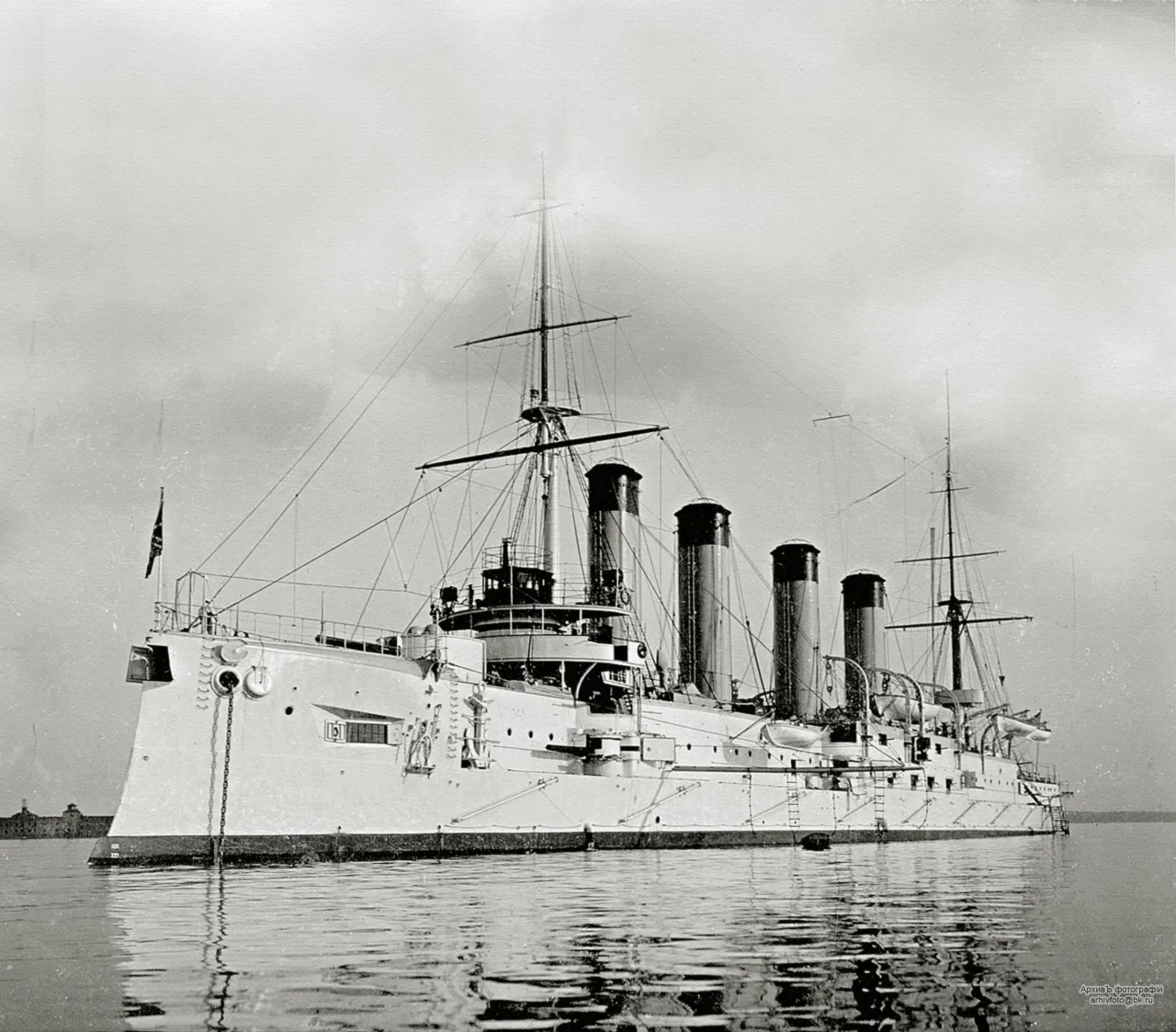
The armored cruiser "Bayan", which fought the Japanese at Port Arthur... Among the fans of the naval stories A rather ambivalent attitude toward this ship has developed. Some consider the Bayan to be optimal in terms of its overall characteristics, while others consider it a complete waste of public funds, as its firepower was significantly inferior to that of Japan's armored cruisers.
In this series of articles, I will examine the design history of the Bayan, its performance characteristics, tactical role, and combat potential in comparison with Japanese armored cruisers. I will also highlight the combat episodes in which the cruiser participated. Based on all this, I will offer my conclusions on the success of this armored cruiser. And, of course, my esteemed readers are free to disagree with me.
As is well known, the tactical and technical requirements for the future Bayan were formulated in May 1897 and supplemented in June of the same year. Let's consider the views on the role and missions of cruisers formed by the admirals of the Russian Imperial Navy. fleet by this time.
On the tasks of the Russian Empire fleet in general and its cruisers in particular
In the first half of 1897, the navy's objectives remained the same as those formulated for the 1881–1900 shipbuilding program. The new shipbuilding program, adopted for 1895–1902, refined the ship composition, including bringing it into line with the country's economic capabilities, but the navy's objectives remained unchanged. I wrote about this in detail in the article On the shipbuilding programs of the Russian Empire in the late 19th century – the emergence of the Japanese threat, I will briefly remind you of them here.
The Black Sea was considered the most important naval theater for the Russian Empire. In the event of war with Turkey, the fleet was to seize the Bosphorus and Dardanelles, ensuring the transport and landing of a 30-strong landing force. The Siberian Naval Flotilla was expected to assist coastal defense, but nothing more. The Baltic Fleet was to maintain primacy in its theater and remain the strongest compared to any foreign power with access to the Baltic Sea, including Germany. Furthermore, in the event of war with China, Japan, or another country, the Baltic Fleet was to dispatch a squadron of battleships to the Far East. The dispatch of battleships from the Black Sea was permitted, but due to the priority of that theater, the Baltic Fleet was considered the primary "donor."
Furthermore, it was planned to create a powerful squadron of ocean-going cruisers in the Far East to operate against British ocean lanes. Naturally, this squadron was also to be formed from the Baltic Fleet.
In accordance with the above, the cruisers of the Russian Imperial Navy faced two tasks:
1. Interruption of enemy ocean communications;
2. Service with battleship squadrons.
Cruisers for fighting communications
It could be said that all cruisers of the Russian Imperial Navy trace their lineage back to the corvette class, but that wouldn't be entirely accurate. When the Russian Navy entered the era of armor and steam, cruising duties were assigned to ships of three classes: frigates, corvettes, and clippers. Clippers were intended to be used as ocean-going cruisers, and they played a crucial role in the development of the Russian Navy and the exploration of the Far East. However, this class never saw further development in our Navy and faded from the scene of history, never having evolved into anything. The frigates, however, have an interesting history.
By 1860, it was already clear to Russian sailors that large ships needed to be protected with armor. Construction began on the first and last wooden armored frigates of the Russian Navy: the Sevastopol and the Petropavlovsk, which were delivered to sailors in 1865 and 1867, respectively.
The next Russian ships, the Prince Pozharsky and the Minin, were designed to have an iron hull and rifled guns. artillery, so at the time of their laying, they were planned to be armed with eight very powerful 300-pound, 229-mm caliber guns. And this is where the terminological quandary arose.
The fact is that, according to the then-existing "table of ranks," these ships could not be considered frigates, hence their designation as armored corvettes. However, since their capabilities clearly conflicted with the classification of sailing fleets, they remained in service as corvettes for less than six months, after which they were reclassified as armored frigates.
In fact, the "frigate" class became a very flexible concept in the Russian Imperial Navy in the 60s. It's worth remembering that alongside ships designed for ocean voyages, such as the Knyaz Pozharsky and Minin, turret frigates of the Admiral Lazarev and Admiral Spiridov classes were also being laid down. These were low-sided, multi-turret monitors suitable only for coastal defense.
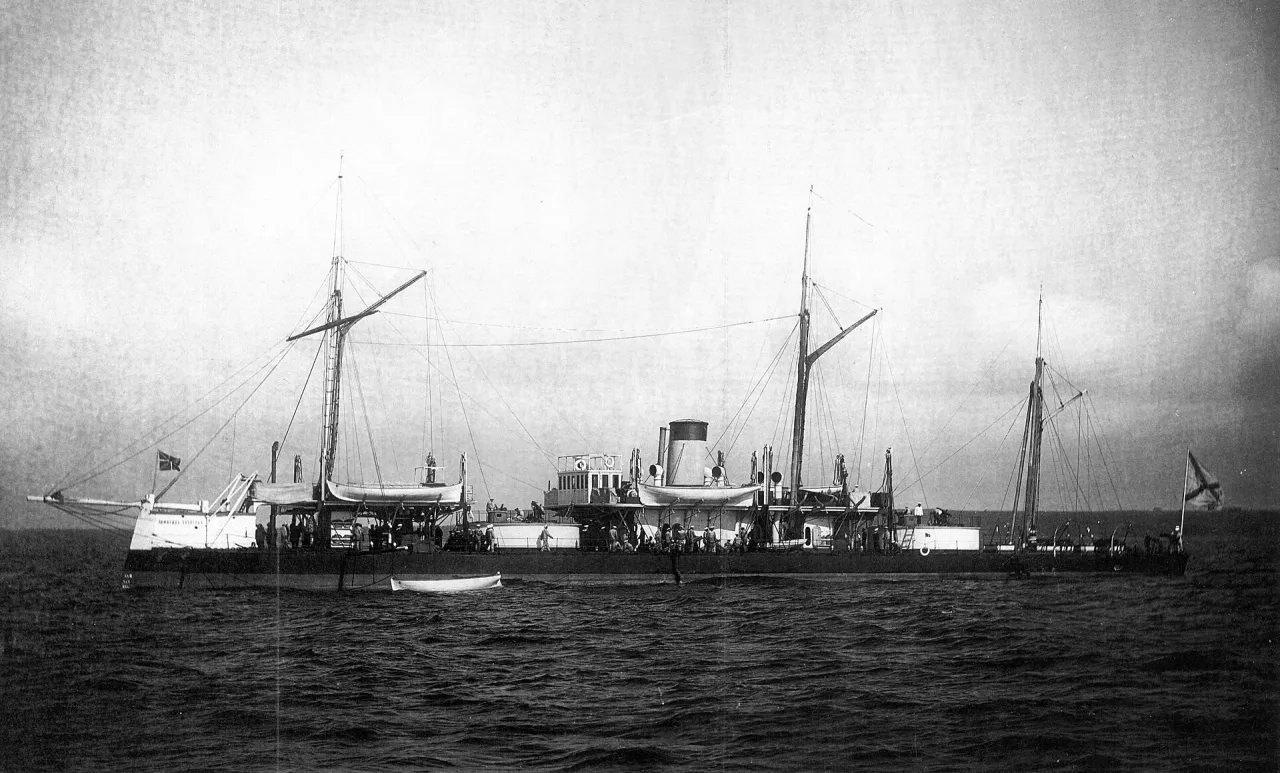
Armored frigate Admiral Chichagov
But while the "monitor" role in the Russian Navy never developed further, the Minin and Knyaz Pozharsky laid the foundation for a generation of distinctive Russian armored frigates, later reclassified as armored cruisers. Their types varied greatly, such as the 5800-ton Dmitry Donskoy and the gigantic Rurik, with an actual displacement of 11,566 tons. Some were quite successful, others less so. But all of them (with perhaps only the Nakhimov being debatable) shared a common purpose: they were single-handed cruisers designed for raiding ocean lanes, which determined their characteristics and design features.
The only truly genuine exception to this rule were the Peresvet-class ships. However, given that their combat capabilities corresponded to those of second-class battleships, they should still be considered not cruisers, but rather battleships adapted for cruising operations. Undoubtedly, in official documents they were initially referred to as armored cruisers, but they were ultimately commissioned as squadron battleships.
We can only state that all armored cruisers of the Russian Empire, right up to the Bayan, were built for the task of interrupting the enemy’s ocean communications.
As for corvettes, things were simple. While frigates, after a brief hiatus with "armored corvettes," evolved into armored cruisers, corvettes evolved into armored-deck cruisers.
Initially, the Russian Imperial Navy was not particularly fond of ships of this class. Our first armored corvettes, Vityaz and Rynda, were begun in the same year as the seventh armored frigate (counting from Knyaz Pozharsky), Admiral Nakhimov. Three years later, in 1886, the third ship of this class, Admiral Kornilov, was laid down at a French shipyard. After this, the Navy took a nine-year hiatus, until 1895, when, again in France, construction began on the armored cruiser Svetlana, commissioned by Russia and discussed below. It's worth noting that prior to Svetlana, all of our armored cruisers were designed for ocean-going warfare, and Svetlana itself was not commissioned until 1898.
Cruisers for service with the squadron
It may seem strange, but for the Naval Ministry in the 90s, squadron cruisers were a new and unfamiliar concept. The reason is simple: for a long time, the Russian Empire lacked squadrons with which cruisers could serve. In the 60s, the star of the propeller-driven battleship had finally faded, but even if that hadn't been the case, such ships could never have represented a squadron of seaworthy ironclads. Such ironclads weren't built in Russia for a long time: shipbuilding programs emphasized ocean-going cruisers on the one hand, and coastal defense ships on the other, the best of which were multi-turreted, low-sided monitors.
Our first relatively seaworthy battleship, the Pyotr Velikiy, despite all its undeniable merits, was built as a single unit in 1877. The situation only began to improve in the early 90s, with the commissioning of the squadron battleships Imperator Nikolai I and Imperator Alexander II. But by that time, the need for large ships capable of long-distance voyages was so great that these battleships did not form a squadron, but instead sailed to New York, the Mediterranean, and the Far East.
The Black Sea Fleet was a different matter, with a force of three modern and powerful Ekaterina II-class battleships created in the early 90s (the fourth, Georgiy Pobedonosets, was commissioned later). While we had an armored squadron, due to the specific nature of its missions, the Black Sea Fleet lacked anything even remotely resembling a cruiser. Perhaps the only thing missing was the Kubanets-class gunboats, but with their speed of 13 knots, performing cruising missions with a squadron was utterly impossible.
Thus it came to pass that by 1897, the Russian Imperial Navy undoubtedly understood the specifics of ocean voyages and long-distance cruises very well, but it had absolutely no experience with cruisers serving in armored squadrons. It also lacked cruisers capable of such service. Consequently, when the Russian Empire began to form squadrons of modern battleships, admirals, lacking any experience, had to somehow figure out what kind of cruisers they would need.
The first armored cruiser since the Kornilov, the Svetlana, ordered from France in 1895, although capable of serving with a squadron, had a completely different purpose. The General Admiral needed a yacht that could also serve as a cruiser. Naturally, the Naval Ministry made an effort to obtain a good cruiser that could also serve as Alexei Alexandrovich's yacht, and to some extent, they succeeded. The Svetlana turned out to be a decent ship for its time, but it wasn't specifically designed for squadron service; rather, it was a second-rank general-purpose cruiser. In our fleet, it was listed as a first-rank cruiser only because it was inappropriate for a General Admiral to sail a ship of the second rank.
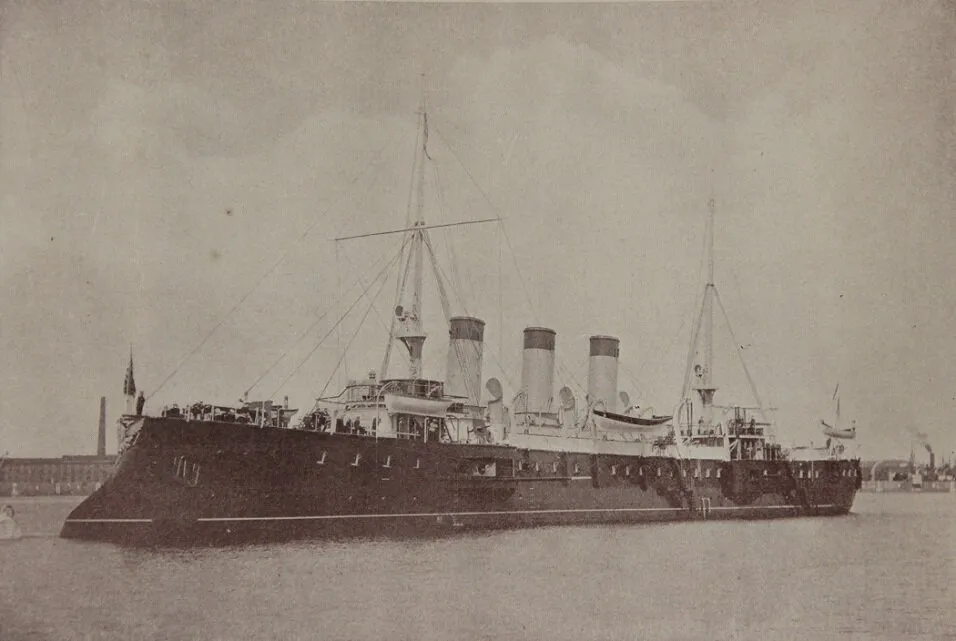
Armored cruiser Svetlana
Therefore, in the first half of 1897, the only cruisers even remotely conceived for squadron service were the newly laid-down armored cruisers of the Diana class. But even here, for cost reasons, the Naval Ministry deemed it impossible to build a series of specialized ships. It wanted cruisers equally suitable for squadron service and for sea-lane warfare.
To do this, the MTC first looked at what was being built in England, France, and Germany. Based on what they saw, they determined that the future cruisers would have a fairly powerful armament, including a main battery (as of 1897) of ten 6-inch guns. Their speed was set at a very high level for the time—20 knots without boosting their boilers, despite the fact that most foreign cruisers used as comparisons did not reach such a speed even with boost. Furthermore, the cruisers were required to carry an impressive coal reserve, reaching 972 tons at full displacement. Unsurprisingly, the Diana-class cruisers turned out to be significantly larger than the armored deck cruisers of the second rank of the British and French navies.
The Naval Ministry was well aware that the Diana was a compromise cruiser. They also saw that progress in naval shipbuilding was progressing very rapidly, and they suspected that in the very near future, the world's navies would be building ships far more advanced than the Diana. Therefore, further production of this less-than-successful design was out of the question.
Where did the word "Bayan" come from?
The shipbuilding program of 1895–1902 envisioned, in addition to ships of other classes, the construction of six first-class cruisers. The type of one of these was determined by Emperor Nicholas II, who ordered the construction of a Rossiya-class cruiser: the Gromoboy. Of the remaining five, four were already under construction: the Svetlana in France and three Diana-class cruisers at domestic shipyards. Consequently, another cruiser could be built, but abroad, as all the large slipways in Russia were occupied by other ships.
The Ministry of the Navy's gaze naturally turned to France. And it's not at all necessary to believe that this was due solely to the weaknesses of the Admiral-General, who gravitated toward all things French. It's worth remembering that France was the world's second-largest naval power, yet it was quite friendly toward the Russian Empire and had considerable experience building cruisers.
The problem was that we had nothing to turn to the French with.
The Russian Imperial Navy certainly didn't need another ocean-going raider. The Naval Ministry wanted a cruiser to serve with the squadron, the shortage of which was already becoming acute. But, as mentioned above, we had no experience operating such cruisers, nor even a general idea for their use.
And again, there's no point in accusing our admirals of incompetence. They certainly had a general understanding of what tasks a cruiser in a squadron could be assigned. It was also clear that the Diana-class cruisers weren't cutting edge and that better cruisers could be built. But just how much better remains to be seen.
What should we do in such a situation? Announce an international competition? But to do so, we needed to formulate the requirements for the cruiser, and that was precisely what the Naval Ministry couldn't do. There was only one option left:
1. First, consider the proposals of shipbuilding companies for various types of cruisers and understand the approximate performance characteristics that could be expected to be achieved;
2. Formulate the tasks that the cruiser must solve and specify its performance characteristics, thereby forming the assignment for its development;
3. Based on this task, hold a competition and select the best project.
This is exactly what the Naval Ministry did.
Step 1: French Sentences
The task of selecting a contractor was entrusted to Captain 1st Rank A. M. Abaza, who, while in France overseeing the construction of the Svetlana, had the opportunity to familiarize himself with the realities of French shipbuilding. He approached the management of Forges et Chantiers de Méditerranée, where the Svetlana was being built, with a proposal to build a first-class cruiser for the Russian Empire to serve with the squadron. He likely shocked the management with the explanation that the exact type of cruiser needed was unknown, and therefore a wide variety of designs should be submitted for the discretion of Forges et Chantiers. Apparently, the only parameter specified by the Russian side was a displacement of 6000 tons.
Well, the customer is always right, especially since Forge et Chantiers was not at all willing to turn down the tempting contract. Therefore, A. M. Abaza was soon able to present five variants of a first-class cruiser. Unfortunately, the data on them is not entirely exhaustive, so I'll present what I have.
Project No. 1. Cruiser "Svetlana", increased by 2000 tons. By increasing her displacement to 5800 tons and eliminating the prince's quarters, the French planned to mount very powerful artillery on her—two 8-inch and fourteen 6-inch guns. This cruiser's speed was expected to exceed 22 knots, while maintaining a significant range. However, this increase in performance left no room for vertical protection—the Svetlana, having gained 2000 tons, remained an armored cruiser. The French themselves did not consider this a good option, stating that an armored belt for a cruiser was highly desirable, but that it could only be achieved by reducing her speed and coal reserves.
Project No. 2. Cruiser "Svetlana", increased by 1000 tons. Its displacement was supposed to be 4800 tons, but unfortunately, I don't know its other performance characteristics. It was an intermediate variant between Option 1 and the Svetlana, which was then under construction.
Project No. 3. Armored cruiser "Dupuy-de-Lom". The design displacement was supposed to be 6296,26 tons (I can't tell whether these were metric or long tons), but in reality, the cruiser was overloaded. The design speed was 20 knots, but during trials it only reached 19,73 knots, and that was with the boilers running at high speed. Armament consisted of 2×194mm, 6×164mm, 6×65mm, 8×47mm, and 8×37mm guns, and 4×450mm torpedo tubes. Vertical armor was "all 100"—the sides, turrets, and conning tower—all 100mm thick. The armored deck was carapace and consisted of three layers: two layers of 5mm standard shipbuilding steel, and a third layer of 20mm armor, or more precisely, steel with improved mechanical properties.
Literally everything about this cruiser was striking. The placement of the main and secondary guns in turrets. The highly original artillery arrangement, which meant that a salvo to the bow and stern, at least theoretically, was stronger than a broadside, as two 194mm guns were mounted on either side of the cruiser, amidships, while three of the six 164mm guns could fire to the bow and four to the broadside. The enormous ram, projecting 9 meters forward. But most importantly, the cruiser's fully armored side.
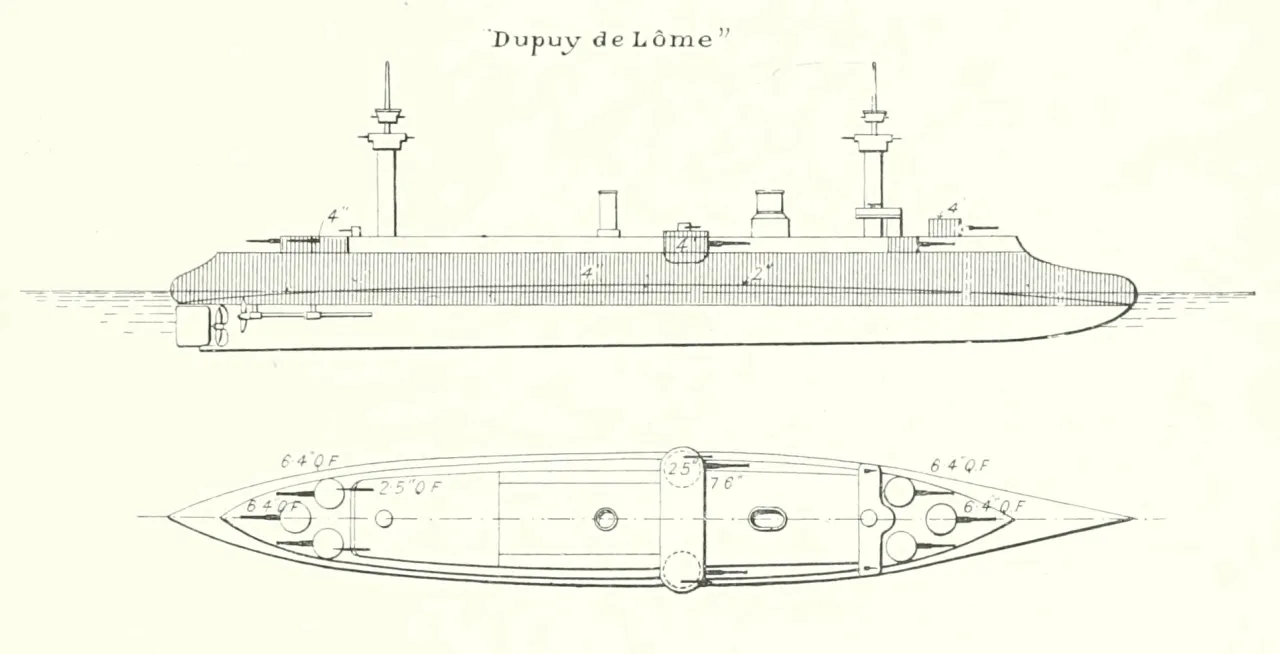
In fact, there was no "super-long" ram on the Dupuy-de-Lome—the shipbuilders simply cut off the stem and the hull behind it in an effort to reduce the weight of the ship's bow. This reduced the weight of the hull structure, as well as the side area, thereby reducing the need for armor protection. Reducing the cruiser's length, however, was impossible, as this would have reduced its speed—as the saying goes, "length is fleeting."
As for the fantastical armored side area, it arose from trials in 1886, when an old French battleship was subjected to shells loaded with melinite. The tests demonstrated the extreme destructive effect of this explosive on unarmored structures. According to the designers' plans, the Dupuy-de-Lôme could operate along the shipping lanes like a conventional cruiser, but it was also capable of destroying enemy battleships with a hail of melinite shells, while being almost completely protected from their effects.
A. M. Abaza's opinion on this ship is interesting. While not fundamentally opposed to the concept of a turret cruiser, he noted that the Dupuy-de-Lôme did not seem optimal for the Russian Navy, and if such a ship were to be built, it should be designed using the domestic Admiral Nakhimov as a basis. A. M. Abaza believed that a good cruiser could be developed from the Nakhimov by improving its lines and increasing the power of its engines to reach a speed of 21 knots. The gallant captain of the first rank was so enthusiastic about the idea that he discussed this option with representatives of Forges et Chantiers and received their full consent, should the client so desire, to undertake the reworking of the Admiral Nakhimov design in this direction.
Project No. 4. Armored cruiser "Potu" (It might be more correct to call it "Potuo", but this is not certain). Displacement is 5374 tons, speed is 19 knots. Armor: belt 35–60 mm (according to other sources - 58 mm), deck in the horizontal part - 45 mm, slopes - 85 mm (according to other sources - 38 and 68 mm respectively, and according to A. M. Abaza - 63 mm), conning tower - 230 mm, turrets - 140–170 mm. Armament: 2×194-mm, 10×138,6-mm, 10×47-mm, 8×37-mm guns and 4×450-mm torpedo tubes.
Armored cruiser Pothuau
The cruiser, it must be said, was quite unique. The French, having begun construction of the Dupuy-de-Lôme, nevertheless deemed her too expensive for serial production. Therefore, the Dupuy-de-Lôme remained a single example, and four armored cruisers of the Admiral Charnet class were laid down in France. These were a scaled-down version of the Dupuy-de-Lôme: their displacement did not exceed 4812 tons, their armament was the same, and their armor was lightened. Like their predecessor, they failed to achieve their designed speed, reaching only 18,4 knots instead of 19 knots.
This speed was deemed too modest and raised concerns that the cruisers would be incapable of effectively pirating the shipping lanes. Therefore, it was decided to slightly increase the displacement of the next cruiser and reduce its armor, thereby achieving a speed of 19 knots.
Despite all their efforts, the Potu only briefly exceeded 19 knots, and that was with forced air. Overall, the French's performance was highly questionable. A. M. Abaza, who had the opportunity to inspect the Potu, found it extremely unsuccessful:
The cruiser is heavy and clumsy both in its external form and, especially, in its internal arrangement and structure.
In addition, he noted that the 19-knot speed was achieved in extremely artificial conditions, and therefore in real operation the Potu would hardly be able to go faster than 16 knots.
It is worth noting that such an assessment could not in any way affect the reputation of the engineers of "Forge et Chantiers", because they did not develop this cruiser - the company only built it according to the issued drawings.
Project No. 5. Citadel cruiser. The displacement was 5500 tons, and the cruising range was stated to be truly mind-boggling – 12,000 miles. Speed was 22 or 24 knots. "depending on the thickness of the armor"All I know about the artillery is that it consisted of 12 guns, and that they included 8-inch guns in turrets located at the bow and stern of the ship. Probably 2x8-inch and 10x6-inch guns. The overall arrangement of the guns was in a purely French style and ensured a powerful longitudinal fire: seven guns could fire forward, five at the stern.
The armor was particularly unique. Between the 8-inch gun turrets, that is, along most of the cruiser's length, and even above its most important machinery (engines, boilers, and apparently medium-caliber ammunition magazines), there was no full armor deck; only slopes from it were present. Instead of horizontal armor, casemates for the deck guns were installed. "internal longitudinal, inclined armored walls", which, according to the designers, were supposed to replace the horizontal armored deck.
All of the above proposals were considered at a meeting of the shipbuilding department of the MTC on April 27, 1897, in the presence of all department heads, as well as naval engineers E. E. Gulyaev and N. E. Titov, and artillery experts K. T. Dubrov and A. F. Brink. The head of the MTC, Rear Admiral N. I. Skrydlov, presided over the meeting.
The meeting found the French proposals unsatisfactory for various reasons, which I will not list in detail here. The conclusion was that when choosing a promising cruiser type,
It is impossible to limit oneself to considering only the types presented by the plant, but it is best to compare the latest typical examples of cruisers from different naval powers.
Which was done immediately.
The following were taken as “typical samples”:
British armored cruiser Arrogant. Displacement - 5,850 tons, speed - 18-19 knots, armor: deck - 37-51 mm, on the slopes - 76 mm. Armament: 4x6-inch, 6x120-mm, 8x3-inch, 3x47-mm guns and 3x457-mm torpedo tubes;
German armored cruiser Victoria LouiseDisplacement: up to 6559 tons, speed: up to 19,1 knots, armor: deck: 40–100 mm, casemates and conning tower: 100 mm. Armament: 2×210-mm guns in turrets, 8×150-mm, 10×88-mm guns, and 3×450-mm torpedo tubes.
But the real star of this meeting was a completely different ship. It was the Esmeralda, the newest Elswick cruiser, just built in England for Chile.
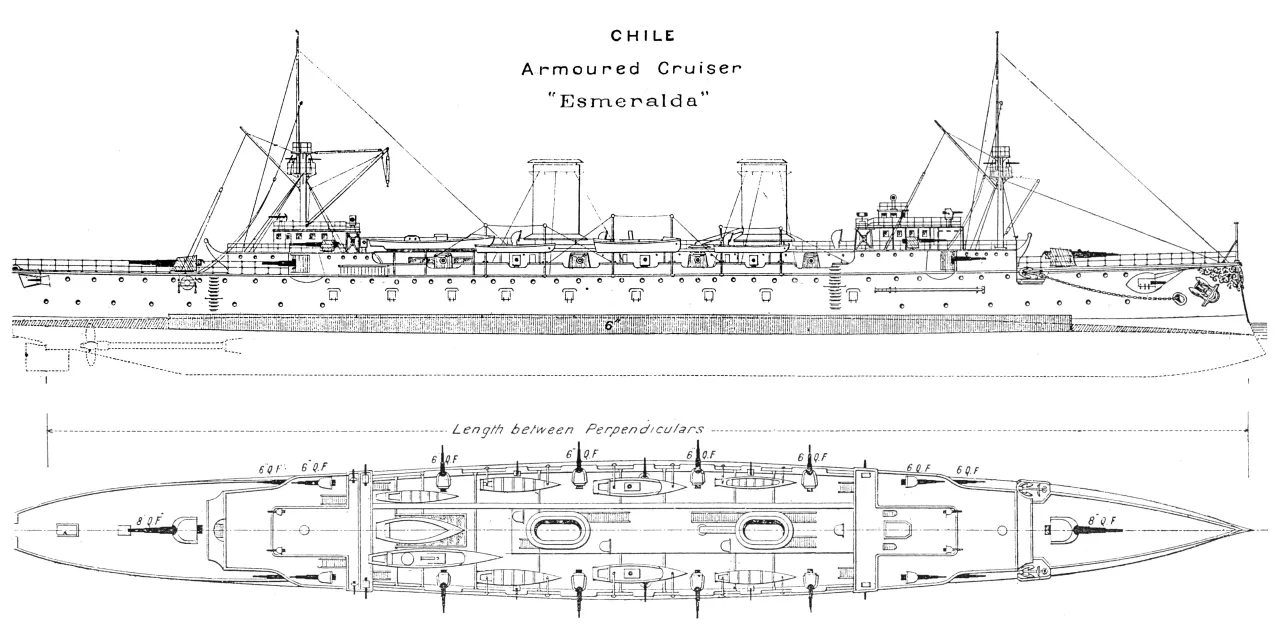
In fact, there was much to admire here: according to the data available to the MTC, this ship, with a displacement of 7000 tons, developed a speed of 23,4 knots, carried an armor belt of 152 mm over 3/4 of the ship’s length with a carapace deck of 38–51 mm and had powerful artillery consisting of 2×8-inch, 18×6-inch, 8×3-inch, 10×47-mm guns, as well as 3×450-mm torpedo tubes.
Needless to say, the Esmeralda looked far superior to all the other cruiser designs considered at the MTC meeting? But one shouldn't think the MTC was swayed by the advertising brochures of the Esmeralda's builder, Armstrong. The MTC was well aware that such high qualities had been purchased at the expense of something else, perhaps something important, something the MTC was unwilling to compromise. Were the hull and machinery of the newest British-built Chilean cruiser overly lightweight? It was known that the Esmeralda lacked a double bottom, and that her guns were mounted openly, without armor protection, which was considered unacceptable for a Russian ship.
The MTC meeting concluded that none of the cruisers it considered fully met the requirements of the Russian Imperial Navy. However, the head of the Naval Ministry was advised:
...to the discretion that when drafting the cruiser project, the Chilean cruiser Esmeralda be taken as a basis in relation to the overall set of achieved combat qualities, but that it be proposed to the same French firm or other foreign manufacturers who will draft the project, without in any case deviating from the displacement of the cruiser Pallada (not exceeding 6000 tons), to more balanced combat qualities of the cruiser in comparison with the Esmeralda...
Thus, the Naval Ministry had chosen a starting point for the tactical and technical characteristics of the future cruiser. This had taken the first step, and they could now move on to the next step: defining the missions and performance characteristics of the future cruiser.
Продолжение следует ...
Information