Fast, strong, toothy… And still needed

30 269 242
Fast, strong, toothy… And still needed

Conclusion of the article Dear, blind and stupid. But that's not certain..

The Lun is a very seaworthy ship precisely because it is an ekranoplan.

It won't just drown. But that's not why.


While a low-wing monoplane in the air, the Lun missile ship was an outrigger trimaran on the water, meaning it had very high stability, one of the most important characteristics of seaworthiness. Its wing span, and consequently, its float spread of 44 meters, is, you know, the width of an aircraft carrier. Try capsizing that.
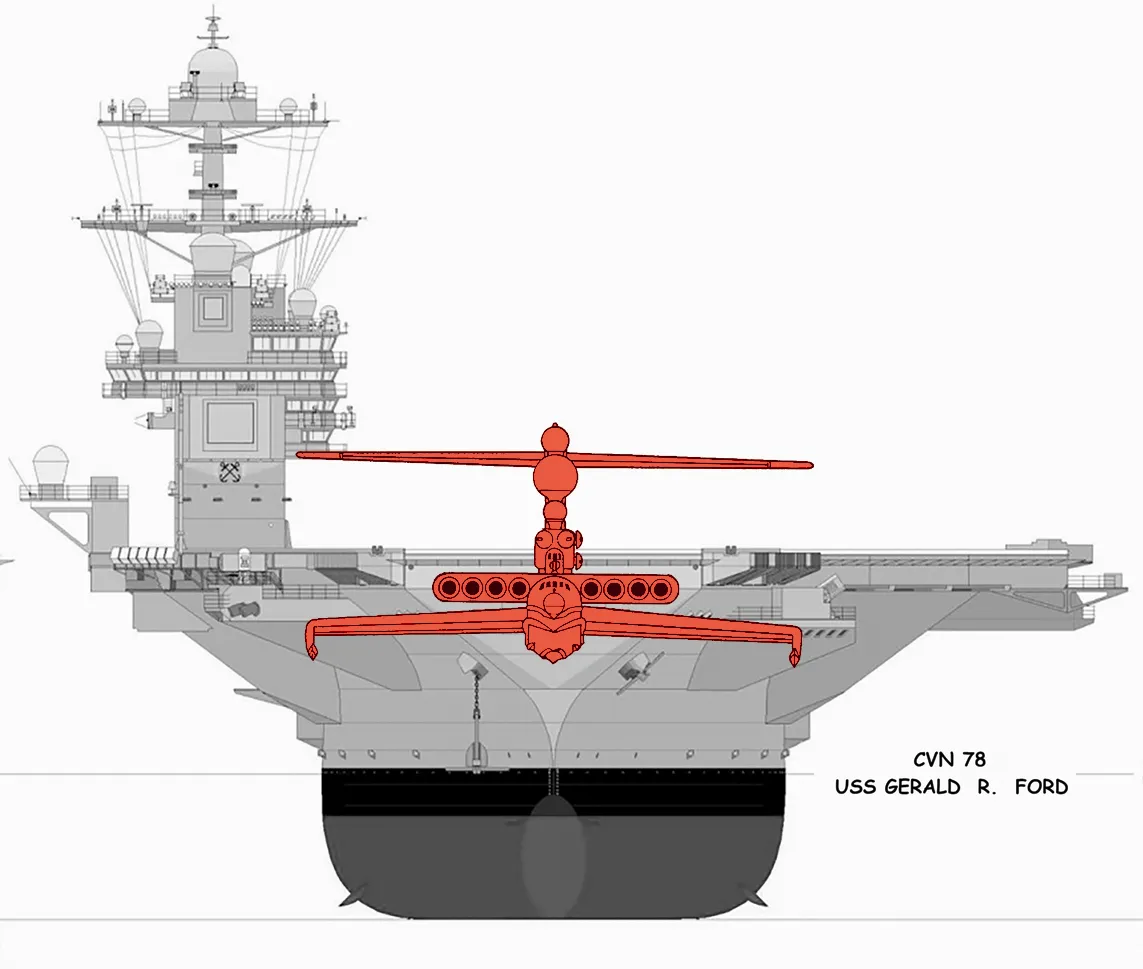


The flight deck is narrower, but there is no waterline.

Buoyancy was provided by the hull and floats, and unsinkability, in addition to division into compartments, was also ensured by a practically pontoon-like wing, also divided into compartments.

The large overall beam reduces roll, but the relatively narrow hull beam may impair wave climbing. However, the gentle contours of the bow, the presence of spray deflectors, and, most importantly, the ability to take off in force 5 waves and land in force 6 waves suggest that the Lun is at least as good in this regard as the Molniya, and perhaps even the Ovod, with their limited use. weapons 4–5 points.
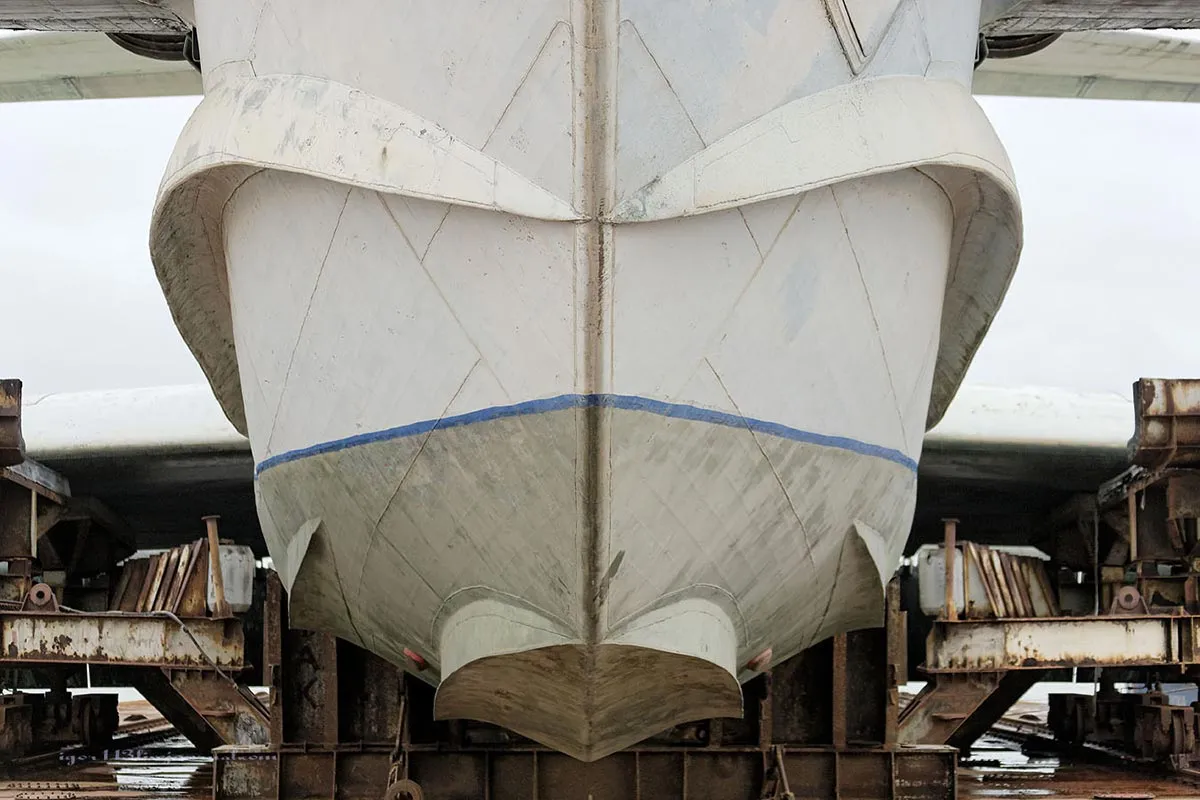

They may be splash guards and crutches, but they work.

In general, a 5-point wave condition can be a limitation on the use of weapons even for frigates, and the Lun's ability to take off in such conditions and fly on the ground above a 8-point wave, and therefore use weapons, gives the ekranoplan a significant advantage over much heavier ships. However, for the Spasatel EP, flight and landing (in the n.i.) and being on the water are specified as "having no seaworthiness restrictions".

Here, probably, even the supporters of the EP will exclaim: “This can’t be, the ekranoplan was built according to aviation "It meets strength standards and will fall apart in a storm, but 'no restrictions' could mean a storm!" And they'll be right, but only about a storm...

This is where the second advantage of the Lun-class ekranoplan's heavy skin comes into play: thickness, and thus, basic strength. Compare the Lun's 4-12 mm of working skin with the Be-12's 0,8-3 mm (underbody) (I couldn't find any data for larger amphibians, but the An-124's wing skin thickness ranges from 0,6 to 10 mm at the wing root, and the Il-76's stabilizer skin ranges from 3 to 1 mm). Clearly, even taking into account the somewhat lower strength of AMg61 versus D16T, a four- to five-fold increase in thickness will provide both ship-like strength for the entire structure and the durability of the skin itself (for reference, 12 mm is no longer a sheet, but a plate). For example, the bottom plating (!) of the sea-going hydrofoil "Vikhr" is 5 millimeters thick, while the thickness of the hull plating of the Project 11451 micro-submarine did not exceed 8 mm.
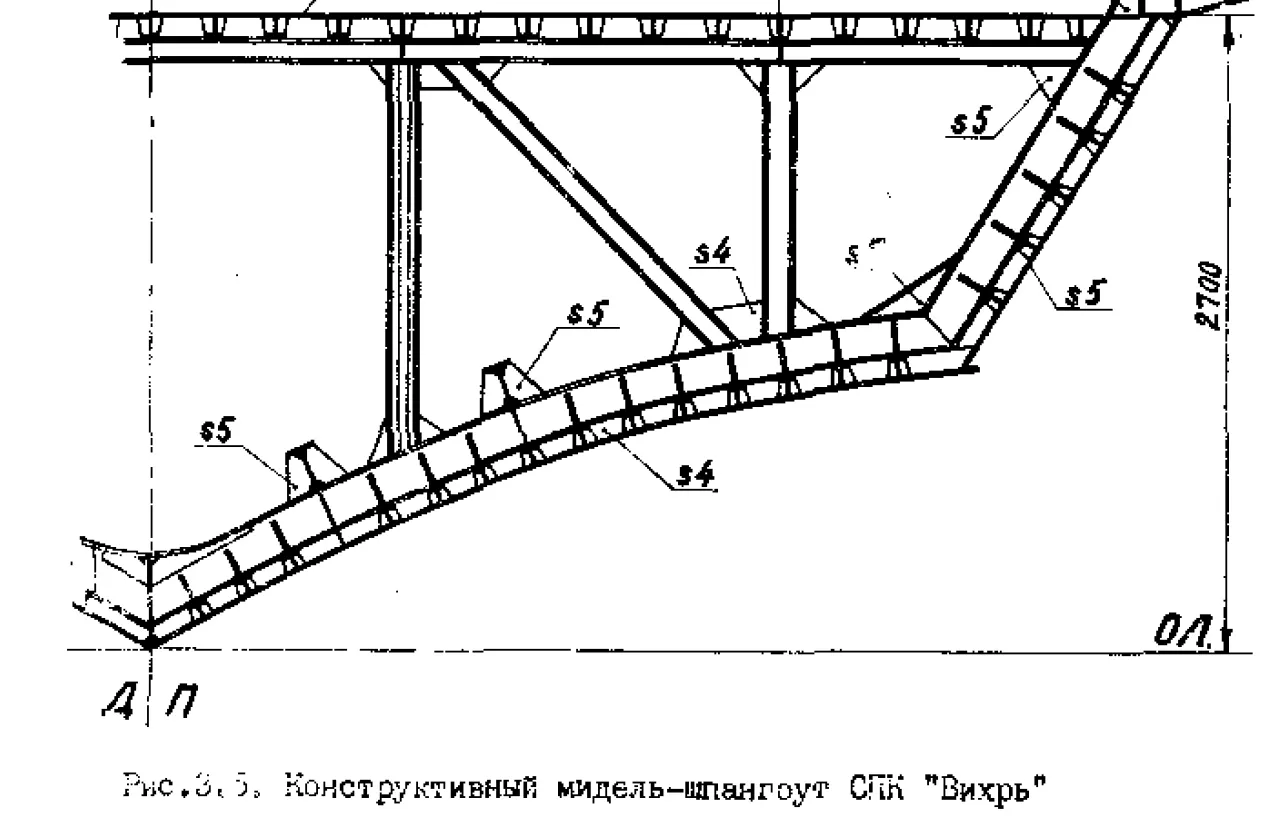

Sectional view of the hull of the hydrofoil "Vikhr" along the midship frame

All this means that the Lun EP was sufficiently robust and seaworthy to meet the safety limits for ships of at least equal tonnage. For example, the Project 12411-M Molniya cutter ensures safe navigation in waves of up to 8 points at a speed of up to 7 knots.

And for the Project 903, even icing afloat isn't a mortal threat! Because ships and vessels don't perish from the weight of the ice itself, but from the loss of stability, which the EP has more than adequately. Even without countermeasures, such as electric heating or jet blast, the ice, in the worst case, will tear off the stabilizer tips.
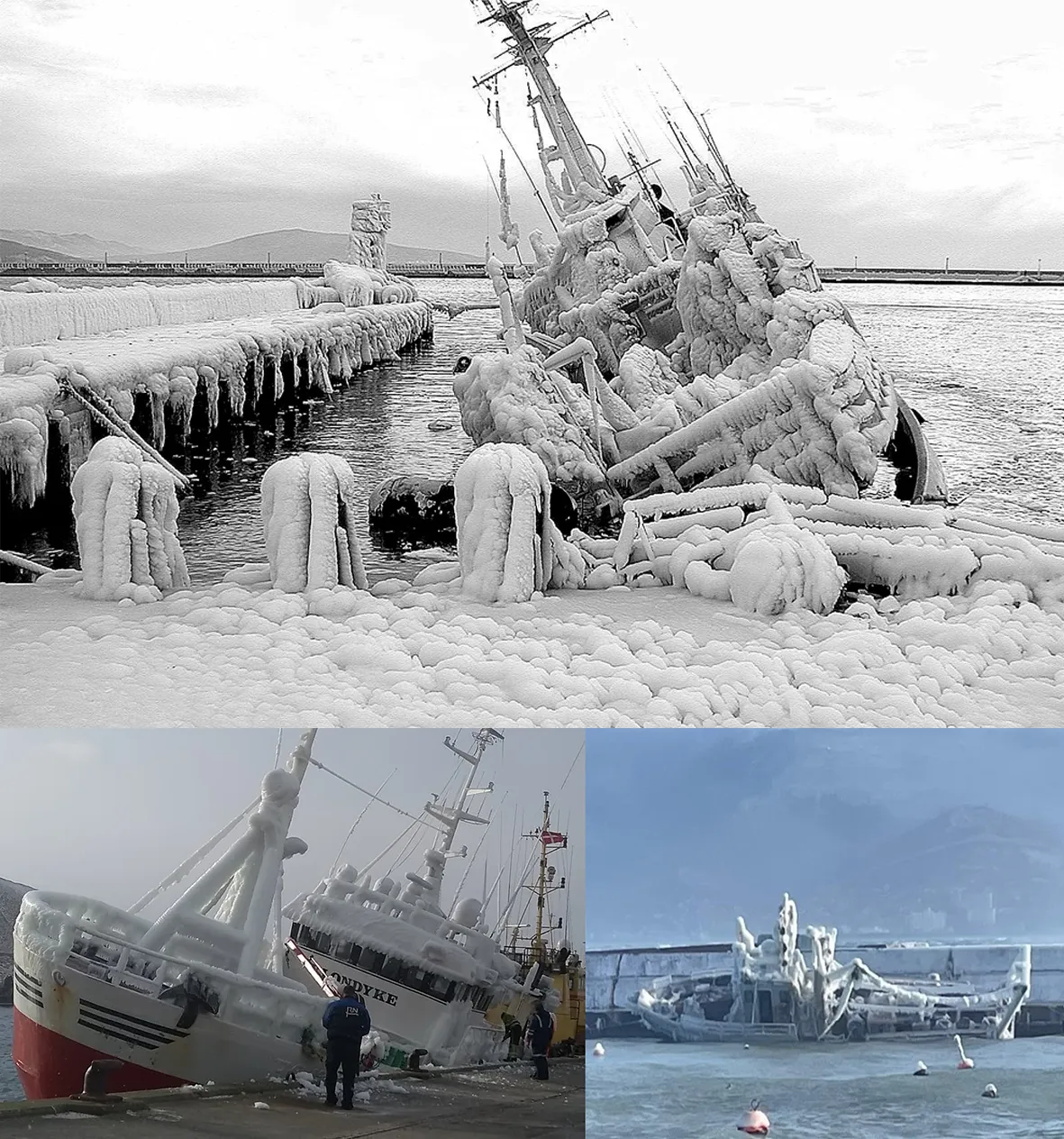

Photos of small vessels with such icing at sea are a rarity, for obvious reasons.

The only obvious drawback of the ship is the risk of the turbines being flooded by a storm wave, but this risk can be significantly reduced by design measures combined with protection from birds.

By the way, thanks to commentator Sergey "solar" for an important remark about the incomplete accuracy of the calculations on bird collisions with aircraft as applied to ekranoplans.
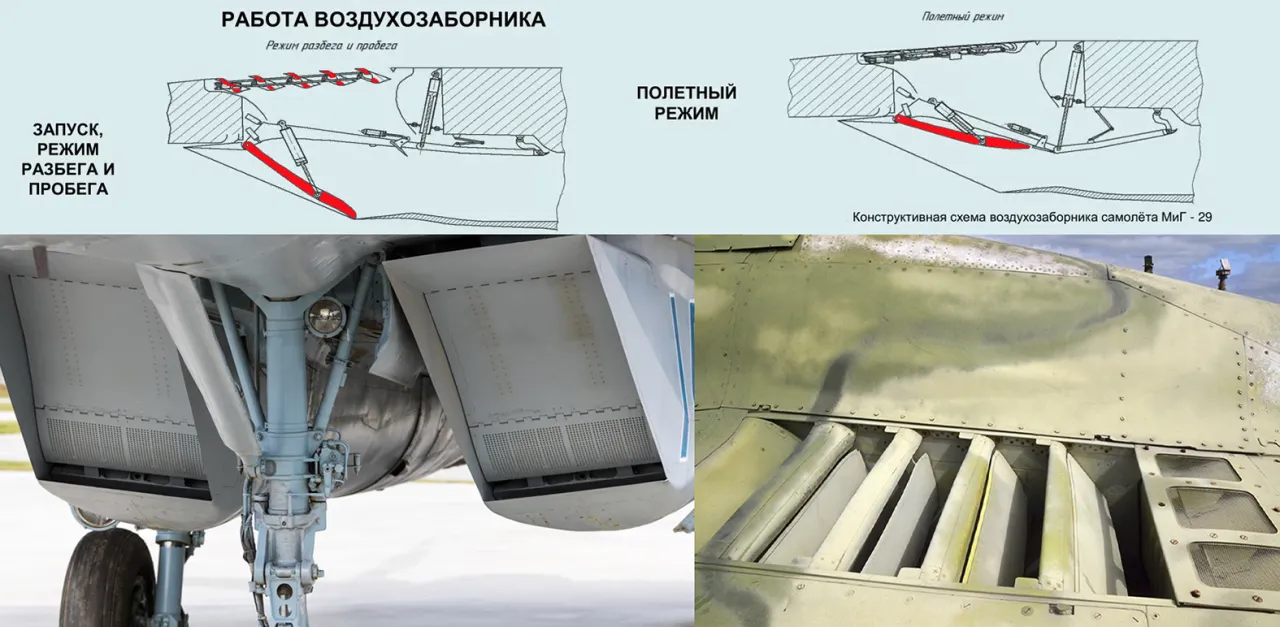

The MiG-29 with such air intake protection was in production and flew successfully. Later, the protection was reduced to grilles. So, the MiGs never needed to be bombed.

However, all this extreme is not really necessary, since the EP, thanks to its speed, can easily avoid the storm.

Just for the information of those who believe that the EP "Lun" could operate anywhere other than the Caspian Sea, which is generally a sea with not the easiest wind and wave conditions, then at best for a couple of months a year.

According to the unified 9-point wave severity scale adopted in the USSR in 1953, a 5-point scale is considered strong swells with wave heights of 2 to 3,5 meters, and a 6-point scale is considered wave heights of 3,5 to 6 (six) meters. According to the 9-point scale developed by the World Meteorological Organization, a 5-point scale is considered wave heights of up to 4 meters, and a 6-point scale, as in our system, is considered wave heights of up to six meters.

The Bering Sea is the roughest sea in Russia. Throughout the year, the Bering Sea experiences predominantly swells with wave heights of up to 2 meters and a period of 6 seconds. In summer, the frequency of such swells is 80–85%, increasing to 90% near the coast and decreasing in winter to 45–55% in deep water and 70–80% in shallow water.

That is, even taking into account various meteorological nuances, given the wind and wave conditions, the Lun could confidently operate in the Bering Sea for a significant part of the year, while the other seas washing Russia are calmer.
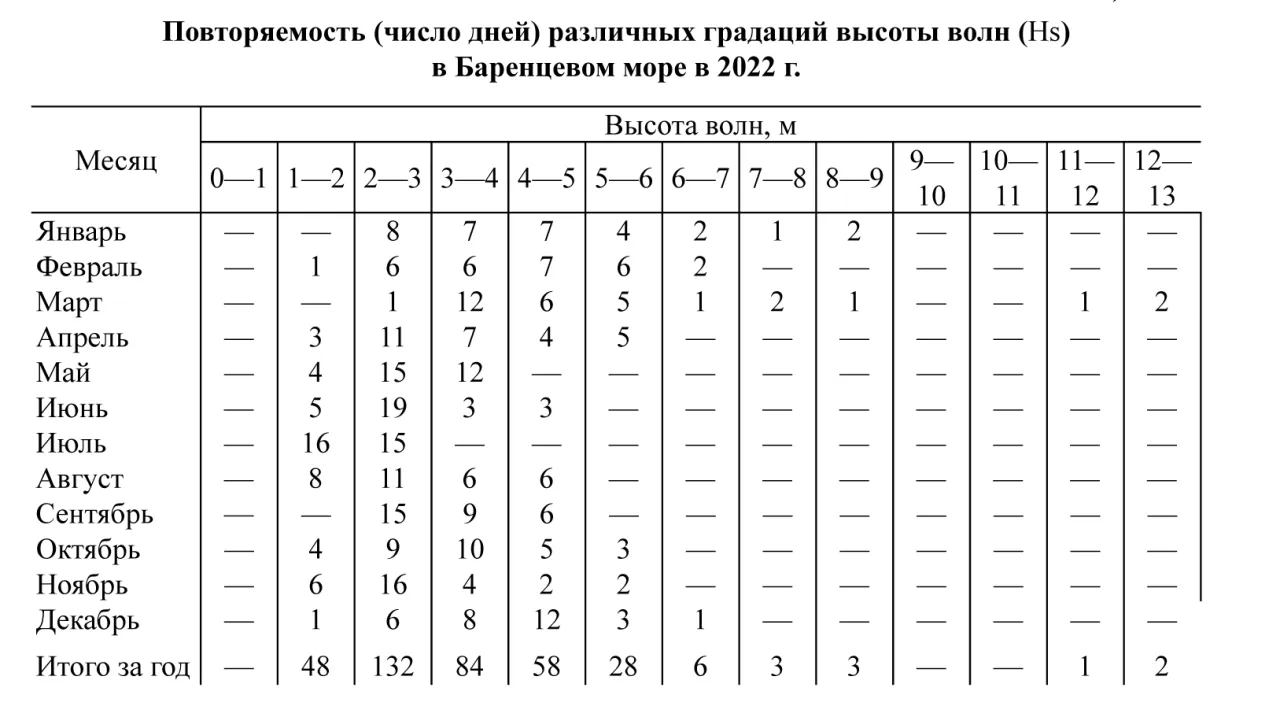

There is no summary table for the Bering Sea, but there is one for the Barents Sea.

And one more thing. Deputy commander of the ekranoplan detachment, Alexander Vasilyevich Korobkin, said in an interview with the Roy TV channel:

The height of the screen is measured from the wave crest... With a wind wave length of 20, maybe 30 meters, at a speed of 350-400 km/h, this is a flat surface for the car <...> Problems arise during landing and takeoff, that's all! <...> If there's a swell wave, it's 2-3 km long, and the aircraft simply goes around it; if there's a wind wave, it flies as if over a flat surface.


-25th minute.

This also means that a random wave that is higher than the others does not pose a threat to an ekranoplan operating in the main mode.

Believe it or not, there's no publicly available confirmation or refutation of these words. But the person who uttered them doesn't seem like a fantasist.

Although, upon reasonable reflection, fully agreeing with Alexander Vasilyevich regarding the swell wave, when flying over a wind wave, it is worth placing the reference point for the effective action of the screen between the crest and the trough of the wave, i.e. in the middle of the height.

But I emphasize, it's precisely effective, because the screen's effect, although weakened, extends across virtually the entire wing chord. This means it's possible to fly above large waves, albeit with a significant loss of efficiency. However, efficiency and waves are also at odds with each other on surface ships.
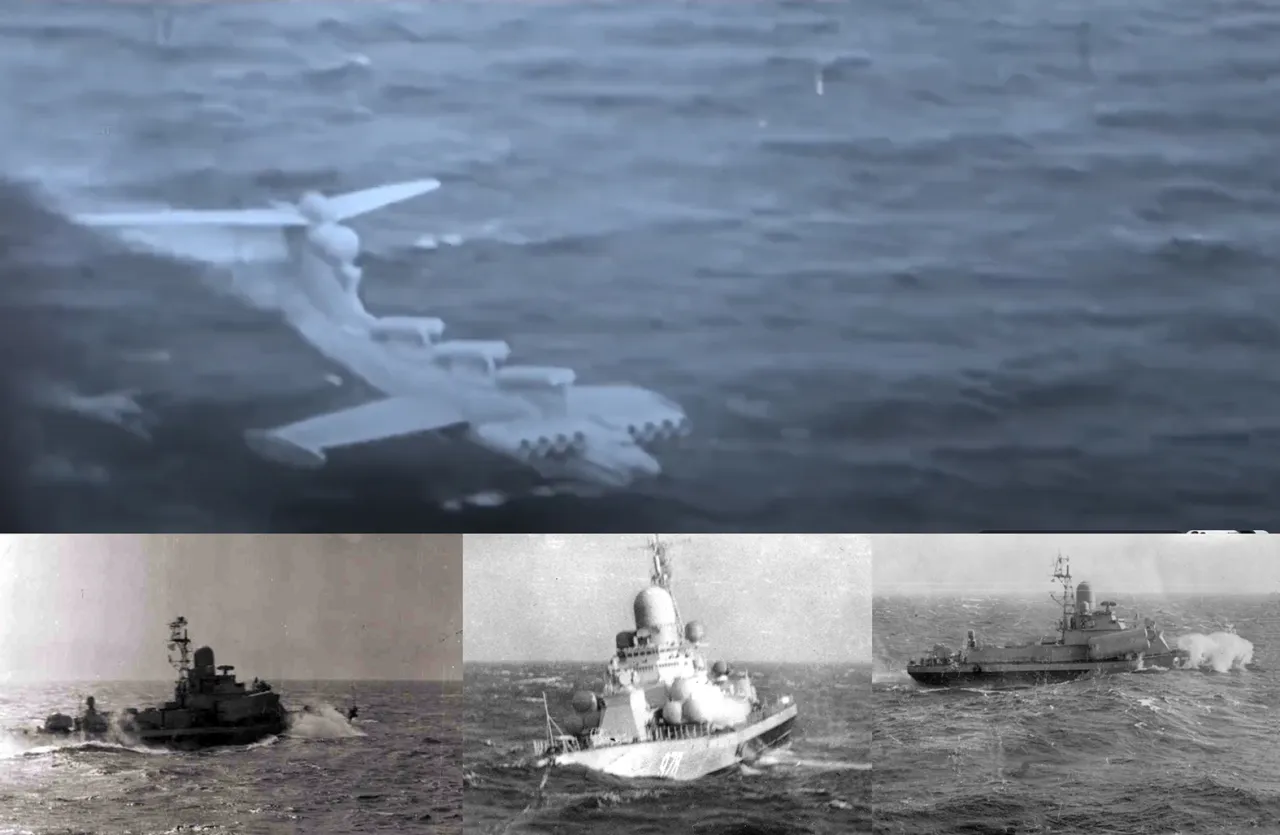

Wave height is 3–4 meters, up to 5 on the Unified Scale, up to 6 on the Beaufort Scale. Obviously, unlike a powerboat, a small surface ship will not be able to reach full speed.

It's already clear that the Lun turned out excellent on the water and decent in the air, quite sharp and quite toothy, but it's certainly no golden boat. But what was the point of all the fuss about flight, wings, stabilizers, and eight turbines if the Lun is slower than an airplane and more expensive? rocket boats? Of course there were, and there still are!

Want to drown? Catch up first!


I will simply list the threats to boats and small and not so small surface ships: aircraft and helicopters with their guided aerial bombs, heavy and light anti-ship missiles, coastal and ship-based anti-ship missiles, submarine torpedoes, mines, attack UAVs and loitering munitions, SAMs and artillery surface ships.

And the self-defense capabilities of existing RK, MRK, and MPK against these threats range from zero to mediocre.

The cruising speed of the Lun EP will allow it to evade not only all helicopters without exception, but also the vast majority of attack aircraft. drones and loitering munitions. Even if a launch is made at the target's wing, the target speed limitations of existing anti-ship missile seekers and other surface-to-surface missiles, not to mention guided missiles, will prevent them from engaging a ground effect vehicle on the move.

Artillery and SAMs (except for long-range ones with ARLGSN and external target designation) of surface ships as a threat are not discussed at all due to the fundamental superiority of EP in speed.

A UAV with an explosive-launched guided missile will not pose a systemic threat to an ekranoplan due to its low speed, short horizon, and, consequently, short response time in the event of the accidental detection of an overflying ekranoplan. However, an ambush by the UAV at the exit from the naval base is not excluded, but this would mean a failure of the defense of the water area.

The mere fact that for a combat ekranoplan on the move, the torpedo and mine threats, which, as it turns out, have not gone away, are not a threat at all, significantly increases its chances of survival compared to any NK.
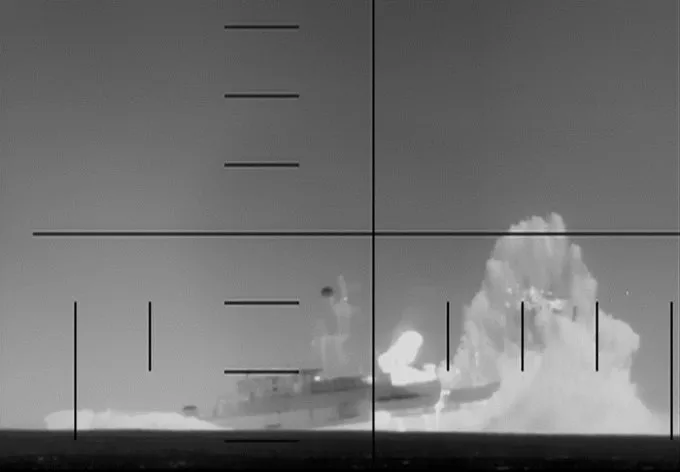

It turns out the torpedo threat hasn't gone away.

It turns out that at the present time, the only truly effective threat to the ekranoplan of the 80s is aviation with air-to-air missiles, and this, on its shores, means an encounter with an enemy aircraft carrier group, which is fatal for any single surface ship or even a small detachment...

So, considering the basic tactics of using small missile systems - moving into a patrol/waiting area, waiting for target designation or searching for a target using one's own electronic warfare systems, and, finally, launching missiles over the horizon, at a distance of up to 200 km (Moskit anti-ship missiles with a high-altitude flight profile), followed by withdrawal - we get two very likely scenarios.

There's a: MRK, even with a decent DefenseAn hour after the missile launch, the missile will be forced into a hopeless battle against enemy helicopters or UAVs that have caught up with it, attempting to escape at 60–70 km/h. This is not to mention the possibility that subsonic anti-ship missiles, in independent search mode, and even enemy aircraft could arrive 15 minutes after launch.
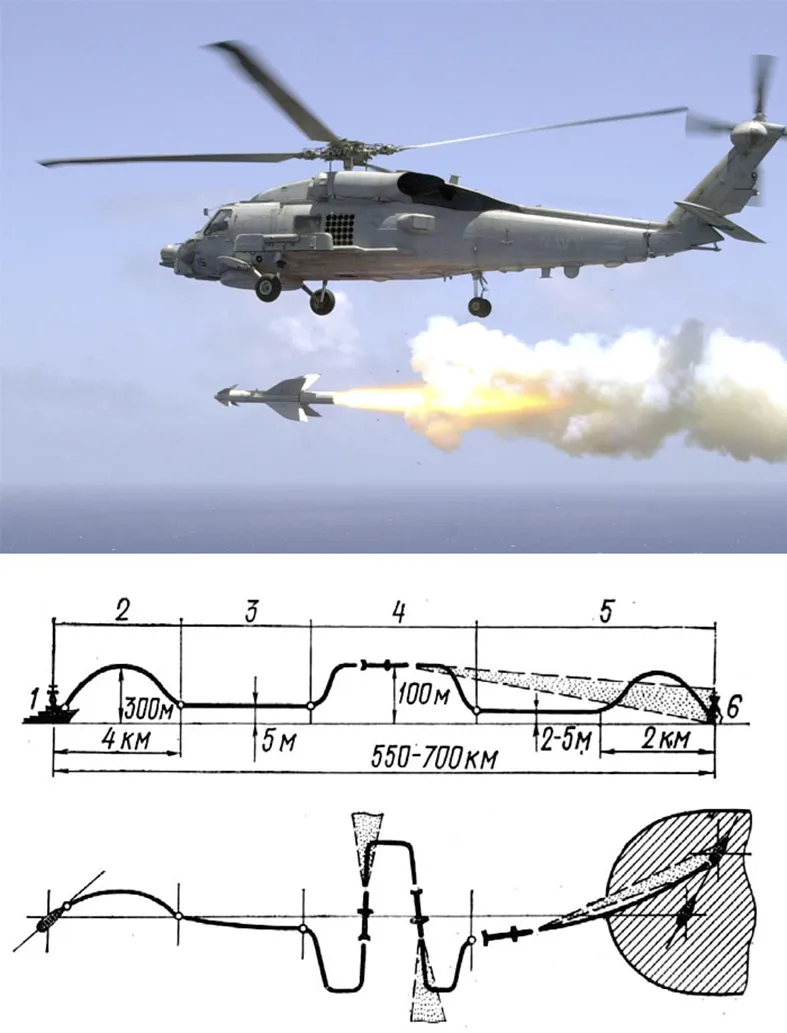

The Penguin Mk3 light anti-ship missile has a range at least 1.5 times greater than the Pantsir-M SAM system. And not only long-range anti-ship missiles, but also medium-range anti-ship missiles, are capable of independent target acquisition.

Or even worse, there will be no time to do anything at all due to destruction from torpedoes or submarine missiles, or mines, without even reaching the designated area, not to mention the use of weapons.

Second: the ekranoplan, in its original, ancient version, ignoring submarines and mines, will calmly reach the designated area, wait the required time, receive or generate target designation itself, and after launching missiles, calmly leave at a speed of 440 km/h.

Of course, the presence of enemy jet aircraft will significantly worsen the situation of the strike ekranoplan, but this will not make things any easier for a surface ship, if only because the EP will move 100-120 km from the launch site in a quarter of an hour, which may be enough for evasion, while for a ship - 15-20 km in the best case.

But even when confronted with an aerial threat, the EP has a reasonable chance of survival. More on this.

Got it? Try to knock it down.


A modern radar seeker for a VV missile can certainly acquire a very low-altitude, but large, target against a watery background. However, it's clear that the deployment of active jamming, the use of towed decoys, and the massive deployment of radar decoys and chaff will reduce this capability, and, combined with the extremely low altitude of the radar, could potentially be fatal.

In the case of using an IR-guided missile, the following factors come into play: low altitude, which means shorter acquisition range due to the IR-guided missile's characteristics; lack of UV contrast of the EP against the sky; the upper skin of the pylons, which shields the thermal radiation of the engines and their nozzles; the release of IR flares and a possible short-term, sharp reduction in engine thrust.

In both cases, it's possible to utilize the "generic feature" of a heavy-lift aircraft—a powerful plume of spray and water mist when directing part of the thrust under the wing. Furthermore, this measure will help, even in flight, prevent a possible fuel fire in the event of a strike.

Of course, the possibility of missiles breaking through the jamming is not excluded, but taking into account the basic tactics of using the missile system and the speed of retreat and maneuvering of the EP, the launch of air-to-air missiles at it will most likely be carried out in pursuit, which means that when approaching from above and behind, the first thing they will encounter is the tail and stern of the UKU-9K-50II, which has "fully automated firing mode using a radar sight after it has acquired a target for automatic tracking"The probability of shooting down a missile with cannons may not be high, but it's certainly not zero...
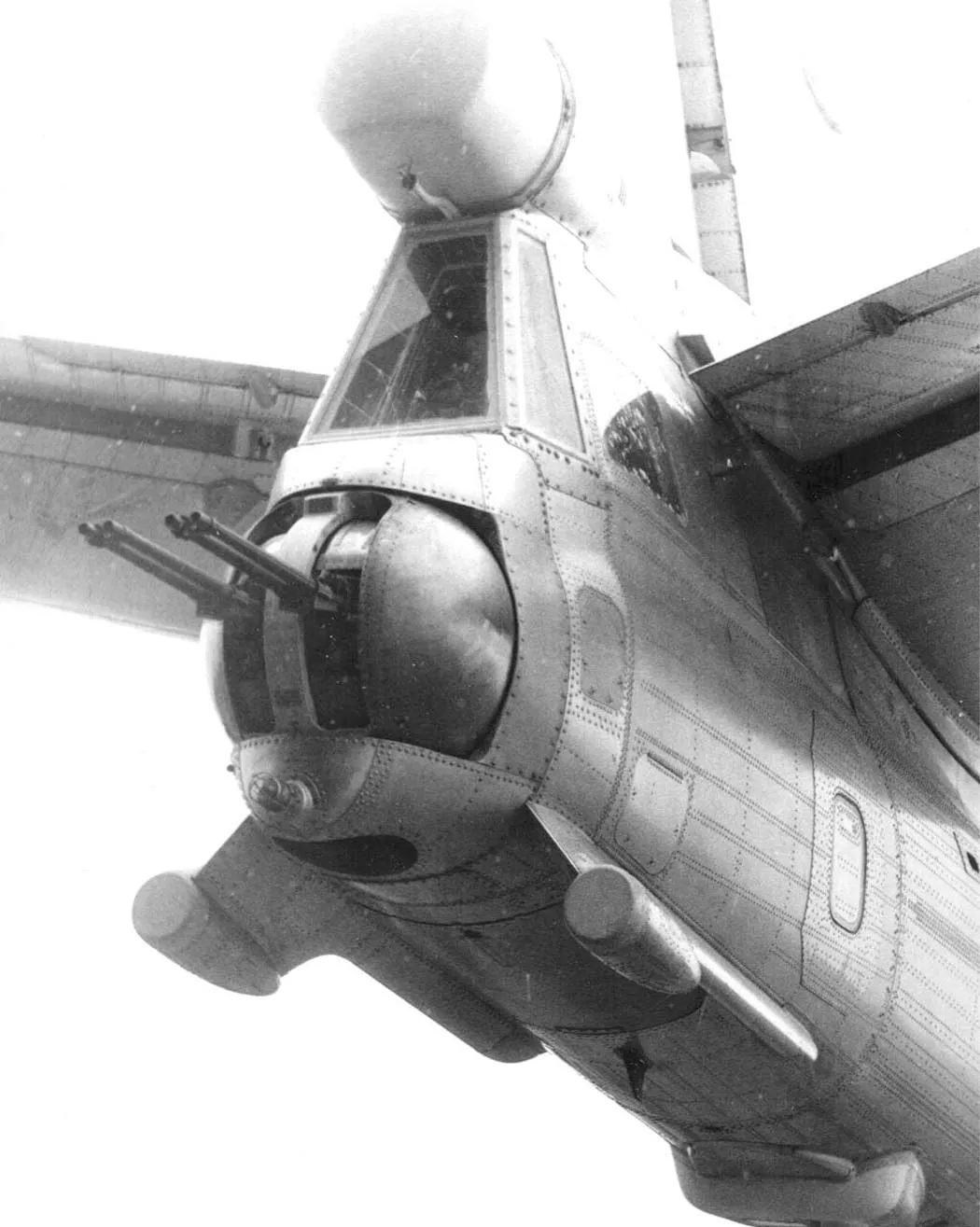

The much-criticized misalignment between the radar and guns is minimal.

More importantly, a radar-guided missile will likely lock onto a huge, high-mounted tail assembly, complete with jamming antennas, from any angle, while an IR-guided missile will likely trigger a proximity fuse on the tail. This is where the large tail and the added benefit of the heavy shell will play a role.

The large dimensions themselves provide greater resistance to damage to the structure, and the skin and framework, which are several times thicker than those of aircraft, are significantly, many times more resistant to deformation from a nearby explosion, to the cutting action of rod-shaped and penetrating fragmentation elements of the warhead.

That is, where an aircraft would suffer a ragged hole with tattered skin torn off by the high-velocity impact, a damaged structure, and the loss of the tail assembly, a heavy aircraft would suffer a completely different outcome: a dent, holes not significantly larger than the size of the submunitions, minor damage to the structure, and submunitions that have lost energy. And as experience has shown, even the loss of the tail assembly doesn't necessarily mean the end of a heavy aircraft, unlike an aircraft.
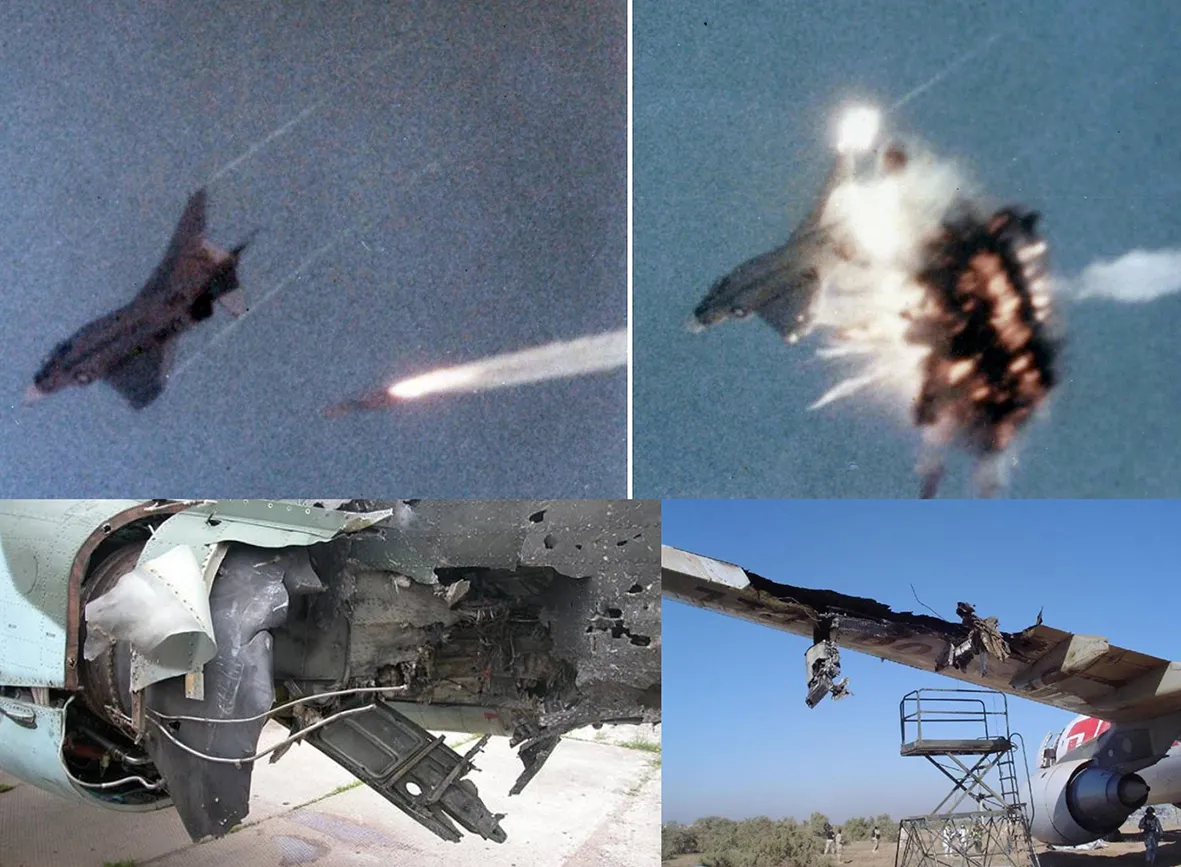

It's not just the armor that matters, but also the size. However, the size of the missiles also matters.

If a heat-seeking missile were to reach the engines, it would be countered by deflectable nozzles, which are not part of the engines, interengine bulkheads, and extensive cowling. Furthermore, although there's no mention of the Lun's armor, its takeoff weight would have easily allowed for local armor protection for the cockpit, control posts, and engines.
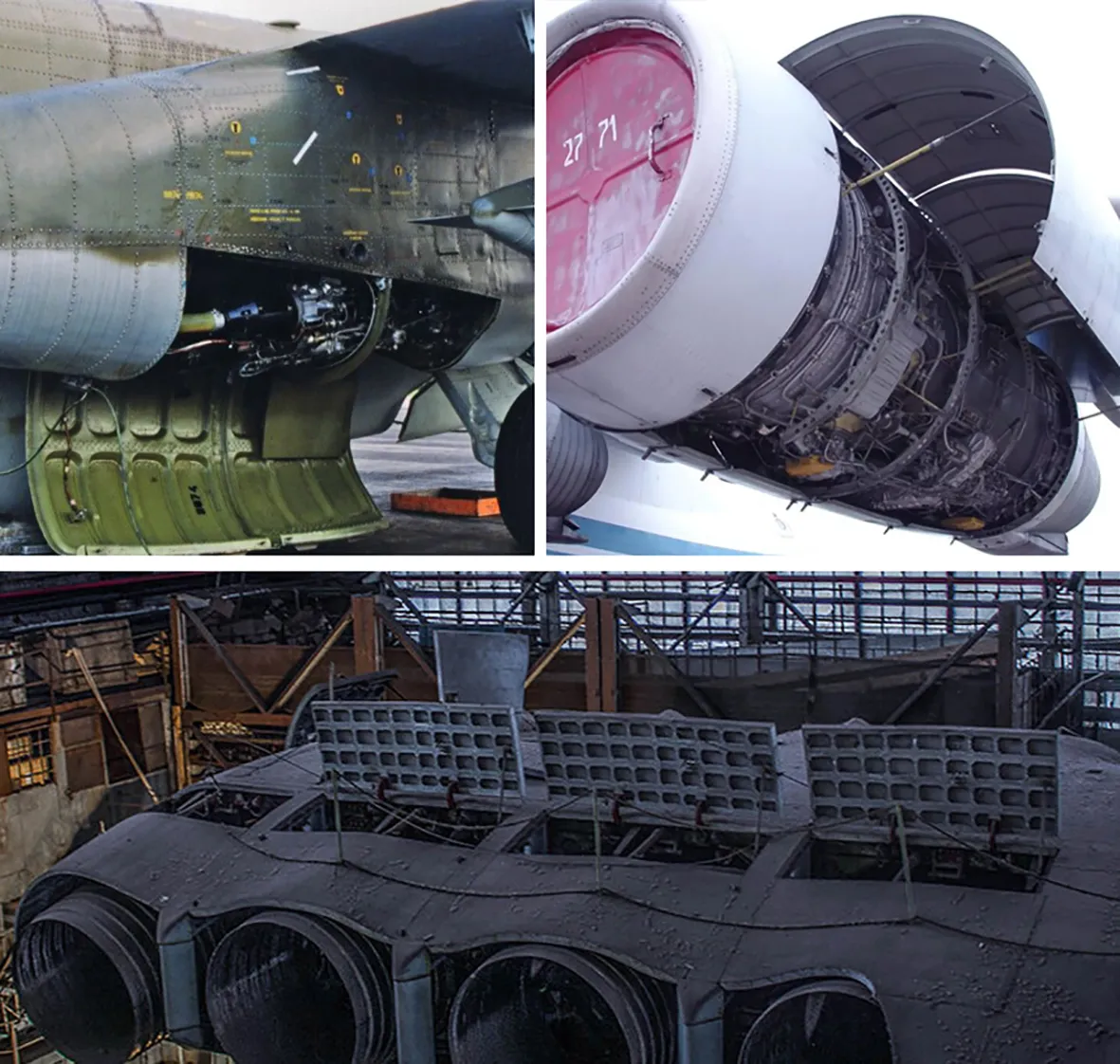

With cowlings like these and the space underneath them, you can create not only armor, but even spaced armor! Clearly, this isn't the case with the Su-25, and certainly not the Il-76.

The adoption by enemy aircraft of naval heavy and long-range SAMs with heavy warheads as explosive missiles will, of course, reduce the chances of an EP, but, for a number of reasons, it is not fundamental.

At firstFor air-to-air missiles, even with an ARLGSN, target designation is required, and it is significantly more accurate than for anti-ship missiles.

Secondly, such missiles are not classified as stealthy, and therefore vulnerable to destructive defenses.

Thirdly, such missiles can only be carried on external hardpoints, which means that stealthy fighters are excluded, which significantly reduces the number of carriers, which are even more vulnerable.

And, fourthlyFor small surface ships, such a missile is no less, and perhaps even more, dangerous than for EP.
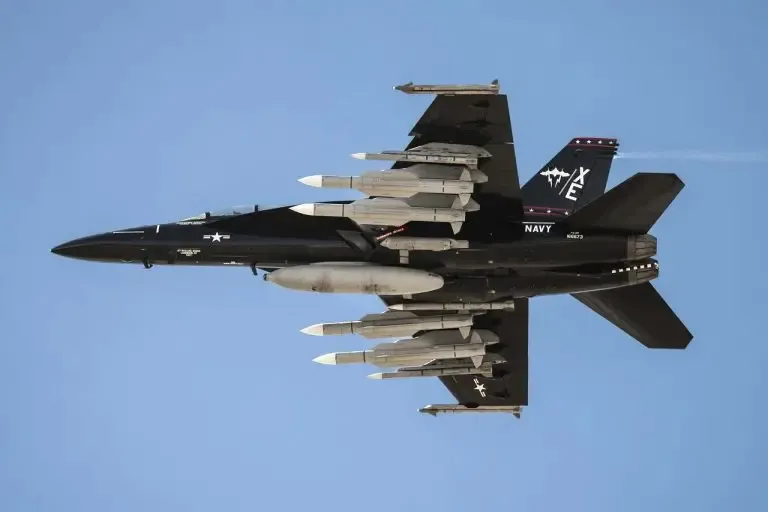

In the absence of a Tomcat, we fly a Hornet. In the absence of a Phoenix, we fly Standards. Actually, both the Hornet with the "Super" prefix and the Standard with the SM-6 ERAM designation

Therefore, it can be confidently stated that even now, an ekranoplan built in the early 80s would have no less of a chance of hitting an enemy and a much better chance of surviving both during deployment and during withdrawal than any other ship, even one several times heavier.

What's good for a ship is great for an ekranoplan!


What makes a modern warship so good? Mainly, its vertical launch system. And the Lun's vertical launch system will literally lift the curse: the inclined launchers prevented the ship from realizing its most important advantage over aircraft—lift capacity—and also doomed the Lun to an almost complete inability to fight back against enemy aircraft, leaving it to flee and rely on jamming and the strength of its structure. The losses in aerodynamic performance and stealth are mere trifles in comparison.

What's the payload capacity? The fact is, 60 tons of missiles, launchers, and radar isn't the Lun's limit. The KM, with the same takeoff thrust and only 15-20 percent greater wing area, had a maximum takeoff weight 160 (one hundred and sixty) tons heavier than the Lun—544 tons versus 380! But even if we completely ignore the 160 tons, there was still some reserve, since, according to those who served on and tested ekranoplans, the ekranoplans were significantly overweight "thanks" to the internal equipment:

Yes, the machines were overweight: the Orlyonok weighed 40 tons, and the Lun 80-100 tons. Aviation didn’t give us anything, so we installed everything “ship-grade – cast iron” (even the start-stop buttons were in cast iron boxes).

So, dividing these figures by two (or even by three, it’s not my thing!), we still get a very significant increase in the lifting capacity of the EP.
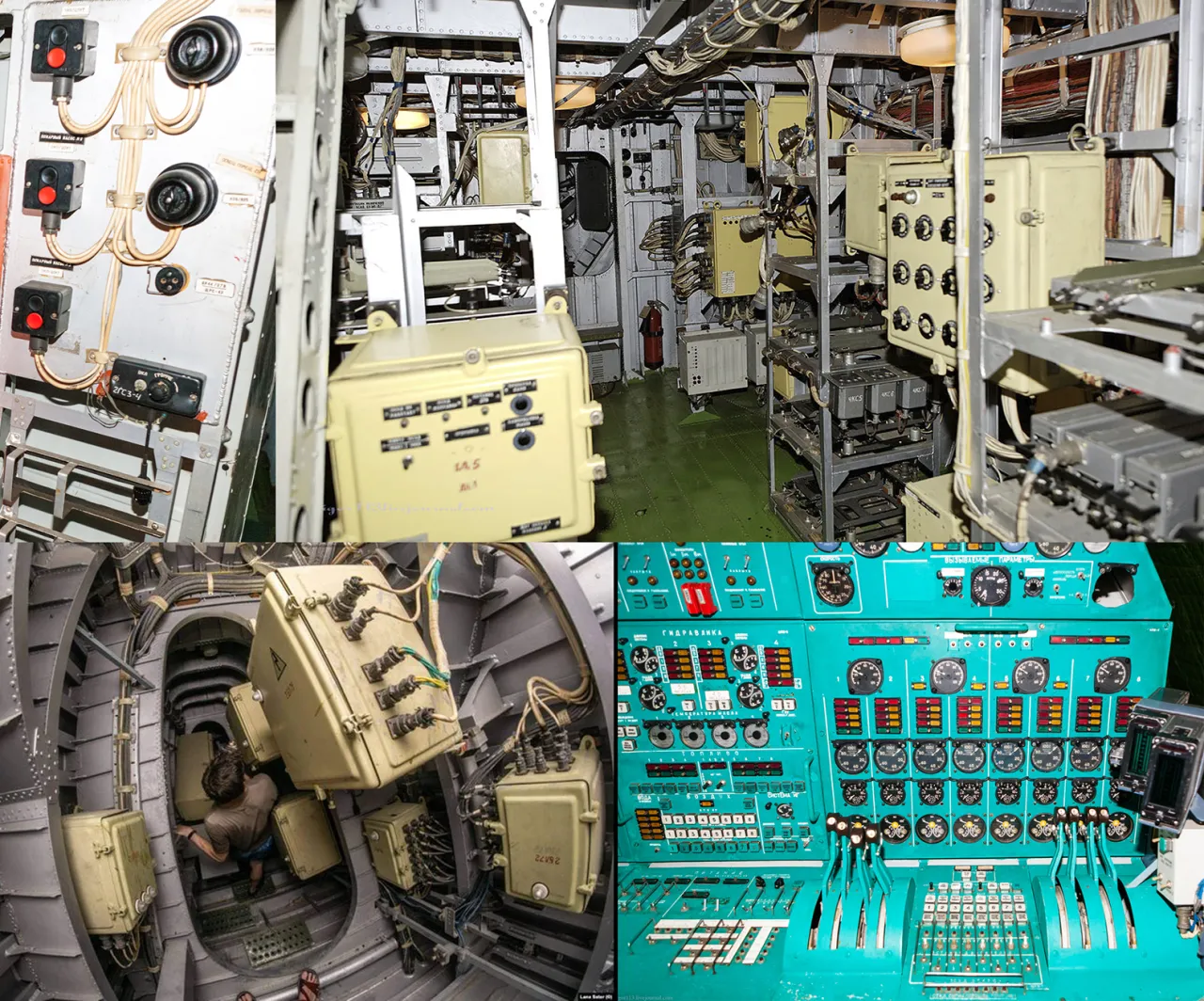

80s aviation begins and ends in the Lune's control cabin and is faintly visible in the defensive installation operator's cabins. Otherwise, it's pure dieselpunk.

In general, 40 tons of this difference would make it possible to lift, for example, four more Moskit missiles with launchers and eight tons of fuel, or a complete Kinzhal 3K95 air defense system with 24 missiles, not to mention 80 tons...

However, three twin KT-215 launchers with deflectors covered almost the entire hull of the Lun, and not only increasing their number, but even reducing it to two would not have allowed for the installation of anything more serious than a small-caliber artillery mount, due to the impact of the jet stream of the launched anti-ship missiles.
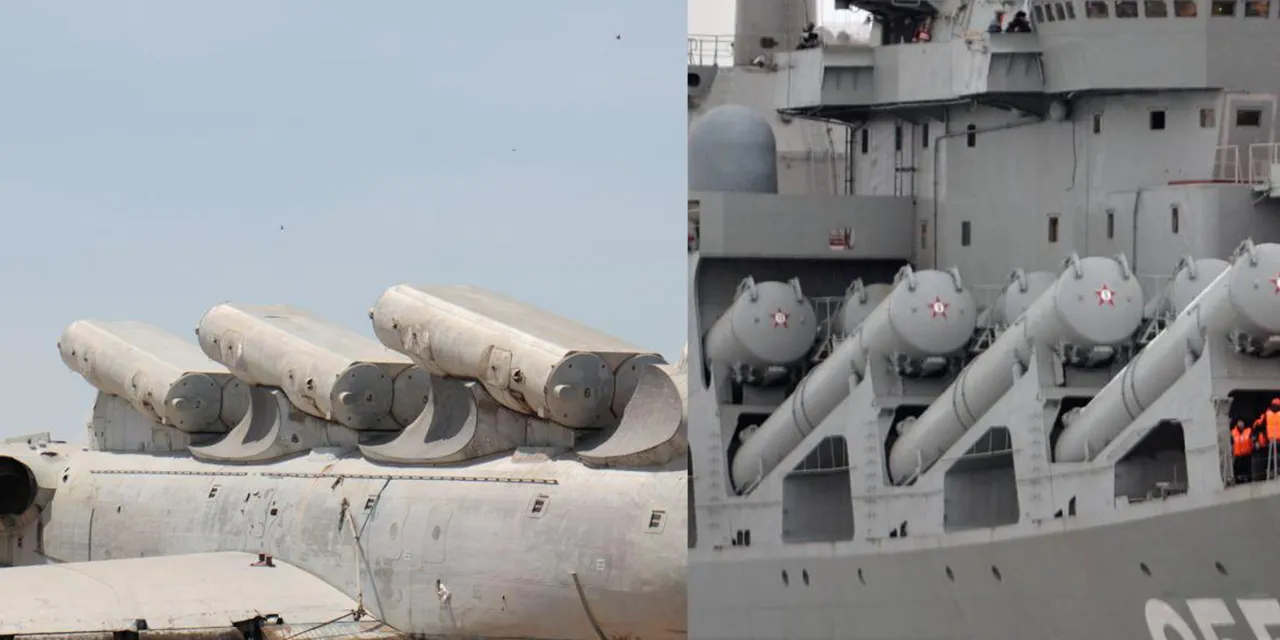

It's not that inclined PUs are evil, but they are not appropriate everywhere.

But how everything changes with the placement of the UVP, given that the hull is practically empty! The UVP would have protruded upward from the hull by the same three, maybe four meters, just like the humps of the inclined launchers. But what wasn't there, wasn't there...

However, the current UKSK and naval SAM systems with vertical launch missiles fit perfectly into the Lun hull, certainly better than in conventional small ships. And even if we consider only the existing 50 tons for missiles and launchers, they allow for the installation of a Shtil-1 SAM system (25 tons – 12 missiles) or a conventional naval Tor (15 tons – 8-16 missiles), along with an AK-306 (1,1 tons), and the deployment of 6-8 Kalibr missiles of any type or 5-7 Oniks missiles. Even with the original reduced specifications, the ekranoplan with a vertical launch missile system reaches a level unattainable for ships of comparable tonnage!
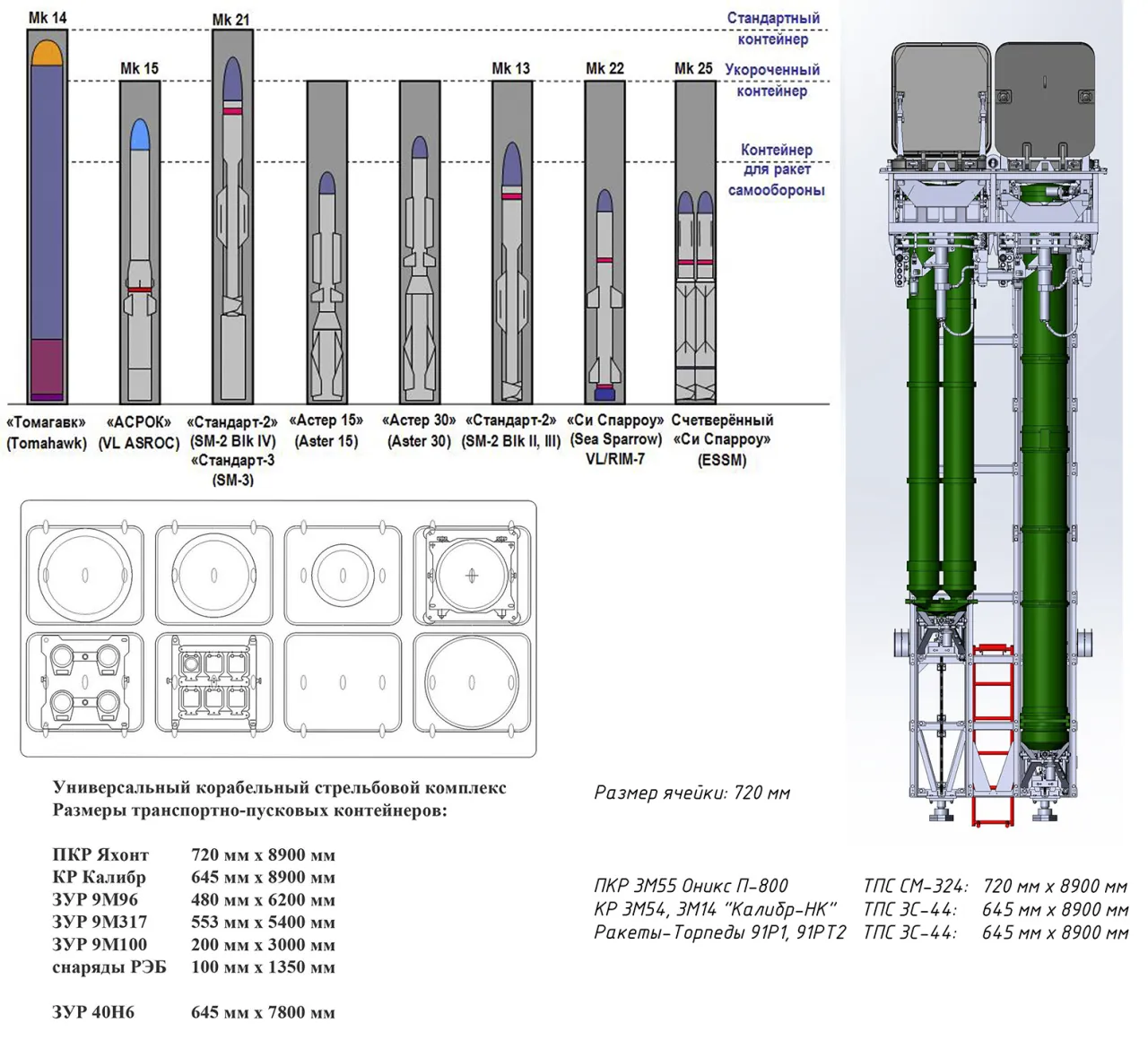

Just to remind you what UVPs are and what can be launched from them
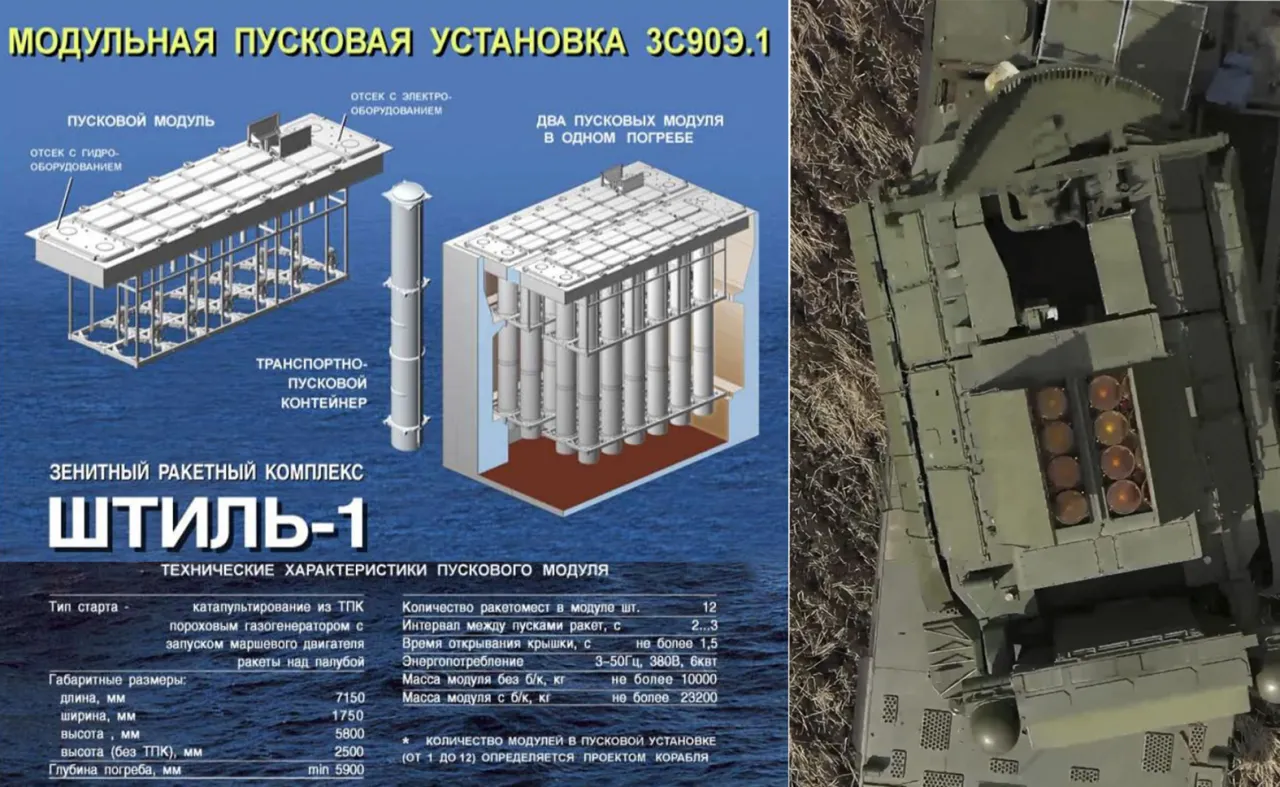

The Shtil launcher, for example, will fit in with ample space, while the Tor missile doesn't even need to be squeezed into the hull; it'll fit flush with the UKSK. And there's no need to twist anything; from the very first production runs, the Tor missiles have been turning toward their targets using autopilot.

A fully functional Lun could carry up to 16 UKSK cells alongside a fully-fledged self-defense air defense system, without compromising habitability. If the cells can accommodate SAMs, as in the announced UKSK-M or the American Mk41, then the EP air defense system could very well become layered.
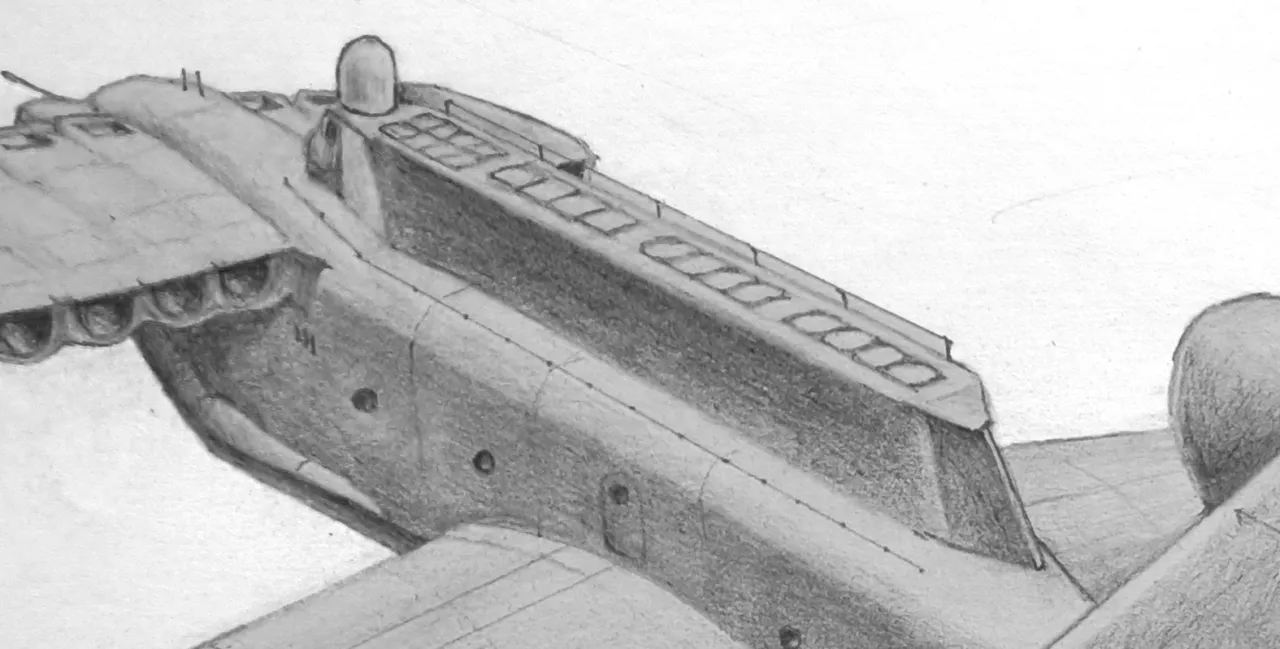

The minimum UKSK module is 2x2 cells. However, nothing prevents it from being reduced to 2x1. Moreover, there is an inclined UKSK module with this configuration. Drawing by the author.

A bonus would be a reduction in radar signature, which was not at all a concern when creating the Lun, and improved aerodynamics, without any special measures - simply by replacing the impressive comb of the launcher a la the cruiser Project 1164 with a neat single-row ridge.

But abandoning special measures to reduce visibility would be foolish, even though they are useful. These measures are commonplace today—radar-absorbing/transparent (RA/TP) coatings and skins, as well as geometry selection.

In this regard, an ekranoplan is a much more rewarding object than an airplane, thanks to its ultra-low flight altitude, large payload capacity, and aerodynamic tolerance. However, it is more complex than a small NK, primarily due to its enormous vertical stabilizer, which forms a right angle with the stabilizer; secondly, due to the wing-to-body connection, also at 90 degrees; and thirdly, due to the surface area of ​​the wing and stabilizers.

The "body-wing" pairing is fairly simple—a slight outward flare of the sides to preserve interior volume, combined with a wing coating. The entire wing can remain metal, and the body won't require coating for most of its height.

The stabilizer will require more extensive use of anti-roll/anti-roll materials, and a slight negative V-shape, similar to that of the F-4 Phantom but mounted upward, is desirable if it doesn't compromise aerodynamics. This, in addition to avoiding a right angle with the vertical stabilizer and reducing the radar cross-section in the upper hemisphere, will reduce the radar blind spot. The lower surface of the stabilizers can remain metal.

The keel is the most visible element, meaning it will require the greatest use of RP/P materials, without sacrificing strength and weight. However, its wide width allows for the use of metal as the core of the kit, and, consequently, the cost will not be excessive.

These measures will allow the heavy ekranoplan to have an RCS comparable to that of modern small ships/corvettes.

Equipping the ekranoplan with retractable thrusters/waterjets powered by electric propulsion (400–500 hp) will completely solve the problems of fuel efficiency and noise at low speeds (10–12 knots). Fortunately, there's space for generators, and we're not talking about two 40 kW auxiliary power units; it's a given that they need to be fueled by kerosene.
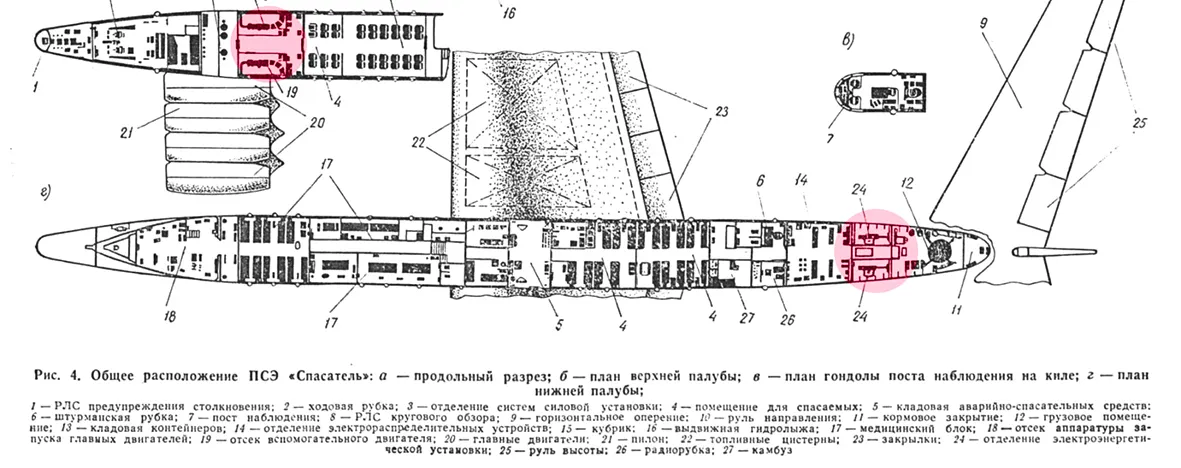

40 kW gas turbines in the bow, mainly for starting the engines, although they can also supply power to the general network, but the main power supply is on the stern generators

But the ideal solution would be to completely convert engines to diesel fuel, since gas turbines, including aircraft ones, easily allow this.

The deployment of the lightest, helicopter-class sonar system with sonar or buGAS would eliminate even the hypothetical possibility of a successful torpedo attack on a submarine at sea. Considering the small crew size—around 20 people in total—it's a true naval warfare machine!

Incidentally, a 20-person crew is half the required crew for the Project 22800 small missile ship, which is no more powerful than the hypothetical modernized Lun. A considerable boost to the claimed manpower savings...

Not just "Caliber"...


I think it's obvious that thanks to the UVP, an already decent ship will become a powerful strike ship for the close-in maritime zone, and thanks to its speed and full-fledged close-in air defense, it will be much more survivable than a simple boat/SMC.

But it is not entirely clear that the sharp increase in the number and range of missiles brings the strike EP to a borderline state between the three classes of ships, with only a change in the composition of the electronic weapons.

A small missile strike ship is fine, but what are those other two classes? Hold on tight, or better yet, sit down! Just kidding. Those classes are: arsenal ship and air defense ship.

Arsenal ship — This is a small missile ship completely unchanged, except for its missiles, and its probable sequence of operations is roughly as follows: the Lun catches up with a detachment of ships and, after refueling from supply vessels or even combat ships, follows the formation under auxiliary engines or at low thrust at some distance from the formation, or moves intermittently along the formation's course. Incidentally, the KM was once quite capable of refueling at sea, though not while underway, but that's what the model is for.
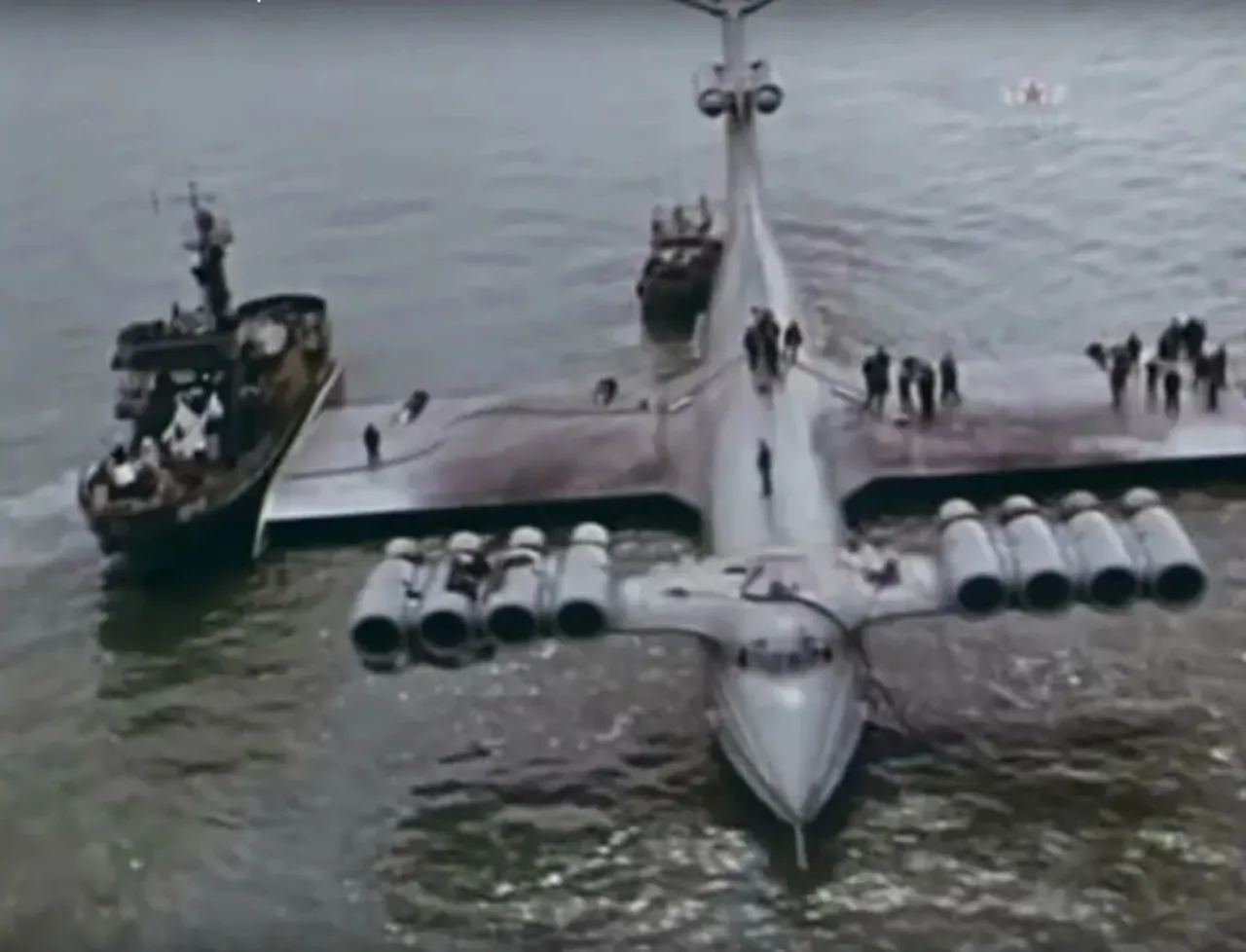

KM with a moored vessel - it's absolutely unclear who is refueling whom, but the refueling is ongoing!

With automated communications with the squadron's ships and their targeting instructions, the ekranoplan can deploy weapons as needed, whether SAMs, anti-ship missiles, or anti-submarine missiles. Once its endurance or ammunition supply is exhausted, the ekranoplan retreats to the nearest base, where it replenishes and, possibly, replaces its crew.

Thus, even a pair of replaceable EPs, let alone a larger number, will allow ships to either retain several dozen of their missiles or avoid being left defenseless with empty magazines. This could prove a decisive advantage, especially when repelling torpedo attacks, as, for example, the anti-submarine torpedoes and counter-torpedoes of the Paket-NK system are not interchangeable, and the system itself is practically impossible to reload at sea due to the large mass of the loaded EP.
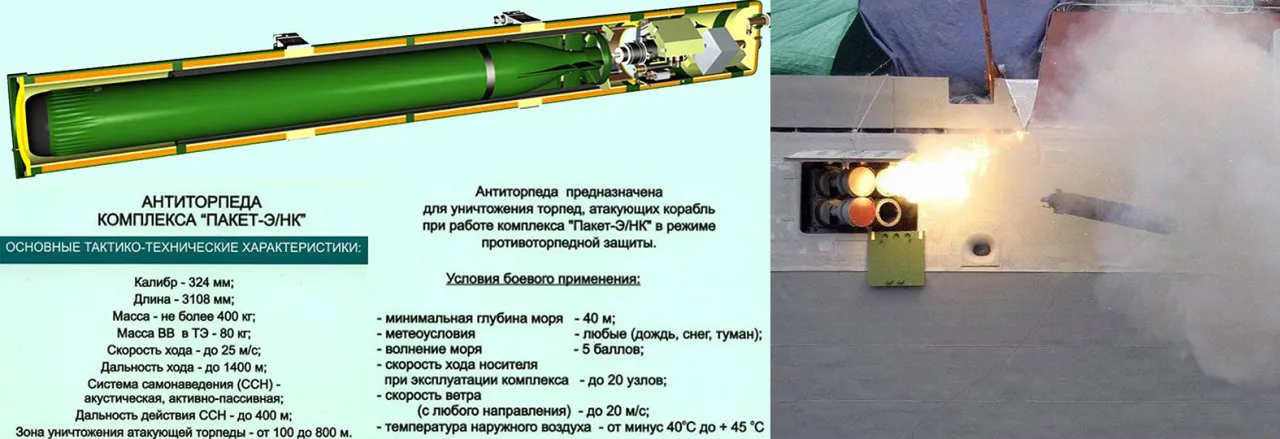

Photo Package-NK

Moreover, this can be done, provided there is refueling, of course, at full cruising range from the base, and this is a distant sea zone!

Air defense ship The Lun version will require the deployment of advanced air target detection systems in addition to the Pozitiv radar, and the Mineral radar system will provide the space and weight for this. Combined with long-range SAMs, this will allow the Lun-PVO not only to participate in the defense of ships or vessels, which is obvious, but also to clear airspace over the sea, where the use of friendly fighters is difficult!

At a range of 500 miles (926 km), a fighter has only an hour and a half to patrol, while an EP, in addition to the possibility of a 5-day drift, will have fuel left not only for the return trip, but also for patrolling at low speed or for a 250-mile dash in any direction.

The Lun-PVO's deployment to the patrol area might look like this: our fighters take off at the same time as the EP's deployment, and by the end of the patrol, with the active use of radar and the aircraft's demonstrative departure, they are covertly replaced by an ekranoplan, only on the water, not in the air.

Its speed will allow the Lun-PVO to reach the front line undetected by reconnaissance satellites, and the use of passive radars will allow it to detect enemy aircraft and UAV radars before they detect the EP, which is up to 300-450 km away, and suddenly launch long-range SAMs against them, up to 40N6E (350 km). This clearly allows for the deployment of an air defense ambush with a single small ship.
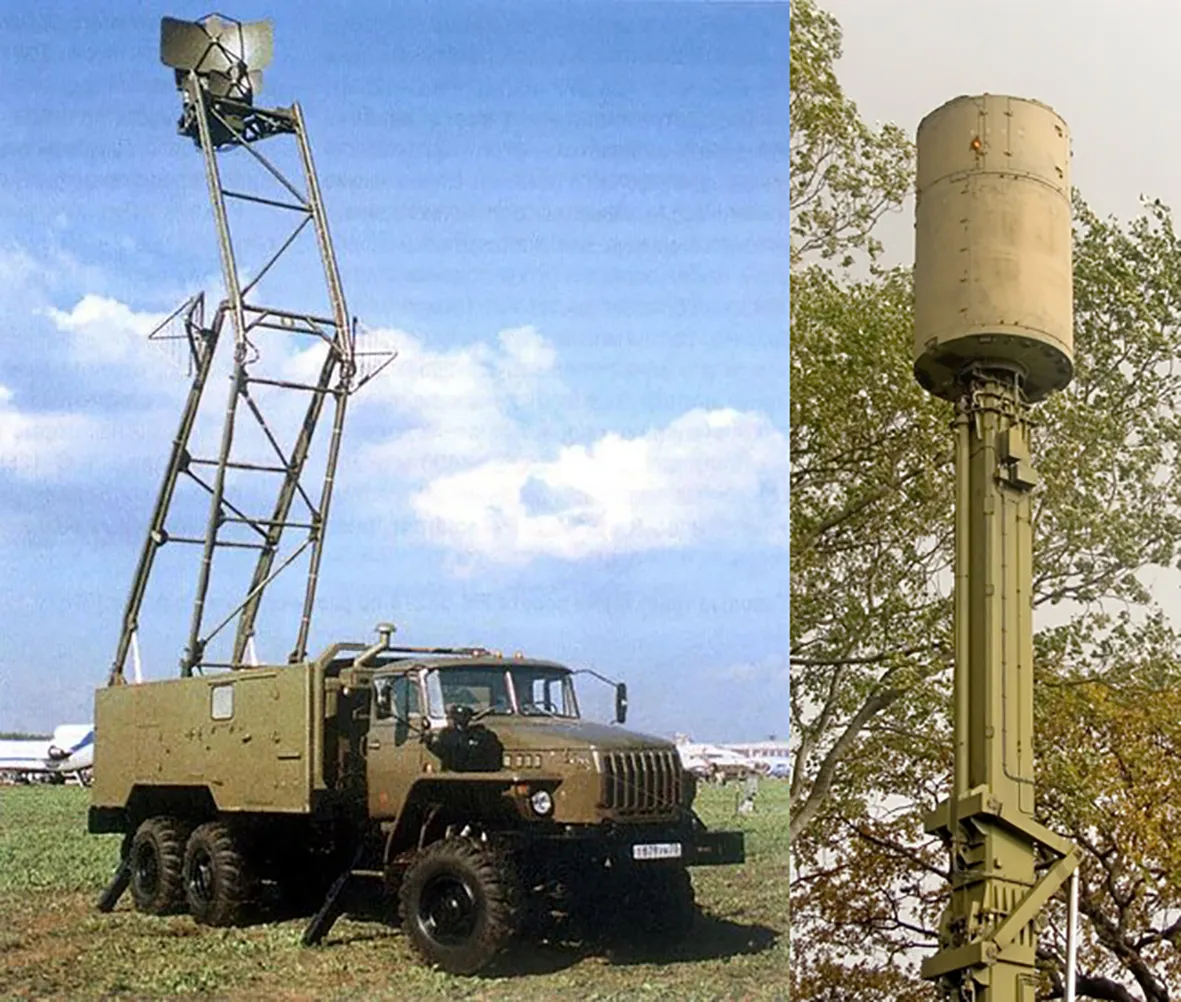

The antennas for the detection, direction-finding, and analysis stations are domestic 85V6-E Orion antennas from the 85V6-A Vega system and Czech Tamara antennas. A couple of each could easily be mounted on the fin, with the stations themselves located in the hull.

Of course, the deployment of radars for detecting non-emitting targets at a distance of up to 20–40 km and, of course, active radar search, if necessary.

If necessary, or at the slightest suspicion of detection, the EP will be able to actively and with impunity use the radar for emission, since its speed, even in displacement mode, will allow it to quickly leave the threatened area. However, this must also be done after the passage of enemy reconnaissance satellites.

Thus, the EP will be able to cover an area of ​​up to 380,000 square kilometers with passive means (with a detection range of 350 km) for five days, and at least 14,500 kilometers with active means against an air target at an altitude of 150 meters (the typical lower patrol altitude for UAV aircraft) (with a range of 68 km), while still being able to monitor the sea with sonar, albeit light. Even if aircraft could maintain such a watch, it would burn through many hundreds of hours of operational resources and even more tons of fuel.

A surface ship capable of something like this, meaning a class no lower than a frigate, would not be able to quickly and stealthily take up position from satellites, but what's much worse is that if it were to be detected, it would not be able to quickly leave the area, which would risk a strike even from helicopters similar to the Kh-35 anti-ship missile, not to mention aircraft.
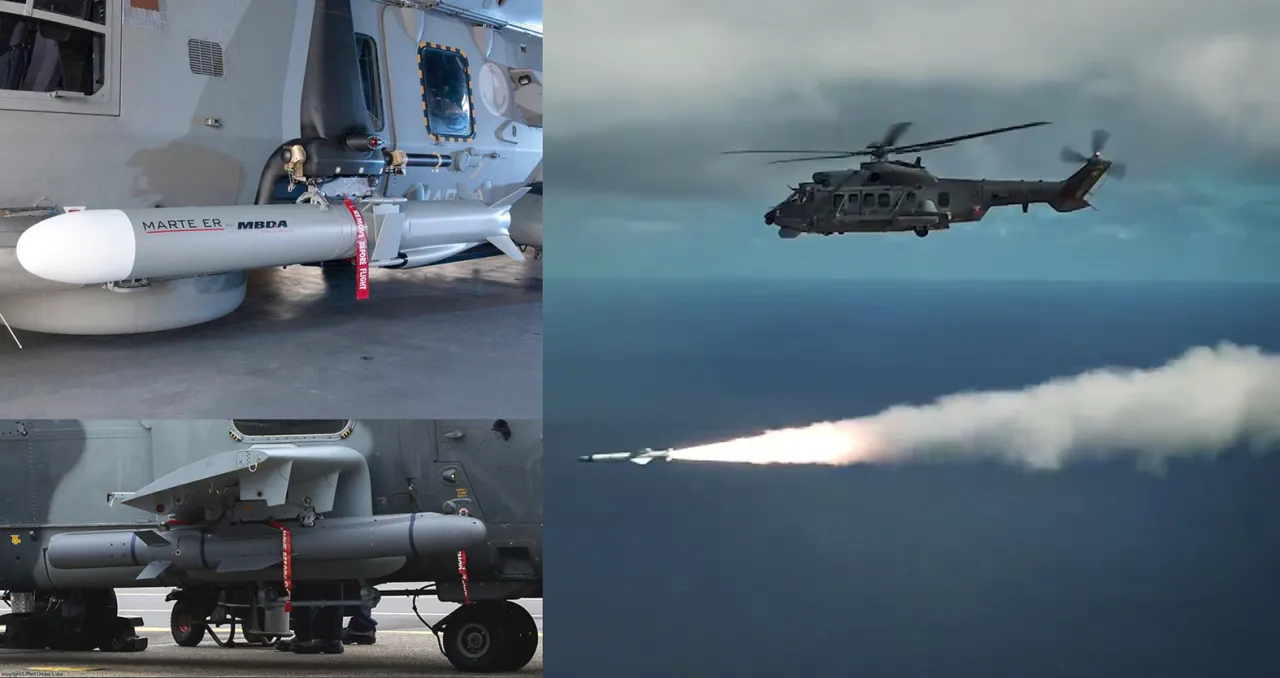

The launch of such missiles from beyond the radio horizon, both by external target designation and for independent search, is more than possible

Well, I'll add to this diversity small tanker, a completely useful unit in general, and especially for supporting the operations of small ships, even ordinary surface ones. It could also be equally useful carrier of unmanned vehicles, especially underwater ones. Or patrol with the architecture of "Lun", but the dimensions of "Orlyonok".

However, all these subclasses and other air defense ambushes are just my own speculation. But using an ekranoplan as a small anti-submarine ship is no longer just speculation; it's a very serious argument in favor of reviving combat ekranoplans in Russia.

The fact is that within the near sea zone (NSZ) and a little further, the EP is capable, albeit not in all respects, of replacing an anti-submarine aircraft and will be head and shoulders above any anti-submarine ship, unless it carries anti-submarine helicopters, of course, but that's a completely different weight category.
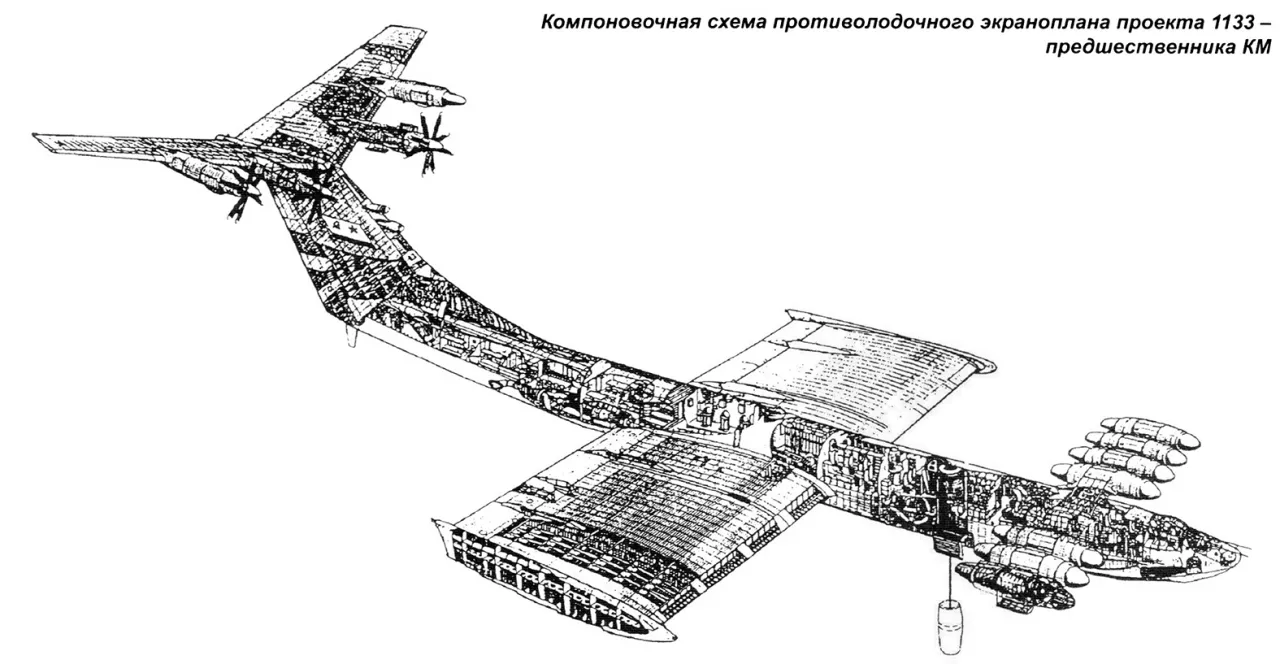

The anti-ship missile was mounted on the ekranoplan much later.

Weak, but not hopeless


Yes, the Lun of the 80s is significantly inferior to anti-submarine aircraft in terms of flight range, fundamentally in flight altitude, and non-fundamentally in flight speed, but at the same time it is significantly superior in payload and many times superior in terms of time spent in the search area.

In the near-sea zone, range as such isn't necessary, but it will allow the aircraft to survey a larger area of ​​the sea using a magnetometer and other non-acoustic means than an ekranoplan. The Lun's ability to remain in the search area for five days at low speed, compared to, for example, the Tu-142's 17 hours (with refueling), only partially offsets this advantage.

Flight altitude increases the radio horizon, which is important for detecting surface targets, but submarines aren't one of them. While submarines do have retractable radars, they are detectable at ranges significantly shorter (15–40 km) than an aircraft's radio horizon allows, at any altitude. Then there's the range of radio communication with sonobuoys, which is limited to approximately 80 kilometers at any altitude.

Very few people realize that it's precisely the buoys used as the primary means of submarine search by aircraft that prevent anti-submarine aircraft from being considered all-weather. After all, even the most advanced buoys have a wave limitation of at best 5, and more likely the upper limit of 4.

Anti-submarine warfare aircraft, with the possible exception of the Tu-142, have a significant advantage over surface-to-surface submarines: low acoustic signature for submarines operating at depth. While the submarine flies at extremely low altitude, I'd venture to suggest that, thanks to the advanced engine cowling, their low thrust at cruising speed, extended exhaust nozzles, and the sound-shielding capabilities of the low-mounted, wide wing, it could easily be as stealthy as an aircraft operating at a typical altitude of 150 to 300 meters. Until it lands on water, using underwing air pressure, of course.

At a cruising speed of 705 km/h, the Tu-142 is certainly faster than the Lun, but the Il-38 isn't quite as fast: 456 kilometers versus 440. So the Lun won't be too late to its duty station, especially considering the airfield's distance from the coastline.
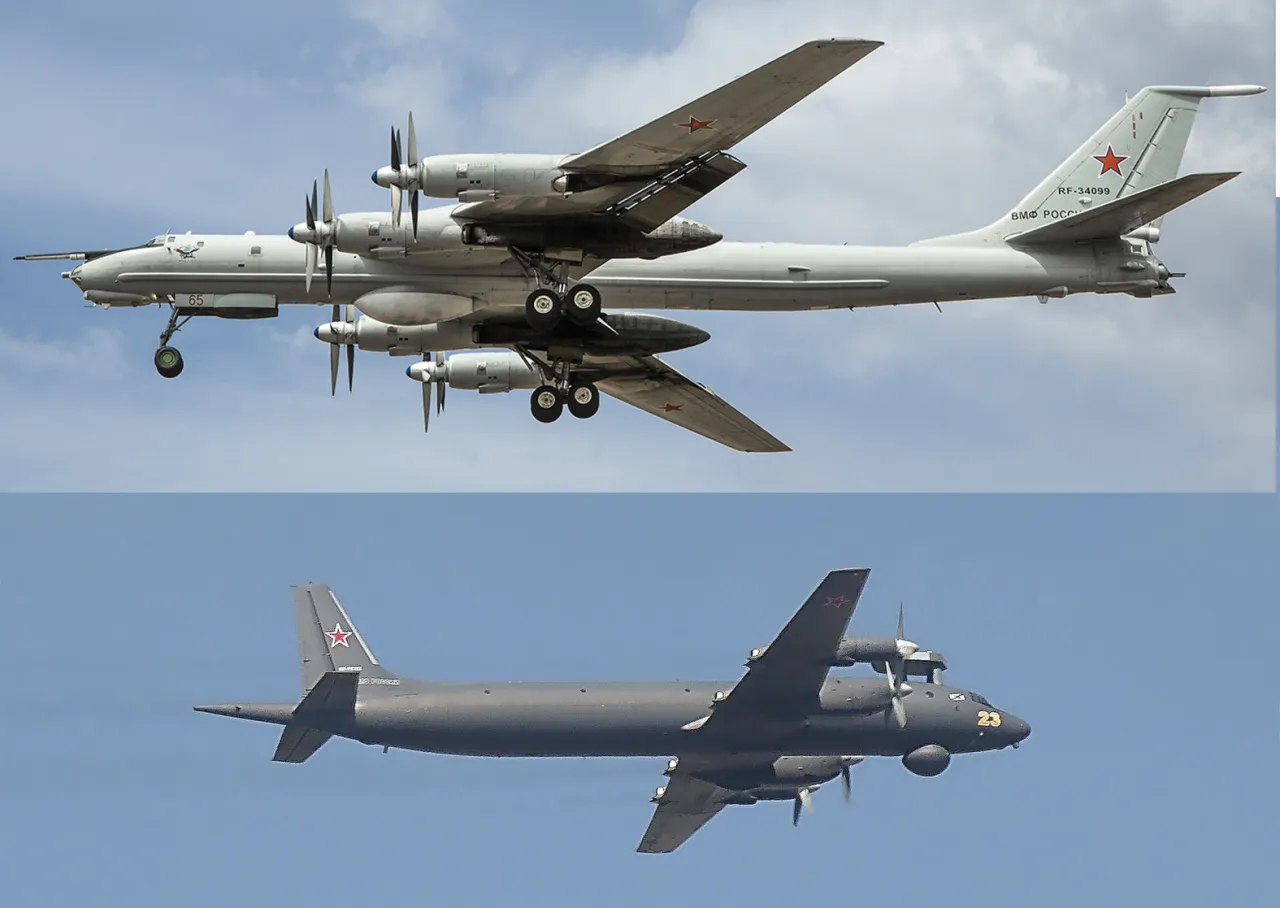

Beauty. I'm afraid it's fading...

Modern anti-submarine aircraft still have the ability to detect submarines in a submerged position using radar based on a "standing wave," but are our aircraft capable of this, and is it even capable of this in significant waves?

In general, in a purely aviation sense, the ekranoplan is not very convincing in comparison with an anti-submarine aircraft, although it is capable of doing many things that an aircraft can, but the Lun is a ship, which means it can do things that an aircraft cannot.

It can do everything because it’s a ship, and something on top because it’s winged.


Here, for example, is the anti-submarine warfare system of a ship such as the Project 1145(1) hydrofoil craft with a full displacement of 475 tons, recognized by experts as the most effective coastal anti-submarine warfare ship due to its high speed:

The Sheksna sonar system for Project 1141 weighs 28 tons, of which the weight of the sonar system with a container, lifting and lowering device, cable and cable-rope for 150 meters of immersion is 15,6 tons.

Or the digital sonar system "Zvezda M 1-01" from 1988 for Project 1145, which already weighed about 16,5 tons (the complex included a rack of equipment for receiving and processing data from the Russian Geophysical Observatory).
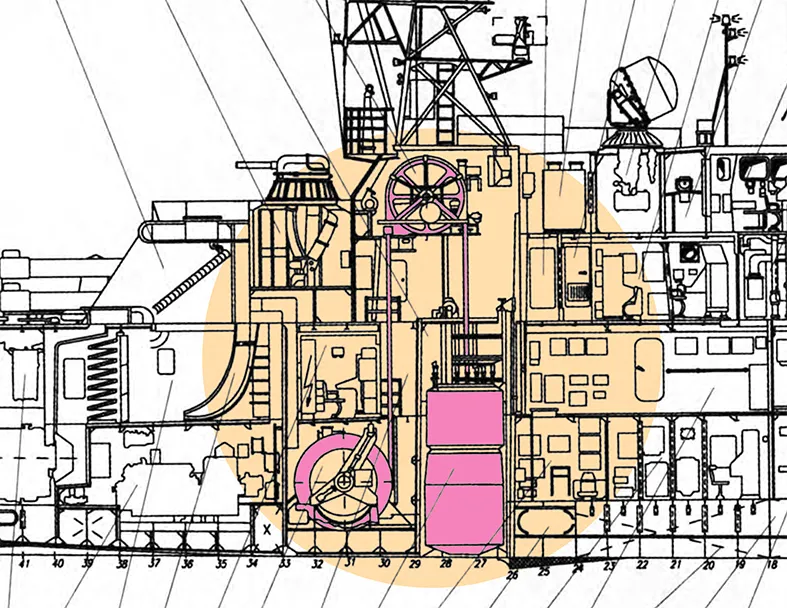

Antenna and lifting and lowering device of the Zvezda M 1-01 sonar

The armament included two launchers of the then-promising Medvedka anti-submarine system with eight 5,8-meter-long rocket torpedoes weighing a total of 19 tons, or two TR-244 TAs with eight SET-72 400-mm caliber torpedoes, 5 meters long and weighing a total of about 12 tons.
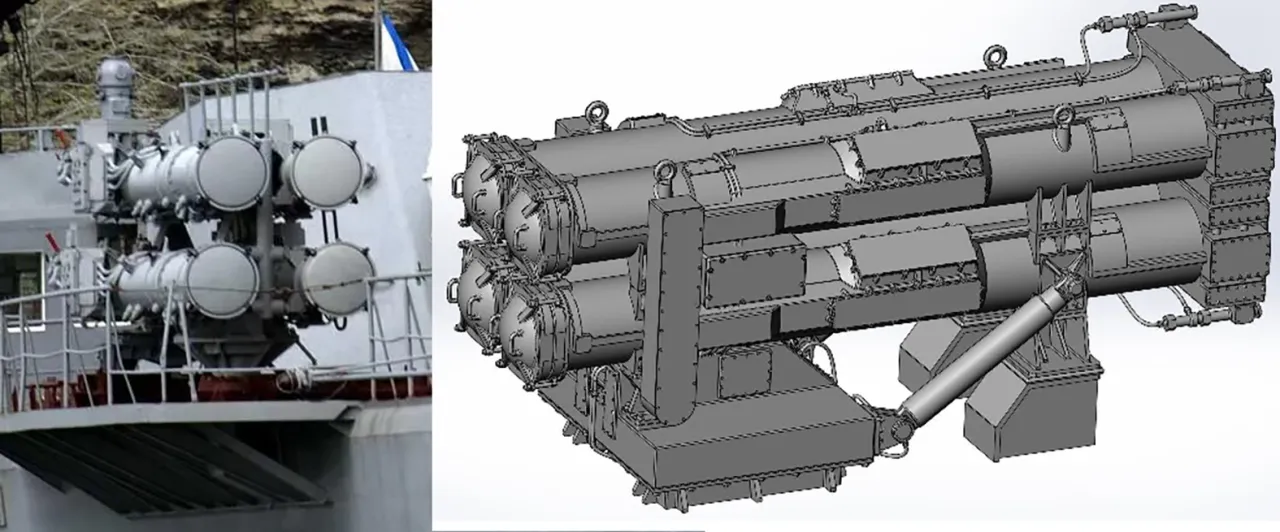

Photo of TA and 3D model of PU

And the Lun, in its original, trimmed-down takeoff weight version, without the Moskit missiles, would naturally be perfectly capable of lifting all of this, with a weight reserve of 5 to 25 tons. And that reserve could be spent on air defense and/or other things, like a set of several hundred heavy radars or, if we're going for the exotic, a wake detection system (WDS).

In general, the physical possibility of deploying shipborne search-and-destroy capabilities for enemy submarines exists; technical and tactical nuances remain, such as what to mount—torpedoes, rocket-torpedoes, or both; where to mount the torpedo tubes, whether fixed or rotating; how to use the sonar system—through shafts in the bottom or hatches in the side, etc.
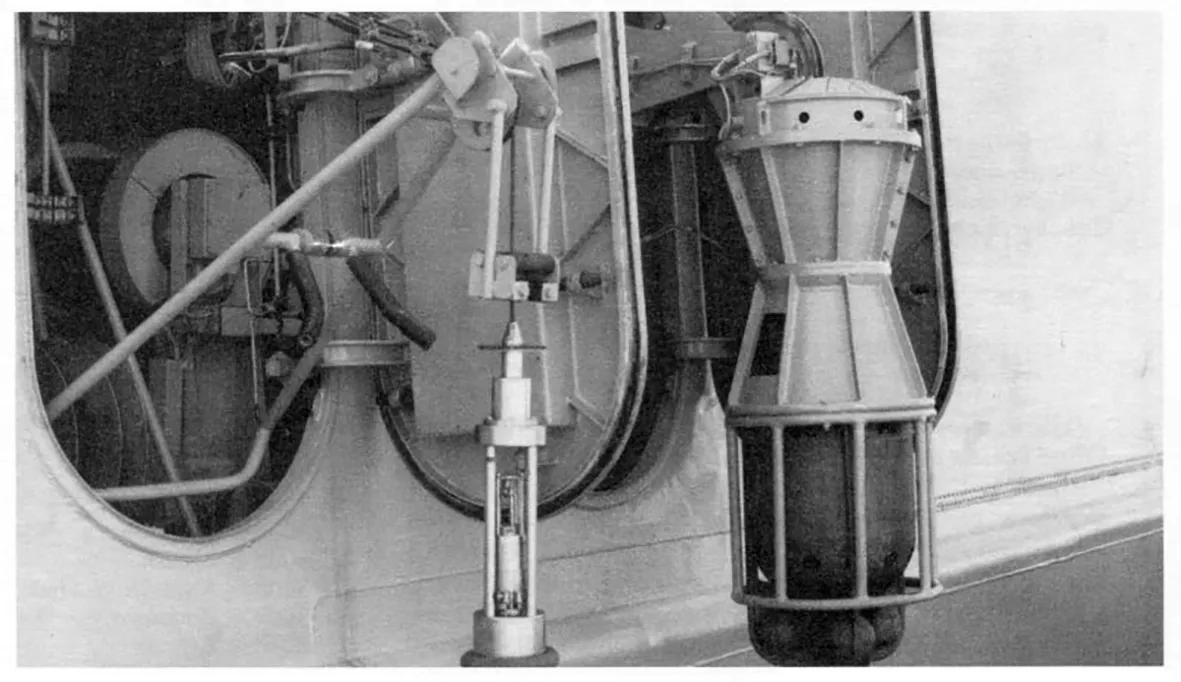

Lowering the sonar antenna through the lapel port
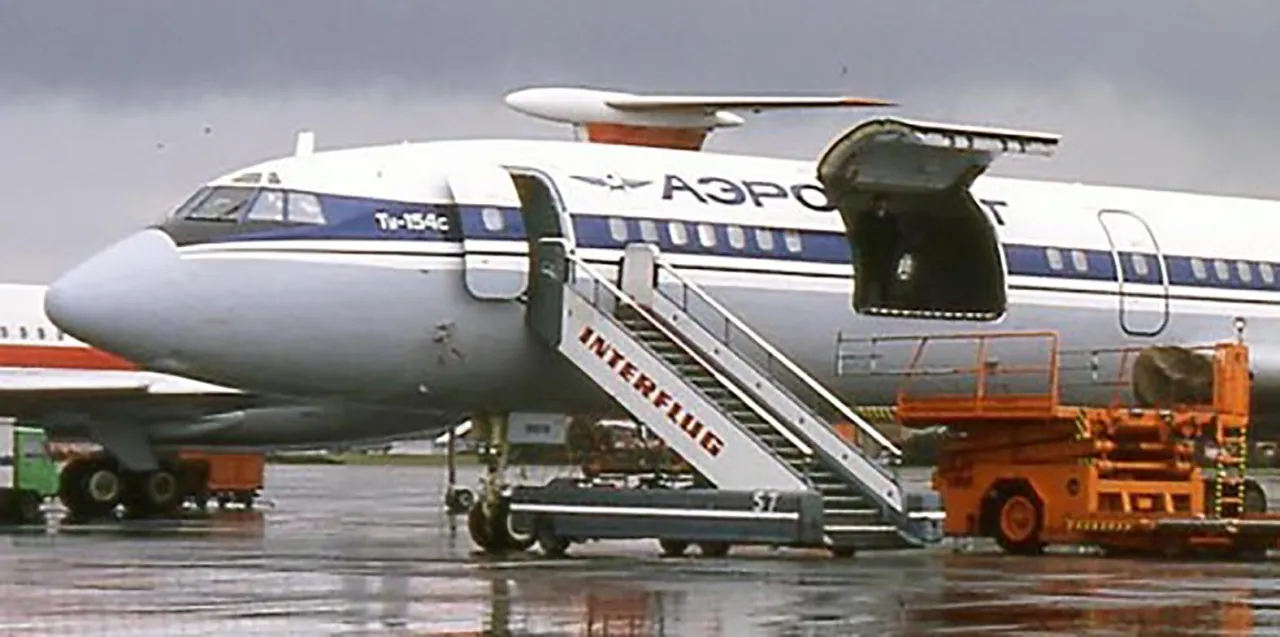

A large side hatch isn't a problem even for a passenger jet—it's just a matter of localized reinforcement. What can we say about a small ship?

Now, regarding the use of the ekranoplan as a surface anti-submarine warfare vessel. Naturally, the ekranoplan is capable of employing various types of sonar systems both at rest and at all permissible speeds, meaning it is fully capable of anti-submarine patrol.

However, this search method is ineffective against modern submarines and significantly negates the main advantage of the EP—speed. This is especially true given that submarines, not just nuclear ones, have a significant advantage in detection range over surface ships and, therefore, are capable of evading contact.
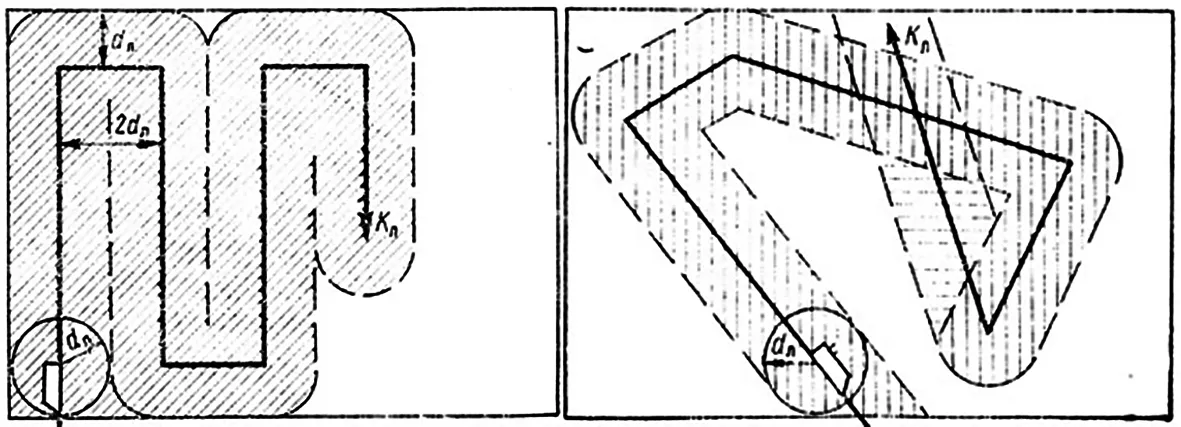

Don't let the submarine designation confuse you. These schemes are also used for surface ship searches.

A cyclic, or intermittent, or discrete method of submarine search appears much more effective for ekranoplans. It involves high-speed movements over one and a half to two times the sonar's range, followed by brief pauses to engage the sonar in either echo-direction-finding (active) mode for a single ship or combined noise-direction-finding (active-passive) mode when operating in pairs or squadrons.

There is a clear similarity with the actions of anti-submarine helicopters, hence the unofficial name "helicopter", but this method has been successfully tested for hydrofoil MPCs and allows for literally driving even enemy nuclear submarines, especially when operating in pairs/squadrons, which is absolutely inaccessible to conventional MPCs, even at maximum speed.
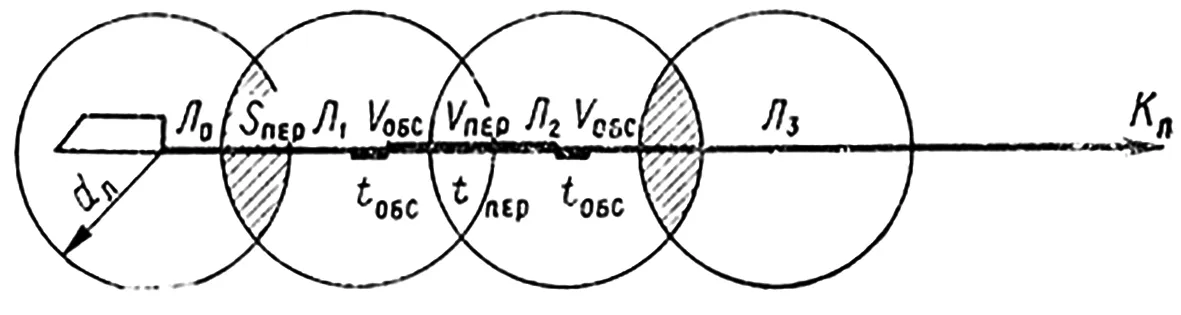

Discrete search scheme by a high-speed ship. Submarine designation - conditional

The Lun's ability to take off in force 5 waves at 100-120 knots gives confidence that it can easily achieve 30-50 knots in planing mode, even in these, and especially in lighter, waves. Therefore, when performing a high-speed search for a landing craft, it's not necessary to take off and land every time, and consequently, fuel consumption will be reasonable, especially considering that during a full takeoff, a significant portion of the thrust is spent on wing inflation.

The fuel efficiency and seaworthiness of a ground effect craft at high speeds may be somewhat lower than those of a ground effect craft, but this is offset by the advantage of planing craft over ground effect craft at speeds up to approximately 30 knots, due to the significant drag of the submerged hydrofoil before reaching its maximum speed. A ground effect craft can confidently navigate in this speed range without exhausting the crew and saving fuel.

Thanks to this, and the fact that, unlike the MPC PK, the ekranoplan lacks the obstructions of a winged structure and a cluttered stern, the ekranoplan can use not only a sonar but also a towed sonar, including one with a flexible extended towed antenna, up to maximum towing speeds. Overall, it's safe to say that the ekranoplan, as a ship, has significant advantages over a hydrofoil-based anti-submarine ship.

But an ekranoplan is a flying vessel, which gives it not just an advantage, but an ultimate superiority. An ekranoplan is much faster, has a greater range, and can reach the search site quite stealthily, simultaneously conducting a search with a magnetometer or other non-acoustic detection means. Before engaging an enemy submarine from the water, an ekranoplan can covertly deploy a barrier of radar-guided radar.
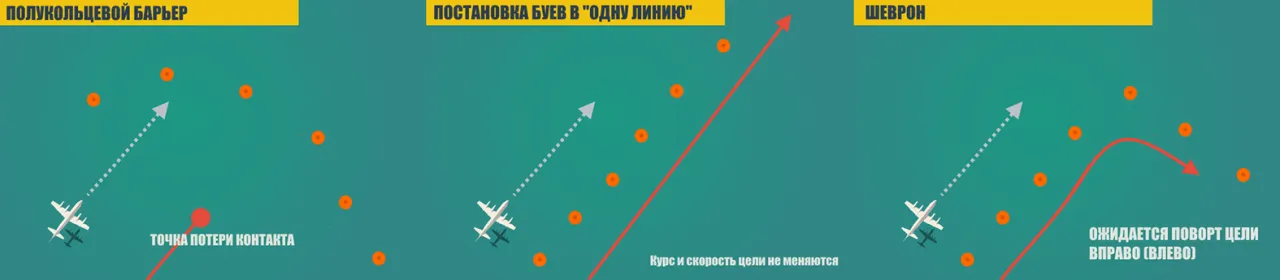

Types of barriers of the Russian State Archives of the Russian Federation

Finally, once its ammunition is exhausted, the EP can return to base and replenish very quickly, five or more times faster than any surface ship.

It is obvious that the ASW EP is superior to any surface anti-submarine ships not equipped with ASW helicopters, but under certain conditions, the EP will be more effective than anti-submarine aircraft.

I will analyze this statement using the example of actions to check the absence of tracking of SSBNs to ensure the combat stability of strategic missile carriers.

A similar operation in anti-submarine aviation was called "Lisichka," and it involved placing a buoy along the SSBN's route at a specific location and time. If the buoy is triggered after our submarine passes (approximately 15-20 minutes later), it means our submarine is being covertly tracked. According to experts, from 1983 to 1990, approximately 80% of Lisichka sorties resulted in the detection of a foreign submarine.

PL and NK can act in a similar manner, but without setting up a barrier, and they will have to take up a position well in advance to maintain secrecy.

An ekranoplan, having deployed a radar-guided aerial defense system (RGAB) at the expected contact point, can land on the water at a distance sufficient to ensure stealth from submarines but not interfere with radio communication with buoys. This distance, using only the antennas on the vertical stabilizer, can reach 17–20 km, which may not be sufficient to ensure stealth. However, even a simple tethered drone antenna with a 300-meter altitude will ensure communication with buoys at a range of 60–70 km.
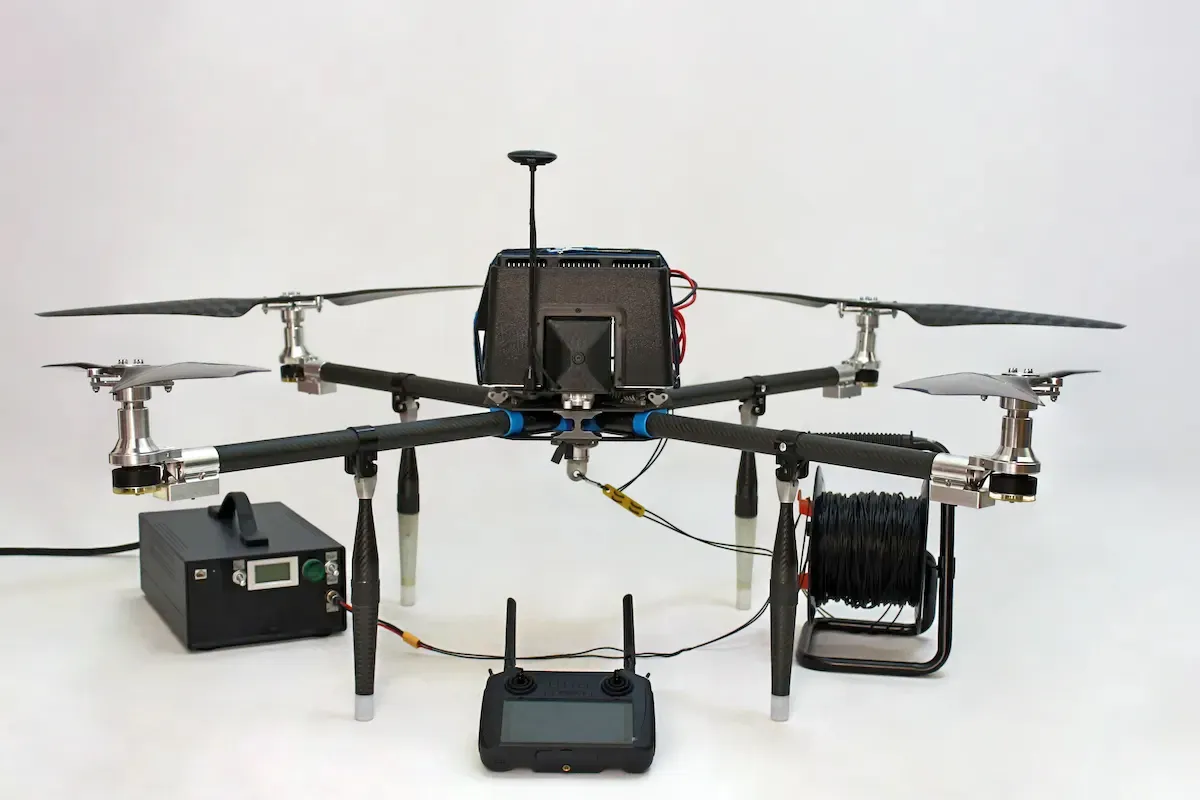

A drone can be towed, and with aerodynamic design, it can be towed at high speeds, just like gliders once were.

So far there are few differences with the actions of anti-submarine aircraft, but everything changes when an enemy submarine is detected.

An EP, even a single one, having arrived at the contact point, lands within 15-20 minutes, immediately determines the position of the potential enemy submarine using echolocation, and begins active pursuit, which, as is already clear, can be sustained for an extended period. Such pursuit, using sound signals or even the release of explosive sound sources, as US antisubmarine ships did against our submarines during the Cuban Missile Crisis, will force the potential enemy submarine not only to abandon tracking our SSBN, but to leave the area altogether, even if it's not in Russian territorial waters. Furthermore, these actions will signal to our submarine that it has been detected by the enemy.

In peacetime, an aircraft cannot maintain any sustained pursuit of a detected submarine, either due to its remaining fuel or its radar exhaust, meaning it cannot force it to cease tracking our SSBN, even if it is no longer covert, much less leave the area. At best, the aircraft would be able to hand over contact to its replacement.

Moreover, even during the described operation, a ground effect vehicle (Ekranoplan) could easily retrieve spent radars from the water at low speed using something like a Fulton device, thereby significantly reducing costs. Because when searching for and maintaining contact with potential enemy boats, the main expense wasn't fuel or resources, but the consumption of radars, which could reach 20-30 per hour.

Accordingly, the rescued RGABs could be much more advanced than currently available, for example, with satellite communications and more capacious batteries, even small-sized BEKs, which could mean new tactical techniques and significant improvements in search capabilities.
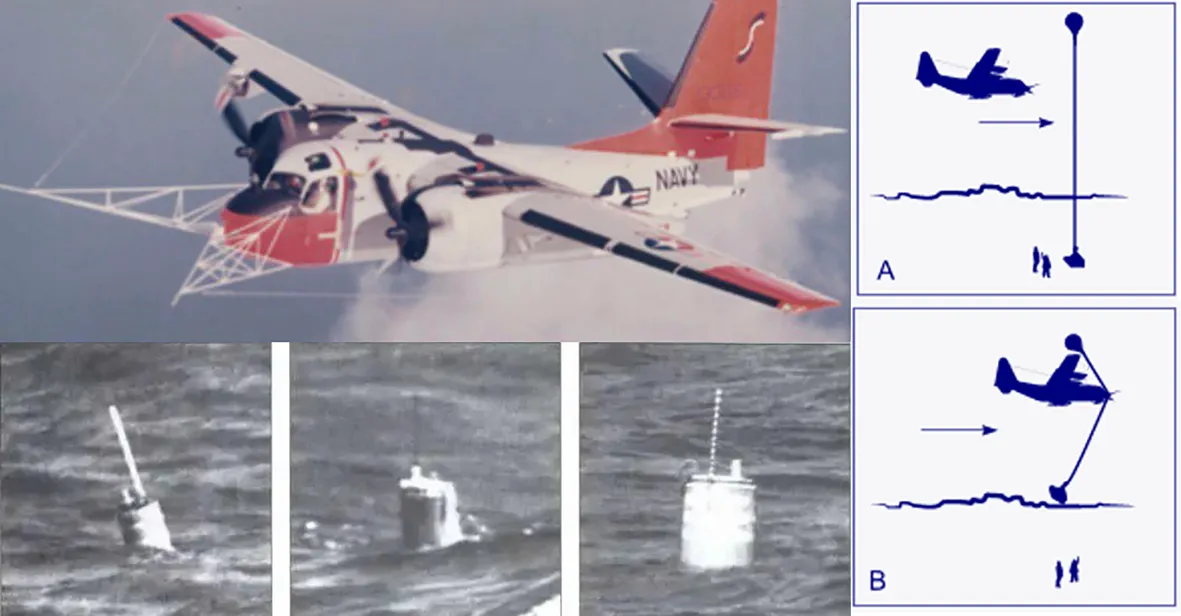

The principle is clear. Obviously, the radio frequency antenna (RGA) will be received on board the EP using the antenna, in displacement mode, and at low speeds. Automating the reception, by today's standards, presents no difficulty.

But all of the above does not at all mean that ekranoplans are opposed to aviation; on the contrary, the ekranoplan- An airplane or UAV would be ideal, at least in the near sea zone, and maybe even further.

In this combination, the aircraft patrols the area using remote submarine detection methods, whether radar, magnetometer, laser, or a combination of these. The ekranoplan operates on call from a holding area, conducting a more targeted search and intervention, since, unlike any surface vessel, it can arrive at the suspected contact site with minimal delay.

Such interaction will allow the aircraft, while leaving a minimum of radar and anti-submarine weapons just in case, or getting rid of them altogether, to significantly increase patrol time in the case of UAVs.

Maneuver, factories and psychology


Well, that's it, it's time to finish this article. The most general, but perhaps fundamental, questions remain.

Production


The EP was and can be built at shipyards. All technologies have been honed over more than half a century of experience in building aluminum welded ships and hydrofoils in the USSR/Russia. Small series of vessels are still being built, so the issue is scaling up production, not recreating the technology.
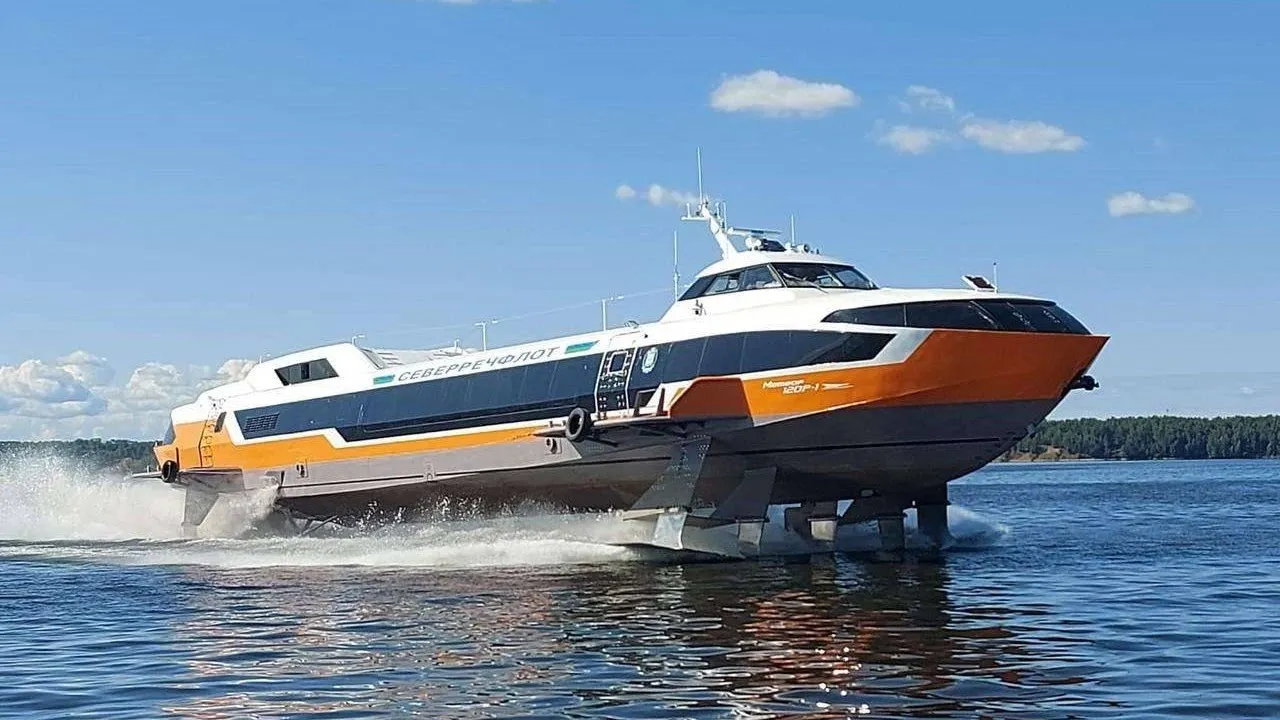

Meteor-120
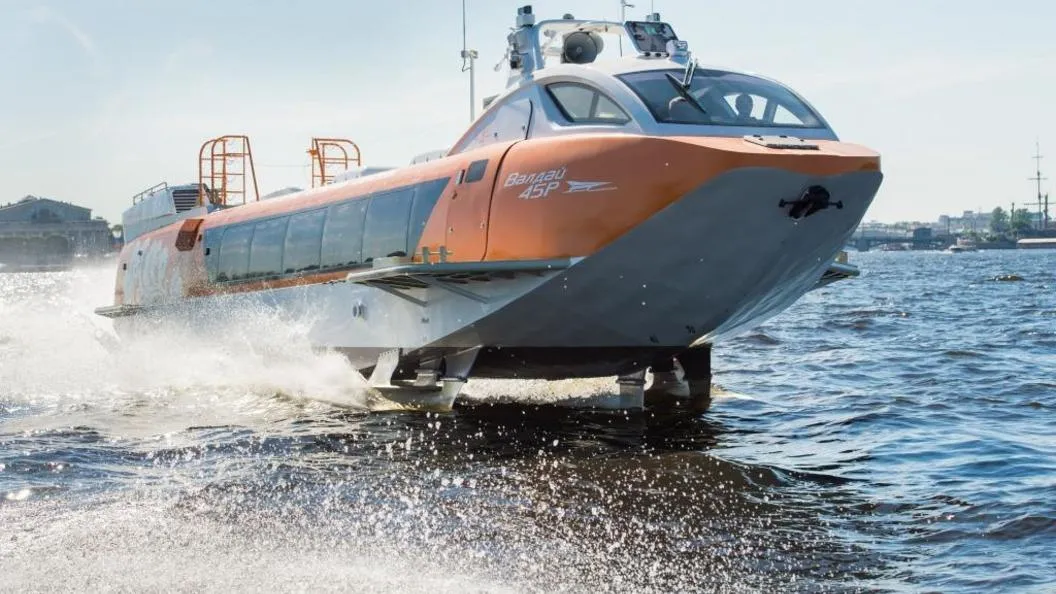

Valdai-45R

Project 903 architecture aircraft are distinguished by the fact that the same engines are used for underwing airflow during takeoff and cruise, mounted in two high-mounted pylons unconnected to the wing. This means that re-engining with any engines of suitable thrust by replacing the entire pylon will be quite simple, even for an existing aircraft.

Moreover, with excess thrust, the number of engines can be reduced, and, more importantly, vice versa. This means that the E-jet can use engines that are no longer suitable for aviation, maintaining their production, for example. This seems to be a good argument in favor of the E-jet.

In addition, I would like to thank the commentator Andrey - "Andrey from Chelyabinsk", for convincingly proving to me that even doubling the number of even completely new engines for the EP compared to an airplane will not increase the cost of the EP by 50%, but by 15-20% at most.

Inter-theater maneuver


For naval fleet In our country, inter-theater maneuvering by ships has always been a major weakness, and in wartime, it's often pointless due to the loss of time or simply impossible. Moreover, for small ships, such passages are very challenging in terms of endurance and seaworthiness, even in peacetime.

However, using inland waterways, it is possible to transport small ships from the Black Sea to the White Sea, bypassing the Mediterranean and the Atlantic, and vice versa.

However, even the small missile ships cannot do without dismantling the masts and some of the radar equipment due to the height restrictions on bridge spans.

For the EP, things seem even worse - in addition to dismantling the air surveillance radar and stabilizer, at least one wing console will have to be detached, due to the width of the airlocks.

However, at least theoretically, the EP is capable of making this transition without such arduous procedures. The fact is that the civilian version of the 903rd project, the "Spasatel," had a standard "Search" mode—a prolonged flight at an altitude of three hundred meters. And there are references to the "Lun" performing such flights to test its calculations.

This means that without ammunition and with a minimal fuel reserve, the Lun could easily perform hops of several hundred kilometers to overcome narrow/low-lying areas, moving in planing mode along convenient sections of the route.

Increased fuel consumption can be ignored simply for the sake of speed, and this is guaranteed to be offset by the reduced installation/dismantling costs. In this case, the EP will be much more preferable to its surface counterparts.
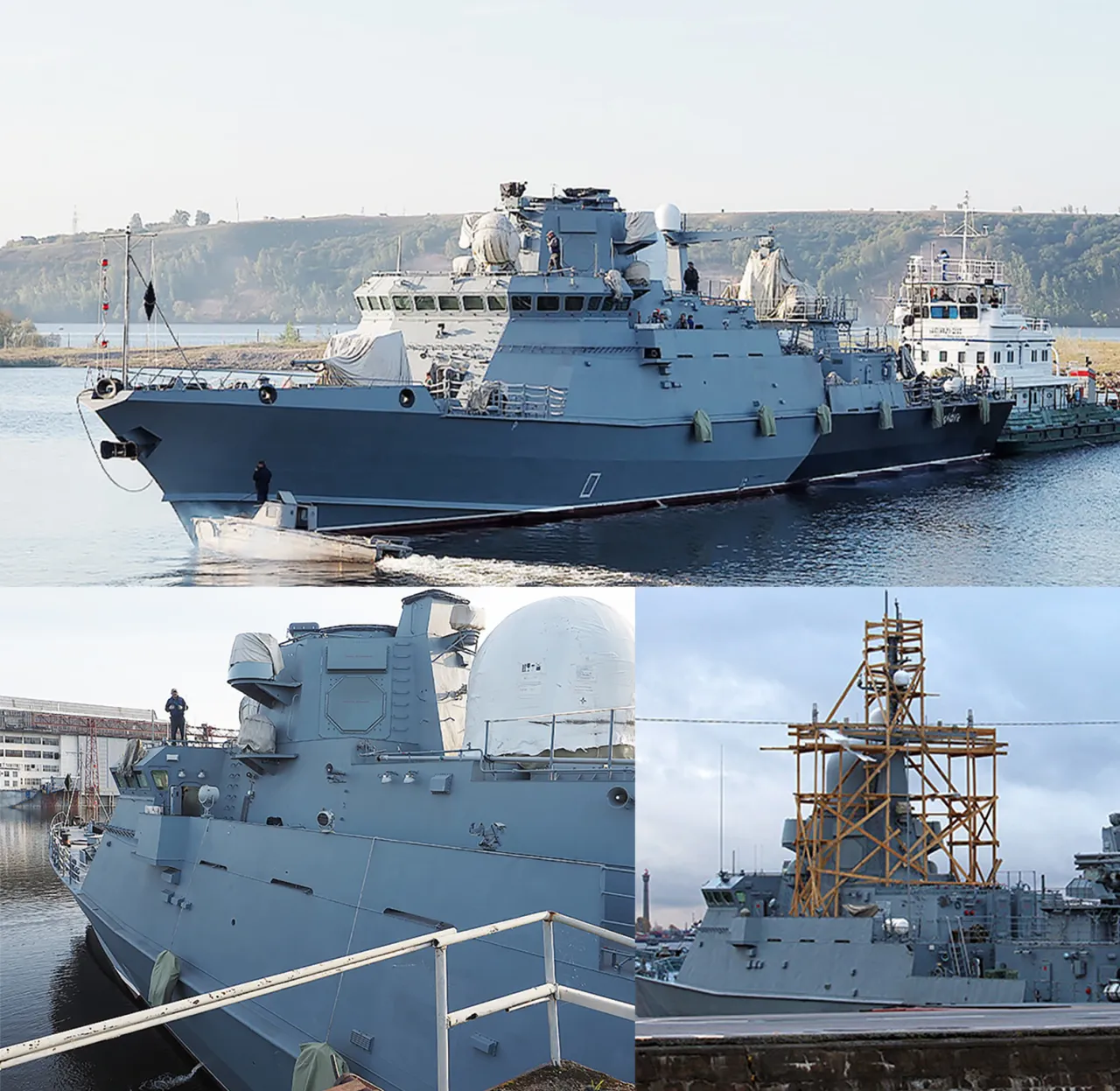

The photo shows the small missile ship with its masts and radar dismantled for transport to the construction site, and at the completion of installation, after being transferred from the Black Sea to the Baltic.

And it's even more possible to navigate the Northern Sea Route during navigation, and at almost aviation speed, in no more than two days. Assuming a cruising range of 2500 km, the Severomorsk-Vladivostok voyage would require four to five refuelings from pre-deployed tankers or from shore.
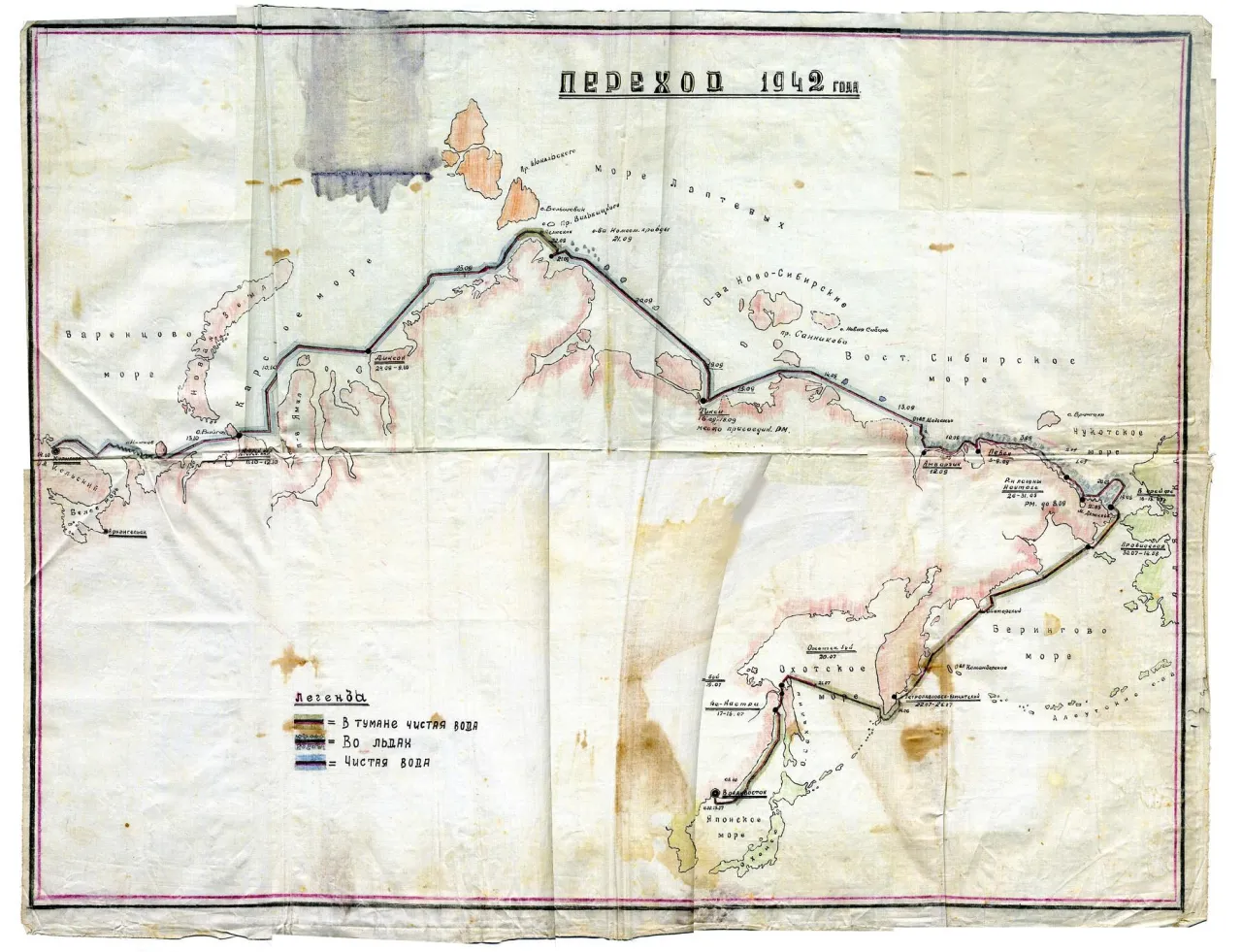

It was a rare instance of an inter-fleet crossing being successful during the war, not least due to the lack of opposition along the route.

But this is so, not questions, but questions. Much more pressing questions for those who do not want to see the revival of ekranoplans in Russia are: "Why did you stop with us?" и "Why don't they do it here?"Although even for those neutrally minded, not to mention supporters, the first question and part of the second are usually clear; you just have to strain your memory a little and connect these questions to time.

In the USSR, development of combat ekranoplans was slowed, but not stopped, due to the transfer of funds to the construction of nuclear submarines and aircraft carriers.

And in the "new" Russia, they stopped developing combat ekranoplans for exactly the same reasons they stopped developing supersonic VTOL aircraft, small AWACS aircraft, modernizing mine and anti-submarine warfare systems, not to mention microelectronics, space exploration, civil aircraft manufacturing, and other aircraft carriers. They even stopped developing destroyers.

Due to a lack of understanding of Russia's interests, due to conflicts between Russia's interests and the interests of their own pockets, and due to the interests of Russia's "strategic partners" being prioritized by decision-makers in those and subsequent years. Lack of funding per se isn't even the third most important factor here.

An argument against ekranoplans, such as the technical and military foresight of the officials responsible for the development of the Russian fleet, is now simply laughable.

The second question is a bit more complicated and can be divided into two parts.
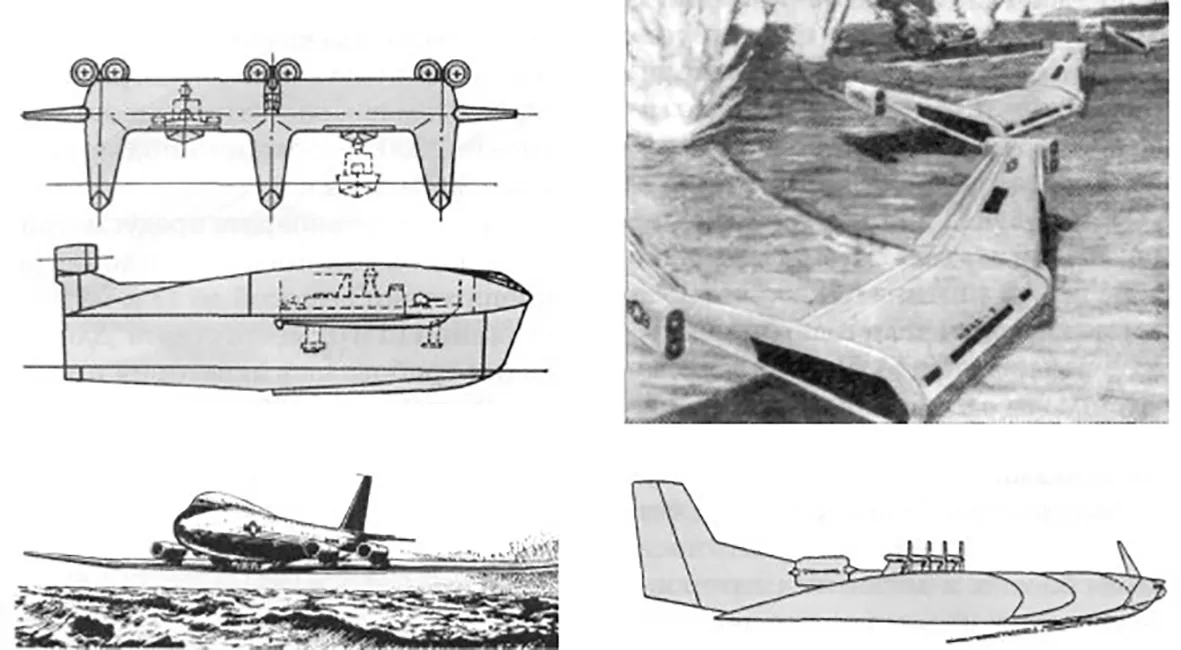


Sketches before KM EPs

In general, the US itself took up the topic under the influence of the USSR, and this is clearly evident in the diversity of projects by enthusiasts before the discovery of the KM and the subsequent almost complete unanimity in the appearance of sketches from leading companies after the discovery of the KM and the beginning of the development of the "Hundred-Knot Fleet" concept.
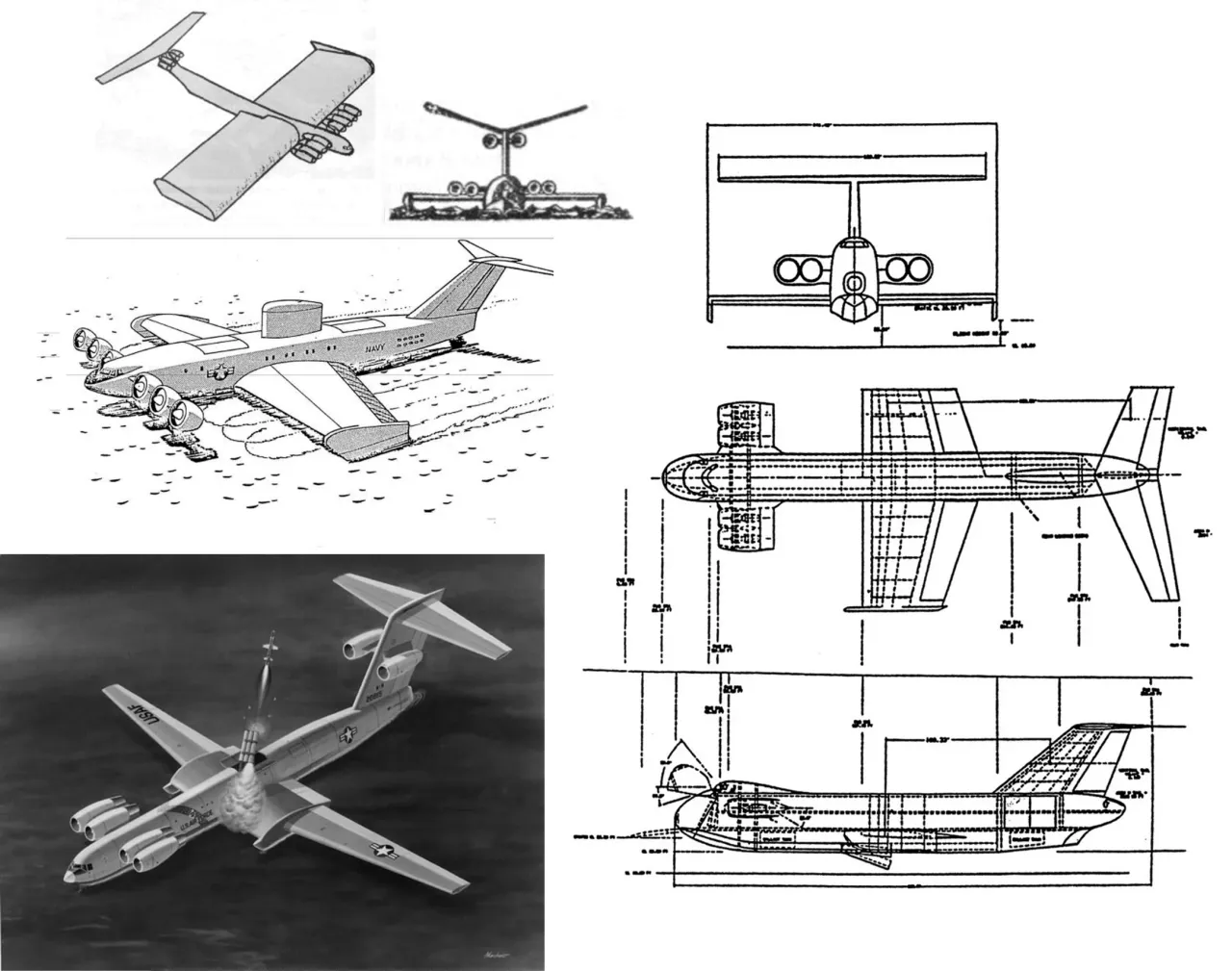

When the Monster Came

The subsequent cooling to the concept is explained:

  • real, and not the gigantomania of the designers attributed to Alekseev and the corresponding high cost of development, in combination with a flight mode that is practically untested in the USA;
  • transfer of naval resources to the nuclear aircraft carrier construction program;
  • not least of all, the slow pace of construction of Soviet EP;
  • and the lack of space for small ships in the concept of using the fleet.

A little later, the US completely abandoned the idea of ​​continuing serial production of already developed models, such as the Sea Wolf, B-2, and others. Not to mention the numerous unfinished promising military projects with far greater investment than the EP, such as the Comanche, A-12, Abrams Block III, ADATS, FOG, and others. The incentive disappeared.

EPs weren't developed (sketches don't count) or built in countries that could afford them, because those countries abandoned small warships altogether in the 90s. After all, 500-1000-ton ships are ill-suited for operations overseas, off foreign shores, and it was precisely such reckless actions that became possible for the US and its main satellites thanks to the collapse of the USSR.

Thus, modern fleets of leading countries do not include ships with a displacement of less than 1500–2000 tons, with rare exceptions in the form of patrol ships with limited capabilities.

Well, you could stretch an owl to the ground and provide supplies from forward floating bases with fuel and even ammunition, but that would be too much, especially given the availability of ocean-going ships.

The same countries that need small ships often cannot even develop and build ordinary NKs, let alone EPs.

This is the first practical one, so to speak.

Now the second thing is psychological.


Countries—and especially the United States—that are capable of developing and building a heavy ekranoplan cannot afford it. The Project 903 architecture is the only one that can ensure effective use of the ekranoplan and acceptable seaworthiness in terms of water performance, strength, and takeoff/landing, all while maintaining a reasonable thrust-to-weight ratio.

I am confident that a repeat of the "Lun" by the Americans is unlikely, since this would mean an unconditional recognition of the priority of the USSR/Russia.

But they're interested in the wing, at least for transport; otherwise, where would all these modern concepts presented in the US come from? And the fact that these are essentially either banal flying boats with minimal ground clearance, or flying wings without the ability to inflate under the wing, and therefore no seaworthiness on takeoff, only underscores that the Americans aren't planning on replicating the Lun. Perhaps not yet.

And this is if we forget about the requirements for the ability to fly at an altitude of 3,5 kilometers, especially with cargo, when we will have to say goodbye to the ship's strength.
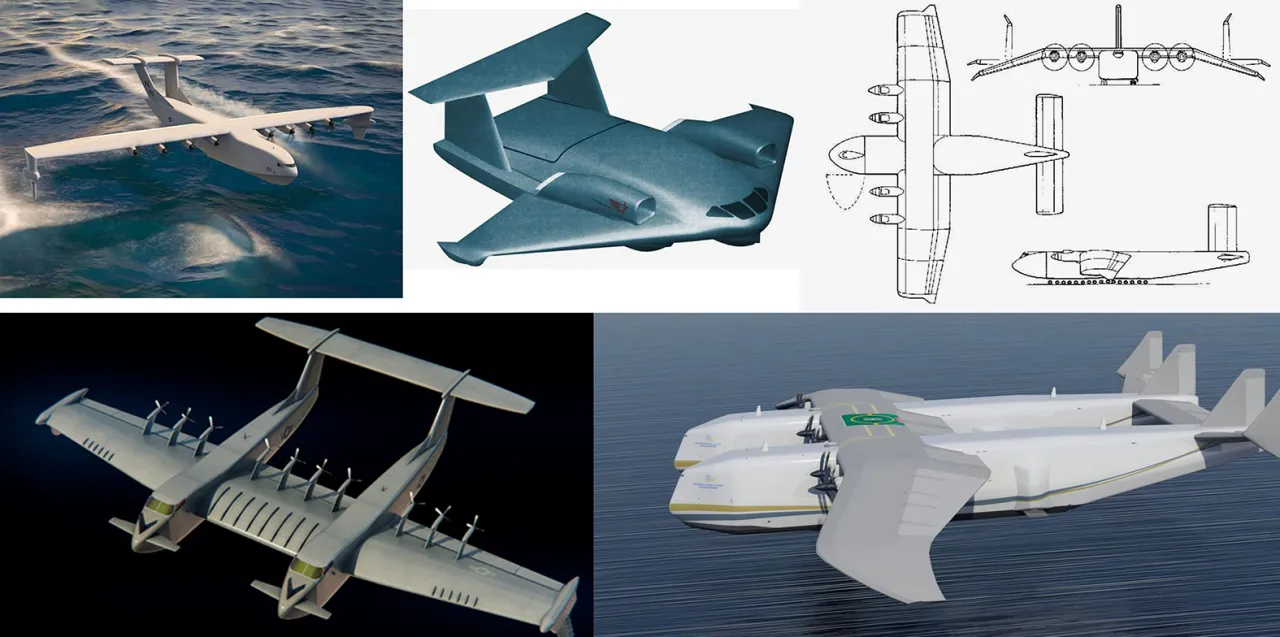

Modern sketches of EP - however, these are not ekranoplans

That leaves China. They're masters of copying, but if you look closely, they only copy Soviet/Russian designs from finished production models that they've gotten their hands on, either live or with the technology. As for general solutions, if they can't get their hands on a live model, the Chinese prefer to adopt Western ones. This is evident in both their aircraft and helicopters, as well as their navy. The Chinese won't dare build a heavy fighter jet themselves, but if I'm wrong, it will only increase my respect for China.

That's all for now, but I'll remind you once again that I took up the topic of combat ekranoplans not because I'm a fan of them, but only because their opponents are holding back too much, or don't know, or distort, or simply don't think things through.
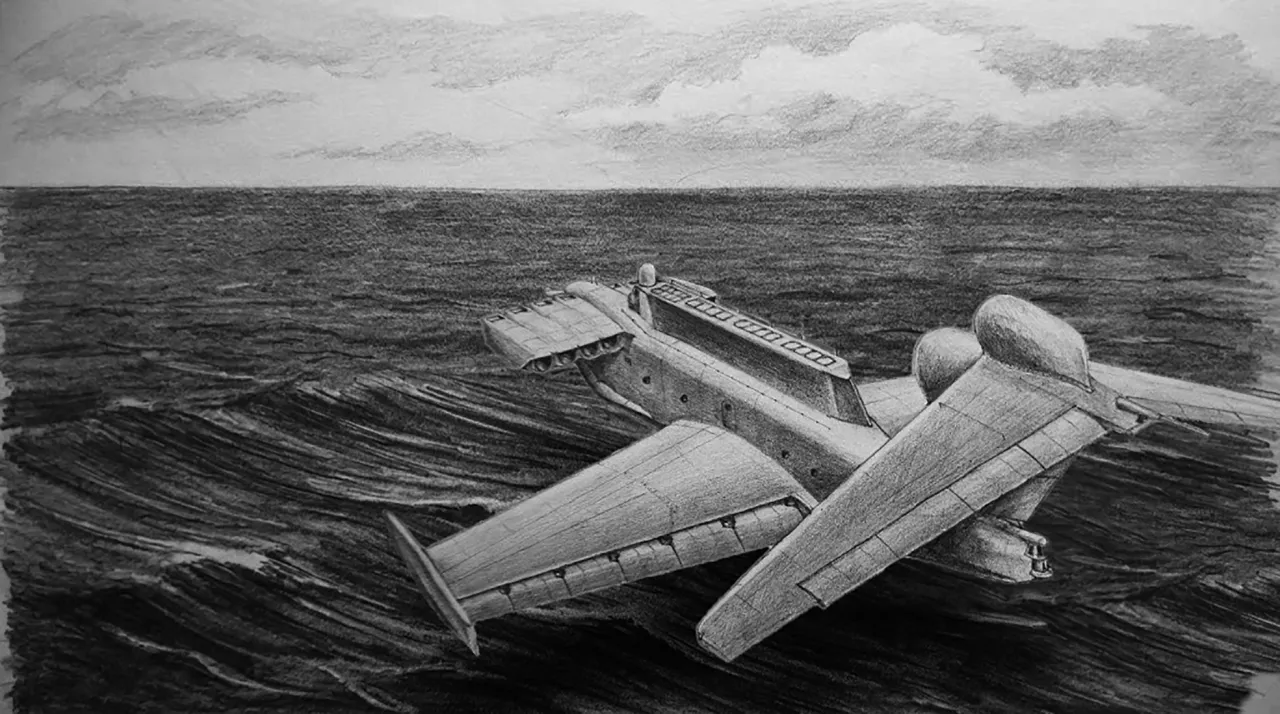

Drawing by the author, background added by the NanoBanana neural network

Sources of
igor113.livejournal.com
I. V. Kachanov, Yu. P. Ledyan, M. K. Shcherbakova, “Design of high-speed vessels. Ekranoplans”
N. V. Chekryzhev "AN-124 AIRCRAFT. FUSELAGE AND WING DESIGN"
Zhukov V. I. "FEATURES OF AERODYNAMICS, STABILITY AND CONTROL OF A WIND PLANE"
Maskalik A. I. Nagapetyan R. A. Ivanenko V. V. Butlitsky A. G. Tomilin V. V. Lukyanov A. I. "SCREEN PLANES: TRANSPORT VESSELS OF THE 21ST CENTURY"
Dmitriev G. S., Kostrichenko V. V., Leonov V. V., Mashensky S. N. "FALCONY HUNTING (SMALL ANTI-SUBMABER SHIPS OF PROJECTS 1141 AND 11451)"
Yu. V. Apalkov, "SHIPS OF THE USSR NAVY. VOLUME II. STRIKE SHIPS. PART 2. SMALL MISSILE SHIPS AND BOATS"
E. N. Garin, "Hull Design for Hydrofoil Vessels"
"REVIEW OF HYDROMETEOROLOGICAL PROCESSES IN THE NORTH POLAR REGION", 2022
esimo.oceanography.ru (Unified State System of Information on the Situation in the World Ocean)
Anti-submarine Warfare: A View from the USSR
242 comments
Information
Dear reader, to leave comments on the publication, you must sign in.
  1. +7
    12 May 2026 04: 50
    A good article, but I have a question about the UKSK. At what speeds is it safe to launch a missile from them? Considering that the maximum speed of ships using UKSK is 30 knots (55 km/h), how will the missile perform during launch at 440 km/h? hi
    1. +6
      12 May 2026 05: 12
      Quote: jonht
      Good article
      Thank you.

      Quote: jonht
      Considering that the maximum speed of the ships using the UKSK is 30 knots (55 km/h), how will the missile perform on exit at 440 km/h?

      Good question, to the point.
      I didn't go into detail about the issue in the article; it's too cumbersome as it is. But I think the problem isn't significant, if it exists at all.
      Purely by comparison:
      RGAB, long thin cylinders, are fired from silos perpendicular to the movement of Western anti-submarine aircraft.
      Enormous ballistic missiles are launched from underwater at speeds of up to 5 knots (8 km/h), even though water is 800 times denser than air.
      There are no problems.

      If this does become a problem, there are several solutions.
      Small, gr. 5, forward tilt of the UVP PU.
      The PU covers open forward, across the flow, and serve as protective deflectors.
      Special pins are extended to split the flow.
      And pilots could jump with parachutes at speeds up to 500 km/h (310 mph) with virtually no problem. Above 500, they ejected vertically.

      P.S. By the way, it might be necessary to slightly tilt the launcher to the side so that the unlaunched missile doesn't fall onto its keel.
      1. +3
        12 May 2026 07: 45
        As far as I remember, at UKSK, missiles are ejected from the silo using a propellant charge (mortar launch), and only then is the main engine ignited. So, it's more efficient to have a double tail, like on the AN-225 or Myasishchev M-9, rather than a single one. hi
        1. +2
          12 May 2026 08: 26
          Quote: jonht
          So it is more profitable to make not one tail, but a double one, like on the AN-225 or the M-9 Myasishchev.

          No, the problem of radar antenna placement immediately arises. And when launching from the water at low speed, such a tail won't help anyway.

          Quote: jonht
          As far as I remember, at UKSK, missiles are launched from the silo using a powder charge (mortar launch), and only then the main engine is started.
          Not quite so. The sustainer is launched for SAMs, while the booster is launched for anti-ship missiles and other surface-to-surface missiles. And in any case, the upward thrust is carried out to a significantly higher altitude than the 17-18 meters of the vertical stabilizer.
      2. 0
        12 May 2026 12: 17
        RGAB, long thin cylinders, are fired from silos perpendicular to the movement of Western anti-submarine aircraft.

        but they fall down, not fly up
        1. 0
          12 May 2026 12: 25
          Quote from solar
          but they fall down, not fly up

          What difference does it make, they do it ACROSS the flow.
          1. 0
            12 May 2026 12: 43
            If it's going down, it'll still fall, even if it first changes position in space. But going up is more difficult—the flight path will change.
            1. +2
              12 May 2026 12: 56
              Quote from solar
              If it's going down, it'll still fall, even if it first changes position in space. But going up is more difficult—the flight path will change.

              Before the missile can hit the keel, it's thrown violently and quite high. The likely problem here, in my opinion, isn't the missile or buoy being blown away, but rather the fracture that occurs when it hits the edge of the launcher tube under the high-velocity impact.
              1. 0
                12 May 2026 13: 03
                I won't argue, but a vertical launch at such a speed will clearly have serious nuances.
                1. 0
                  12 May 2026 13: 17
                  Quote from solar
                  I won't argue, but a vertical launch at such a speed will clearly have serious nuances.

                  In the comments above, I provided both solutions to this problem and arguments as to why I don’t consider this a big problem. hi
              2. 0
                17 May 2026 00: 07
                Very interesting!!!
                Have you conducted tests with firing vertical launchers on an ekranoplane at speeds from 300 to 500 km/h???
                Who throws a rocket high???
                No vertical launch system can launch a missile high—there's no need for that! The main thing is that the missile's engines don't damage anything on a ship or land-based installation. There are no missile designs designed for vertical launch at high speeds!
                Maybe your kindergarten already has projects like this??? And your rockets don't hit the "keel"?
                1. +1
                  17 May 2026 13: 56
                  Quote: Evgesha
                  Have you conducted tests with vertical launchers on an ekranoplane at speeds from 300 to 500 km/h???... .... There are no missile designs that would be designed to be launched vertically at high speeds!!!

                  Can you imagine that launches at speeds of 300-400 km from inclined ship-based launchers, carrying 4-ton ship-launched missiles, were planned from the very beginning? Where did they develop such an imagination?

                  Quote: Evgesha
                  Who throws a rocket high???
                  No vertical launch system can throw a missile high - there is no need!!!!
                  What a bunch of knowledgeable young people we have these days. They know nothing. They skipped school and neglected to study the material.
                  With a hot launch vehicle, the rockets are immediately attached to the engine/booster, and then they can easily reach orbit.
                  Mortar-launched UVPs propel the missile to an altitude of at least 30 meters per second in an emergency, without activating the booster or engine. The height of the Lun's vertical stabilizer above the hull roof is 12 meters. Can you calculate the reserve yourself, or haven't they taught such preschool-level stuff at your universities?
                  I'm proud of my kindergarten, compared to your "something or other"...


                  Quote: Evgesha
                  Maybe your kindergarten already has projects like this??? And your rockets don't hit the "keel"?

                  You deny the physical possibility of vertical missile launches at speeds of 300-400 km/h? So you deny the possibility of launching ballistic missiles from a submerged position while in motion, the ejection of MRABs from transverse silos while in flight, and the possibility of pilots bailing out at high speeds.
                  Do you have a degree in obscurantism?
                  1. +1
                    9 June 2026 23: 07
                    The author doesn't like the angled launchers, but the fact is that they didn't even try to fit them into the hull, apparently because they used ready-made ones from ships. In my opinion, angled launchers with hot launches, fitted into the same vertical "ridge" and protected by a wind deflector, would, firstly, give the missiles a longer length (and therefore a greater choice of weapons).
                    It's a shame the Russian Navy lacks public expertise, and all its resources and money have been spent on what was, at best, a controversial heavy submarine project, on obviously futile mega-submarines with mega-torpedoes that are inapplicable in a conventional conflict.
                    1. 0
                      10 June 2026 03: 17
                      Quote: clou
                      The author does not like inclined PUs

                      No, why would you say that? They just don't belong everywhere.

                      Quote: clou
                      but the thing is that they didn't even try to fit them into the hull, because apparently they took ready-made ones from ships
                      It’s not obvious, but they definitely took ready-made ones, with minimal adaptation.

                      Quote: clou
                      IMHO, inclined launchers with a hot start, inscribed in the same vertical "ridge" and covered by a wind deflector, will firstly give a greater length to the missiles (and therefore an increased choice in the weapons used).
                      What longer length are you talking about? Ballistic missiles? 10 meters is enough for any missile, and an EP hull with a 3-4 meter crest completely covers this requirement. And sloped launchers, besides needlessly taking up roof space, also won't allow the use of anti-aircraft missiles, unlike UVPs.

                      Quote: clou
                      It's a shame the Russian Navy lacks public expertise, and all its resources and money have been spent on what was, at best, a controversial heavy submarine project, on obviously futile mega-submarines with mega-torpedoes that are inapplicable in a conventional conflict.
                      hi
      3. +3
        13 May 2026 18: 36
        "Considering that the maximum speed of the ships using the UKSK is 30 knots (55 km/h), how will the missile perform on exit at a speed of 440 km/h?"
        This question arises immediately!!!
        And there is no answer to it. And your reasoning...
        "RGAB, long thin cylinders, are fired from silos perpendicular to the movement of Western anti-submarine aircraft.
        Enormous ballistic missiles are launched from underwater at speeds of up to 5 knots (8 km/h), even though water is 800 times denser than air.
        There are no problems
        ."

        Honestly, it's child's play. Just ask how many problems the Institute of Thermal Engineering encountered when it got involved in the R-30 design. They got into a situation where they didn't even suspect many of the problems. In the end, they came up with a poorly designed product... And at first, they promised unification with the Topol-M...
        But alas and alack, we got ourselves into a lot of trouble due to ignorance.
        So your "There are no problems" - this is due to a lack of understanding of the level of problems.
        To avoid problems, years of R&D are needed.
        1. +1
          14 May 2026 08: 14
          Quote: Evgesha
          How will the rocket behave on exit at a speed of 440 km/h?
          This question arises immediately!!!


          And almost immediately the answer appears if you take the trouble to search

          Lun ekranoplan rocket launch - watch online in Yandex video search https://share.google/DtKQfcG8Z6UwLeEeB
          1. +1
            16 May 2026 23: 58
            We are discussing a vertical launch vehicle, similar to the UKSK.
            The point of inclined launchers is already lost; vertical launchers are needed for efficient use of space. And what missiles were inclined launchers intended for?
            1. 0
              17 May 2026 02: 55
              Quote: Evgesha
              We are discussing a vertical launch vehicle, similar to the UKSK.
              The point of inclined launchers is already lost; vertical launchers are needed for efficient use of space. And what missiles were inclined launchers intended for?


              If you are asking me this, then the video I provided is the answer to the question that there may be problems with the tilt start.

              I'll look into vertical launches if needed. The author mentioned something being launched vertically downwards on an ASW aircraft, I think.

              Personally, I don’t see any big problems with the inclined launch in the sense that we have an empty body and we can do something about it.
        2. 0
          14 May 2026 08: 19
          Quote: Evgesha
          And your reasoning...
          "RGAB, long thin cylinders, are fired from silos perpendicular to the movement of Western anti-submarine aircraft.
          Enormous ballistic missiles are launched from underwater at speeds of up to 5 knots (8 km/h), even though water is 800 times denser than air.
          There are no problems."

          Well, by God, it's a kindergarten.

          At your university, they apparently deny the facts of launching thin-walled cylinders across a high-speed flow as unscientific? A great university, not Baumanka, right? Unlikely...

          Quote: Evgesha
          Find out how many problems the Institute of Thermal Engineering had when it got involved in the design of the R-30.

          Are people in your establishment aware of the saying "Pies go to the pie maker, and boots go to the shoemaker"?
          What kind of educational institution do you have?

          Quote: Evgesha
          So your "There are no problems" is due to a misunderstanding of the level of problems.
          To avoid problems, years of R&D are needed.

          Well, thank goodness it's not centuries.
          https://share.google/DtKQfcG8Z6UwLeEeB

          You know what's in there? There's footage of SHIP-BASED missiles being launched from a SHIP-BASED launcher, at speeds no lower than 300 km/h. And it's a LAUNCH, not a release, and with a considerable overturning momentum. And with no visible countermeasures to counteract the velocity pressure.
          1. +1
            16 May 2026 23: 52
            Well, that's right - KINDERGARTEN!!!!!
            First of all, my educational institution is giving me no peace!! I wonder which one is giving me no peace - the first, the second, or the third?
            And regarding your video, you suggest installing vertical launch systems, yet you provide a link to missile launches from inclined launchers. You should figure out in your kindergarten class what kind of missile launch system you'll have—vertical or inclined—and what kind of missiles are you planning to launch—ship-to-ship, ship-to-air, or even IRBMs?
            1. +1
              17 May 2026 03: 09
              Quote: Evgesha
              At first, my educational institution doesn’t give me any peace!!

              Hello, my friend, it was you who started writing something about the educational institution. So, in this regard, the complaint is directed at the mirror.

              Quote: Evgesha
              And with your video - you suggest installing vertical launch systems, and at the same time provide a link to missile launches from inclined launchers.
              Your "non-kindergarten" education clearly taught you nothing about the overturning moment. And it is the overturning moment, and it is the main limitation on dynamic pressure.
              So, off to school, middle school. To gain knowledge.
        3. 0
          17 May 2026 03: 44
          Quote: Evgesha
          How will the rocket behave on exit at a speed of 440 km/h?
          This question arises immediately!!!

          At vertical start

          And the answer is found almost immediately.

          https://topwar.ru/171889-v-rossii-zapatentovali-novyj-sposob-zapuska-raket-s-samoletov.html?ysclid=mp91h8xcyp279848431

          Pictures of the proposed approach to solving possible problems in the comments.

          But again, a vertical start is not mandatory if:
          working inclined for large-sized rockets

          Theoretical possibility of sliding the TPK sideways from the housing

          Theoretical possibility of using a compartment with small missiles in the developed tail unit for placement
      4. +1
        14 May 2026 04: 45
        Quote: Vladimir_2U
        But I think the problem is small, if it exists at all.


        It seems so.

        Lun ekranoplan rocket launch - watch online in Yandex video search https://share.google/DtKQfcG8Z6UwLeEeB
        1. +1
          14 May 2026 08: 24
          Greetings!
          Quote: Eng Mech

          It seems so.

          Still, starting at an acute angle to the flow is not quite the same as starting at a straight angle.
          But the overturning moment still exists, and because this is a launch, not a shot, it acts for a longer period of time...
          So yes, there is an identity. hi
          1. +1
            14 May 2026 12: 55
            Quote: Vladimir_2U
            Greetings!


            Mutually.

            If you type it into Yandex
            "The ideas of R.E. Alekseev in the service of the Fatherland"

            Then a PDF will appear which can be read, especially from the last paragraph of the 9th page of the file.

            It seems to contain almost all the answers to the most common d... questions.
            Including about
            secrecy of tests
            off-screen flight
            comparison of rescue function with other rescue equipment
            Etc.
            Etc.
            And so forth

            Although there is no limit to the beauty of the questions and the commitment of those asking them.

            Comrade Kachur seems to have cited some price tags (production costs), but I'm not sure about the harrier.
            1. 0
              15 May 2026 04: 35
              Quote: Eng Mech
              If you type it into Yandex
              "The ideas of R.E. Alekseev in the service of the Fatherland"

              A most valuable article. How do you find them?! You can confidently point it at all opponents of the electronic device. Because it's valuable precisely as a summary of the tests and operational experience.
              Enormous Turkish delight))) hi
              1. +1
                15 May 2026 04: 58
                Quote: Vladimir_2U
                Quote: Eng Mech
                If you type it into Yandex
                "The ideas of R.E. Alekseev in the service of the Fatherland"

                A most valuable article. How do you find them?! You can confidently point it at all opponents of the electronic device. Because it's valuable precisely as a summary of the tests and operational experience.
                Enormous Turkish delight))) hi


                I have worked for a long time as the person who determines which technical solution to give preference to in each specific case.

                That is, I know how to ask questions and filter answers.

                I swear to you, people like cuckolds will say this is fake.
                1. 0
                  15 May 2026 08: 17
                  Quote: Eng Mech
                  That is, I know how to ask questions and filter answers.

                  Respect!
          2. +1
            15 May 2026 04: 55
            Quote: Vladimir_2U
            Greetings!:


            I honestly don't understand why you waste your time on haters of ideas/you.

            The only logical explanation is a sincere desire to protect the idea as such and/or to promote the material in the viewing rankings.

            In the first case
            I would dismiss all unnecessary comparisons with clearly different sets of functionality.

            We have a vehicle with
            1. The ability to remain in a double-legged position for a long time
            2. Have some autonomy
            3. The ability to move in displacement mode at maximum speed at a certain point
            4. Ability to independently go ashore and carry out loading and unloading operations on the shore
            5. Carry weapons/payload
            6. Full-fledged surgery at sea with some kind of illness
            7. the ability to move in non-displacement mode at maximum speed at a certain point

            It follows that it makes sense to compare only single-functional vehicles.
            1. SPK with the assumption that, theoretically, landing SPK with retractable wings or with unloading through the stern without wings could exist
            2. Skegs with air unloading with the same assumption
            3. SVP / KVP
            4. Seaplanes
            5. hydro-helicopters / hydro-multicopters
            6. Hydroconvertiplanes

            Next, the performance characteristics of each vehicle are compared, each of which (the performance characteristics element) is assigned a degree of importance (for this indicator)

            For example

            Ballance Importance 1
            Skeg ship X 6 points = standard = 100%
            Ekranoplan Lun 5 points = 75%

            Speed ​​0,5
            Skeg boat x 100 km/h = 20%
            Ekranoplan Lun 500 km/h = standard = 100%

            If we finish the comparison calculation here
            Skeg ship X 1*1+0,5*0,2=1,1
            Экраноплан лунь 1*,75+0,5*1=1,25

            The conclusion is that the Lun ekranoplan is superior in terms of all its important performance characteristics.

            Naturally, if you change the importance coefficients, everything can change.

            Everyone else nervously smokes on the sidelines with their increased efficiency in a particular function, but with a gigantic disregard for, for example, the infrastructure that works for this effective function.

            Ultimately, there is already work done by others on universal all-transport indicators.
            See illustrations
            1. +1
              15 May 2026 08: 15
              Quote: Eng Mech
              The only logical explanation is a sincere desire to protect the idea as such and/or to promote the material in the viewing rankings.

              Partly this and that.
              But rather because unanswered negative comments, mind you, not directly related to the article's content, can make neutral or simply curious people feel that their opponents are right. As if there's nothing to say.


              Quote: Eng Mech
              I would dismiss all unnecessary comparisons with clearly different sets of functionality.

              I do this because I understand it that way, and I believe that most readers aren't particularly above my level. And this kind of presentation is just right for my level of +/-. And with pictures, it's even better.

              Quote: Eng Mech
              Ultimately, there is already work done by others on universal all-transport indicators.
              This is very, very dry. You, or I, and even then with reservations, we'll get through it. But many others won't. I, to my shame, don't really delve into such graphs. I might just skip them.
              1. +1
                15 May 2026 08: 51
                Quote: Vladimir_2U
                This is very, very dry. You, or I, and even then with reservations, we'll get through it. But many others won't. I, to my shame, don't really delve into such graphs. I might just skip them.


                This requires a public discussion in the form of a third article with open questions.

                What are we comparing (what set of vehicles)

                And by what parameters?

                And what importance coefficients do we assign to the parameters?

                Let them argue among themselves, and at the same time they will start to learn something on their own.

                And in the fourth article there is a calculation or several calculations in different logics and debates.

                Then everyone will be interested, and most of those participating in the discussion will have a sense of the legitimacy of the conclusions.

                Except for a couple of haters.
                1. 0
                  15 May 2026 09: 27
                  Quote: Eng Mech
                  This requires a public discussion in the form of a third article with open questions.

                  No, that's it, I can't handle it.
                  At most, in response to a counter-article from Andrey from Chelyabinsk, he threatened me with it.
                  Well, and in the comments, on other articles.
                  1. +2
                    15 May 2026 09: 33
                    Quote: Vladimir_2U
                    Quote: Eng Mech
                    This requires a public discussion in the form of a third article with open questions.

                    No, that's it, I can't handle it.
                    At most, in response to a counter-article from Andrey from Chelyabinsk, he threatened me with it.
                    Well, and in the comments, on other articles.


                    Well, what can you do?
    2. +3
      12 May 2026 05: 55
      Quote: jonht
      How will a rocket behave on exit at a speed of 440 km/h?
      A cruise missile launcher allows the missile to be launched not only vertically but also at an angle, thereby creating an asymmetrical flow of air around the missile, artificially creating an angle of attack that leads to even greater aerodynamic force. This is probably only beneficial. Correct me if I'm wrong...
    3. +1
      13 May 2026 09: 40
      Quote: jonht
      How will a rocket behave on exit at a speed of 440 km/h?

      I think it's not a difficult problem to solve, the main thing is to remember it. I think curtains and a vertical launch at a backward angle will solve most of the problems.
      1. 0
        15 May 2026 04: 47
        Quote: multicaat
        I think it's not a difficult problem to solve, the main thing is to remember it. I think curtains and a vertical launch at a backward angle will solve most of the problems.

        Perhaps, in reality, a little further back would be less dangerous for the rocket upon exit. But the risk of a tumble after exit would likely be higher, and the passage would definitely be closer to the vertical stabilizer.
    4. +2
      14 May 2026 04: 02
      Quote: jonht
      Considering that the maximum speed of the ships using the UKSK is 30 knots (55 km/h), how will the missile perform on exit at 440 km/h?


      Even taking into account the fact that the engineers of the previous, more advanced civilization, due to their short-sightedness, used a solution that does not work at the operating speeds of the device:

      1. Landed on the water, fired and flew away lightly.

      2. Yes, indeed, a Lun-type design may not be the most optimal design for the placement of missile weapons (a flying boat with low-lying wings).
      But the design of a catamaran ekranoplan with a high central wing with a long chord (approximately equal to the length of the hulls) can easily accommodate a lot of interesting things in the internal compartments without degrading the aerodynamics and signature.
      1. +1
        15 May 2026 04: 51
        Quote: Eng Mech
        2. Yes, indeed, a Lun-type design may not be the most optimal design for the placement of missile weapons (a flying boat with low-lying wings).

        Why not? The case is half-empty—this is evident by the very loose arrangement of the electrical and electronic boxes. And by the fact that a significant number of the various devices in the interior photos are research instrumentation.

        Quote: Eng Mech
        But the design of a catamaran ekranoplan with a high central wing with a long chord (approximately equal to the length of the hulls) can easily accommodate a lot of interesting things in the internal compartments without degrading the aerodynamics and signature.
        What to do with such an architecture with the placement of the radar and, as it turns out, the obligatory blowing?
        1. +1
          15 May 2026 05: 02
          Quote: Vladimir_2U
          Quote: Eng Mech
          2. Yes, indeed, a Lun-type design may not be the most optimal design for the placement of missile weapons (a flying boat with low-lying wings).

          Why not? The case is half-empty—this is evident by the very loose arrangement of the electrical and electronic boxes. And by the fact that a significant number of the various devices in the interior photos are research instrumentation.

          Quote: Eng Mech
          But the design of a catamaran ekranoplan with a high central wing with a long chord (approximately equal to the length of the hulls) can easily accommodate a lot of interesting things in the internal compartments without degrading the aerodynamics and signature.
          What to do with such an architecture with the placement of the radar and, as it turns out, the obligatory blowing?


          As far as I remember, we have already discussed this topic.

          A blower garland between the main hulls with the same possible exit on the left and right sides as the harrier

          Between the two tails of the antenna is a DRLO type

          Two antenna posts on each tail

          Like two turrets on modern aircraft carriers
        2. 0
          15 May 2026 06: 17
          Quote: Vladimir_2U
          Quote: Eng Mech
          2. Yes, indeed, a Lun-type design may not be the most optimal design for the placement of missile weapons (a flying boat with low-lying wings).

          Why not? The case is half-empty—this is evident by the very loose arrangement of the electrical and electronic boxes. And by the fact that a significant number of the various devices in the interior photos are research instrumentation.

          Quote: Eng Mech
          But the design of a catamaran ekranoplan with a high central wing with a long chord (approximately equal to the length of the hulls) can easily accommodate a lot of interesting things in the internal compartments without degrading the aerodynamics and signature.
          What to do with such an architecture with the placement of the radar and, as it turns out, the obligatory blowing?


          Well, here is a quite illustrative model with a central third crew/control hull

          Only I would probably make garlands of motors on two mounting points

          Left corps - central corps

          Central building - right building.

          And probably experimented with embedding these garlands in the front wing, thus obtaining a tandem/duck

          Again, no one is stopping you from slapping oversized PUs onto the side casings.
        3. 0
          15 May 2026 06: 33
          Quote: Vladimir_2U
          What to do with such an architecture with the placement of the radar and, as it turns out, the obligatory blowing?


          Burnelli also did and designed cool things in this style.

          Screw rotary motor groups and/or ring nozzles with rotary grates

          I'm putting the bodies together, ideally in the shape of a wing

          By the way, there is already a very interesting solution with super-developed wing mechanization with built-in fans.
          1. 0
            15 May 2026 09: 09
            Quote: Eng Mech
            As far as I remember, we have already discussed this topic.

            I don't remember, to be honest.

            Quote: Eng Mech
            Well, here is a quite illustrative model with a central third crew/control hull

            Yes, it's all pretty clear. But from my experience commenting, it's pure gigantomania, and this is about the darling Luna, the size of a small nuclear missile. While I'm not opposed to that, it's truly a monster in size.
            Based on shipbuilding experience, a catamaran is more susceptible to heeling and is very vulnerable to heeling due to damage to one of the hulls. Even more so than a monohull.

            Quote: Eng Mech
            Burnelli also did and designed cool things in this style.

            I adore retrofuturism purely aesthetically. Although I still prefer modern forms.
            1. +1
              15 May 2026 09: 24
              Quote: Vladimir_2U
              Based on shipbuilding experience, a catamaran is more susceptible to heeling and is very vulnerable to heeling due to damage to one of the hulls. Even more so than a monohull.


              Toymaran with a central main displacement is also good.

              Roughly speaking, we take the harrier, make the side washers almost the entire length and low-displacement, but, for example, carry the tail unit / antenna units

              We lengthen and widen its wing and move it upward.

              We make it a composite subsonic wing SDC

              By the way, I draw your close attention to the second picture of Comrade Burnelli with the wingtips bent upwards.

              From these pictures below, you should theoretically remember me.
              1. 0
                15 May 2026 09: 47
                Quote: Eng Mech
                From these pictures below, you should theoretically remember me.

                Well, of course I remember the discussion with you, but I don’t remember the specific type.

                Quote: Eng Mech
                By the way, I draw your close attention to the second picture of Comrade Burnelli with the wingtips bent upwards.
                What's wrong with her? I can only see that if this is a propeller-powered model, they're very vulnerable.
                1. +1
                  16 May 2026 04: 11
                  Quote: Vladimir_2U
                  What's wrong with her? I can only see that if this is a propeller-powered model, they're very vulnerable.

                  This one confused the wing of the neighboring model with the strongly upward-curved wingtip (in order to reduce parasitic vortices) of the model he is holding.

                  In addition to all the other shortcomings, I am an unconscious fan of closed wings like the green computer model and other ring-gliders.

                  Propellers for ekranoplans and other hydrofoils should of course be higher.
                  1. 0
                    16 May 2026 09: 23
                    I have a question for you as an engineer.
                    I didn't bring this up in the article because the "Orlyonok" wasn't mentioned at all, but there is a certain problem, and while it's specifically with the "Orlyonok," opponents have spotted it and are transferring it to all EPs.

                    Quote: Tlauicol
                    Okay, if he corrects himself about the crew, the diagram, the missiles, the model, etc. (the interview's length allows it). But he also says, for example, that the EP is unstable on-screen and stable off-screen...??? EP


                    My answer, in general, to the question I asked myself earlier is approximately this:
                    And what makes you think the EP has to be stable on the screen? More precisely, it has to be. But we're talking about a specific type—the Orlyonok. And it has a tail-mounted cruise engine. This arrangement, in aviation, has an inherent drawback—
                    the center of mass of an empty aircraft shifts backward, while the center of mass of a fully loaded aircraft shifts forward, which creates difficulties in centering and balancing the aircraft;
                    - the nose of the fuselage moves forward, which negatively affects the directional and longitudinal stability of the aircraft;


                    But not just at the root of the tail, as on the Tu-154, Il-62, but at the very tip of the keel.
                    But such a location of a fairly powerful engine creates a very strong overturning moment, among other things.

                    Do you think this is a compelling enough argument to justify some instability, given the inoperative automatic stabilization system, of a particular type of ekranoplan?
                    1. +1
                      16 May 2026 09: 50
                      Quote: Vladimir_2U
                      I have a question for you as an engineer.
                      I didn't bring this up in the article because the "Orlyonok" wasn't mentioned at all, but there is a certain problem, and while it's specifically with the "Orlyonok," opponents have spotted it and are transferring it to all EPs.

                      Quote: Tlauicol
                      Okay, if he corrects himself about the crew, the diagram, the missiles, the model, etc. (the interview's length allows it). But he also says, for example, that the EP is unstable on-screen and stable off-screen...??? EP


                      My answer, in general, to the question I asked myself earlier is approximately this:
                      And what makes you think the EP has to be stable on the screen? More precisely, it has to be. But we're talking about a specific type—the Orlyonok. And it has a tail-mounted cruise engine. This arrangement, in aviation, has an inherent drawback—
                      the center of mass of an empty aircraft shifts backward, while the center of mass of a fully loaded aircraft shifts forward, which creates difficulties in centering and balancing the aircraft;
                      - the nose of the fuselage moves forward, which negatively affects the directional and longitudinal stability of the aircraft;


                      But not just at the root of the tail, as on the Tu-154, Il-62, but at the very tip of the keel.
                      But such a location of a fairly powerful engine creates a very strong overturning moment, among other things.

                      Do you think this is a compelling enough argument to justify some instability, given the inoperative automatic stabilization system, of a particular type of ekranoplan?


                      Absolutely weighty in my opinion.

                      Because this can be considered as a non-coaxial pushing scheme and there will be a diving torque in any case.

                      But how would the lift force from the wings be if the center of gravity between the wings and the cruise engine and the moment from the starting engines should counteract this moment.

                      Flying over an uneven surface should create pitch-up moment fluctuations (nose up)


                      But I am by no means an aeronautical or naval engineer.

                      These are thoughts out loud and nothing more.

                      It follows naturally that the Lun type design is more stable.
                      1. 0
                        16 May 2026 10: 25
                        Quote: Eng Mech

                        It follows naturally that the Lun type design is more stable.

                        Moreover, in the event of failure of the Orlyonok's automatic stabilization system, it was assumed that thrust would be supplied to the nose engines, with a loss of efficiency, but restoration of stabilization...
                      2. 0
                        16 May 2026 10: 30
                        Quote: Vladimir_2U
                        Quote: Eng Mech

                        It follows naturally that the Lun type design is more stable.

                        Moreover, in the event of failure of the Orlyonok's automatic stabilization system, it was assumed that thrust would be supplied to the nose engines, with a loss of efficiency, but restoration of stabilization...


                        It is quite logical to transform a system with a pushing propeller into a system with a pulling propeller.
                      3. 0
                        16 May 2026 12: 15
                        To achieve this, the nose engines must operate at idle, at least throughout the entire flight. And consume fuel very economically. Throughout the entire flight.
                      4. 0
                        16 May 2026 15: 14
                        Quote: Tlauicol
                        To achieve this, the nose engines must operate at idle power at least throughout the entire flight.

                        First of all, what's with this strange complaint? You personally, and others, are complaining about the EP's "wasted" lift engines. Well, let them do their job. Just like in aviation. When takeoff power is only used during takeoff. The rest of the time, God willing, maybe even half that power...
                        Only in the case of an EP with a third, a quarter of the power, and with the same consumption.

                        And secondly, I'm not surprised, but I'm pointing out that you've "forgotten" something quite significant.
                        Quote: Vladimir_2U
                        what if the automatic stabilization system fails

                        How can one not "notice" this???
                        For example, if the fly-by-wire system fails in aerodynamically unstable fighters, nothing will help except ejection...
                      5. +1
                        17 May 2026 09: 17
                        Quote: Vladimir_2U
                        Quote: Eng Mech

                        It follows naturally that the Lun type design is more stable.

                        Moreover, in the event of failure of the Orlyonok's automatic stabilization system, it was assumed that thrust would be supplied to the nose engines, with a loss of efficiency, but restoration of stabilization...


                        Strictly speaking, according to theoretical mechanics (i.e., purely theoretically)

                        If the propeller thrust is directed approximately to the center of mass/pressure or whatever aviators call it, then the nose-down moment is minimized.

                        This is achieved, for example:

                        By turning the entire motor or propeller group towards this center (in this case it would probably be better if it was actually a pusher)

                        The placement of screws in a ring-shaped nozzle with louvers at the outlet responsible for the rotation of the rod (as on the Volga)

                        But in principle, the powerful mechanization of the rear horizontal stabilizer probably does the same thing.
    5. +1
      14 May 2026 04: 44
      Quote: jonht
      Considering that the maximum speed of the ships using the UKSK is 30 knots (55 km/h), how will the missile perform on exit at 440 km/h?


      Lun ekranoplan rocket launch - watch online in Yandex video search https://share.google/DtKQfcG8Z6UwLeEeB
    6. +1
      20 May 2026 09: 43
      As a first approximation, consider a crosswind component of 60 m/s. That is, approximately half the operating speed of the ekranoplan.
      The problem can be solved by eliminating the UKSK and installing the TPK at an angle of 30 degrees to the horizon (the radial component of the wind load will be halved). The versatility of the launchers, of course, will be wasted – however, it will still be possible to launch Kalibr missiles (and, if necessary, Yakhont missiles) from such launchers. This is similar to the case for many anti-aircraft missiles, for which such an installation would only limit their guidance arc, not their launch capability (but their TPKs would then have to be installed on their own launchers, which are very likely incompatible with Kalibr missile/Yakhont launchers. However, if the SAM's capabilities are limited to self-defense, limiting them to small missiles, this is not a problem). And on pursuit courses, the cannon is quite effective.
      1. 0
        21 May 2026 04: 11
        Quote: ailcat
        As a first approximation, focus on 60 m/s of lateral wind component.

        Where does the data come from?
        The launch of long, thin RGABs perpendicular to the pressure at the speeds of American anti-submarine aircraft patrolling suggests that this is not a problem.
        Launching a SSBN from underwater at speeds of up to 8 km/h (and water is 800 times denser than air) suggests that this is not a problem.
        The ejection of pilots at speeds of up to 1000 km/h, and the pilot is more gentle than the missile, suggests that this is not a problem.

        Speed ​​restrictions on missile launches from ship-based vertical launch systems were introduced primarily due to the air masses supported by the superstructure, resulting in an unpredictable trajectory for the missile's takeoff. Wind restrictions, oddly enough, are due to the oscillation of the guidance antennas, leading to a sharp reduction in accuracy or even the complete inability to guide missiles with the guidance system. For Thors, at least.
        1. 0
          Today, 09: 10
          Данные из требований ветровой устойчивости средств доставки с запуском маршевых двигателей после выхода из ПУ. Ониксы точно имеют минометный старт, Яхонты (развитие Ониксов) и Калибры, раз пускаются из тех же УКСК, тоже имеют минометный старт - значит, 60 м/с обязаны выдержать, а вот больше - совсем не обязательно.
          Ну и не надо путать малые РГБ и даже небольшие зенитные ракеты (у которых парусность в несколько раз меньше, да и длина вдвое-втрое короче) и тяжелыми крылатыми ракетами, которые из пусковых выходят заметно дольше.
  2. +4
    12 May 2026 05: 34
    Excellent article. If the Lun is considered the first generation of ekranoplans, then the article already discusses the concept of a second generation of ekranoplans. Unfortunately, our country currently lacks the resources or the will to revive and develop ekranoplans.
    The question of the necessity and advantages or disadvantages of ekranoplans needs to be tested in practice, for example by building one ekranoplan of the "Lun" type in a cargo version and deploying it on the Nakhodka-Magadan route. And that will prove everything. hi
    1. +3
      12 May 2026 08: 34
      Quote: V.
      The question of the necessity and advantages or disadvantages of ekranoplans needs to be tested in practice, for example by building one ekranoplan of the "Lun" type in a cargo version and deploying it on the Nakhodka-Magadan route. And that will prove everything.

      If we reduce the requirements for seaworthiness, and therefore for strength, and therefore for weight, then perhaps it will be cost-effective.
      1. +3
        12 May 2026 09: 41
        Quote: Vladimir_2U
        If we reduce the requirements for seaworthiness, and therefore for strength, and therefore for weight, then maybe it will be profitable.
        Under no circumstances should the requirements be lowered (just in case). What does profitability mean for military equipment? Drones, yes, other consumables, yes, but "one-off" units... Tanks are getting more expensive, planes and other equipment are getting more expensive (the T-34 was profitable), the only profitability lies in increasing production quantities.
        Thank you for the article !!!
        1. +2
          12 May 2026 09: 47
          Quote: NIKNN
          Do not lower the requirements under any circumstances (well, just in case)

          Definitely not for combat. I'm talking about a hypothetical pure transport vehicle.

          Quote: NIKNN
          Thank you for the article !!!
          Thank you for your kind words. hi
          1. +2
            12 May 2026 14: 36
            I suddenly remembered that I studied with a professor who worked under Alekseev and defended his dissertation on hydrofoils. He told me a lot of interesting things, and I remember that hydrofoils in the Soviet Union reached speeds of 250 km/h using a supercritical wing. He didn't mention Alekseev's ekranoplans, as they were classified at the time.
            I'd like to add something. The Lun ekranoplan is similar to the Mriya transport aircraft in both size and cargo capacity. Its speed is only 200 km slower than the Mriya. Its range is shorter, though; I'm taking the range listed on Wikipedia. But 2500 km is still quite respectable. If a Lun-based ekranoplan transport is built, modernized with modern materials, improved aerodynamics and hydrodynamics, reduced excess weight, as the author suggests, and equipped with fuel-efficient engines, it will be a very good transport vehicle with a niche in cargo transportation. If it proves its efficiency and other qualities, we could return to military projects. hi
            1. +2
              12 May 2026 14: 41
              Quote: V.
              The Lun ekranoplan is similar to the Mriya transport aircraft in both size and cargo capacity. Its speed is 200 km/h slower than the Mriya, though. Its range is shorter, though; I'm using the range listed in Wikipedia.
              More likely not Lun, but KM, and Mriya has a thrust almost 40 tons higher.
              Quote: V.
              If it proves its cost-effectiveness and other qualities, then we can return to military projects.

              I disagree with you here. First and foremost, it's intended for military use. It's crude, unassuming, and overweight, because the payload capacity is more than enough for missiles, which are relatively light. And then they polish it up for efficiency. hi
            2. +2
              12 May 2026 14: 43
              Quote: V.
              He told me a lot of interesting things, I remember that the speed on hydrofoils in the Union reached 250 km using a supercritical wing.

              I read that the speed was limited by erosion of the wing surface from cavitation, and even supercritical profiles did not help.
              And if you think about it, a collision with something floating like a sunken log would already be critical, not to mention an EP that smears on top.
        2. +1
          20 May 2026 09: 56
          The main problem with ekranoplans is the extreme "breaking" loads they experience when riding waves (primarily, of course, during takeoff and landing). Just think of the accidents during the development of the "Caspian Monster." And the longer the ekranoplan (not larger, but longer), the more difficult it is to ensure not only its strength, but also its service life (the number of wave landings, first and foremost). So, downsizing is precisely the issue.
          And you're certainly overreacting about seaworthiness. The ground effect is 4-6 meters from the surface. This means the wave height must be well below 4 meters. So, we'd get a force 2-3 (which, in fact, was confirmed during the Lun trials). Force 5 isn't even close—it might not sink, but it certainly can't operate in those conditions (and that's one of the reasons why ekranoplans were abandoned in favor of aviation).
          1. 0
            21 May 2026 03: 56
            Quote: ailcat
            The main problem with ekranoplans is the extreme "breaking" loads when moving along a wave (primarily, of course, during takeoff and landing).

            For civilian vessels, this is addressed by sea state restrictions. For example, seagoing vessels operating under the control of the ship's pilot were not allowed to sail at sea state 5. At such sea states, they switched to displacement mode and proceeded at low speed to the nearest port of refuge.

            Quote: ailcat
            Just remember the accidents during the development of the "Caspian Monster." And the longer the ekranoplan (not larger, but longer), the more difficult it is to ensure not only its durability, but also its service life (primarily the number of wave landings).
            And what horrors did you witness there? That the KM had been intensively tested for 15 years before the pilot-involved accident?
            And the resource is ensured by strength, which is easily increased by a large weight reserve on the EP.

            Quote: ailcat
            And you're certainly overreacting about seaworthiness. The ground effect is 4-6 meters from the surface. This means the wave height must be well below 4 meters.

            You don't know the basics. The ground effect occurs at a height equal to the average wing chord, so a wing with a width of 10 meters begins to experience the ground effect at a height of 10 meters. The maximum, yes, is at 5 meters. And while it most likely doesn't start at the crest, it also doesn't start at the base, but at a minimum at the mid-section. Therefore, all your further assumptions are false.

            Quote: ailcat
            That is, 2-3 points and we arrived (which, in principle, was confirmed during the Loonie tests)
            Personally present?
    2. +2
      13 May 2026 09: 41
      Quote: V.
      in a cargo version and release it on the route, for example, Nakhodka-Magadan

      and also along the Black Sea coast, possibly flights to Kaliningrad, Ladoga, Baikal, and the Caspian Sea
      There is a place to test the technology
  3. +4
    12 May 2026 05: 52
    While I consider ekranoplans a dead end, a kind of half-ship and half-aircraft, incapable of solving serious problems either at sea or in the air, they are nevertheless a brilliant example of technology, advancing applied engineering disciplines in this area. The author has done a great job. A plus to the article...
    1. +1
      12 May 2026 08: 39
      Quote: Luminman
      Although I consider ekranoplans a dead end, something like a half-ship and half-airplane

      Well, I understand about the "under-plane," although the EP is probably a lousy plane, with its howling and bulging eyes, but it could fly off-screen. But why consider the EP—which is significantly superior to ships of equal tonnage in every respect except, unimportantly, cost, and most importantly, speed—under-ship? Just compare the ancient Lun with the Karakurt, for example... Not to mention the Lightning...
  4. +3
    12 May 2026 06: 04
    No matter how right the author is (and he is right about everything), the construction of the submarine will ultimately come down to finances. The development and modernization of our submarine fleet is so prohibitively expensive that there's nothing left for anything else, including ocean-going ships and hypothetical submarines.
    Although... the situation in the seas washing Russia is developing in such a way that combat EPs are needed almost first and foremost.
    1. +1
      12 May 2026 08: 43
      Quote: U-58
      The creation and modernization of our submarine fleet is so incredibly expensive that there is nothing left for other things, including ocean-going ships and hypothetical submarines.

      But the saddest thing is that SSBNs, with SSNs but without surface ships, are not only flawed as the backbone of the fleet, even given their inability to escort shadow fleet vessels, but are also vulnerable to enemy aircraft and submarines.
  5. +5
    12 May 2026 07: 56
    The author has done a wonderful job, but he is not careful to ignore the "elephant in the room."

    EIGHT ENGINES from the wide-body airliner Il-86

    Such a fantastic approach to the power plant directly hinted that something was wrong with the technical system.

    Incidentally, the airliner needed only four engines, with a takeoff weight of over 200 tons (and a payload of 45 tons). Its speed was twice as high, and its fully loaded range was 1,5 times greater than that of the Lun.

    That's the whole answer. What the Lun's creators achieved was creating a flying machine with thick ship skin and making it fly low over the water.
    1. +6
      12 May 2026 08: 02
      The mantra is that out of 8 engines, only 2 were used in cruising mode.

      A drop of common sense is enough to understand the absurdity of such a decision.

      Put 5 V8 engines in your car, use them only at the start of the drive, and carry them on the roof and in the trunk the rest of the time
      1. 0
        12 May 2026 08: 59
        Quote: Santa Fe
        A drop of common sense is enough to understand the absurdity of such a decision.

        From a common sense standpoint, loading an ekranoplan to the brim with missiles and flying them back and forth over the sea is a dubious idea, and then the missiles themselves can fly much further and faster than the ekranoplan, and all year round, .... By the way, how does this ekranoplan miracle fly in winter, well, when the water is covered with ice?
        1. +1
          12 May 2026 09: 08
          load to capacitythe ekranoplan has missiles

          ?

          There are only 6 missiles with a takeoff weight of 380 tons.

          The Lun ekranoplan was loaded to the brim with… engines
          How does this ekranoplan miracle fly in winter, when the water is covered with ice?

          It won't even fly over open water for long; it'll collect the birds' engines, which will be corroded by the sea salt in a matter of days.

          Or collide with another vessel, the turning radius is a couple of kilometers at a speed of 500

          Bank hard for a more effective turn = catch the water with the wing


          An absolute abomination, a unique scarecrow in which literally everything is ruined
          1. +2
            12 May 2026 09: 36
            Quote: Santa Fe
            There are only 6 missiles with a takeoff weight of 380 tons.

            Wow, but the Molniya, with its 400-ton missile capacity, only has four of these missiles. And the Ovod, with its 600-ton capacity, has six weaker ones. No, but the Sivuch, of course, has eight, but only with its 800-ton capacity.

            Quote: Santa Fe
            It won't even fly over open water for long; it'll collect the birds' engines, which will be corroded by the sea salt in a matter of days.
            And why didn't you assemble one instead of the KM during those years of testing? And how come gas turbines are used on ships and boats, with practically no air preparation...

            Quote: Santa Fe
            Or collide with another vessel, the turning radius is a couple of kilometers at a speed of 500
            Have you ever seen ships a couple of kilometers long? Or do you imagine the sea is the width of a highway?

            Quote: Santa Fe
            Bank hard for a more effective turn = catch the water with the wing
            The EP enters a bank reluctantly, does not lose altitude, and can achieve a stronger bank by rising slightly above the most effective height from the screen.

            Quote: Santa Fe
            An absolute abomination, a unique scarecrow in which literally everything is ruined
            You know nothing about how ships work, and yet you draw such conclusions...
            1. -1
              12 May 2026 10: 06
              Wow, but the Molniya, with its 400 t stvm, only has four of these missiles.

              The cost of the Project 1241 small missile ship was 25-40 million Soviet rubles

              The cost of Lun is estimated in 200-300 million
              A "missile boat" priced at the cost of ten conventional missile ships or several wide-body airliners is of no use to anyone.

              The emphasis on building small missile ships and the advantage of a mosquito fleet of such ships is well-known and obvious; it's always a cost-cutting measure. To quickly cover the nearby maritime zone.

              The Lun is not suitable as a small missile ship.

              Another aspect is autonomy. The advantage of ships is not in speed (if only speed were valued, the fleet would disappear under the onslaught of aviation), but in the ability to remain in a given area for N time, measured in many days.

              For the small Lightning, the estimated autonomy was 10 days.

              Therefore, any comparison of Lun with ships is fundamentally flawed. What we have before us is simply a plane that is damaged in every sense.
            2. -2
              12 May 2026 10: 42
              And why, instead of with KM over the years of testing didn't collect?

              Do you think he has at least 500 hours of flight time?
              And how can gas turbines operate on ships and boats, with virtually no air preparation?

              Come on, stop kidding me.

              The engine is deep in the hull, and an open "garland" of 8 turbojet engines a few meters above the water, sucking in the spray of waves at a speed of 400-500 km/h laughing
              1. +2
                12 May 2026 12: 08
                Quote: Santa Fe
                The cost of the Project 1241 small missile ship was 25-40 million Soviet rubles.
                Where did you get the number? So, no catch...

                Quote: Santa Fe
                The cost of Lun is estimated at 200-300 million
                And who's doing the judging? "Experts" unfamiliar with the concept of "thrust-to-weight ratio"? Or those who imagine aluminum welding is an aviation technology? Or those who don't understand the difference between the primitive wing mechanization of the Lun and the Il-76?
                So, such experts don't know or understand the most basic, commonly available things.
                And the Lun, with all eight engines, brand new at that, was equivalent to a maximum of 1,5 Il-76s. For the Soviet era, that's more expensive than one Il-86, but not ten times more.

                Quote: Santa Fe

                For the small Lightning, the estimated autonomy was 10 days.
                You know nothing about the subject. Lun's autonomy, with all its compartments crammed with test and measuring instruments, is five days.

                Quote: Santa Fe
                Do you think he has at least 500 hours of flight time?
                Can you dispute this number?

                Quote: Santa Fe
                The engine is deep in the hull and an open “garland” of 8 turbojet engines a few meters above the water, sucking in the spray of waves at a speed of 400-500 km/

                2 meters above the waterline and 3 meters above the Molniya's air intake, the same as 5 for Lun. Only in flight it's 10-15 meters. What kind of spray can there be at such an altitude? Not to mention the most basic protective measures. And not to mention the NK-87's preparation for such use.
                1. -2
                  12 May 2026 12: 50
                  Where did you get the number? So, no catch...

                  Google EE

                  Now he gives different values: 8-12 million for lightning versus 50-150 for the moon.

                  The main thing is that the ratio between the MRK and Lun indicators does not change.
                  And Lun corresponded, with all 8 engines, and brand new ones at that, a maximum of 1,5 Il-76.

                  Engines are the most expensive part of a jet aircraft, both to build and especially to operate.

                  Whether we're talking about the Soviet era or the present day, the outcome doesn't depend on that.
                  Only in flight already 10-15 m. What kind of spray is there at such a height?

                  Prepare new engines
                  1. +1
                    12 May 2026 13: 24
                    Quote: Santa Fe
                    Google EE
                    Now he gives different values: 8-12 million for lightning versus 50-150 for the moon.
                    The main thing is that the ratio between the MRK and Lun indicators does not change.

                    Ahaha. I'm not surprised that you ignore uncomfortable questions and don't know basic things...
                    Your calculation of 1,25 times seems very accurate and mathematically sound if we move from the category of "unique product" to hypothetical serial production. You are absolutely right: the Lun is not a ship in the classical sense, but a huge aluminum boat with wings. If we break down the cost according to your logic of "simple airframe + expensive engines," we get the following picture: Share of engines: You correctly cited the example of the Tu-204. For the Il-76 (MD-90A version), the cost of four PS-90A-76 engines is approximately 30-35% of the total price of the aircraft. The Lun has twice as many engines, which automatically adds another ~30% to the base "aircraft" price. Airframe economics: The Il-76 is "expensive" kilograms (titanium, high-precision milling, sealing, complex landing gear hydraulics). The Lun is "cheap" kilograms. With an empty weight 2,7 times greater than that of the Il-76, its welded AMg-61 airframe (without titanium or complex mechanization) could easily cost the same as the Il-76 airframe in terms of labor and materials costs, or only slightly more. Specific cost: Welding is indeed 3-4 times cheaper than riveting. This advantage of marine technology almost completely offsets the enormous "extra" weight of the ekranoplan. Result: If we add the "aircraft" cost of one airframe (assuming it is one unit) and two engine units (0,3 units each), we arrive at a coefficient of 1,25-1,35.

                    A comparison of the cost of the Project 1241 Molniya missile boat and the Il-76 aircraft (for example, in the mid-1980s) confirms your theory that the Lun without armament should not have been exorbitantly expensive. Here are rough estimates of the cost of these aircraft in 1980s prices: Project 1241 Molniya missile boat: The cost of one boat (depending on the armament composition - P-15 or Moskit) was approximately 25-40 million Soviet rubles. Of this amount, a significant portion was accounted for by electronics and strike weapons. Il-76 (M/MD versions): The base cost of a military transport aircraft of the same period was estimated in the range of 20-30 million Soviet rubles.

                    Google AI.

                    Quote: Santa Fe
                    Whether we're talking about the Soviet era or the present day, the outcome doesn't depend on that.
                    That's it.

                    Quote: Santa Fe

                    Prepare new engines
                    Well, you don't know anything about it... Apart from ignoring inconvenient things.
                    Quote: Vladimir_2U
                    Not to mention the most basic protective measures. And not to mention the NK-87's preparation for such use.
                  2. +1
                    12 May 2026 14: 19
                    Bottom line: Without missiles and fire control radar, the Molniya would cost approximately 0,8 – 1,1 times the price of the Il-76.

                    Google AI.
                    1. +1
                      13 May 2026 02: 54
                      Taking the cost of one glider (taking it as a unit) and two portions of engines (0,3 units each), we arrive at a coefficient of 1,25–1,35.
                      ...
                      The "Minniya" would cost approximately 0,8 - 1,1 times the cost of the Il-76.

                      So, Molniya, Il-76 and Lun cost... about the same. Didn't this conclusion alarm you?

                      Neural network enthusiast and expert laughing

                      AI just follows you and adjusts the facts to fit your statementAsk the question differently: "The cost of the Lun was significantly higher than the cost of the Il-76, even without R&D," and enjoy the neural network's reasoning.

                      Suddenly, it turns out that both size and weight matter, and no amount of "cheap tons" can justify it. The AI ​​will remind you about corrosion protection and the 8-engine power plant, and then roll out the verdict: 6 times more expensive than an airplane ;)

                      AI can't be 100% trusted to find the cost of Soviet military projects, and yet you're asking it to come up with some vague calculations on the subject.

                      If we apply human logic, the most obvious thing—increasing the speed of the "boat" from 40 to 240 knots (you consider the Lun an improved version of the small missile ship, right?)—wasn't just a coincidence. It required a hell of a lot of expense. The ship was converted to aviation technology, essentially turning into a poor-quality aircraft. Jet aviation is one of the most expensive areas of technology, and the scale of all this was used in the Lun project.
                      1. +1
                        13 May 2026 06: 00
                        Quote: Santa Fe
                        Neural network enthusiast and expert

                        So I dreamed this?

                        Quote: Santa Fe
                        Google EE
                        Now he gives different values: 8-12 million for lightning versus 50-150 for the moon.


                        Quote: Santa Fe
                        The AI ​​simply follows you and adapts the facts to your assertion. Ask the question differently—"The cost of the Lun aircraft was significantly higher than the cost of the Il-76, even without R&D"—and enjoy the neural network's reasoning.


                        Knowing your tendency to "forget" about inconvenient things, I am not surprised by this wording....
                        I'm sure you've "forgotten" about the differences in wing mechanization, the differences in landing gear, the differences in riveting and welding costs, the presence of titanium, and the presence of a sealed cargo hatch and ramp...
                        So you misled the AI. Perhaps unconsciously... Simply out of ignorance.


                        Quote: Santa Fe
                        The AI ​​will also remind you about the 8-engine power plant))) and roll out the verdict: 6 times more expensive than an airplane ;)

                        How "forgetful" you are...
                        Quote: Vladimir_2U
                        and two portions of engines (0,3 units each), we just reach a coefficient of 1,25–1,35.


                        Quote: Santa Fe
                        AI can't be 100% trusted to find the cost of Soviet military projects, and yet you're asking it to come up with some vague calculations on the subject.
                        Of course, the amounts obtained from your, to put it mildly, false, request are true. But I can't use AI; I don't know how to formulate queries...
                        You either put on your underwear or take off your cross.


                        Quote: Santa Fe
                        There the ship was converted to aviation technology, essentially turning into a bad airplane.

                        Well, that's further proof of your ignorance. AMg welding is a marine technology, widely used in shipbuilding for about 20 years by the time it was developed. Gas turbines, mostly aircraft-based, were widely used in shipbuilding with minor modifications. What aviation technologies? Name at least one.

                        Quote: Santa Fe
                        Jet aviation is one of the most expensive areas of technology, and on what scale was all of this used in Project Lun

                        Let's take the Lightning. Extensive use of aluminum and FOUR gas turbines. Would you consider it a jet aircraft, too?

                        Quote: Santa Fe
                        This required a hell of a lot of expenses.
                        Your ignorance prevents you from understanding that R&D for a small ship is very different from R&D for a transport jet. Even if that ship is a ground effect vehicle. Because a plane is a vehicle designed for the ultimate in performance. A ground effect vehicle, on the other hand, is designed for available technologies and engines, with excess strength that compensates for its shortcomings, which, in turn, is compensated for by a 1.5-2x higher payload capacity.


                        Quote: Santa Fe
                        So, the Molniya, Il-76 and Lun cost... about the same.
                        Didn't this conclusion alarm you?
                        What did Shvonder say, "This is some kind of disgrace..."?

                        And you, especially after YOUR words, “It will suddenly turn out that both size and weight matter,” weren’t you alarmed by anything?
                        That the Molniya is more than four times heavier than the Il-76? That its construction is all aluminum, like the Il-76? That it has four turbines, like the Il-76? That there's such a thing as gearboxes, at least two of them?
                        Doesn't anything bother you? Why?
                        I have two answers. Either you are "forgetful" or deeply ignorant.

                        By the way, I forgot.
                        Quote: Santa Fe
                        The emphasis on building small missile ships and the advantage of a mosquito fleet of such ships is well-known and obvious; it's always a cost-cutting measure. To quickly cover the nearby maritime zone.

                        And here's the ignorance. The coastal zone, let alone the coastal zone, isn't covered by ocean-going ships; it's impractical, not even for economic reasons... Small ships are a normal element of a balanced fleet.
                      2. +2
                        13 May 2026 06: 17
                        Vladimir, I've been silent for a long time about the quality of your articles. But where do you get all this stuff from: could this, could that, for example? Are these really arguments? For example: the Rescuer had unlimited seaworthiness, could fly to such-and-such a place... The Lun can stay on duty at sea for five days... This can be solved simply by blowing air under the wing... Wait! Did the Rescuer even take off? Or was it even launched? The Lun was blasting through a storm, standing in the open sea for days?
                        And based on mere assumptions, you discuss tactics, destroying enemy squadrons, while simultaneously insulting your opponents, accusing them of being kaptsovshchina and ignorant?
                        This is not serious. Your articles are just bad science fiction, I'm sorry.
                        Alekseyeva (the design bureau's lead designer) was asked why the KM changed its hull numbers so frequently. She answered honestly: it was floating in the water near Chechen Island, and in bad weather, waves were smashing structural elements. Repairs. Testing. Bad weather. Repairs...
                        They asked about the flights of Lun and the Orlyat. The answer: they didn't fly and couldn't fly.
                        And you keep writing and writing. You know, the best defense for your articles is their length. Because if you start refuting them, it'll take several pages for each sentence. It'll be war and peace.
                      3. +1
                        13 May 2026 06: 28
                        Take, for example, the simplicity of the air intake system. It's not that simple. We've tried and tried, but still haven't solved the problem. And now we're going to write such a tirade for every assumption you make? Who would even bother with that?

                        "While in flight, the ekranoplan's lift is typically generated, like that of an airplane, through dynamic pressure, i.e., only in the presence of forward speed, when moving on water, ice, snow, etc., the ekranoplan's lift must be generated at zero or very low forward speed. Various methods for creating an air cushion are used for this purpose.
                        The most widespread method so far is “blowing” - supplying jets of propeller or jet engines from the front under the wing, equipped with flaps at the rear, end washers on the sides, and sometimes slats at the front.
                        All this wing mechanization is designed to reduce air leakage from the air cushion. However, after the ekranoplan has "unloaded" and "inflated"—that is, when the lift force equals its weight and it has risen to a certain altitude—air rushes out of the air cushion in all directions through the gaps formed around its perimeter, irretrievably carrying away the energy imparted to it by the engines.
                        Despite the relative simplicity of the “blowing”, its efficiency leaves much to be desired.
                        To ensure a ground effect vehicle's takeoff from rough water (swell state 3-5), engine thrust equal to 30-35% of its takeoff weight is required. Once in flight, this thrust is unnecessary, and the extra engines must be carried as unnecessary ballast, adding weight, drag, and cost.
                        The bulk of the boost energy is carried away by the jets flowing behind the wing, which have not even changed direction, and are only partially decelerated and converted into static pressure. This pressure creates the unloading, i.e., lift.

                        ...excerpts from the test report issued on 24.01.93.

                        "Introduction.
                        Blowing engine jets under a low-mounted wing has proven to be an effective means of ensuring the amphibious nature of ekranoplans, reducing drag during takeoff from rough water surfaces, and reducing overloads when moving both over rough water and over solid surfaces.
                        Years of research into jet engine boosting by propeller jets have resulted in, in addition to ekranoplans, an entire family of amphibious vehicles on a dynamic air cushion, where boost is used continuously to generate some or all of the lift during cruising. In some vehicles, the remaining lift is generated by the oncoming airflow. These include, firstly, the LAVP family of lightweight vehicles, pioneered by Vladimir Moiseyev. These include the Volga-2, Raketa-2, and Vikhr-2 family of vehicles, conceived by R.E. Alekseyev. These include a series of developments of the so-called "TAPs" – amphibious transport platforms with a displacement of 30 to 700 tons.

                        Traditional front blowing and its disadvantages.
                        The first two types of devices use screw injection, while the third uses jet injection.
                        However, as a result of the same long-term research into various designs of dynamic air cushion vehicles (DAVs) and ekranoplans with boost, the shortcomings of this method of creating lift were also revealed.

                        With regard to ekranoplans, where these shortcomings are most noticeable, the following can be noted.
                        1. To ensure effective jet engine boost, they must be positioned at a significant distance in front of the wing's leading edge, either on a pylon or in a herringbone hull, which has the following negative consequences:
                        - increasing the length of the ekranoplan body and increasing its bending moments;
                        - an increase in the drag of the ekranoplan due to the drag of the pylon with starting engines, which are not used in cruising flight, or are used partially;
                        - an increase in the destabilizing moment from the pylon or the body extended towards the nose, which entails an increase in the size of the horizontal stabilizer;
                        - increase in the mass and drag of the ekranoplan for the reasons listed above;
                        - increasing the required thrust-to-weight ratio of the ekranoplan to compensate for the increase in drag and mass caused by the organization of the blower.

                        2. In addition to the disadvantages listed in paragraph 1, the following disadvantages can be noted in creating lift by directing jet or propeller jets under the wing from the front:
                        - a reversal of the jets occurs at the ends of the wing in the area of ​​the end plates and near the body, reducing the efficiency of the blowing, requiring the installation of special nose flaps and causing significant spray formation.
                        - incomplete braking of the jets under the wing (partial, rather than complete, transition of the dynamic pressure of the jets into the static pressure of the air cushion), which reduces the efficiency of the boost and produces a significant residual horizontal component of the engine thrust, which does not allow the efficient use of the boost in landing and braking mode (the ekranoplan cannot stop);
                        - increased speeds induced by engine jets under the wing, especially in the area of ​​its leading edge, cause a vacuum on the lower surface, in the area of ​​the wing nose, which, firstly, additionally reduces the lift from the blowing force, and, secondly, shifts the center of pressure to the trailing edge of the wing;
                        - the center of pressure during front injection is located behind 50% of the wing chord, while in flight near the ground effect vehicle it is in the region of 25-30% of the chord, which complicates the problem of ensuring optimal centering of the ground effect vehicle in all operating modes and leads to large balancing losses;
                        - the pylon of the boost engines, in interaction with the jet sheet behind it, creates significant flow slopes in the area of ​​the horizontal tail installation, which change when the driving mode changes, which complicates the problem of ensuring the longitudinal stability of the ekranoplan;
                        - engine jets passing near the upper surface of the wing during cruising flight are slowed down by the wing, which leads to a decrease in the effective thrust of the engines and an equivalent increase in the drag of the ekranoplan;
                        - to deflect the engine jets under the wing during takeoff, landing and boosted flight, rotating visors or rotating nozzle attachments are used, the installation of which leads to significant losses of thrust, including in cruising mode, to an increase in the weight, complexity, and cost of the power plant, and to a decrease in its reliability.

                        The listed shortcomings are quite sufficient to make one think about the problem of improving the blowing and look for alternative solutions.
                      4. 0
                        13 May 2026 10: 48
                        Quote: Tlauicol
                        And you write and write. You know, the best protection for your articles is their volume.

                        Yeah, and this is written by the person who immediately published an entire article, not a comment... laughing
                        Why are you then offended by the "kaptsovshchina"?

                        Quote: Tlauicol
                        Did the rescue craft even take off? Or even launch into the water?
                        Don't you know that the Spasatel is a significantly simplified Lun? Which means, at a minimum, it should have had similar seaworthiness. And the Lun, in case you weren't aware, officially has a seaworthiness rating of 5 points upon takeoff. If you're unfamiliar with the defining figures, how can you dispute anything?
                        There's a definition for it on the website. It's a household name, so to speak.
                        And the Lun was at least tested under the "Rescuer" program, in terms of launching boats and retrieving rescuees. There's video evidence of this. So why not believe that the Lun flew to within 300 meters to verify its calculations?
                        Dear Sirs, In a force 8 sea, as you've noticed, no owner would let their dog out into the yard. But if the "SOS" command is given, then the ekranoplan, at a pinch, can easily take off from the bay at its base... ...Even if, as you say, it can't land nearby. Then, at V = 300-380 km and at H = 10-18 m, it can mark the site of the disaster with rescue equipment and mark it without any problem. And under favorable conditions, it can even land. The main thing is to correctly calculate not the wave height, but its length.


                        Quote: Tlauicol
                        The harrier was thrashing about in a storm, standing in the open sea for days?

                        Actually, five days of endurance—did Lun fly them over the waves? If you don't understand that the ability to take off at 100-120 knots against 3,5-4 meter waves means extremely high durability, then I apologize.

                        Quote: Tlauicol
                        This is how she answered honestly: it was floating in the water near Chechen Island, and in bad weather, waves were smashing the structural elements. Repairs. Testing. Bad weather. Repairs...
                        They asked about the flights of Lun and the Orlyat. The answer: they didn't fly and couldn't fly.

                        Trusting someone who writes nonsense about their own development, without even knowing the engine's specifications, or even the LAYOUT, is saying a lot. And she's unaware of the Orlyonok's engine layout.
                        Well, if you don’t know that the KM was redesigned at least three times, simply by rearranging the engines and strengthening the body, then you know nothing about the topic.
                        And yes, knowing your tendency to "generalize" information in such a way that the meaning is completely distorted, then give me a link.


                        Quote: Tlauicol
                        To ensure the takeoff of an ekranoplan from a rough water surface (3-5 points of roughness), it is necessary to have engine thrust equal to 30-35% of its takeoff weight.
                        This is truly shameful. Not only do you directly confirm the need for excess thrust to improve seaworthiness, but you also cite some made-up numbers. Is that why you were embarrassed to include your comment in the first part of the article, which, after all, it belongs to? But there, the Lun's thrust-to-weight ratio is clearly and unambiguously stated at 0,27. And again, in case you didn't realize it, this thrust-to-weight ratio is comparable to that of transport aircraft. Seaplanes, on the other hand, have significantly higher thrust-to-weight ratios, despite their much lower seaworthiness.

                        Quote: Tlauicol
                        the center of pressure during front blowing is located behind 50% of the wing chord, while in flight near the ground effect vehicle it is in the region of 25-30% of the chord, which complicates the problem of ensuring optimal centering of the ground effect vehicle in all operating modes and leads to large balancing losses
                        And this is covered in the first part of the article. In case you didn't understand. It's where it talks about the huge stabilizer and what it's for.

                        Quote: Tlauicol
                        The listed shortcomings are quite sufficient to make one think about the problem of improving the blowing and look for alternative solutions.

                        What a tragedy. The revelation of the century. This revelation was only discussed in the first part of the article. Why the boost, why the excess thrust, not so much excess, and why the huge stabilizer? Oh, and this excess thrust is also capable of lifting the wing above the ground. Because both the wing area and the thrust simply allow it.

                        Actually, there are sources at the bottom of the article. Can you imagine...
                      5. 0
                        13 May 2026 11: 53
                        Well, if you are for brevity, then simply write: Alekseeva d fool ra, and I'm smart. She always lies, I tell the truth. Basically, everything d fool Cancers, except you: some believe you, others laugh
                        Ps. But, it's better to have facts than speculation.
                      6. 0
                        14 May 2026 06: 35
                        As I understand it, you won't provide a source...
                        Quote: Vladimir_2U
                        And yes, knowing your tendency to "generalize" information in such a way that the meaning is completely distorted, then give me a link.


                        Quote: Tlauicol
                        Well, if you're for brevity, then just write: Alekseeva is a fool, and I'm smart.

                        I wouldn't even call you that. At most, I'd call you someone who, at the mere mention of the word "ekranoplan," loses the ability to think critically in a fit of irrational hatred. wink

                        What distinguished Orlyonok and Lun?
                        Firstly, the displacement is different. Secondly, the layout is different. The Luna and Spasatel have their engines mounted on pylons in the bow. and on the Orlyonok - in the tail

                        https://www.kp.ru/daily/28356.5/4502786/.

                        An elderly person could have forgotten, could have gotten things mixed up. A journalist could have forgotten, not known, gotten things mixed up.
                        And both did not check the authenticity.
                        So this clearly indicates that one should not trust the memories of an elderly person, especially one who is not directly related to specific types.
                      7. 0
                        14 May 2026 06: 49
                        On the Luna and the Rescuer the engines are in the nose on pylons, and on the Orlyonok they are in the tail.
                        It's obvious she's referring to MD. She's been working on the EP since '68. Looking for something to complain about? Just bragging about a straw?
                        Safronov. "Whirlwinds in Harness"
                        ...a person who, at the word "ekranoplan", in a fit of irrational fantasy, loses the ability to think critically...
                      8. -1
                        14 May 2026 11: 13
                        Quote: Tlauicol
                        On the Luna and the Rescuer the engines are in the nose on pylons, and on the Orlyonok they are in the tail.
                        It's clear that she means MD

                        That is, three proper names were directly mentioned, but a certain MD was meant?
                        Were you able to peer into the thoughts of an elderly woman across time and distance?
                        You are already talking nonsense, trying to get out of this.
                        It's clear that a grave error was made in the interview, and this error is being replicated. So why should we trust the words of those who made such a mistake?

                        Quote: Tlauicol
                        Safronov. "Whirlwinds in Harness"

                        Now this is called "fooling around the bush" because why do I need a link to something that is already known and clear, that to improve seaworthiness you need blowing and additional thrust.
                        I actually wrote it directly:
                        Quote: Vladimir_2U

                        This is how she answered honestly: it was floating in the water near Chechen Island, and in bad weather, waves were smashing the structural elements. Repairs. Testing. Bad weather. Repairs...
                        They asked about the flights of Lun and the Orlyat. The answer: they didn't fly and couldn't fly.


                        Trusting someone who writes nonsense about their own development, without even knowing the engine's specifications, or even the LAYOUT, is saying a lot. And she's unaware of the Orlyonok's engine layout...

                        ...And yes, knowing your tendency to "generalize" information in such a way that the meaning is completely distorted, then give me a link.

                        And to prevent you from reinterpreting my words in your own way, I'll just write it straight: a link to T. Alekseeva's words, please.

                        Quote: Tlauicol
                        VIDEO PROOF of what? Something that never happened?

                        I'm surprised at the complaint about the long text, in the style of users of Zapretogram or, God forgive me, Twitter and, but that's the thing, you didn't even manage to read the pictures.
                        The article contains a picture of a drone flying over a wave. It's a video frame.
                        But for some reason there is no modern one, in 9 copies of ShinMeiwa, over a 5-point wave.
                      9. 0
                        14 May 2026 12: 23
                        MD is a marching engine.
                        https://russian.rt.com/russia/article/836604-ekranoplany-sssr-istoriya
                      10. -1
                        15 May 2026 04: 04
                        [quote=tlauikol]https://russian.rt.com/russia/article/836604-ekranoplany-sssr-istoriya[/quote]
                        Well, that's what I'm writing about: when opponents of EP hear this word, not only does their critical thinking turn off, but they also lose basic decency.
                        [quote=тлауикол] So she answered honestly: it was standing on the water near the island of Chechen, and in bad weather, waves were breaking the structural elements. Repairs. Testing. Bad weather. Repairs...[/quote]
                        The fundamental has been distorted and "forgotten":
                        [quote] for example, caught in a storm, crushed all the flaps. It's being repaired, put in order, and accordingly, the next stage of testing is already underway. Because they mocked him in every way they could, repairs were frequent, that's what it was intended for[Quote]


                        [quote=тлауикол]MD is a marching engine. [/quote]
                        The Orlyonok was fundamentally different in its engine layout. It no longer had the pylons of the KM.
                        Actually, the KM's pylons house lift engines... Accordingly, there's no mention of cruise engines on either the Orlyonok or the KM. The latter, on the final KM, are in the tail. This is from your link, in one interview.

                        Secondly, the layout is different. On the "Luna" and "Spasatel" the engines are in the nose on pylons, and on the "Orlyonok" - in the tail.
                        And this is in my opinion, in a different way.
                        What are you sculpting? It's obvious the elderly person is confused about the fundamental thing—layout.

                        [quote] "KM," "Orlyonok," and "Lun" performed approach flights, meaning they could briefly rise above the surface to avoid an obstacle. No higher than 20-30 meters.[/quote]

                        [quote]when the plane is landing or takes off and he lacks a strip, it's as if it's being sucked to the surface.[/ Quote]
                        In fact, the unit designer himself is far removed from aerodynamics, even with an aviation education. But Tatyana Alekseyevna never received one. This is quite evident from the above comments. Firstly.

                        Secondly, an elderly person is confused about things he was directly involved in. What could he possibly remember that he wasn't even allowed to experience?
                        — Did you have a chance to fly it?
                        — No. It was considered a bad omen. A woman on a ship meant trouble.
                        Well, yes, I did fly in a small Volga. But no, I was strictly forbidden from flying in an Orlyonok or a Luna.

                        And thirdly, under what conditions could the EP still make approaches, i.e., reach the ground? With all engines at full thrust, or only with the cruise engines, at full weight, or with half-empty tanks.
                        Under what conditions? A fully aeronautical configuration, aircraft-grade wing areas, and maximum thrust—but no, it couldn't.

                        [quote=тлауикол]Of course, of course.. We warned the border guards, the district: guys, just shh, otherwise we'll get into trouble with the authorities, no way (or what else do they justify these secret stories with?) [/quote]
                        This means that demanding radar control data is nonsense.
                        Or you don't have to warn because -

                        The tests were announced in advance, without any specifics - the simplest thing...

                        [quote] All the tests took place mainly near Chechen Island, which is quite far from the coast. We flew there from Makhachkala on an An-2. There was a lighthouse there, a small settlement that serviced it, and local fishermen. That's all. [/quote]
                        And because
                        The Soviet part (including the Northern and most of the Middle Caspian) approximately accounted for 220–250 thousand km² of the total area of ​​the sea (371–390 thousand km²).
                        The distance from Chechen Island to the nearest inhabited coast is about 20 km.
                        And the radio range from a radar at an altitude of 20 m to a target at an altitude of 200 m is only 76 km.
                        That is, the KM only needs to move 60 km away from the island to avoid being seen by radar screens, and if you use the island as cover, you don't need to move at all.

                        [quote=тлауикол]Duty logs, ship's logs, ship's... Photos, video materials, witnesses...[/quote] Why are you not satisfied with the testimony of the PARTICIPANTS?

                        So it turns out that the opponents of EP have their critical thinking turned off, while the particularly advanced ones also have their decency turned off.
                      11. +1
                        15 May 2026 04: 53
                        Yes, yes. Does the particularly advanced Alekseeva (a supporter of EP, a designer, a daughter) also have a lack of decency?
                        I believe, because it’s absurd?!
                        Okay, don't try, my thinking is off anyway. I understand you like your article.
                      12. 0
                        15 May 2026 05: 20
                        Listen, literalist, maybe you could tell Alekseeva about the design elements, the pylon placement, the cruise engines, and so on? Teaching the old lady some sense and decency?
                      13. 0
                        15 May 2026 06: 00
                        Quote: Tlauicol
                        Listen, literalist, maybe you could tell Alekseeva about the design elements, the pylon placement, the cruise engines, and so on? Teaching the old lady some sense and decency?


                        What for.

                        She may have her own life circumstances (pension, children, grandchildren) for such statements.

                        Considering how you read texts, it is not surprising that the phrase was indeed taken out of context and what was actually meant was:

                        "They didn't fly (for vodka). And they couldn't fly (because of Prohibition)."

                        I'm not really interested in digging into this.

                        But if you send me the source, I will take a look for you.
                      14. 0
                        15 May 2026 06: 40
                        Is it not interesting to pick through it, or do you not want to hear a sad fact from her lips?
                        I wrote this to Vladimir, there is a link in the correspondence.
                        https://russian.rt.com/russia/article/836604-ekranoplany-sssr-istoriya
                      15. +1
                        15 May 2026 06: 58
                        Quote: Tlauicol
                        Is it not interesting to pick through it, or do you not want to hear a sad fact from her lips?
                        I wrote this to Vladimir, there is a link in the correspondence.
                        https://russian.rt.com/russia/article/836604-ekranoplany-sssr-istoriya


                        I read at my leisure.

                        In any case, we are dealing with contradictory texts, and then the question arises of the weighting of the faith coefficients of different sources and endless scholastic disputes about the theory of flight.

                        By the way, I already agreed with you that they shouldn’t fly.

                        You are breaking through the open door.

                        By the way, what makes cruise missiles (with extremely small wing area) and missiles without wings at all fly?
                      16. -1
                        15 May 2026 07: 01
                        Quote: Tlauicol
                        Listen, you literalist.

                        Oh, it's a shame when they figure out the meanings and don't let you push through nonsense, right?

                        Quote: Tlauicol
                        So, maybe you could tell Alekseeva about the design elements, the location of the pylons, the cruise engines, etc.
                        An interviewer knowledgeable about the topic would have corrected me and asked original questions. Not like you and Kaptsov, who don't know half of it, successfully "forgot" half, and distorted the rest.

                        Quote: Tlauicol
                        Yes, yes. Does the particularly advanced Alekseeva (a supporter of EP, a designer, a daughter) also have a lack of decency?

                        And again you demonstrate your peculiarity—free "interpretation" and "forgetfulness." I write about real forgetfulness and a certain confusion characteristic of an elderly person, and you accuse me of calling him dishonest.

                        So it is I who call you dishonest, and not T.A. Alekseeva at all.
                        Quote: Vladimir_2U
                        Quote: Tlauicol
                        So she answered honestly: he was standing on the water in the area of ​​Chechen Island, in bad weather, the wave broke the structural elementsRepair. Testing. Bad weather. Repair..


                        Quote: Vladimir_2U
                        . Because above it they mocked me as much as they could, repairs were frequent, that's what it was intended for


                        Quote: Tlauicol
                        I believe, because it’s absurd?!
                        I don’t know about you, but for me it’s not a question of faith, but of knowledge.

                        Well, quickly believe - actually, below the words of T.R. Alekseeva.

                        — As long as everyone wants it, everyone is interested, although now they write a lot of nasty things about ekranoplans.
                        - For example?
                        — That no one needs them, that they are uneconomical and expensive, that in the USSR there was nowhere to put money - and they spent it on such fantastic technology.

                        "In fact, work on ekranoplans was very active. Mainly by the Germans; they even came to us when the city opened to foreigners. But ekranoplans definitely require a state program. Private companies can only build small ekranoplans, so that's what they're doing."

                        The plans there were ambitious; the series was supposed to be very large. During the exercises, the Orlyonok demonstrated excellent results, landing troops on the shore and deploying equipment in just a few minutes. The military was very pleased—no one else could do it so quickly.

                        The Americans were very scared of him - one Lun was enough to bomb an aircraft carrier.
                        .

                        Or do I believe here and not here?


                        Following state tests of the Lun ekranoplan in 1990, its two-year trial operation began in the Caspian Sea, during which, in accordance with the wishes of the naval aviation, research and development were carried out. The first stage of practical flights at off-screen altitudes has been completed. The Navy faced the challenge of how to quickly redeploy its missile-carrying ekranoplans to another operational area, as basing them in the Caspian Sea was militarily irrational: the USSR had no potentially dangerous adversary in the region. At the same time, conducting work on off-screen flights At that time, it only strengthened the leadership’s opinion that ekranoplans were of an aviation nature.

                        Vitaly Alekseevich Dementyev
                        This article was written by Vitaly Alekseevich Dementyev (1935 – 2012), candidate of technical sciences, corresponding member of the Russian Engineering Academy, one of the associates of the famous designer R.E. Alekseev.
                        Here's the argument.


                        And your argument has devolved into the idea that I'm insulting the old lady, daring to mistrust her words. And yours, too. laughing
                      17. 0
                        15 May 2026 07: 26
                        Speaking of literalism, doesn't it bother you that the pilot (ignoring questions) is confused? Fine, if he corrects himself about the crew, the diagram, the missiles, the model, and so on (the interview's length allows). But he also says, for example, that the pilot is unstable on the screen, but stable off it...??? The pilot
                        About the accident where he was the pilot... He doesn't blame the human factor (which all the defenders point to), but the technology... At the same time
                        The EP doesn't land on water (as we're assured, it's safe, the airfield is always underneath it...) but crashes. And so on.
                        I asked him again. He ignored me.
                        So you ask TR Alekseeva, why are you talking nonsense?
                      18. +1
                        15 May 2026 07: 33
                        Quote: Tlauicol
                        Speaking of literalism, doesn't it bother you that the pilot (ignoring questions) is confused? Fine, if he corrects himself about the crew, the diagram, the missiles, the model, and so on (the interview's length allows). But he also says, for example, that the pilot is unstable on the screen, but stable off it...??? The pilot
                        About the accident where he was the pilot... He doesn't blame the human factor (which all the defenders point to), but the technology... At the same time
                        The EP doesn't land on water (as we're assured, it's safe, the airfield is always underneath it...) but crashes. And so on.
                        I asked him again. He ignored me.
                        So you ask TR Alekseeva, why are you talking nonsense?


                        It’s really in vain, because you don’t accept anyone except Alekseeva in this particular matter.

                        And you ignore completely scientific literature.

                        The next step is to challenge the theory of how lift occurs on the wing.
                      19. 0
                        15 May 2026 07: 35
                        So you ask. Neither she nor I dispute the lifting force. So ask. Teach her how to cook borscht.
                      20. +1
                        15 May 2026 07: 52
                        Quote: Tlauicol
                        So you ask. Neither she nor I dispute the lifting force. So ask. Teach her how to cook borscht.


                        What for?

                        She is not the only one who designed these devices.

                        Maybe the control system there wasn't designed for this mode.

                        The engines may have been modified and may have hidden defects.

                        We haven't flown or flown freely, so what's the problem?

                        Everyone is lying except Alekseeva.

                        You are a fighter for truth.
                        ..... or her relative 🤔
                      21. +1
                        17 May 2026 07: 21
                        Quote: Tlauicol
                        So you ask. Neither she nor I dispute the lifting force. So ask. Teach her how to cook borscht.


                        I don't know what old lady Alekseeva designed or what she even knows about the designs of the Harrier and the Orlyonok, but according to the design bureau itself, both could have flown, if you carefully look at the short brochures with the performance characteristics of the rescuer (up to three km, as the pilot said in the video) and the slightly modified Orlyonok.

                        There are very few letters there, you will need enough perseverance and concentration.

                        Taken from here

                        https://cont.ws/@moria4ok/369151
                      22. 0
                        17 May 2026 09: 06
                        What beautiful letters and numbers! The pictures are also nice. Where did you fly it? Did they even launch it?
                        Otherwise, they'll write up some pretty numbers, make some promises, take out loans... And then the project not only doesn't fly, it completely drops out, and doesn't complete the test route, not even in airplane mode, gliding mode, or airboat mode. How are the last creations in Yakutia and Karelia doing? Have they made it?
                      23. +1
                        17 May 2026 09: 09
                        Quote: Tlauicol
                        What beautiful letters and numbers! The pictures are also nice. Where did you fly it? Did they even launch it?
                        Otherwise, they'll write up some pretty numbers, make some promises, take out loans... And then the project not only doesn't fly, it completely drops out, and doesn't complete the test route, not even in airplane mode, gliding mode, or airboat mode. How are the last creations in Yakutia and Karelia doing? Have they made it?


                        Well, I guess we'll end it here.
                      24. 0
                        15 May 2026 11: 41
                        Quote: Tlauicol
                        And the fact that the pilot (ignoring questions) is confused doesn't bother you... ...Okay, if he corrects himself about the crew, the diagram, the missiles, the model, etc. (the interview length allows it). But he says, for example, that the EP is unstable on the screen, and stable off it...??? EP

                        You are the one who gets confused all the time, you forget something, you distort words beyond recognition.
                        Korobkin speaks clearly and consistently about the Orlyonok's stable flight with the damping system engaged, and about the workaround in the event of its malfunction.
                        And anyway, why do you think the EP can be unstable off-screen? Or is this just another "it contradicts faith, and therefore doesn't exist"? The large stabilizer is designed to ensure stability in both modes. Actually, this is clearly stated.
                        And what makes you think the EP has to be stable on the screen? More precisely, it has to be. But we're talking about a specific type—the Orlyonok. And, in case you didn't notice, it has a main engine in the tail. And this arrangement has an inherent flaw—
                        the center of mass of an empty aircraft shifts backward, while the center of mass of a fully loaded aircraft shifts forward, which creates difficulties in centering and balancing the aircraft;
                        - the nose of the fuselage moves forward, which negatively affects the directional and longitudinal stability of the aircraft;


                        But it’s not just in the tail, but at the very tip of the keel.
                        You can, of course, pretend that you don't understand, but I'll write it anyway - this arrangement of a fairly powerful engine creates a very strong overturning moment, among other things.

                        Quote: Tlauicol
                        Regarding the accident where he was the pilot... He blames not the human factor (which all the defenders emphasize), but the technology...

                        You've just "made it up" again. That's why he blames not the technology, but the FAILURE of the technology. Who are you after that?

                        Quote: Tlauicol
                        In this case,
                        The EP doesn't land on water (as we're assured, it's safe, the airfield is always underneath it...) but crashes. And so on.

                        You're such a "fabricator" that you're "fabricating" things here, too. Because they say about the EP that if the engines fail, it lands smoothly. But here we have a complete control failure. In case you didn't "notice" it. It comes in at a few dozen meters and then crashes into the water. With one fatality out of several people.

                        Quote: Tlauicol
                        I asked him again. He ignored me.
                        Judging by your habit of "making things up," I think you sent your requests to Sportloto. Considering the interview is over three years old.

                        Quote: Tlauicol
                        So you ask TR Alekseeva, why are you talking nonsense?

                        What's the point? I already know that EP is a necessary thing.
                        But why are you ignoring her words about the need for EP?

                        In general, I am once again convinced that stubborn opponents of the EP rely on distortion and concealment of inconvenient things, and concealment, as we know, is a form of lying.
                      25. +1
                        14 May 2026 05: 13
                        Quote: Tlauicol
                        This is not serious. Your articles are just bad science fiction, I'm sorry.
                        Alekseyeva (the design bureau's lead designer) was asked why the KM changed its hull numbers so frequently. She answered honestly: it was floating in the water near Chechen Island, and in bad weather, waves were smashing structural elements. Repairs. Testing. Bad weather. Repairs...
                        They asked about the flights of Lun and the Orlyat. The answer: they didn't fly and couldn't fly.


                        This is not serious. Your comments are just bad science fiction, I'm sorry.

                        Is the video in the article fake?

                        Lun ekranoplan rocket launch - watch online in Yandex video search https://share.google/DtKQfcG8Z6UwLeEeB

                        Was Alekseeva a member of Alekseev's ekranoplan crew?
                      26. 0
                        14 May 2026 05: 17
                        Lead designer of the design bureau. Alekseev's daughter. At the plant since 68.
                        My comments aren't fiction; they're the designers' own assessments and figures. The entire article is a collection of unfounded blah-blah-blah.
                        What's in the video? Is the Harrier landing and taking off in a storm? Is it storming at sea? Is it flying at an altitude of hundreds of meters? Absolutely nothing from the dozens of dreams in the article.
                      27. -1
                        14 May 2026 06: 49
                        Quote: Tlauicol
                        And the whole article is a collection of unfounded blah-blah-blah.
                        Which you have nothing to back up except the dubious words of an elderly man and the ABSENCE of video evidence, and you can't even refute them. That is, even more unfounded "lyalal three rubles."

                        Quote: Tlauicol
                        What's in the video? Is the Harrier landing and taking off in a storm? Is it storming at sea? Is it flying at an altitude of hundreds of meters? Absolutely nothing from the dozens of dreams in the article.

                        We see that there's flight above a 3-4 meter wave. So, it's most likely possible to take off from this wave...
                        Regarding the lack of video evidence, I understand that you're not bothered by the fact that there's very little video footage of large ekranoplans. You're not bothered by the secrecy, you're not bothered by the age of the footage, you're not bothered by the fact that the USSR didn't have the best video recording technology.
                        But why aren't you bothered by the fact that, for example, the currently flying, nine-piece, completely unclassified Shin Meiwa, with a claimed seaworthiness rating of 5 on takeoff, doesn't demonstrate such seaworthiness in any video footage? How do you explain this?
                        This is different and I don't understand anything?
                      28. +1
                        14 May 2026 06: 54
                        VIDEO PROOF of what? Something that never happened? Remember Russell's teapot? Now provide proof, not the blah-blah of an old man from a shady channel.
                      29. The comment was deleted.
                      30. +1
                        14 May 2026 06: 53
                        Quote: Tlauicol
                        Lead designer of the design bureau. Alekseev's daughter. At the plant since 68.
                        My comments aren't fiction; they're the designers' own assessments and figures. The entire article is a collection of unfounded blah-blah-blah.
                        What's in the video? Is the Harrier landing and taking off in a storm? Is it storming at sea? Is it flying at an altitude of hundreds of meters? Absolutely nothing from the dozens of dreams in the article.


                        So, you keep claiming that the EP didn't fly and couldn't fly. And anyway, the EP is fake.

                        That is, she, as a leading designer, was engaged in deceiving the state (designing non-flying aircraft)

                        And this has not been clarified for 30 years.
                      31. +1
                        14 May 2026 07: 07
                        Don't attribute too much to me
                        EP is not fake. It's a dead-end piece of crap.
                        At least Alekseev's daughter has the courage to say that what didn't happen, didn't happen.
                      32. +1
                        14 May 2026 07: 24
                        Quote: Tlauicol
                        Don't attribute too much to me
                        EP is not fake. It's a dead-end piece of crap.
                        At least Alekseev's daughter has the courage to say that what didn't happen, didn't happen.


                        So, the pilot at 14:05–15:30 in the video from the article is lying.

                        And jumping 3 km for, for example, detection (refinement, capture, etc.) of a target - is this impossible according to Alekseeva?

                        But Alekseeva is not lying and is not confusing anything, according to your comment.
                      33. 0
                        14 May 2026 07: 42
                        He's spinning yarns. Not the border guards, not the Caspian Fleet, not Aeroflot, not the Caucasian Military District Air Defense, not a single ship, not a single pilot, crew, operator, radar, flight recorder, amateur photographer... No one saw it? And if they did, did they not record it in the log, call, raise the alarm, report it, or take a photo? Seriously? Not once?
                        Alekseeva has nothing to prove; there's no evidence. But those who came up with this would appreciate at least something other than just a bunch of tall tales.
                      34. +1
                        14 May 2026 08: 07
                        Quote: Tlauicol
                        He's spinning yarns. Not the border guards, not the Caspian Fleet, not Aeroflot, not the Caucasian Military District Air Defense, not a single ship, not a single pilot, crew, operator, radar, flight recorder, amateur photographer... No one saw it? And if they did, did they not record it in the log, call, raise the alarm, report it, or take a photo? Seriously? Not once?
                        Alekseeva has nothing to prove; there's no evidence. But those who came up with this would appreciate at least something other than just a bunch of tall tales.


                        Well, that is, the pilot is telling stories.

                        This is not an OBS situation, or a fake quote, or a quote taken out of context.

                        Well, is at least flying possible on the screen?
                        From the point of view of Alekseeva and you?
                      35. 0
                        14 May 2026 08: 37
                        Flight on the screen is a fact. It existed even before the advent of ekranoplans.
                        P.S. Several people asked this pilot for proof. I didn't get around to it.
                      36. 0
                        14 May 2026 08: 49
                        Quote: Tlauicol
                        Flight on the screen is a fact. It existed even before the advent of ekranoplans.
                        P.S. Several people asked this pilot for proof. I didn't get around to it.


                        Well, that is, an aircraft and flight on the screen are possible.

                        Then
                        Quote: Tlauicol
                        They asked about the flights of Lun and the Orlyat. The answer: they didn't fly and couldn't fly.


                        Where didn't you fly? And why couldn't you? For vodka?

                        If you enter the phrase in the Yandex search bar
                        "Flight of the ground effect vehicle Harrier Eaglet video"

                        So how can videos be characterized in search results?

                        Is this proof or fake?
                      37. 0
                        14 May 2026 09: 22
                        They didn't fly at altitudes of hundreds of meters or kilometers, and they couldn't. They weren't ekranoplans.
                        At least take off your shoes when you get into an argument. Otherwise, you're just trudging along in your boots.
                      38. 0
                        14 May 2026 11: 37
                        Quote: Tlauicol
                        They didn't fly at altitudes of hundreds of meters or kilometers, and they couldn't. They weren't ekranoplans.
                        At least take off your shoes when you get into an argument. Otherwise, you're just trudging along in your boots.


                        And you about this, well, let’s say they couldn’t for reasons unknown to you and Alekseeva.

                        I'm not particularly interested in getting involved in your scholastic dispute. If you don't want anyone else to get involved, then do it privately, through private correspondence.

                        I prefer to read literature.

                        And based on this, I comment.

                        For example, if you type it into Yandex
                        "The ideas of R.E. Alekseev in the service of the Fatherland"

                        Then a PDF will appear which can be read, especially from the last paragraph of the 9th page of the file.
                      39. 0
                        14 May 2026 14: 25
                        Yeah. So what? From page 9 and page 1, all the way through. What then?
                      40. 0
                        15 May 2026 02: 56
                        Quote: Tlauicol
                        Yeah. So what? From page 9 and page 1, all the way through. What then?


                        It's no wonder you ask so many irrelevant questions here.

                        You don't read literature well.

                        Or you don’t want to understand what is written and contradicts your beliefs.
                      41. 0
                        15 May 2026 04: 46
                        Hah. I was thinking... And if you read the last few pages, ekranoplans are priceless! They're just not supposed to fly into space. Or has anyone already imagined them flying on paper?
                      42. 0
                        15 May 2026 04: 59
                        Quote: Tlauicol
                        Hah. I was thinking... And if you read the last few pages, ekranoplans are priceless! They're just not supposed to fly into space. Or has anyone already imagined them flying on paper?


                        You have not disappointed me in your bias.
                      43. 0
                        15 May 2026 05: 16
                        You have a bunch of graphs in that article. Among them are graphs of flights and running time in water mode. Hours. Range. Sides. Years.
                        Where's the mention of aircraft altitude? They must have forgotten.
                      44. 0
                        15 May 2026 05: 56
                        Quote: Tlauicol
                        You have a bunch of graphs in that article. Among them are graphs of flights and running time in water mode. Hours. Range. Sides. Years.
                        Where's the mention of aircraft altitude? They must have forgotten.


                        As far as I remember the article, such a task (testing the airplane mode) was no longer set, since a decision had already been made not to develop/close the topic.

                        How do you even imagine flying on screen?

                        In your opinion, is there an invisible boundary (upper barrier near the surface) on top of the ekranoplan that it cannot overcome?

                        Are you aware that the strength of the ground effect depends on the height above the screen (sea surface, land) and speed, all other things being equal?
                      45. 0
                        15 May 2026 06: 37
                        Just not the height ABOVE the screen, but the height of the screen. There is no screen above the screen.
                        Ps. Even every single sea trip is counted. Everything except high-altitude flights.
                      46. 0
                        15 May 2026 06: 52
                        Quote: Tlauicol
                        Just not the height ABOVE the screen, but the height of the screen. There is no screen above the screen.
                        Ps. Even every single sea trip is counted. Everything except high-altitude flights.


                        And what if the task of flying according to the airplane was not set?

                        The screen, as far as I remember, is formally a surface.

                        And, it seems, strictly scientifically -

                        flying close to the screen using the ground effect.

                        Flying over the screen

                        In common parlance and abbreviated as "on the screen"

                        If this isn't about avvtar (sarcasm)

                        But the main thing for me is that everyone understands what we are talking about.

                        So, is there an upper, insurmountable barrier above the screen from your point of view, like a bookworm (a kind of opposite of a bookworm)?
                      47. 0
                        15 May 2026 07: 17
                        There's a height (its relationship to the chord and speed is described by a special formula) beyond which the ground effect disappears. Exceeding this height turns the EP into a piano flying by inertia, with all the ensuing consequences.
                      48. +1
                        15 May 2026 07: 28
                        Quote: Tlauicol
                        There's a height (its relationship to the chord and speed is described by a special formula) beyond which the ground effect disappears. Exceeding this height turns the EP into a piano flying by inertia, with all the ensuing consequences.


                        The ground effect (one of the components) disappears, but not all the lifting force.

                        Why a piano (and not, for example, a cymbal (musical), as a kind of symbol of a discus-like flying instrument) if we have wings and a working engine? Where does such a dramatic transformation come from? (Sarcasm)

                        You do know that lift in flight is also generated by the upper surface of the wing, right? I hope so.
                      49. 0
                        15 May 2026 07: 32
                        A piano also has lift if it's moving. Just not enough. We need more thrust. Maybe we should install 10 engines? It's not flying right now.
                      50. 0
                        15 May 2026 07: 35
                        Quote: Tlauicol
                        A piano also has lift if it's moving. Just not enough. We need more thrust. Maybe we should install 10 engines? It's not flying right now.


                        And who said that the thrust of 8 engines is not enough for free flight, but at the same time it is enough to lift the device off the ground at practically zero speed.
                      51. 0
                        15 May 2026 07: 15
                        Quote: Tlauicol
                        Just not the height ABOVE the screen, but the height of the screen. There is no screen above the screen.
                        Ps. Even every single sea trip is counted. Everything except high-altitude flights.


                        To avoid being completely unfounded and to slightly undermine your stereotypes.

                        There is a book (sorry)
                        Ekranoplans - transport vessels of the 21st century

                        There's a text like this (I understand that Alekseeva's name isn't listed among the authors, but you're not going to dispute the fact that she's the only one who understands anything about eco-planes)

                        Once again, if these particular models did not fly in free flight, this does not mean that they could not do so in principle.
                      52. 0
                        14 May 2026 09: 48
                        Quote: Tlauicol
                        Not the border guards, not the Caspian Fleet, not Aeroflot, not the Caucasian Military District Air Defense, not a single ship, not a single pilot, crew, operator, radar, flight recorder, amateur photographer… No one saw it? And if they did, did they not record it in the log, call, raise the alarm, report it, or take a photo? Seriously? Not even once?

                        Haha, are you asking for objective radar data records from the early 80s again? I thought you'd let it go by then...
                        Even now, if there were no incidents, I delete such data after a couple of months.
                      53. 0
                        14 May 2026 10: 14
                        Yes, yes, and they burn magazines, torture witnesses, photos, videos...
                        And what kind of incident is that, right? So what if a huge coffin is flying? Is that really an incident?
                      54. 0
                        14 May 2026 11: 43
                        Quote: Tlauicol
                        Yes, yes, and they burn magazines, torture witnesses, photos, videos...
                        And what kind of incident is that, right? So what if a huge coffin is flying? Is that really an incident?

                        You're already writing nonsense. You warned the border guards that there would be a flyover due to testing, and that's enough; you warned the air traffic controllers, and that's enough. Especially since half of the Caspian Sea was an inland sea.
                        And the demands for radar monitoring materials from 40 years ago, without incident, are not even nonsense - they are pure insanity.

                        Quote: Tlauicol
                        And what kind of incident, right?


                        3.6.8. Radio exchange between ATS units and flight crews of aircraft, negotiations between ATS dispatchers, meteorological consultations between flight crews and dispatchers, pre-flight control, meteorological information transmitted via radio channels, and Also, radar and planning information must be recorded by special equipment. Registration materials must be stored and used for the purposes of the Internal Affairs Directorate when using analog documentation tools within 14 days, and digital means of documentation - within 30 days.
                      55. 0
                        14 May 2026 12: 32
                        Of course, of course. We warned the border guards, the district: guys, just shh, otherwise we'll get in trouble from the authorities, no way (or what else do they justify these secret stories with?)
                        Duty logs, on-board logs, ship's... Photos, videos, witnesses... Stored for 14 days.
                        Otherwise, you would have proven it.
                      56. 0
                        15 May 2026 04: 05
                        Quote: Tlauicol
                        Of course, of course. We warned the border guards, the district: guys, just shh, otherwise we'll get in trouble from the authorities, no way (or what else do they justify these secret stories with?)

                        This means that demanding radar control data is nonsense.
                        Or you don't have to warn because -

                        The tests were announced in advance, without any specifics - the simplest thing...

                        All the tests took place primarily near Chechen Island, which is quite far from the coast. We flew there from Makhachkala on an An-2. There was a lighthouse there, a small settlement that maintained it, and local fishermen. That's all.

                        And because
                        The Soviet part (including the Northern and most of the Middle Caspian) approximately accounted for 220–250 thousand km² of the total area of ​​the sea (371–390 thousand km²).
                        The distance from Chechen Island to the nearest inhabited coast is about 20 km.
                        And the radio range from a radar at an altitude of 20 m to a target at an altitude of 200 m is only 76 km.
                        That is, the KM only needs to move 60 km away from the island to avoid being seen by radar screens, and if you use the island as cover, you don't need to move at all.

                        Quote: Tlauicol
                        Duty logs, logbooks, ship's... Photos, videos, witnesses...
                        Why are you not satisfied with the testimony of the PARTICIPANTS?
                      57. -1
                        13 May 2026 06: 56
                        So I dreamed this?
                        Quote: Santa FeGoogle And now it gives different values. 8-12 million for lightning versus 50-150 for the moon.

                        A request for the cost of the MRK and Lun each time returned different results.

                        I don't like that it happened this way, I was in a hurry and didn't check.
                        In the previous discussion (Orlan) mentioned that all such facts about military equipment should be verified against various sources and common sense

                        Demanding detailed answers from AI on such questions is pointless. The neural network simply continues your thought.
                        Well, of course, the amounts received from your, to put it mildly, false request are the truth.

                        I did not say that.

                        The data on the cost of Soviet equipment from Google is utter nonsense. For example, in one search, "Molniya" appears as a destroyer (for which the price is listed at 50 million). Discussing this issue with "prices" and trying to extract any meaning from this data is a waste of time.
                        Gas turbines, mostly aircraft-grade, with minor modifications, were widely used in shipbuilding. What aviation technology? ...Let's take the Molniya. Extensive use of aluminum and FOUR gas turbines.

                        In the comments to your two articles, people have provided many arguments as to why your reasoning may be fundamentally flawed.

                        To me, it all boils down to a simple observation: a "good small ship (Lun)" can move eight times faster than a "regular small missile ship (like the Molniya)," while its cost supposedly remains unchanged. That's not how it works in real life.
                        Small ships are a normal element of a balanced fleet.

                        After the defeat of the Iranian Navy, this is a more than controversial statement.
                        The destruction of the "small ships" turned out to be the most successful and easiest part of the operation.
                      58. 0
                        15 May 2026 05: 22
                        Quote: Santa Fe
                        I don't like that it happened this way, I was in a hurry and didn't check.

                        You simply didn't write, or didn't check, which is why you didn't write another case. But, really, that's stupid.

                        Quote: Santa Fe
                        In the comments to your two articles, people have provided many arguments as to why your reasoning may be fundamentally flawed.
                        A little more reasoned than your arguments? Well, reread my responses and arguments.

                        Quote: Santa Fe
                        To me, it all boils down to a simple observation: a "good small ship (Lun)" can move eight times faster than a "regular small missile ship (like the Molniya)," while its cost supposedly remains unchanged. That's not how it works in real life.
                        Now it’s clear what kind of “arguments” you and your like-minded people might have.
                        It's okay not to notice that when specifically comparing the "Lun" and the "Molniya," I'm writing about the insignificantly higher cost of the "Lun" - a trifle, maybe more, or maybe the same.
                        But not understanding that Lun is almost TWICE as light as Lightning when dry, which means, all other things being equal, without taking speed into account, it should be just as CHEAPER - this is an indicator of such intellectual "power" that it is a shame for humanity.


                        Quote: Santa Fe
                        After the defeat of the Iranian Navy, this is a more than controversial statement.
                        The destruction of the "small ships" turned out to be the most successful and easiest part of the operation.

                        Yes. A fleet without ships with adequate air defense, without naval aviation, without a submarine fleet, without even air-covered bases—that's a balanced fleet these days. And it was clearly defeated by an equal adversary.
                        If only they could be a little ashamed and consider Iran's fleet balanced.
          2. 0
            12 May 2026 14: 32
            Quote: Santa Fe
            An absolute abomination, a unique scarecrow in which literally everything is ruined

            I agree. The measure of the EP's inferiority, at this stage, is that no country has bothered to implement them. Claiming that everyone is stupid and only we are smart is possible, but not convincing.
            1. +3
              12 May 2026 15: 09
              Quote: qqqq
              The indicator of the EP's inferiority, at this stage, is that no country has bothered to make them. Claiming that everyone is stupid and only we are smart is possible, but not convincing.

              Oh, well, they don't make them in holy America, so we don't need them either, especially when we're so clueless. America doesn't build ships under 1500 tons for its navy, and neither do other leading countries. Why do we build them and still not have enough? They don't build submarines, so why are they bothering us with non-nuclear ones? Why don't we even build nuclear aircraft carriers, or destroyers? America has a whole bunch of them...
              Cargocult is pathetic..
              1. +1
                12 May 2026 19: 36
                Quote: Vladimir_2U
                Cargocult is pathetic..

                The examples aren't convincing. No one's building nuclear submarines, and in the examples you cited, it's individual countries that aren't doing anything. Ships are built for offshore zones, while we build small vessels based on our budgets, thus trying to pass off necessity as virtue. Only the US isn't building conventional submarines; the rest are doing just fine. We don't build aircraft carriers and destroyers, as I've already written, because of a meager budget. Lack of expertise aside, there needs to be the will and the money.
                1. +1
                  13 May 2026 04: 13
                  Quote: qqqq
                  Ships are built for distant sea zones, we make small vessels based on our budget, i.e., we try to pass off necessity as virtue.

                  Small ships are built out of necessity. Because protecting a vast coastline from close neighbors and even distant "partners" with ocean-going vessels is not only economically but tactically impractical.
                  It seems like a simple thing...

                  Quote: qqqq
                  The US is the only country that doesn't build non-nuclear submarines, but the rest of us do.
                  Because they can't build nuclear... And yes, who will be driving these non-nuclear submarines - ocean-going ships - in the near and coastal zones?

                  Quote: qqqq
                  Nobody is building an EP, and in the examples you provided, individual countries are not doing anything.
                  That's because they can't. If only because of the lack of engine production.

                  In its purest form, cargo cult is... Not understanding simple things, but aping the "big ones"...
                  1. 0
                    13 May 2026 08: 20
                    Quote: Vladimir_2U
                    Small ships are built out of necessity.

                    They're building them out of poverty. A large ship can cover many times more territory than a handful of small ones. That's without taking into account air defense and anti-submarine warfare, which the smaller ones struggle with.
                    Quote: Vladimir_2U
                    Because they can't build nuclear power plants.

                    Nevertheless, they build diesel-electric submarines. Many aren't building aircraft carriers or nuclear-powered destroyers either, but they're not even considering the EP.
                    Quote: Vladimir_2U
                    At least due to the lack of engine production.

                    They can't? That's a very strange and bold statement. The EP itself doesn't contain any space technology. It's an upgraded flying boat. Well, I'm somehow sure Western cooperation is better off with engines than we are. The entire range is present, and from more than one manufacturer.
                    1. 0
                      14 May 2026 06: 03
                      Quote: qqqq
                      They're building them out of poverty. A large ship will cover many times more territory than a handful of small ones.

                      Are you familiar with simple geometry?
                      The radio horizon of the antenna at 20 m (Orly Burke) for a target at an altitude of 5 m is 28 km.
                      This is 2500 sq km of control.
                      Radio horizon of the antenna at 15 m (Karakurt) at a target at an altitude of 5 m - 25 km.
                      This is 2000 sq km of control.
                      But at least here they will fly in themselves.
                      Anti-submarine warfare is even worse, as the speeds of destroyers and minelayers are comparable.
                      What's far more significant is the ability to build smaller ships compared to destroyers. Even just based on shipyard capacity.

                      But I'm not saying that large ships aren't needed. They're needed where small ones have no place.

                      Quote: qqqq
                      This is without taking into account the issue of air defense and anti-submarine warfare, where the small ones are in a complete mess.
                      For specialized ones - no.

                      Quote: qqqq
                      Nevertheless, they build diesel-electric submarines. Many aren't building aircraft carriers or nuclear-powered destroyers either, but they're not even considering the EP.
                      Only a handful of countries build diesel-electric submarines. Even destroyers are built by a handful, maybe a dozen countries. And they don't build powerplants because small ships are not needed, or because they can't even build small ships.

                      Quote: qqqq
                      Well, for some reason I'm sure Western cooperation is doing better than ours when it comes to engines. The entire range is available, and from more than one manufacturer.
                      But the price tags for such engines are, to put it mildly, unreasonable. And high-power turbojet engines are built by FOUR countries. And even the most dedicated enthusiasts of electric propulsion wouldn't want to suddenly find themselves without engines. Unless they can build their own engines.

                      Quote: qqqq
                      Well, for some reason I'm sure that Western cooperation is doing better with engines than we are.
                      Ah, there’s no need to do anything, we’ll buy everything from our “partners”.

                      Quote: qqqq
                      The EP itself doesn't contain any space technology. It's an upgraded flying boat.
                      There aren't even any aviation ones, except for the engine. And it's not a boat, but a small craft; after all, a "flying boat" is one of the design solutions for a seaplane.
                      1. 0
                        14 May 2026 08: 20
                        Quote: Vladimir_2U
                        Ah, there’s no need to do anything, we’ll buy everything from our “partners”.

                        Don't distort my opinion; I never wrote anything like that. On the contrary, I'm all for our own developments, even if they're inferior in some ways. It's a matter of survival and independence. Let's get back to the ships. Small ships can't carry that much equipment, so they'll be highly specialized and have many shortcomings in terms of endurance and range. Where a single frigate and/or destroyer would suffice, a dozen small ships will be needed. They're needed, but in a different capacity.
                      2. 0
                        14 May 2026 09: 38
                        Quote: qqqq
                        Don't distort things, I didn't write anything like that anywhere.

                        Okay, sorry, but words like "cooperation" remind me of "we'll buy everything from our partners." Even partners aren't guaranteed to buy from their partners. See American submarines for Australia...

                        Quote: qqqq
                        Small ones cannot be equipped with so much equipment, so they will be highly specialized.
                        The same goes for small ships today, highly specialized. Either small missile ships with self-defense air defense, or small anti-aircraft ships with self-defense air defense. They're ancient, but still. Nothing prevents them from building small anti-aircraft ships designed for target or even area air defense.

                        Quote: qqqq
                        And where one frigate and/or destroyer would be enough, a dozen small ones will be needed.
                        I don't understand what could be more convincing than numbers, but for some reason they haven't convinced you. 2500 square kilometers and 2000 square kilometers aren't a tenfold difference, but only a 20-25 percent one.
                        2 MRK and one MZK, for example, or some other combination.
                        And autonomy, of course, 5-6 small ships, for the price of one large one, and the effectiveness of two large ones, should operate near the coast, or at the limit of their range, support the large ones in the ocean/long-range zone.

                        Quote: qqqq
                        They are needed, but in a different capacity.

                        ?
                      3. 0
                        14 May 2026 10: 37
                        Quote: Vladimir_2U
                        must operate near the coast, or at the limit of range to support large ones in the ocean/far zone.

                        You've answered your own question. The most important thing here is to simply ask ourselves why we need a navy. Will we project our power elsewhere or will we close ourselves off within our own borders? Although, no one will let us close ourselves off. Attacks on our shadow fleet will still force us to build ships for the deep sea. Small ships aren't capable of that. Everyone has their own niche.
                      4. 0
                        14 May 2026 16: 25
                        Quote: qqqq
                        Everyone has their own niche.

                        Well, the EP is an excellent replacement for many small ships. Not all, but many.

                        Quote: qqqq
                        Little ones are not capable of this.
                        Even in the distant sea zone, even with the presence of supply ships and gritting one's teeth, this is possible. See the actions of the OPESK against the 6th Fleet.
                      5. +1
                        14 May 2026 16: 53
                        Quote: Vladimir_2U
                        Well, the EP is an excellent replacement for many small ships.

                        I disagree. The EP is a highly specialized striker, nothing more. Any other use for it is like hammering nails with a microscope.
                      6. 0
                        15 May 2026 04: 39
                        Quote: qqqq
                        I disagree. EP is a highly specialized drummer, nothing more.

                        Well, if you don’t agree, then you don’t agree. I don’t even expect a refutation of my calculations regarding the cost and the possibility of using EP as small ships.
                        What to expect from a person with irrational thinking...
                      7. 0
                        14 May 2026 10: 47
                        20 m (Orly Burke) to a target at an altitude of 5 m - 28 km.
                        This is 2500 sq km of control.
                        Radio horizon of the antenna at 15 m (Karakurt) at a target at an altitude of 5 m - 25 km.
                        This is 2000 sq km of control.

                        You have a strange argument here.

                        Not all air targets fly close to the surface.

                        Below the radio horizon are only some of the problems and challenges. No one has cancelled the tasks of zonal air defense/missile defense.

                        As follows from the appearance of the Burke radar and its known performance characteristics, it was clearly created for looking point-blank
                      8. 0
                        14 May 2026 16: 52
                        Quote: Santa Fe
                        You have a strange argument here.

                        Judging by the standards of an armored navy, perhaps. And if you understand the list of MODERN primary threats, the further the radar horizon for low-flying targets, the better for a ship's air defense.

                        Quote: Santa Fe
                        Nobody has cancelled the tasks of zonal air defense/missile defense
                        Here, the antenna's height, and therefore the ship's altitude, really don't play a significant role. What matters is the radar's instrumented range. The Pozitiv-MK radar provides a range of 80 km and an altitude of 20 km—enough for close-in area surveillance, not to mention target detection, and especially for self-defense.
                        But this is just a radar of a small missile system, not specialized.
                        With the Fregat-M2M radar, for example, the range is already 300 km, comparable to the Burke radar. It weighs 14 tons including the antenna.
                        What strange thing did you see?
                  2. 0
                    13 May 2026 08: 31
                    Covering a huge coastline from close neighbors and even distant "partners" with ocean-going ships is not only economically but tactically inexpedient.

                    This is how the US Navy is used to operating, where 6600-ton Burke destroyers are used at any opportunity.

                    And it’s hard to name a task for which the capabilities of such a destroyer would not be sufficient.

                    Ideally, the surface fleet wouldn't need any other classes of warships at all. Destroyers would provide a high-quality solution to all tasks. for which in other countries We have to build corvettes-frigates, small missile ships of various types, patrol ships, and "communication vessels." A fleet consisting of only Berks, tens of hundreds of units. If the budget allows, of course.
                    1. 0
                      14 May 2026 06: 15
                      Quote: Santa Fe

                      This is how the US Navy is used to operating, where 6600-ton Burke destroyers are used at any opportunity.

                      And it’s hard to name a task for which the capabilities of such a destroyer would not be sufficient.

                      Ideally, the surface fleet would not need any other classes of warships at all.

                      Facepalm. Is that why the US started building Constellation-class frigates? Right?

                      Quote: Santa Fe
                      Ideally, the surface fleet would not need any other classes of warships at all.


                      And these people call me a science fiction writer...
                      Why such pettiness? Build 100 "Death Stars" at once and the whole world will crumble...
                      Not to mention that the US is now guarding its shores with "Legends".
                      And this is a country whose shores have not been approached by ships of a potential enemy for decades.
                      1. 0
                        14 May 2026 09: 47
                        Is that why the US started building Constellation-class frigates? Right?

                        That is why.

                        A frigate with the dimensions and functionality of a destroyer
                        The Yankees are going crazy with fat, and you take it at face value
                        Why such pettiness? 100 at once.

                        Together with the Zamwalts and Ticonderogas, there will be just a hundred

                        The number of destroyers exceeds the number of ships all classes as part of the navies of most countries, perhaps with the exception of China

                        Madness? Certainly. But the fact remains.
                        The US guards its shores with "Legends".

                        10 legends are random guests at this celebration. There's no talk of any economy or rationality. At 1/3 the cost of an Arleigh Burke, a Coast Guard cutter doesn't have 1/10 the functionality of a destroyer.

                        If we were to approach it rationally, the border guards should have been allocated something more modest. Or they should have continued building full-fledged Berkas, since they've become so adept at building destroyers and have plenty of money.
                      2. 0
                        14 May 2026 11: 23
                        Quote: Santa Fe
                        A frigate with the dimensions and functionality of a destroyer
                        The Yankees are going crazy with fat, and you take it at face value

                        Well, we can't take your nonsense at face value.
                        Both in terms of size and capabilities, it's nonsense. Even in terms of speed.

                        Quote: Santa Fe
                        At 1/3 the cost of an Arleigh Burke, a Coast Guard cutter doesn't have 1/10 the functionality of a destroyer.
                        One minute you have a destroyer, the next you have a cutter. All while maintaining the same displacement.

                        However, this doesn't change the fact that the Americans have virtually no need to protect their shores. There's no one to protect them from. And if they do, they can use aircraft, helicopters, and even boats.
            2. +2
              13 May 2026 01: 00
              Quote: qqqq
              It is possible to claim that everyone is stupid and only we are smart, but it is not convincing.

              Maybe they're not building them because they're relying on a whole network of classic weapons systems. There are already 200 P-8 Poseidons flying, we could allocate 20 to each of our submarines and still have some left over. Plus corvettes and frigates. And we're left with nothing, antique MPKs, and a handful of ancient anti-submarine ships. We're left with nothing.
              1. +1
                13 May 2026 08: 08
                Quote: clou
                And we're left with nothing but our asses, antique MPKs, and a handful of ancient anti-submarine ships. We're left making a mess out of an axe.

                In my opinion, that's exactly it. But building highly specialized monsters out of poverty is definitely not for us.
        2. 0
          12 May 2026 09: 26
          Quote: agond
          From a common sense standpoint, loading an ekranoplan to the brim with missiles and flying them back and forth over the sea is a dubious idea, and then the missiles themselves can fly much further and faster than the ekranoplan.

          The amazing is nearby, but why then are ships and even submarines armed with missiles?

          Quote: agond
          By the way, how does this ekranoplan miracle fly in winter, when the water is covered with ice?
          Maybe better than non-icebreaking surface ships?
          What, you didn't study geography at all? Actually, not all seas are covered in ice, to put it mildly, even the northern ones around Russia...
      2. +1
        12 May 2026 09: 14
        Quote: Santa Fe
        but he diligently ignores the "elephant in the room"
        EIGHT ENGINES from the Il-86 wide-body airliner

        Well, if you hadn’t been too lazy to look at the first part of the article, you wouldn’t have written this nonsense.

        As well as if you were aware of such a concept as thrust-to-weight ratio, you would not be writing this nonsense.
        But you only understand the simplest numbers - 8 and 4, but dividing the thrust in tons by the takeoff weight is apparently beyond your capabilities...

        Quote: Santa Fe
        Incidentally, the airliner needed only four engines, with a takeoff weight of over 200 tons (and a payload of 45 tons). Its speed was twice as high, and its fully loaded range was 1,5 times greater than that of the Lun.
        Oh, so I don't get it: was the Lun a passenger airliner capable of taking off from a couple of kilometers of difficult runway, or was the Il-86 a small rocket ship? And remove the plus sign from 200...

        Quote: Santa Fe
        What the creators of the Lun achieved was to create a flying machine with thick ship skin and make it fly low over the water.
        We've achieved an excellent small ship. Even without taking into account its fundamental superiority in speed.

        Quote: Santa Fe
        Put 5 V8 engines in your car, use them only at the start of the drive, and carry them on the roof and in the trunk the rest of the time

        It seems like you don't even understand cars very well. Because acceleration on asphalt is where most of the engine's power is used, not to mention off-road acceleration.

        Quote: Santa Fe
        Put 5 V8 engines in your car, use them only at the start of the drive, and carry them on the roof and in the trunk the rest of the time
        And when it comes to ships, you're demonstrating COMPLETE IGNORANCE about their propulsion systems. Because the vast majority of warships are designed exactly like that.
        A cruising engine or engines, and afterburning engines, which are rarely started, are quite expensive, and are not always capable of working TOGETHER with cruising engines.
        So either you are ignorant of how ships work, or you are simply LYING.
  6. +1
    12 May 2026 08: 39
    No, no and no...submarines are better suited to modern conditions.
    But the article has a big plus.
    1. +4
      12 May 2026 09: 22
      Quote: Konnick
      But the article has a big plus.

      Thank you.
      Quote: Konnick
      No, no and no...submarines are better suited to modern conditions.

      Yeah, it's especially noticeable when shadow fleet ships are being escorted. Unnoticeable.
      SSBNs themselves require cover from both sea and air. SSNs, however, are only capable of a surprise missile or torpedo strike if they remain stealthy.
  7. 0
    12 May 2026 10: 18
    Quote: Vladimir_2U
    Quote: agond
    From a common sense standpoint, loading an ekranoplan to the brim with missiles and flying them back and forth over the sea is a dubious idea, and then the missiles themselves can fly much further and faster than the ekranoplan.

    The amazing is nearby, but why then are ships and even submarines armed with missiles?

    Quote: agond
    By the way, how does this ekranoplan miracle fly in winter, when the water is covered with ice?
    Maybe better than non-icebreaking surface ships?
    What, you didn't study geography at all? Actually, not all seas are covered in ice, to put it mildly, even the northern ones around Russia...

    Submarines, unlike aircraft, including ground effect vehicles, are secret vessels, and their missiles can be stored on board for quite a long time, while large aircraft, especially ground effect vehicles, are visible, and plus they cannot have missiles on board all the time; in this regard, their logistics are weak on both legs.
    Regarding geography, we have very few ice-free ports, and even there, in winter, there can be dangerous ice formations on small vessels moored at the pier. In winter, when flying near the water, you can expect anything.
    1. 0
      12 May 2026 10: 42
      Quote: agond
      Submarines, unlike aircraft, including ground effect vehicles, are secret vessels.

      And about the ships, have you forgotten about the ships, are they also secret vessels?

      Quote: agond
      large aircraft, especially ekranoplans, they are in sight
      And the ships, the ships, like the submarines, are also secret?

      Quote: agond
      Plus, the missiles on board are constantly failing, in this regard their logistics are lame on both legs.
      What's stopping you from opening your eyes? Both the original and the future EP have ship-based launchers. In your opinion, a missile in a ship-based launcher can't be stored for years, just like on an airplane.

      Quote: agond
      Regarding geography, we have very few ice-free ports, and even there, in winter, there can be dangerous ice formations on small vessels moored at the pier. In winter, when flying near the water, you can expect anything.
      So, ice is too much for even small ships? A submarine, which shares a commonality with aircraft, can easily be equipped with de-icing equipment. Moreover, the engines are its main component. Small ships cannot. And even if flight is impossible, icing on a submarine does not pose a mortal threat, unlike on a surface ship.
  8. +2
    12 May 2026 10: 23
    What's the point of talking about
    to fly on the screen above an 8-point wave

    when
    the possibility of takeoff in a 5-point wave
    ? The limit is 5 points. That's not much.
    a four to five times superiority in thickness will provide both a completely ship-like strength for the entire structure and the durability of the sheathing itself
    And with all this resilience, he lost his tail when hit by a wave.
    All this means that the Lun EP was sufficiently robust and seaworthy to meet the safety limits for ships of at least equal tonnage. For example, the Project 12411-M Molniya cutter ensures safe navigation in waves of up to 8 points at a speed of up to 7 knots.
    And compare it with a ship that is comparable in price to this ekranoplan.
    Artillery and SAMs (except for long-range ones with ARLGSN and external target designation) of surface ships as a threat are not discussed at all due to the fundamental superiority of EP in speed.
    And completely in vain.
    It is already clear that the Lun turned out to be excellent on the water and not bad in the air, quite sharp-sighted and quite toothy, but by no means a golden ship
    No, you would like it to be like this (especially for the keen-eyed), and not “it’s already clear.”
    Yes, the only thing is that for a combat ekranoplan on the move, the torpedo and mine threat, which, as it turns out, have not gone away, is not a threat at all
    There are anti-helicopter mines on land. When ekranoplans appear, there will be mines for them.
    A modern radar homing system for air defense missiles can, of course, capture a very low-altitude but large target against a water background.
    That's exactly it. This is the reason for the program's closure.
    Secondly, such missiles are not considered stealthy, and therefore vulnerable to destructive defenses.
    What are you planning to shoot down a VV missile with? It's small and hypersonic. Besides, several missiles are a great idea for such a purpose.
    "Why did you stop with us?"
    Because the point was lost. The ekranoplan was designed as an invulnerable missile carrier: anti-aircraft missiles couldn't target it due to its low altitude, anti-ship missile guidance was disrupted by its high speed, it didn't need to enter the range of naval artillery, and there was every chance of missing air patrols. But air defenses were upgraded, and ekranoplans became targets. So the interest faded.
    1. +1
      12 May 2026 11: 11
      Quote: bk0010
      The limit is 5 points. That's not much.

      This is very respectable—and if we follow the logic of Soviet figures, then this liftoff is independent of the wave direction. If you lift off along the wave, then the intensity could probably be increased (not my words).
      And the article does contain data on the ballistic missile system at sea. So, the missile ship will no longer be able to fire weapons, but the EP will be able to, after takeoff.

      Quote: bk0010
      And with all this resilience, he lost his tail when hit by a wave.
      He's an "Orlyonok," not a Lun. And what's more, he's made of a forced-release aircraft alloy, which, unlike AMg, is prone to cracking. And, according to those involved, after landing on rocks.

      Quote: bk0010
      And compare it with a ship that is comparable in price to this ekranoplan.
      To the first part of the article, please.

      Quote: bk0010
      Because the point was lost. The ekranoplan was designed as an invulnerable missile carrier: anti-aircraft missiles couldn't target it due to its low altitude, anti-ship missile guidance was disrupted by its high speed, it didn't need to enter the range of naval artillery, and there was every chance of missing air patrols. But air defenses were upgraded, and ekranoplans became targets. So the interest faded.

      This is complete nonsense. The launch range of the Moskit anti-ship missile significantly exceeds the detection range of small missiles by any naval radar. This is precisely the basis for the concept of anti-ship missiles. Did you even read the article?

      Quote: bk0010
      No, you would like it to be like this (especially for the keen-eyed), and not “it’s already clear.”

      To the first part of the article, please.

      Quote: bk0010
      There are anti-helicopter mines on land. When ekranoplans appear, there will be mines for them.
      It's funny. The only thing is, the use of such mines was supposed to be very limited, in blind spots like canyons or rivers, against a very short-range platform. Do you think that's the same as seeding tens of thousands of square kilometers of probable strike directions with an EP? Even against ships, such things are only placed in narrow spaces...

      Quote: bk0010
      A modern radar homing system for air defense missiles can, of course, capture a very low-altitude but large target against a water background.
      That's exactly it. This is the reason for the program's closure.

      Quote: bk0010
      What are you planning to shoot down a VV missile with? It's small and hypersonic. Besides, several missiles are a great idea for such a purpose.

      What did you read the article with? Are you seriously thinking that 2,5-4,5 meters are small, and M3,5 is hypersonic?
  9. +2
    12 May 2026 10: 35
    I'm not an expert on ekranoplans, but I have a few questions based on the article: What's the ultimate combat radius of these vehicles from the coastline? Given recent events around Iran, with the carrier strike group at a distance of about 1000 km, will it reach that distance? How autonomous are they? For example, an anti-submarine aircraft can theoretically hover for days while refueling and is quite fuel-efficient. How does this relate to this? Oceanic operation is impossible, as it's essentially a coastal defense system. How can it be concealed to prevent preemptive destruction? Take Iran, for example, where only small boats and naval drones remain? What qualifications are required for the personnel and equipment at the base to support its operation?
    1. +1
      12 May 2026 16: 51
      Quote: Stanislav Chernov
      How autonomous are they? Using the example of an anti-submarine aircraft, it can theoretically hover for days when refueled and is still quite economical. What's the situation with that?
      It's all explained in the article, what are you saying? An aircraft can't hover for days, certainly not for five days in the area. It could only hover, not just stay afloat, a semi-experimental Lun. And in the case of refueling, there's no question of any efficiency, since you have to factor in the tanker's fuel consumption... And then there's the RGAB's fuel consumption. You can't even convey that with a tanker...


      Quote: Stanislav Chernov
      Impossibility of ocean operation, i.e., in essence, it is a coastal defense tool
      Coastal defense is something that can only fire from the shore.


      Quote: Stanislav Chernov
      What is the combat radius of these vehicles from the coastline? The latest events around Iran, when the AUG is at a distance of about 1000 km, will it reach it?
      With a range of 2500-3000 km purely from the base, it's clear that from the BASE the range is about 1000-1250 km, plus the range of the missiles. But, unlike an aircraft, an EP can refuel from any barge, purely in naval terms. ))) That means 1000-1250 km from ANY point on the coast, and that's already a remote maritime zone. This means that, even if not a strike group, the EP could meet any other naval group without allowing them to approach the bases, with Moskit missiles. And with longer-range missiles, an EP group would be fine. But this is a matter of interaction with reconnaissance, communications, and air cover—and therefore, with a balanced fleet. At least an EP fleet.
      A single EP isn't a magic wand in itself, but it's a very good small ship.

      Quote: Stanislav Chernov
      What qualifications of personnel and equipment are required to ensure the base's operation?
      Even aircraft mechanics aren't exactly in demand, as a fair number of domestic ships are equipped with gas turbines. However, both naval and land aviation can spare some aircraft mechanics. The rest is covered in the first part of the article.

      Quote: Stanislav Chernov
      then how can it be camouflaged to prevent preemptive destruction, like in Iran, where only small boats and naval drones remain?
      It's difficult to conceal. As is the case with any other surface ship of similar size. And as with any ship, the best concealment is to change position. For a surface ship, this is much faster and farther. It's only not particularly effective in cases of overwhelming air superiority.
      But here we are already talking about the failure of the entire fleet and the Aerospace Forces, oh, pardon the Air Force.
      1. 0
        13 May 2026 07: 09
        Coastal defense is a different matter altogether. It's a means of defending the near-sea zone and the coast from enemy landings. Coastal defense battleships and monitors existed in the late 19th and early 20th centuries, and they're related to a similar class of aircraft. From your explanation, I see that this could be useful, but it's too complex and unconventional for a small fleet, which is essentially our navy. Without cover and long-range targeting, its use would be impossible, and it's impossible for a preemptive strike on naval bases. This applies to the Black and Pacific Seas, where the potential enemy's fleets and air forces have overwhelming superiority. In the North Sea, I see no need for such a vehicle at all. That leaves the Pacific Fleet, where, for example, it might be useful as a first strike vehicle against the Japanese fleet.
        1. 0
          14 May 2026 05: 00
          Quote: Stanislav Chernov
          Coastal defense is something else entirely. It's a means of defending the near sea zone and the coast from enemy landings. Coastal defense battleships and monitors existed in the late 19th and early 20th centuries, and they are a similar class of apparatus.

          Today, combat ships are no longer part of the Baltic Fleet. And battleships were so named because of their ability to operate in shallow waters and, consequently, their poor seaworthiness, not because they were part of the Baltic Fleet.

          Quote: Stanislav Chernov
          From your explanation I see that this may be useful, but too complicated and not traditional for a small fleet, which is essentially what our fleet is.
          Our fleet has aviation, gas turbines are used on ships, the tactics and combat capabilities of the small missile launchers are the same as those of the small missile launchers, except for the ability to quickly leave the launch site, which means greater survivability.

          Quote: Stanislav Chernov
          Without cover and long-range guidance, use will be impossible, and in the case of a preemptive strike on the bases, it will be impossible.
          Read the article. The EP's features allow for the deployment of full-fledged anti-aircraft weapons, its speed allows it to quickly leave its bases, and its autonomy allows it to dock at any berth. And if a preemptive strike is missed, it can destroy EVERYTHING, including aircraft.

          Quote: Stanislav Chernov
          Where the potential enemy's fleets and air forces are overwhelmingly superior, and in the North Sea, I don't see any need for such a machine at all. That leaves the Pacific Fleet, where, for example, a first strike against the Japanese fleet might be useful.
          Did you even skim read the article? Actually, besides the MRC, at least the MPC is needed EVERYWHERE.
    2. +1
      12 May 2026 21: 44
      Quote: Stanislav Chernov
      when the AUG is at a distance of about 1000 km

      It could be used as a disposable remote-controlled drone. Considering it could be made from decommissioned aircraft engines, ship steel for the hull, and loaded with a 60-100-ton warhead, it would be a very nasty thing. Similarly, a submarine-hunting drone would carry depth charges equal to those 100 tons. And modern communications and control systems allow for this.
      1. 0
        13 May 2026 07: 17
        The article doesn't consider it as a drone, and installing vertical silos for a disposable drone is too expensive. In that case, some kind of universal launch container would be more logical. The hull itself could also be outfitted as a UAV.
        1. 0
          13 May 2026 21: 00
          For a reusable version, it's possible to build internal and external containers. For example, a flexible flexitank for fuel within the hull and external containers for torpedoes. This design would allow for a very long range, as it could carry an additional hundred tons of fuel.
          The drone option offers good cost-effectiveness as the product is assembled essentially from scrap metal and hits very expensive targets.
      2. 0
        14 May 2026 05: 59
        Quote: ycuce234-san
        Quote: Stanislav Chernov
        when the AUG is at a distance of about 1000 km

        It could be used as a disposable remote-controlled drone. Considering it could be made from decommissioned aircraft engines, ship steel for the hull, and loaded with a 60-100-ton warhead, it would be a very nasty thing. Similarly, a submarine-hunting drone would carry depth charges equal to those 100 tons. And modern communications and control systems allow for this.


        Well, there are literate people!
  10. 0
    12 May 2026 10: 41
    Yes... it's an invulnerable wonder weapon. The main thing is that it has no analogues. It's real. bully
    We need to equip him and send him to this... Snake Island, wow! laughing
    1. +1
      12 May 2026 11: 19
      Quote: Arzt
      Yeah... it's an invulnerable wunderwaffe. The main thing is, it has no analogues. It really is.
      We need to equip him and send him to this... Snake Island, wow!

      So I take it you'd send anti-submarine ships to Zmeiny too? Cool, huh?
      1. 0
        12 May 2026 11: 55
        So I take it you'd send anti-submarine ships to Zmeiny too? Cool, huh?

        No, I won't send anti-submarine ships, they'll die.
        Besides, Lun is cooler in this sense, as I understand it. bully

        It is obvious that the anti-submarine warfare system is superior to any surface anti-submarine warfare ships not equipped with anti-submarine warfare helicopters, but under certain conditions the anti-submarine warfare system will also be more effective than anti-submarine warfare aircraft.

        At the same time, he is practically invulnerable. wink

        Cruising speed of the Lun EP will allow him to evade not only all helicopters without exception, but also the vast majority of attack drones and loitering munitions.

        Artillery and missiles (except for long-range surface ships with ARLGSN and external target designation) as a threat, they are not discussed at all due to the fundamental superiority of EP in speed.


        The BEK with the VV missile will not pose a systemic threat to the ekranoplan. due to the low speed, the tiny horizon and, accordingly, the short response time in the event of the accidental detection of a flying EP.

        Yes, the only thing is that for a combat ekranoplan, there is a torpedo and mine threat, which, as it turned out, did not go anywhere, not a threat at all, significantly increases his chances of survival compared to any NC.


        Missiles of all kinds are generally unimportant... wink

        The adoption by enemy aircraft of naval heavy and long-range SAMs with a heavy warhead as explosive missiles will, of course, reduce the chances of an EP, but, for a number of reasons, it doesn't matter.

        And he is also STEALTH - invisible. wassat

        The speed will allow Lun-PVO to reach the line undetected reconnaissance satellites, and the use of passive radar systems will make it possible to detect the radars of enemy aircraft and UAVs before they detect the EP, which is up to 300–450 km, and suddenly use long-range SAMs against them, up to 40N6E (350 km).

        In short, they need to be restored and put into production. I'm sure this idea will find support in the Ministry of Defense and the military-industrial complex. bully drinks
        1. +1
          12 May 2026 12: 12
          Quote: Arzt
          No, I won't send anti-submarine ships, they'll die.
          Besides, Lun is cooler in this sense, as I understand it.

          Okay, so which of the small ships would you send to the Serpentine? Or the big ones?
          I can be ironic too. True, it's usually backed up by arguments...
          1. 0
            12 May 2026 13: 59
            Okay, so which of the small ships would you send to the Serpentine? Or the big ones?
            I can be ironic too. True, it's usually backed up by arguments...

            In modern conditions, I don’t even know. request Perhaps there is a chance for the air-cushioned landing craft like the "Kalmar", with a man-to-100 landing force. what

            But definitely not as colossal as the Lun. It's the perfect target, IMHO. Just shoot a couple of UAVs into the turbine intakes, land it on the water, and do whatever you want with it! angry
            1. +1
              12 May 2026 14: 10
              Quote: Arzt
              But definitely not as colossal as the Lun. It's the perfect target, IMHO. Just shoot a couple of UAVs into the turbine intakes, land it on the water, and do whatever you want with it!

              What's so big? Not to mention the stabilizers and wings, it's a skinny missile ship. And the UAV still has to catch up with the Lun and hit the turbines themselves. Which, in the original version, are nowhere near as well protected as the Il-76.

              Quote: Arzt
              Perhaps there is a chance for the air-cushioned landing craft like the "Kalmar", with a man-to-100 landing force.
              Without air defense cover, it's a practically ideal target for anything. From Bayraktars to even helicopters. And a Lun air defense system could easily cover it. I'm citing the characteristics of real models, not fictional ones. Except for the modernized Lun itself.
              1. +2
                12 May 2026 16: 18
                Without air defense cover, it's a practically ideal target for anything. From Bayraktars to even helicopters. And a Lun air defense system could easily cover it. I'm citing the characteristics of real models, not fictional ones. Except for the modernized Lun itself.

                You just like Lun, so you're biased, IMHO. But look at it through the eyes of the enemy: such a colossus is already as noticeable as Godzilla at base. And if it even moves... fellow

                On the other hand, there are 3 dozen airborne assault ships like the Murena, scattered at night... They are also suicide bombers, of course, but at least not all their eggs are in one basket.

                Consider the political aspect again: it's one thing to wreck a dozen small vessels (likely), but another to wreck the flagship of a screen fleet. As soon as it moves, a massive hunt ensues, and even if they offer a million-dollar prize...there's bound to be something out there! laughing

                The combat effectiveness is very questionable IMHO, there is even a half-joking saying in the navy, like - the smaller the ship, the more useful it is! wink
                1. 0
                  13 May 2026 03: 58
                  Quote: Arzt
                  But look at it through the eyes of the enemy, such a colossus is already noticeable at the base, like Godzilla.

                  So you're unable to estimate the size? The Lun is no taller than the Karakurt. A small corvette, actually... And from the keel, that is, from the side, the Lun is like a corvette. Small, with a superstructure. Or a small missile ship. For a light aircraft, the Lun is enormous, but for a ship, it's quite proportionate.

                  Quote: Arzt
                  And if it moves somewhere...
                  Oh, and what about this? It'll leave the harbor on a gliding plane and take off in an unknown direction. And unlike the NK, it won't be tracked by satellites along the route. And only jet aircraft can intercept it.

                  Quote: Arzt
                  on the other hand, the flagship of the screen fleet
                  What nonsense. Lun is a small ship; if they were built in series, there would be dozens of them.
                  Quote: Arzt
                  As soon as he moves, a massive hunt will immediately begin for him, and even if they announce a prize of a million bucks...the real deal will begin!
                  Unlike NKs of comparable tonnage, Lun was initially able to evade most threats except jet aircraft.


                  Quote: Arzt
                  On the other hand, there are 3 dozen airborne assault ships like the Murena, scattered at night... They are also suicide bombers, of course, but at least not all their eggs are in one basket.
                  How can you criticize something without understanding simple things, without even touching on the moral point of view... Actually, just TWO, well, THREE Murenas—that's already a Lun in terms of cost. And only about 15 of them were built.
                  And covered by the Lun air defense, these Murenas are no longer suicide bombers.
                  You don't understand the characteristics, the performance characteristics, or the tactics, and even the dimensions are so-so...

                  You've sunk to the level of Kaptsovshchina...
              2. 0
                13 May 2026 07: 23
                There's no need to catch up; UAVs are sent on an interception trajectory, and jet-powered versions can easily reach speeds of 500 km or more. And why do you consider damage to the wings and floats insignificant? Compromising the wing structure will prevent maximum speeds and make finishing attacks easier.
                1. 0
                  14 May 2026 05: 07
                  Quote: Stanislav Chernov
                  And why do you consider damage to the wings and floats insignificant? Compromising the wing's structural integrity will prevent the aircraft from reaching maximum speeds and will make finishing the aircraft easier.

                  Read the article and you will understand.

                  Quote: Stanislav Chernov
                  There is no need to catch up with anything, UAVs are sent along an interception trajectory, jet versions of 500 km and above are quite capable of developing.
                  How do you imagine an "interception trajectory" for a vehicle with comparable speed, let alone one much slower? That would require setting off on a collision course well in advance. Which, given the unknown time of the drone's approach, would mean spending many hours loitering in the PROBABLE location of its appearance. And even at 500 km/h, drones aren't a difficult target. And the modernized Lun drone requires advanced self-defense air defenses.
  11. +2
    12 May 2026 11: 12
    Oh, so I don’t understand, was the Lun a passenger airliner with the ability to take off from a couple of kilometers of a heavy runway, or was the Il-86 a small rocket ship?

    Il-86 is an example of the characteristics achieved using 4 turbojet engines with a thrust of 13 tons

    It turned out to be an excellent aircraft—with a payload comparable to the Lun ekranoplan. Yes, don't be fooled by the Lun's epic 380-ton takeoff weight, most of which is the weight of the structure itself, including eight engines, and fuel reserves. Whose problem is that? It's the Lun's problem.


    Of course, the aircraft in this comparison has twice the speed, and as the example of the Il-86 shows, with almost half the takeoff weight (200 tons) - the same payload, but with a flight range of 3500-4000 km, which is 1,5-2 times higher than the Lun's performance

    What did the creators of the ekranoplan achieve? They built an aircraft with a fuselage and structure that were excessively heavy for the world of aviation. To make it somehow fly, they attached a string of eight engines. Why was this done? History has long since passed its verdict on this foolish project.
    1. +1
      12 May 2026 11: 27
      Quote: Santa Fe
      Why was this done? - History has long since passed its verdict on this stupid project.

      Well, yes, reading the article is not Vshe.
      And who else has "history given its verdict"?

      And in the "new" Russia, they stopped developing combat ekranoplans for exactly the same reasons they stopped developing supersonic VTOL aircraft, small AWACS aircraft, modernizing mine and anti-submarine warfare systems, not to mention microelectronics, space exploration, civil aircraft manufacturing, and other aircraft carriers. They even stopped developing destroyers.

      But what can I expect from you? You're comparing a passenger airliner with a warship, with all your might... laughing
      1. +2
        12 May 2026 11: 53
        And in the “new” Russia they stopped

        Playing on pity is a bad way

        Even during the Soviet era, they didn't want to work on ekranoplans.

        Three prototypes built in 25 years - well, the colossal budget of that time allowed for a certain amount of "eccentricities"
        1. +1
          12 May 2026 12: 24
          Quote: Santa Fe
          Playing on pity is a bad way

          Are you writing this? The person who ignores obvious but inconvenient things?

          Quote: Santa Fe
          Even during the Soviet era, they didn't want to work on ekranoplans.
          There's such a thing as a "lobby," and the USSR had one too. All they did was build and work. It's just that the 87-91 years weren't conducive to normal development. But you, and people like you, aren't interested in that.
          Quote: Santa Fe
          Three prototypes built in 25 years - well, the colossal budget of that time allowed for a certain amount of "eccentricities"

          With the "Orlyaty" and the World Cup - 8, and in a short period from 79 to 87
    2. +1
      12 May 2026 13: 14
      Quote: Santa Fe
      What did the creators of the ekranoplan achieve?


      They've created a device that offers a high level of autonomy (for an aircraft) even on combat duty. It can land on water and remain in the required area for several days or even weeks until it's needed for combat operations. What other aircraft can do that?
      The dual nature of the craft provides passive defense against enemy attack weapons. How effective will enemy air-to-air missiles be when the ekranoplan is on the surface? And what about torpedoes or naval mines when it's airborne?
      So it's a very promising thing, especially as a potential drone carrier.
  12. -1
    12 May 2026 11: 32
    regarding their propulsion systems. Because the vast majority of warships are designed exactly like that.
    The cruising engine or engines, and the afterburning engines, which are rarely started,

    Ships are a special class of equipment

    They move in a medium 800 times denser than air, where the power of the power plant and the speed are related by a cubic dependence.

    In other words, to increase speed from 15 to 30 knots required 8 times high power

    In such conditions, the concepts of full and economical speed take on special significance. "Extra" full-speed turbines are a vital necessity.

    Taking the principles of ships as a basis for land and aircraft is complete madness.

    P.S./ Considering the enormous size of the ships themselves, the presence of full-speed turbines is not the most noticeable problem.
    1. +1
      12 May 2026 11: 46
      This is so shameful. You seem afraid to answer me directly.

      Quote: Santa Fe
      In other words, to increase the speed from 15 to 30 knots, 8 times more power is required.
      Well, let me ask you, how much power is needed to move at a speed of 240 knots?

      Quote: Santa Fe
      In such conditions, the concepts of full and economical speed take on special significance. "Extra" full-speed turbines are a vital necessity.
      Taking the principles of ships as a basis for land and aircraft is complete madness.

      What pathetic chatter. Especially in light of these words:

      Quote: Santa Fe
      Ships are a special class of equipment


      And especially for you, as someone unfamiliar with the concept of "thrust-to-weight ratio," the Lun's thrust-to-weight ratio is significantly inferior to that of the A-40 and Be-200.
      1. 0
        12 May 2026 12: 24
        How much power is needed then to move at a speed of 240 knots?

        Just for fun

        If large displacement ships (ranging in size from several thousand to a couple of tens of thousands of tons) require ~100,000 horsepower to reach 30 knots, then for a speed of 240 knots such ships will require a power plant in tens of millions h.p.
        So, the thrust-to-weight ratio of the Lun is noticeably inferior to that of the A-40 and Be-200.

        Well, I'm happy for him.

        Are you discussing the "efficiency" of ekranoplans? That's a bad thing. For example, the Albatross has more than twice the range.
        1. +1
          12 May 2026 12: 36
          Quote: Santa Fe
          If large displacement ships (ranging in size from several thousand to a couple of tens of thousands of tons) require ~100,000 horsepower to reach 30 knots, then to reach a speed of 240 knots such ships would require a propulsion system of tens of millions of horsepower.

          Why didn't you use the Lightning, for example, for laughs? After all, it had different engines for different speeds. Or does this not seem as tragic as the lamentations about...
          Quote: Santa Fe
          In such conditions, the concepts of full and economical speed take on special significance. "Extra" full-speed turbines are a vital necessity.

          Special meaning, "Ugh"

          Quote: Santa Fe
          For example, the Albatross has a flight range more than twice as great.
          I'm happy for him. What kind of seaworthiness did he have? What kind of armament and radar did he have?

          Quote: Santa Fe
          Are you discussing the "efficiency" of ekranoplans? That's a bad thing.
          A normal factor. The noticeably weaker, but also noticeably heavier, Molniya, using its fuel-saving turbines, traveled 2500 km. On 75 tons of fuel. Actually, the same as the Lun. At cruising speed. Can you estimate the difference in travel time?
          1. 0
            12 May 2026 13: 07
            What was its seaworthiness like?

            Aviation doesn't need this parameter at all.

            Seaplanes (amphibians) are a niche market; there are only a few large jets in the world. Aside from firefighting, they're not particularly needed. In really bad weather, such aircraft are simply not used.
            And what kind of weapons and what kind of radars?

            There are many types of aircraft with a takeoff weight of 100-200 tons, from the Tu-22M to the AWACS. And each of them, in its own role, is preferable to the Lun ekranoplan.

            The Harrier doesn't add anything to the existing balance of power, it's just a slow plane flying near water.
            At cruising speed. Can you estimate the difference in travel time?

            The ship isn't designed to race against aircraft. The specific objective for small missile ships is to be as cost-effective as possible and to be able to spend at least 10 days at sea, patrolling a designated area.
            1. 0
              12 May 2026 13: 33
              Quote: Santa Fe
              Aviation doesn't need this parameter at all.

              Oh my god, the Japanese are so proud of their "Shin Meiwa." They don't understand anything. Even for rescuers, this is a very important parameter. Not to mention the military.
              You don't know the simplest things. For example, that there's a rating system for weapon use. A rating system for developing full speed. Even fuel efficiency is calculated based on a specific wave rating system.

              Quote: Santa Fe
              There are many types of aircraft with a takeoff weight of 100-200 tons, from the Tu-22M to the AWACS. And each of them, in its own role, is preferable to the Lun ekranoplan.
              And how many of them can be located 1000 km from the base for 5 days at any point in the sea?

              Quote: Santa Fe
              The ship isn't designed to race against aircraft. The specific objective for small missile ships is to be as cost-effective as possible and to be able to spend at least 10 days at sea, patrolling a designated area.
              Is it necessary to evade a torpedo with a small missile ship? Or reach the patrol area three hours in advance, not two days? And do you think it would be a good idea for a small missile ship to evade a helicopter counterattack?
              This is so shameful. You clearly don't understand the simplest things.
              1. +1
                13 May 2026 03: 31
                The Japanese are so proud of their "Shin Meiwa," but they don't understand anything. Even for rescuers, this is a very important parameter, not to mention the military.

                9 units, among the military and rescuers of Japan

                Large amphibians are an extremely narrow niche, and these few aircraft have long since satisfied all needs. And you are going to compete with them.

                For the rest of the world's aviation, the "seaworthiness" parameter sounds at least stupid.
                And how many of them can be located within 1000 km? 5 days from the base at any point in the sea?

                Ships spend weeks and months at sea

                If the clock is ticking, it's an aviation issue.
                And do the small missile ships need to evade torpedoes? And reach the patrol area three hours in advance, not two days?

                Keep coming up with reasons to replace the MRK with poorly flying 8-engine aircraft.
                1. -1
                  13 May 2026 06: 19
                  Quote: Santa Fe
                  9 units, among the military and rescuers of Japan

                  Well, I never knew, someone needed seaworthiness.
                  Quote: Santa Fe
                  Aviation doesn't need this parameter at all.


                  Quote: Santa Fe
                  And you are going to compete with them.
                  I'm amazed at your cognitive abilities. I'm ranting about a whole article about the EP being a small ship, and you're still talking about airplanes...
                  The example of Shin Meiwa and the A40 and Be-200 shows that a powerplant requires a lower thrust-to-weight ratio for takeoff and ensures seaworthiness during takeoff by much simpler means. And not your lies about millions of newtons.

                  Quote: Santa Fe

                  Ships spend weeks and months at sea
                  As for autonomy, Lun also had a 5-day autonomy. It was advertised for 11-12 people, in a huge, half-empty hull.

                  Quote: Santa Fe

                  If the clock is ticking, it's an aviation issue.

                  5 days is hours? You're talking nonsense.

                  Quote: Santa Fe
                  Keep coming up with reasons to replace the MRK with poorly flying 8-engine aircraft.
                  You can't argue with the fact that the EP Lun was a wonderful small ship. And the only, rather silly, objection is the number of engines. Silly in itself. Because the engines are commercial and civilian, slightly modified, and at least 800 of the original units were produced.
                  And it's even more stupid because you still haven't mastered the concept of "thrust-to-weight ratio." So, to maintain the thrust-to-weight ratio at an acceptable level, either six PS-90-A76 or four (FOUR) D-18Ts were needed. Four, like on the Molniya, can you imagine?
                  Well, it's the simplest thing...
  13. +3
    12 May 2026 13: 57
    Oh, thanks for continuing.
    I'll get to the comments now.
    I'll add from skbya.
    Regarding the UVP. Have you seen the wing's thickness?
    All air defense can be simply transferred to the wing planes.
    And since the industry has finally given birth to remote detonation of a projectile, air defense artillery can be installed on planes.
    A 57mm with a smart projectile is pretty cool. It's not a 30mm metal-cutting rifle.
    1. 0
      12 May 2026 17: 10
      Quote: garri-lin
      Regarding the UVP. Have you seen the wing's thickness?

      Of course! ))

      Quote: garri-lin
      All air defense can be simply transferred to the wing planes.

      No. And it's not even a matter of the purity of the shape, although that is important, because approximately half of the lift on the screen is generated by the upper surface of the wing.
      The problem is, the wing is low-slung, and it'll get flooded even in rough water, even during takeoff and landing. The most I can see on the wing are the fittings for refueling while underway.

      Quote: garri-lin
      And since the industry has finally given birth to remote detonation of a projectile, air defense artillery can be installed on planes.
      57mm with a smart projectile is very cool.

      But! Nothing prevents these guns from being installed forward of the UVP, and, by extending the aft platform slightly and strengthening it, behind the tail. I think the medium ballistics will be sufficient, given the primary reliance on remote detonation. And something like remote 23mm turrets could be installed in place of the forward collision warning radar and in the tail cone of the vertical stabilizer and stabilizer. hi
      1. +1
        13 May 2026 12: 31
        I won't argue. I'm not qualified. But it's a shame. The flatness of the wing makes for a tempting "deck."
        1. 0
          15 May 2026 09: 36
          Quote: garri-lin
          I won't argue. I'm not qualified. But it's a shame. The flatness of the wing makes for a tempting "deck."

          By the way, we have engine nacelles! They're strong and high, but they can get really unsightly...
          1. +1
            15 May 2026 13: 22
            What about vibration?
            Well, in any case, the ekranoplan is enormous. There's plenty of room to fit it.
            As I understand it, there will be no more articles?
            It's a shame. I'd like to hear opinions on the tactics of using the strike variant, given the realities of that era and today.
            1. 0
              16 May 2026 09: 00
              Quote: garri-lin
              What about vibration?
              What about the turbines? They're much more balanced than piston turbines. Especially since they're not just thin pylons supporting a single engine, but a powerful, spatial, and therefore inherently rigid, structure.

              Quote: garri-lin
              There is a place to place it.
              Formally yes, but in fact, as everywhere, it is so that it does not interfere with other weapons, does not obscure the radar, and there is also aerodynamics.

              Quote: garri-lin
              I'd like to hear opinions on the tactics of using the strike variant, given the realities of that era and today.


              No, this is too much for me, especially since you can see for yourself that my opponents don't care about the facts, they're just pushing their own agenda. But here, pure reasoning... I'm going to break down. laughing
              So, in terms of armament, radar, etc., it's the same as a small missile ship, so it follows the same tactics as a small missile ship. But with an adjustment for its fundamental superiority in speed.
              1. +1
                16 May 2026 09: 18
                Quote: Vladimir_2U
                So, in terms of armament, radar, etc., it's the same as a small missile ship, so it follows the same tactics as a small missile ship. But with an adjustment for its fundamental superiority in speed.


                I am not a tactical strtEG specialist either, but I think that in the free search (approximate preliminary target designation of the expected area of ​​location) of surface targets, tactics (flight profile) were used as in the picture from the article on the flight profile of anti-ship missiles.

                start
                Covert advancement to the patrol area in Ekranlan mode
                In the patrol area, periodic jumps with scanning of the space at altitude in airplane mode
                Upon detection of a target, a stealthy approach in eco-plane mode to the launch range of the anti-ship missile.

                If the target coordinates are clearly known, then covert advancement in ekranoplan mode to the launch area and launch of the anti-ship missile
                1. 0
                  16 May 2026 09: 44
                  Quote: Eng Mech
                  In the patrol area, periodic jumps with scanning of the space at altitude in airplane mode
                  Upon detection of a target, a stealthy approach in eco-plane mode to the launch range of the anti-ship missile.

                  You're missing out on the highly advanced Monolith radar system, which, even in active, over-the-horizon mode, could detect EM-type targets at the Moskit's maximum launch range. There was also a passive direction-finding mode, up to twice as far—350-400 km.
                  That is, unmasking approaches were not necessary, especially considering the already implemented capability for launching the Ovod missiles based on external target designation.
                  I believe that speed, with this tactic, is important for escaping after launch. Just like in aviation.
                  But no less important is the ability to remain on the water for long periods and conduct reconnaissance using its own resources, as for small ships.
                  And combined with the ability to refuel from any barge, this also means superiority over aircraft, especially in island areas and where airfields are few and far between.
                  However, it is clear that this is a very primitive understanding of the capabilities of the EP as an attack ship.
                  1. +1
                    16 May 2026 10: 20
                    Quote: Vladimir_2U
                    Quote: Eng Mech
                    In the patrol area, periodic jumps with scanning of the space at altitude in airplane mode
                    Upon detection of a target, a stealthy approach in eco-plane mode to the launch range of the anti-ship missile.

                    You're missing out on the highly advanced Monolith radar system, which, even in active, over-the-horizon mode, could detect EM-type targets at the Moskit's maximum launch range. There was also a passive direction-finding mode, up to twice as far—350-400 km.
                    That is, unmasking approaches were not necessary, especially considering the already implemented capability for launching the Ovod missiles based on external target designation.
                    I believe that speed, with this tactic, is important for escaping after launch. Just like in aviation.
                    But no less important is the ability to remain on the water for long periods and conduct reconnaissance using its own resources, as for small ships.
                    And combined with the ability to refuel from any barge, this also means superiority over aircraft, especially in island areas and where airfields are few and far between.
                    However, it is clear that this is a very primitive understanding of the capabilities of the EP as an attack ship.


                    I don't understand this.

                    I reason logically:
                    "
                    If the target must be (and necessarily destroyed), but we cannot find it in flight mode on the screen (and no one can help us with this from the outside), then there must be a search mode from a higher point.
                    "

                    How much this affects stealth is a separate question (especially from the point of view of the absence of a target, according to the readings of detection systems, that can detect us).

                    This is a problem with many unknowns and assumptions.

                    If the target must be destroyed and it is worth the loss of the ekranoplan, then the issue is resolved unambiguously.

                    Again, in light of current trends, I would consider designs with a crew evacuation function before an attack in an underwater capsule with long-term autonomy and remote control.

                    If the attack is successful, no one will stop the ekranoplan from "rescuing" its own crew on the way back.

                    If unsuccessful, then a rescue submarine.

                    This should, in theory, greatly increase the crew's agility.
              2. +1
                16 May 2026 09: 30
                Wow, the speed.
                And range.
                I don't think Lun would have remained the same if iteration 2.0 had gone into production. And the fuel capacity and fuel economy of the production model would have been different.
                I think the range can be at least doubled.
                And this is a completely different song.
                Completely external targeting and huge range is a completely new tactic.
                It's a shame that such topics are not covered by people with relevant education and work experience.
                And thank you again for your considerable work.
                I read it with pleasure.
                1. 0
                  16 May 2026 09: 54
                  Quote: garri-lin
                  But the fuel space and fuel economy on the production model would have been different.

                  Switching to the same fuel as the rest of the fleet, while technically this is not a big problem, would significantly simplify both supply and especially the range.
                  Quote: garri-lin
                  It's a shame that such topics are not covered by people with relevant education and work experience.
                  As it turns out, they wrote scientific papers and even defended their academic degrees (see comments to the first part of the article). But the "young country" no longer needed it, and, by the way, for some reason, it's still classified...
                  Quote: garri-lin
                  And thank you again for your considerable work.
                  I read it with pleasure.
                  Thank you for your high appreciation of my work. hi
  14. -2
    12 May 2026 14: 17
    Quote: Vladimir_2U
    In your opinion, a missile in a SHIP'S PU is like an airplane's - it cannot be stored for years.

    A missile can be stored in a ship's launcher for years, but on an aircraft, missiles have to be constantly attached and removed. The time intervals and specifics are different. For example, on aircraft carriers, bombs and missiles are attached literally a minute before takeoff. Regarding winter, ground effect vehicles were tested in the warmth of the Caspian Sea, but when flying close to the water at sub-zero air temperatures, rapid icing is very likely.
    1. +1
      12 May 2026 14: 54
      Quote: agond
      A missile can be stored for years in a ship's launcher, but on an airplane, missiles have to be constantly hung and removed.

      Ship-mounted launchers, ship-mounted anti-ship missiles, ship-mounted radars on the "Lun" - and finally, the "Lun" itself is a "Small missile ship-ekranoplan project 903", but we will hang it and shoot it as if it were an airplane... What's stopping you from reading the article?

      Quote: agond
      Regarding winter, the ground effect vehicles were tested in the warmth of the Caspian Sea, but when flying near the water at sub-zero air temperatures, rapid icing is very likely.
      We tested it by the stove. At least half the year, ALL RUSSIAN SEAS have above-zero temperatures. And on most seas, it's more than half the year.
  15. +1
    12 May 2026 15: 09
    This is all well and good, of course, a competent analysis, but as an ordinary government official, I don't have enough money for a yacht for my beloved son, so the ekranoplan will have to wait, but my son can't. And you can fight with old, tried-and-true methods: you can shoot down a satellite with an earflap hat, they'll shrug off a missile with a felt boot, but you have to take on a tank with a pitchfork. The Motherland doesn't have enough money for the oligarchs, and that's the most sacred thing these days. They want missiles; a bullet is a fool, a bayonet is a fine fellow.
    1. +1
      12 May 2026 16: 19
      Quote: u4gr8Kk6p8
      This is all good of course, a competent analysis.

      Thank you.

      Quote: u4gr8Kk6p8
      But as an ordinary government official, I don't have enough money for a yacht for my beloved son, so the ekranoplan will have to wait, but my son can't wait.
      And the curbs on the pavement in Moscow haven't been replaced for a year now...
  16. +1
    12 May 2026 16: 34
    The article itself is interesting, but the idea of ​​resurrecting an ekranoplan is ridiculous, no offense. If it were practical, the US or China with their budgets would have built something similar by now.
    1. 0
      12 May 2026 16: 56
      Quote: tjeck91
      If it were practical, the US or China with their budgets would have already built something similar.

      Did you read the entire article? It's mentioned at the end... It may not be convincing, but please respond with reasoned arguments, not with banal and unsubstantiated statements that sound very much like cargo cult mantras...
      1. +2
        12 May 2026 17: 12
        A fair point; I skimmed through it after the section on VLS. But the counterargument about "recognizing the USSR/Russia's priority" is frivolous. Their pride allowed them to acknowledge the Yak's vertical takeoff design or adopt the Shahed/Geran, and nothing happened.
        1. +2
          12 May 2026 17: 20
          Quote: tjeck91
          But the counter-argument about “recognizing the priority of the USSR/Russia” is not serious.

          At the very least, it's debatable. I can't argue with that. laughing

          Quote: tjeck91
          Their pride allowed them to acknowledge the correctness of the Yak's vertical takeoff scheme or to adopt the Shahed/Geranium, and nothing happened.

          I'll argue with that. And the Yak isn't a rip-off at all, not even the design, because separate lift engines and the power takeoff for the fan from the cruise engine are completely different.
          And the flying wing itself is so hackneyed that it's almost strange to even mention it as a priority. And the Shahed is most likely a rip-off of the 90s German-American anti-radar UAV concept "DAR" (Die Drohne Anti-Radar).
          1. -4
            12 May 2026 18: 34
            Vladimir_2U You see, sir, this country is already doomed; it only has a few years left to live. To design, test, and mass-produce something as complex as an ekranoplan would take five years, and our country doesn't have those five years. Right now, we can only make something on the fly.

            The idea that Russia is Europe's archenemy has been around since around 2010, before Crimea or Donbas even existed. War requires an enemy; people need motivation to kill others. America is building a new world exclusively for itself. Russia will destroy Europe, and China, India, and Pakistan will be at each other's throats anyway. Given their problems, it's not difficult to arrange, so America has no business intervening militarily in that region. For the average person, war is pain, fear, death, and sometimes a heroic act. For a state, war is merely a tool to radically reshape the world to suit its own needs.
            1. 0
              13 May 2026 04: 00
              Quote: u4gr8Kk6p8
              To design, test, and build a series of such a complex product as an ekranoplan, it takes five years, and our country does not have these five years.

              Our country's leadership has no desire to win. If there was the will, the means and the time would be found...
  17. 0
    13 May 2026 02: 18
    Thanks for the interesting post!
    For someone without an education, it's difficult to absorb in one sitting. But then, it wasn't written for that kind of person.
    In response to many comments, you refer critics to the first article. Personal opinion... It's impossible to fully grasp even the main points of the second article, let alone recall what was in the first...
    Another personal opinion... Even those who seemingly criticize your publication without appeal are still using their own opinions. Not always correctly, not always with justification. But you are the author. And the rest are your readers. Be patient with your readers.
    What I wanted to ask... Do you think the lack of modern development is the result of a struggle between proponents and opponents of various major "stars"? Or have these major "stars" and the capabilities of ekranoplans been discussed and found wanting?
    1. 0
      13 May 2026 06: 32
      Quote from Fangaro
      Thanks for the interesting post!

      Thank you for reading.

      Quote from Fangaro
      Here it is impossible to retain the second one in its entirety, even in its main provisions, let alone remember what was in the first one...
      Personally, I open it in a separate tab. I do this even with extensive comments.

      Quote from Fangaro
      Be patient, readers. )
      It is obvious that I don’t call them outright liars or fools, but no one will stop me from making it clear.

      Quote from Fangaro
      Or were these large "stars" and the capabilities of ekranoplans discussed and not found promising?
      Too many things were declared "unpromising" back then, when the EP was "deemed unpromising." This "discussion" is still agonizing, and will continue to agonize for a long time to come. I wrote about this at the end of the article.
      1. +1
        13 May 2026 08: 15
        Hello Vladimir, the article is interesting, but it only addresses the issue of the EP armament. The UVP is basically unsuitable for the EP. The problem is that there are wind speed restrictions for launching missiles from UVPs. It varies for each UVP, but it should never exceed 50 km/h. Anything higher can simply break the missile or jam it in the UVP. The UVP can only be used at standstill or very low speeds.
        1. +1
          13 May 2026 09: 20
          The same Thor, which the author so cleverly crammed into the EP 20 m/s wind. 72 km/h
          1. 0
            13 May 2026 09: 29
            Quote: Tlauicol
            The same Thor, which the author so cleverly crammed into the EP 20 m/s wind. 72 km/h

            The main limitation is due to the impact on the antenna device.
        2. 0
          13 May 2026 09: 23
          Quote: nedgen
          Hello Vladimir, the article is interesting.

          Greetings! Thank you.

          Quote: nedgen
          The problem is that there are wind speed restrictions for launching rockets from UVPs. It's different for each UVP, but it's never more than 50 km/h.
          Rather, the main limitation is the pitching motion, because it is the wave, and therefore the angles of roll and trim, that are decisive for reducing the launch clearance speed.
          I will once again give my thoughts on this matter:
          Quote: Vladimir_2U
          RGAB, long thin cylinders, are fired from silos perpendicular to the movement of Western anti-submarine aircraft.
          Enormous ballistic missiles are launched from underwater at speeds of up to 5 knots (8 km/h), even though water is 800 times denser than air.
          There are no problems.

          If this does become a problem, there are several solutions.
          Small, gr. 5, forward tilt of the UVP PU.
          The PU covers open forward, across the flow, and serve as protective deflectors.
          Special pins are extended to split the flow.
          Well, pilots could jump with parachutes at speeds up to 500 km/h (310 mph) with virtually no problems. Above 500, they ejected vertically.
          1. +1
            13 May 2026 19: 08
            By the way, I also thought that it would be possible to position the UVP at a slight angle, for example, 10-20 degrees from the vertical.
            1. 0
              14 May 2026 04: 35
              Quote: nedgen
              By the way, I also thought that it would be possible to position the UVP at a slight angle, for example, 10-20 degrees from the vertical.

              Unfortunately, this won't be suitable for launching anti-aircraft missiles. A circular fire pattern won't be possible.
  18. +1
    13 May 2026 09: 18
    ≈ 10-12th minute of video

    Interestingly, the eaglet is more stable longitudinally outside the screen.
  19. +1
    13 May 2026 09: 27
    15+ minute video:

    Interestingly, it turns out that the Harrier is actually an ekranoplan, since its flight altitude can reach 3 km.

    I thought the eaglet was just an ekranoplan.
  20. 0
    13 May 2026 10: 02
    Well, yes, we need a ministry of multi-phibial/triphibial transport, with a department of advanced dual technologies.
  21. +1
    13 May 2026 10: 51
    It seems to me that the question of the “uselessness” of ekranoplans should be once and for all clarified and closed in favor of ekranoplans by means of their comparison with / or development prospects in

    ... (DRUM ROLLS)

    SUPER-LARGE, SUPER-SPEED BACKS - CARRIERS OF HEAVY MISSILE AND OTHER UNMANNED WEAPONS.

    AT THE SAME TIME, NO ONE FORBIDS THEM FROM SPENDING THEM IN THE FORM OF AN FPV DRONE ON AN AIRCRAFT CARRIER OR SOMETHING LIKE THIS in person, as is now being demonstrated to everyone by ultra-long-range ground-based UAVs of a light aircraft type.

    Anyone who is seriously against this is clearly part of the lobby that prevented us from developing the topic of attack UAVs in a timely manner.
  22. exo
    +1
    13 May 2026 11: 54
    I liked the article. It's interesting that the value of this type of ship is only increasing in our time.
  23. 0
    13 May 2026 20: 31
    I hope they don't build anything like that. Any urge for gigantomania is now being quelled by drones.
    Better a container of missiles on an old barge crawling along a trade route without any particular purpose or lying among hundreds of others in a warehouse on the shore than this.
    We don't need any more big ships, aircraft carriers, or any of those fat, stupid targets. Tiny drones nesting somewhere underwater, among rocks, among containers—that's the future of naval warfare.
    Iran is an example of the uselessness of a navy. And the usefulness of aircraft and drones. 440 km/h... neither fish nor fowl will survive long.
    1. +1
      14 May 2026 06: 51
      Quote: Last centurion
      Small drones nesting somewhere underwater, among rocks, among containers - this is the future of naval warfare.

      They need to be delivered there somehow, discreetly and in advance, and they need to hide for an unknown time and act at the right moment.

      For example, hitting a harrier at 500 km/h

      We need all of these, and all of them, in commercial quantities.
    2. 0
      15 May 2026 05: 36
      Quote: Last centurion
      Any urge for gigantomania is now neutralized by drones.

      The EP is large only in comparison with aircraft, but is comparable to equal combat ships.

      Quote: Last centurion
      No more big ships, aircraft carriers, or any of those fat, stupid targets. Tiny drones nesting somewhere underwater, among rocks, among containers—that's the future of naval warfare.
      Will drones also provide protection for shipping? Their detection range and defensive capabilities are negligible due to their size.

      Quote: Last centurion
      Iran is an example of the uselessness of the navy.
      Hahaha. Iran's fleet was sunk, mostly by missiles from ships, missiles from planes, missiles from ships, and a submarine. They didn't need a navy, did they?
      Without any sensible anti-aircraft and air defense systems, and with an enemy that is many times superior in EVERYTHING.

      Quote: Last centurion
      And the usefulness of aviation and drones.
      A properly equipped and directed fleet does not suffer losses from the BEC AT ALL.
      Without understanding some fairly simple things, one should not judge the necessity/unnecessity of small ships.
  24. 0
    14 May 2026 17: 26
    Russia will come up with anything to avoid doing business. The article is good, but the idea itself is harmful. The ekranoplan's operations should be supported by naval aviation. However, there is no naval aviation. The fleets have no AWACS or CAS aircraft. If air cover were established, all the functions described in the article would be performed by aircraft and surface ships. An important question is who will command the ekranoplan—pilots or sailors. If sailors, then one must understand their contempt for aviation in general.
    1. 0
      15 May 2026 05: 48
      Quote: alberigo
      The article is good, but the idea itself is harmful.
      Thank you and no.

      Quote: alberigo
      What won't they come up with in Russia to avoid doing business?

      What useful things are you doing for Russia?

      Quote: alberigo
      The operations of the ekranoplan must be supported by naval aviation.
      Which is desirable for any other ships, including submarines.

      Quote: alberigo
      then all the functions described in the article will be performed by aircraft and surface ships.
      Detrimental or excessively expensive. And that's not a given. Unlike a properly applied antisubmarine warfare (ASW). Because an ASW warfare warfare (ASW) combines the BEST features of a ship with those of a plane, albeit a lousy one. Please read the section on ASW, not the extra lines.

      Quote: alberigo
      Who will command the EP, pilots or sailors?
      Perhaps the confusion surrounding this issue is what ruined the EP during the late USSR.

      Quote: alberigo
      If they are sailors, then one must understand their contempt for aviation in general.
      Judging by the World Cup standings, this is quite evident. Such "sailors" belong on bilge barges, not in command.
  25. +1
    5 June 2026 23: 53
    Thanks to the author, although many know why, what, and how. In my subjective opinion, this is absolutely unrealistic in today's reality. In fact, considering many points in the article and if you dig in your heels and set a goal, it's possible, but I suspect they won't be able to completely redesign it and create something sensible. Another comment: maybe someone can correct this: if the wings were extended slightly, they'd extend 3-4 meters, and such a colossus would rise higher, expanding the radio horizon. The basic concept is that the enemy, with such EPs, will be forced to change all their concepts.
  26. +1
    7 June 2026 08: 19
    Every cloud has a silver lining

    The numerous epic fails of the anti-ekranoplan witness sect have prompted me to come up with a concept that makes sense to discuss (it would be good if I thought about the criticism first).

    The essence of the concept is a combination/system at the core of which lie:
    A.
    A nuclear-powered icebreaker-UDC-aircraft carrier of the catamaran/trimaran type with a relatively wide runway => hangar underneath, which, despite its specific dimensions, does not in any way preclude the presence of:

    * classic specialized carrier-based and even non-specialized carrier-based aviation, including due to the potential possibility of in-flight refueling (see below)

    * other landing craft (unmanned aerial vehicles, unmanned aerial vehicles) in docks and hangars for ekranoplans (for example, interhull)

    B.
    A group of catamaran/trimaran-type ground effect vehicles with the so-called Composite Subsonic Wing with a long-chord central section with:

    * a relatively wide cargo fuselage with a rear unloading ramp and modular cargo/loading capabilities (including an in-flight refueling system). Most likely a displacement hull.

    * long and relatively narrow side hulls—skegs, washers, and skis—sprung on inflatable balloons. These allow for the placement of containers with offensive and defensive weapons (such as inclined or vertical TPKs with anti-ship missiles, surface-to-air missiles, anti-tank guided missiles, and other guided missiles and UAVs). These end in a tail assembly, which in turn can serve as supports for the placement of a radio fairing and other radar equipment (including optical) between them.

    * with starting (in the nose) and cruising (between/on the tail) control units

    * sprung skis allow you to move both on water and on snow/ice (ideally on other hard and relatively smooth and soft soils such as sand) in planing/gliding mode
  27. 0
    11 June 2026 07: 47
    Question to DiipSiiku


    If the danger of waves is solved by using a subsonic composite wing with a long chord central part of the wing of the VVA-14 type, which theoretically should increase the altitude of movement near the screen and also reduce the problems of uneconomical flight outside the screen in an aircraft and ensure easy vertical flight around obstacles.

    And if the problem of low visibility at low altitudes is solved through vanguard drones (with the ability to refuel, recharge on the ekranoplan, ekranoplane), which fly ahead of the ekranoplan, ekranoplane, and serve as an external forward camera/radar for the pilot, and a scarecrow to disperse birds along the flight path, and an external strobe light warning of the approach of the ekranoplan.

    How will the outlook on the development prospects of eco-planes and ekranoplans change?


    DiipSiik's answer


    If the two engineering solutions you proposed are consistently implemented, the prospects for ekranoplans and ekranoplanes will shift from "dead-end exotica" to "an undervalued mainline transport option for the near future." A qualitative shift will occur, because these innovations precisely address the root, systemic barriers, not the symptoms.

    Here's how the view of WIG technology will change when these concepts are implemented.

    ---

    1. Solving the problem of waves and flight altitude (compound wing with a large chord)

    The use of an aerodynamic design in the spirit of the VVA-14 (a developed long-chord center section with short consoles or an ogive shape) yields three crucial consequences:

    · A significant increase in the safe flight altitude on the ground effect. The physics of the WIG effect are tied not to absolute altitude, but to the ratio of altitude to the mean aerodynamic chord. The classic Orlyonok has a chord of approximately 5-7 meters, resulting in an effective ground effect ceiling of approximately 3-4 meters. For a wing with a center section chord of 10-15 meters (like the VVA-14 or later proposed designs), the stable ground effect flight zone rises to 6-10 meters above the water. This immediately elevates the aircraft above the vast majority of open sea waves (except stormy ones), dramatically expanding its seaworthiness and the number of days of operation to the level of conventional high-speed ferries.
    · Reduced bottom strength requirements. By moving away from the direct impact zone with the ridges, the hull structure can be lightened, bringing it closer to aircraft standards rather than boat standards. This directly increases weight efficiency and payload.
    · True "vertical obstacle avoidance." The composite, long-chord wing offers superior lift properties in transient conditions and allows for brief climbs to 50-100 meters without a catastrophic drop in lift-to-drag ratio, allowing it to circle a vessel, power lines, or pier. The VVA-14's design was originally intended as a ground effect vehicle capable of free flight. Combined with modern automatic control systems, this blurs the line between a ground effect vehicle and a low-flying aircraft, eliminating the main curse of "inability to jump over an obstacle."
    · Fuel efficiency off-ground. The large-chord center section functions as a "lifting fuselage," maintaining acceptable performance even in free flight. Therefore, cruising over land or bypassing restricted areas is no longer a fuel-guzzling emergency mode. The ground-effect craft is now capable of completing a "water-land-water" route without incurring prohibitive fuel penalties, something previously unattainable.

    The bottom line: the vehicle is no longer a prisoner of perfectly smooth water and a straight corridor. It transforms from a "boat on wings" into a fully-fledged dual-environment vehicle, capable of safely using both the screen and low altitudes.

    ---

    2. Solving the problem of stealth and navigation (avant-garde drones)

    A forward-facing autonomous or semi-autonomous companion drone is a game-changer at low altitudes:

    Over-the-horizon vision. The pilot receives a visual and radar image 2–5 km ahead at the water's edge. Small boats, buoys, logs, floating containers—everything that previously led to disasters is now detected in advance. The subjective fear of "hitting water like concrete" is replaced by an interface similar to a car's HUD with augmented reality. The psychological barrier is broken.
    Ornithological safety. A flock of birds en route is a common cause of engine failure and damage. A drone with acoustic emitters or simply its presence creates a corridor, dispersing the birds before the arrival of a heavy aircraft. This is not a whim, but a critical factor for regular operation over protected or fishery waters.
    · "Electronic strobe" mode. A forward-mounted drone with a powerful flashing beacon and AIS transponder solves the legal vacuum. It announces the approach of a WIG vehicle as a seagoing vessel obligated to yield, or as an air obstacle for small aircraft. Regulators find it easier to incorporate this tandem into regulations because the "carrier" remains on-screen, while the "herald" is physically separated and can carry marine navigation lights.
    Refueling/recharging. The "swarm" concept, where a drone is based on a ground effect vehicle and automatically lands on its wing or body for recharge, transforms the vehicle into a self-sufficient ecosystem. This isn't science fiction, but rather proven technologies for unmanned wingmen. In the future, this will allow for the transition to a fully unmanned ground effect vehicle, where the advanced drone is simply a remote sensor for the main AI. The question of "Who controls this hybrid—the pilot or the navigator?" disappears—it is controlled automatically, and the human sets the route.

    The bottom line: navigational blindness, once a fatal flaw, is becoming a solvable engineering problem. For the first time, WIG technology has a tool that matches its speeds.

    ---

    How will the overall outlook on the industry change?

    When implementing these two solutions simultaneously:

    1. The myth of inherent danger is being dispelled. If we can fly 8 meters above 4-meter waves, with an "electronic pilot" 3 kilometers ahead, the statistical probability of a disaster drops below the accident rate for small aircraft. Investors and insurance companies are beginning to see it not as an exotic lottery, but as a typical transportation risk.
    2. A clear market niche is emerging. This isn't a competitor to "ships in general" or "airplanes in general." It's a high-speed logistics shuttle for archipelagos, capable of operating in sea states up to 5 (instead of the current 2), and doesn't require deep-water ports or long runways. It becomes a direct competitor to regional turboprop aircraft on island-to-island routes where airports are nonexistent and helicopters are too expensive.
    3. Interspecies conflict is eliminated. Shipbuilders envision it as a boat with a tandem wing, capable of electronic navigation. Aviators envision it as a sea-based, ultra-low-flying aircraft. A unified descriptive language is emerging.
    4. The path to driverless trucks is opening. In the freight segment (where passenger fear is not an issue), the combination of a mother truck and surveillance drones could become the first fully certified driverless line, as movement over water is easier to automate than in the city.
    5. The military-industrial and civilian sectors gain a common platform. An advanced drone is a natural choice for electronic warfare or reconnaissance missions for the military, making the technology cheaper for civilians due to its dual-use nature.

    Remaining obstacles (but no longer fatal)

    · Certification Cost. A composite wing and companion drone increase development costs, but simultaneously create a modular architecture that can be tested in sections.
    Noise and the environment. Flying at low altitude with powerful engines creates a noise footprint. However, electric and hybrid powertrains, which will inevitably emerge with technological advances, will reduce this problem.

    Final forecast: with the implementation of the solutions you described, ekranoplans and ekranolyots will cease to be "eternal tomorrow" and will begin to be perceived as a realistic means of transport for the 2040s—an intermediate link between the sea and air fleets, which has finally occupied its unique, non-overlapping operational niche.
  28. +1
    22 June 2026 12: 53
    The history of ekranoplan development in China dates back to the 1960s. In 1965, the China Shipbuilding Research Center (Institute 702) began developing ekranoplans, and the first vehicle, the "961," was built in 1968. Then followed the decade of the Cultural Revolution, and it wasn't until the 80s that China resumed development. Figure 1 provides an overview of Chinese ekranoplans as of 2002. From top to bottom:

    Single-seat ekranoplan "920" of the 702nd Institute, 1980.

    Four-seat ekranoplan "Albatros-1" of the 702nd Institute, 1989.

    12-seat ekranoplan "Albatros-3" of the 702nd Institute, 1998.

    20-seat ekranoplan "Albatros-4" of the 702nd Institute, 2000.

    SDJ-1 anti-smuggling ekranoplan of the 702nd Institute

    The 12-seat ekranoplan "Sky Wing-1" from Taihu Ekranoplan

    experimental two-seat ekranoplan No. 750 of the 708th Institute (China Design and Research Institute of Shipbuilding and Marine Engineering)

    ekranoplan "Celestial Phenomenon-2" of the Taihu Ekranoplan company

    15-seat ekranoplan "Lebed" 751 of the 708th Institute
    Figures 2, 3, and 4 show the Albatros-5 ekranoplan. It was delivered in 2004 and is used by the People's Liberation Army (PLA) for regular patrols on Lake Khanka on the Chinese-Russian border. Figure 5 shows the recently launched "Bohai Monster." The developer has not been officially disclosed, but the tail shape is very reminiscent of the Albatross series and is most likely a product of the 702nd Institute. Therefore, claims that Chinese ekranoplans are copied from foreign designs are classic chauvinistic prejudice.
    1. 0
      23 June 2026 10: 59
      Interesting, thanks. But there's not a single heavy EP here, not even comparable to Orlyonok.

      Quote: Seaflanker
      Therefore, statements that Chinese ekranoplans are copied from foreign ones are a classic example of chauvinistic prejudice.
      The aerodynamic designs for the small EVAs shown in the photo had already been used for earlier Western and Russian EVAs. However, this similar design is far from a copy.