Egypt's Air Defense System: Mobile Troop Anti-Aircraft Missile Systems
28 518 40
Egypt's Air Defense System: Mobile Troop Anti-Aircraft Missile Systems

The Egyptian armed forces received the Kvadrat medium-range mobile complexes (the export version of the Kub SAM system) on a tracked chassis and the Strela-1M short-range SAM system on a BRDM-2 wheeled base before the Yom Kippur War, which began on October 6, 1973. At that time, these were the newest military assets of the military DefenseThe Kvadrat air defense missile system has proven itself particularly well in combat.

Following the Egyptian-Israeli Peace Treaty of 1979, IDF units withdrew from the Sinai Peninsula, and the United States began providing defense assistance to Egypt, including funding part of its defense expenditures and supplying weapons. In the 1980s, in addition to the American-made MIM-23B I-Hawk target-based air defense systems, the Egyptian army also acquired the M48 Chaparral mobile short-range air defense system.


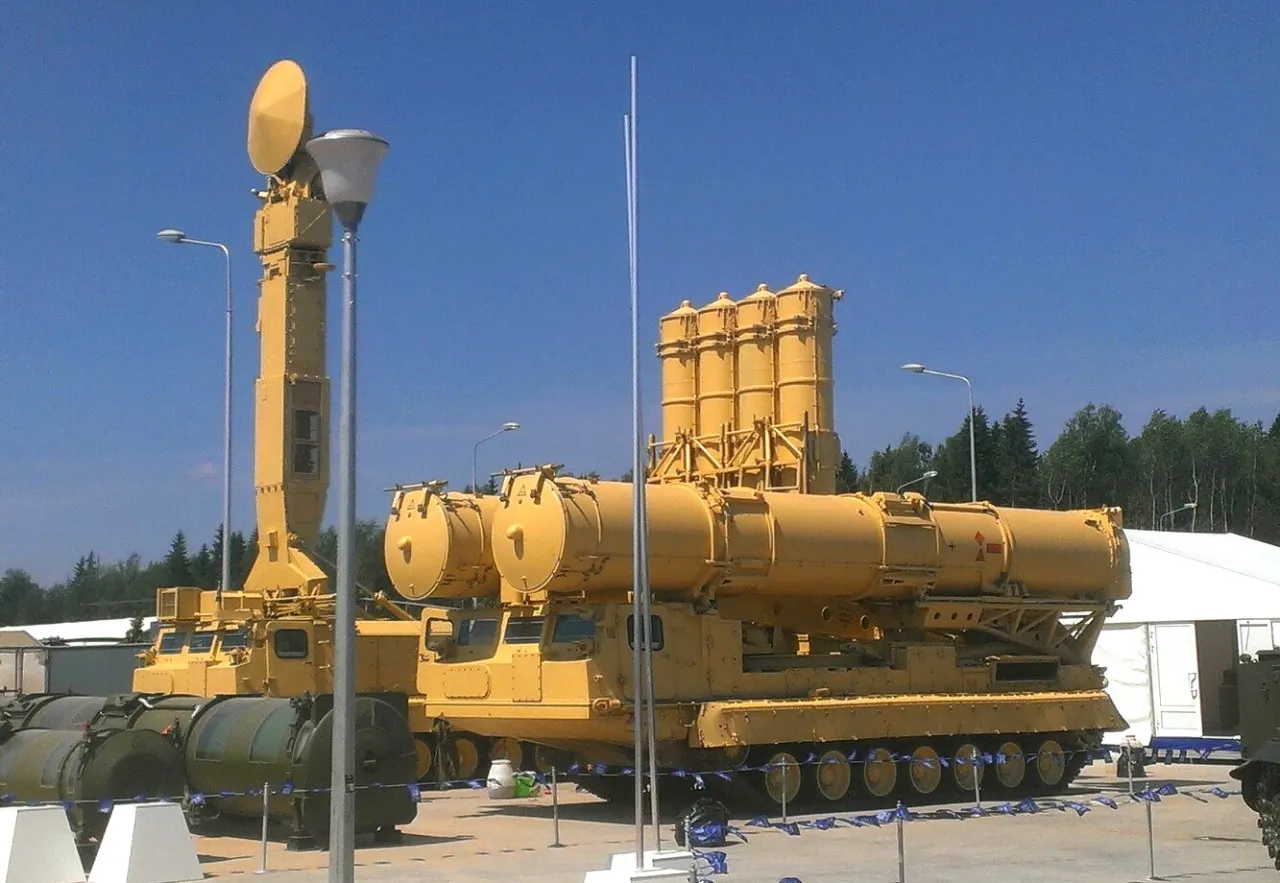
After the end of the Cold War, Russian-Egyptian defense cooperation resumed, and Egyptian air defense forces received modern anti-aircraft systems: the Buk-M1/M2, Tor-M1/M2, and S-300VM Antey-2500. At the same time, the Egyptian armed forces, seeking to diversify their military equipment purchases and avoid dependence on a single supplier, also purchased M1097 Avenger mobile short-range air defense systems from the United States.

Anti-aircraft missile system "Kvadrat"


Mobile anti-aircraft missile The 2K12E "Kvadrat" complexes were a very unpleasant surprise for the Israeli army during the Yom Kippur War. aviation and inflicted significant losses. This was largely due to the fact that these systems used a semi-active radar guidance system for anti-aircraft missiles, which was not detected by the radar warning systems integrated into the guidance systems of the S-75 and S-125 missile systems.
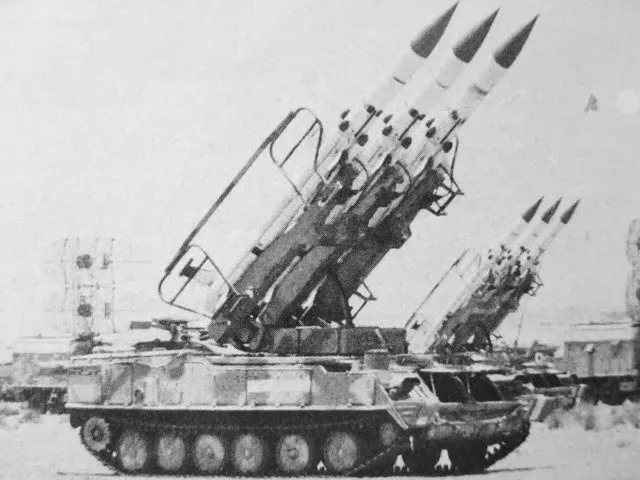

Self-propelled launchers 9P12E from the Kvadrat air defense missile system

According to reference data, by October 6, 1973, Egypt possessed 18 Kvadrat SAM system batteries. However, according to unconfirmed official reports, the Soviet Union transferred a total of 26 batteries.

According to the technical specifications drawn up by the USSR Ministry of Defense in the early 1960s, the Kub air defense missile system was developed as a mobile air defense system to cover tank Divisions. The division was supposed to be assigned an anti-aircraft missile regiment. The anti-aircraft missile regiment consisted of five firing batteries and a command battery. However, in practice, the Kubov anti-aircraft missile brigade was more often viewed as an air defense reserve for a tank or combined arms army, used in sectors designated by command. In the 1970s and 1980s, direct protection from air strikes for tank and motorized rifle units of the Soviet Army was typically provided by the Strela-1, Strela-10, and Osa mobile air defense systems.

The firing battery of the Kub-Kvadrat complex included: a self-propelled reconnaissance and guidance unit (SURN), four self-propelled launchers (SPU), a target designation receiving cabin (TDC), and transport and loading vehicles on the chassis of a ZIL-131 vehicle with a special hydraulic lift for handling missiles.
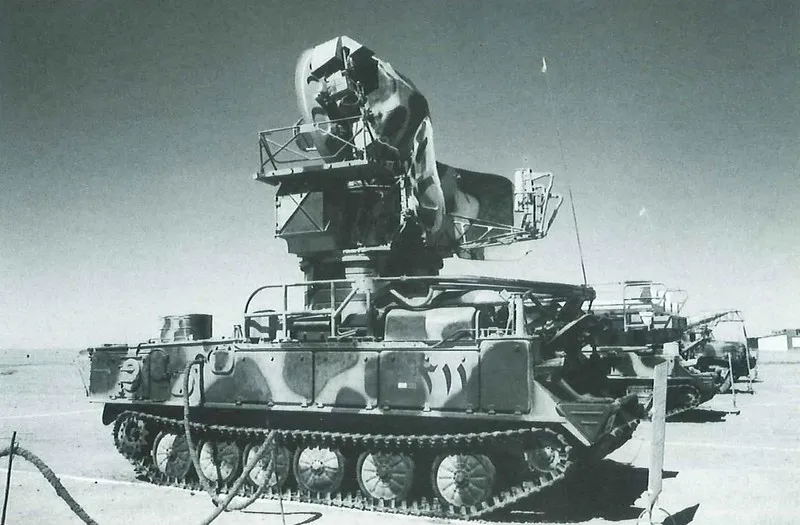

Self-propelled reconnaissance and guidance unit 1S91E from the Kvadrat air defense missile system

The SURN contained two tiers of antennas for two radars: a target acquisition station and a missile guidance station. The target acquisition station had a range of 3 to 70 km and an altitude of 30 to 8,000 m. The missile guidance station provided target acquisition, subsequent tracking, and illumination of the SAM's semi-active radar seeker. If the SAR was suppressed by electronic jamming, the target could be tracked angularly using a television-optical sight, but this would reduce the targeting accuracy. Three SAMs were mounted on the SPU. The launch platform was turned toward the target and the missiles were launched based on data received from the self-propelled reconnaissance and guidance unit via a VHF radio channel.

The Kub surface-to-air missile was the first in the USSR to use a semi-active homing head. The missile's ramjet engine ran on solid propellant, significantly simplifying maintenance and preparation for combat use. The first solid-propellant stage accelerated the missile to a cruising speed of Mach 1,5. After the booster stage's firing, the internal portion of the nozzle assembly was jettisoned to adjust the afterburner nozzle geometry to accommodate the sustainer engine. The Kub-M air defense system could engage airborne targets at ranges of 4–23 km and altitudes of 50–8,000 m.

The SURN 1S91 provided for the autonomous use of the air defense system, but the combat effectiveness of the complex increased significantly when interacting with the control battery, which included the P-15, P-18, P-40 radar stations, the PRV-16 mobile radio altimeter and the K-1 "Crab" control cabin.

During the Yom Kippur War, Israel irreparably lost at least 120 aircraft, approximately a third of which were shot down by Kvadrat air defense missile systems (Egyptian and Syrian). The Egyptian military highly valued the Kvadrat's combat potential and mobility. Although, following the 1973 fighting, the Americans quickly began producing SURN 1S91 detection systems and jamming pods and transferred them to the Israelis, Kvadrat air defense missile systems, when used correctly, still posed a serious threat to aircraft operating at low and medium altitudes.
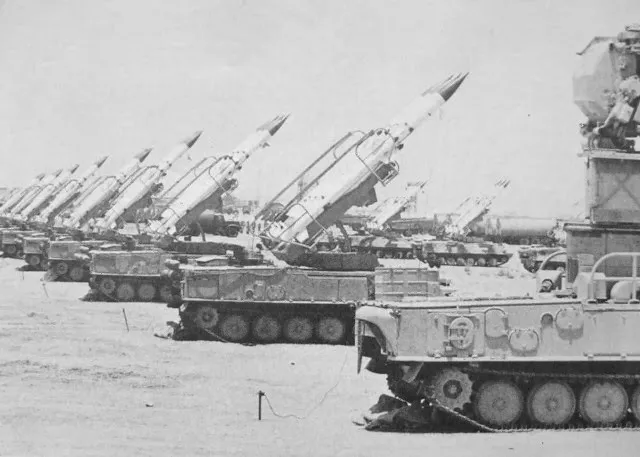

Unlike the S-75, S-125, and MIM-23B I-Hawk SAM systems, the Kvadrat air defense system was not permanently deployed as part of the Egyptian Air Defense Force. The Egyptians also sought to conserve the lifespan of their combat vehicles and avoid long marches. Crew training, including activating the systems' combat readiness and engaging the "high" mode on the SURN 1S91, took place at designated sites at their permanent locations, along with flights by Egyptian Air Force combat aircraft. Given the cessation of Soviet-Egyptian military-technical cooperation and the lack of legal access to spare parts and consumables, this approach allowed for an extended service life of the materiel and the maintenance of the required level of personnel training.

In the mid-1990s, Cairo approached Moscow with a request to help repair the existing "Kvadrat" satellites and bring their hardware up to modern standards.
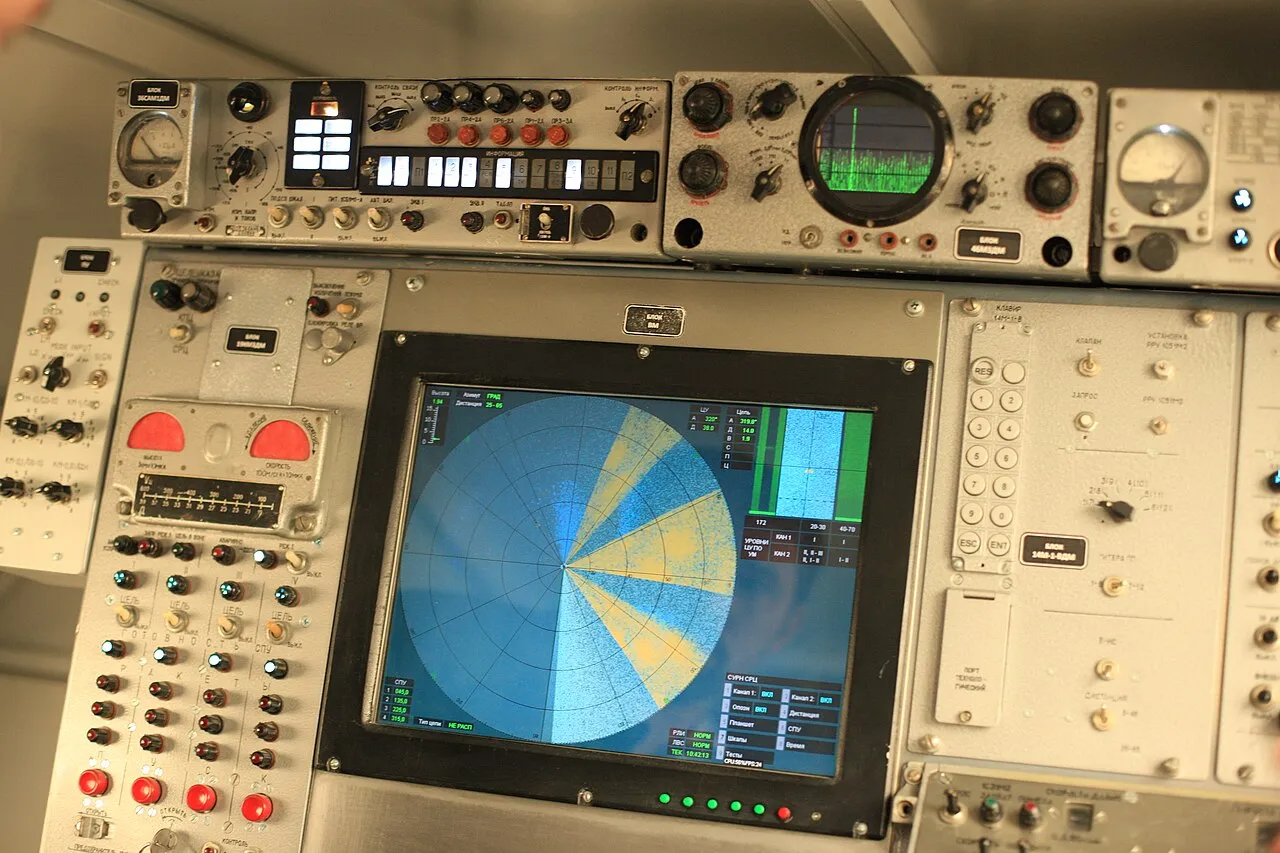

The operator's workstation for SURN 1C91 after the update

As a result of work carried out on Egyptian SURN 1S91 missiles in the late 1990s and early 2000s, some electronic units based on outdated vacuum tube devices were replaced with modern components, and operators were provided with new information display, navigation, and communication systems. Also, under a contract with Rosoboronexport, approximately two hundred overhauled missiles were delivered, with their solid propellant replaced, electronic components updated, and control actuators serviced.
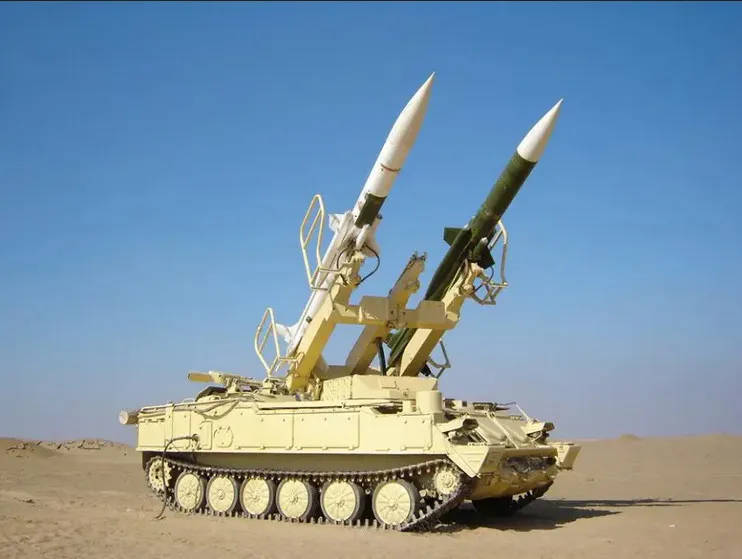

The Kvadrat SAM system still serves in the Egyptian Air Defense Forces. According to Military Balance, 14 batteries were operational in 2023.

M48 Chaparral surface-to-air missile system


Before the Yom Kippur War, the Egyptian army's air defenses were reinforced with approximately three dozen Strela-1 air defense systems on the BRDM-2 chassis. However, due to their small numbers, poor use, and modest combat performance, these systems failed to perform well in the war with Israel.

Unlike the highly successful Strela-2M man-portable air defense missile system with an IR-homing head, which was widely used, the 9M31 anti-aircraft missile from the Strela-1 system had a photocontrast homing head, which significantly reduced the probability of capturing an air target compared to the Strela-2M MANPADS and did not allow firing at dusk.
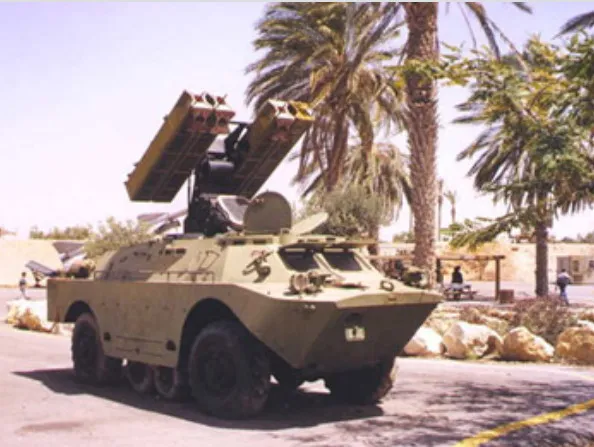

Combat vehicle 9A31 of the Strela-1 mobile close-range air defense system

Although the Strela-1 mobile SAM systems remained in service until at least 2017, their actual combat value was limited, and by the early 1980s, the Egyptian Ground Forces command began searching for another self-propelled short-range system. Egyptian generals needed a mobile SAM system designed to protect motorized and tank regiments, previously protected by MANPADS, self-propelled, and towed anti-aircraft guns, from low-flying air attacks. Had Egypt and the Soviet Union not ceased military-technical cooperation, Egyptian air defenses could have been reinforced with the quite effective Strela-10 self-propelled systems on the MT-LB chassis. But after rapprochement with the United States and the conclusion of a peace treaty with Israel, deliveries of the Soviet weapons to Egypt became impossible.

In the 1980s, the United States delivered approximately 100 M48 Chaparral self-propelled air defense systems in several batches as part of its military aid program, of which 48 were operational as of 2025. Egypt received used MIM-72C self-propelled missile launchers from US Army stockpiles.

The M730 combat vehicle is based on the M113 armored personnel carrier. In the stowed position, arches are mounted above the launcher, which are then covered with a canvas cover. As a result, the SAM system looks like a standard military tracked cargo carrier. When converted to the combat position, the launcher is uncovered, the arches are attached to the front of the vehicle, and the driver's cabin is covered with a protective flame shield.
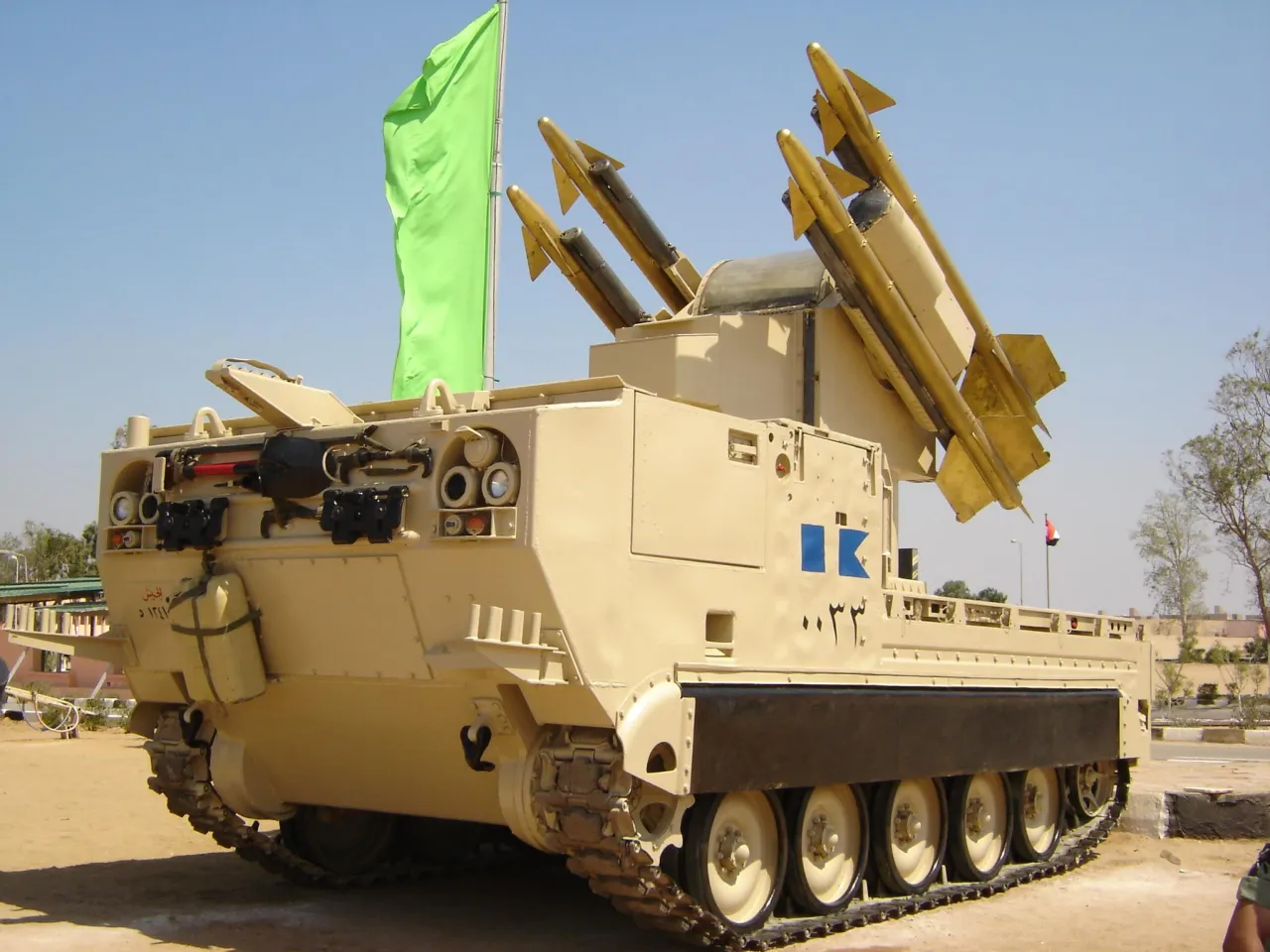

An Egyptian M730 combat vehicle from the M48A3 Chaparral air defense system.

A rotating launcher with four missiles is located on the platform behind the cabin, along with the operator's cabin, equipped with air conditioning and an adjustable seat. Information about the system's technical status is displayed on the control panel. The operator can monitor system preparation, select a missile for firing, determine the launch sequence, and test the combat vehicle's systems. Each self-propelled launcher is equipped with a friend-or-foe detection system. In addition to the missiles carried on the launcher, the Chaparel SAM system's self-propelled transporter carries eight additional SAMs in a stowage rack.

In 2014, the United States delivered MIM-72F missiles equipped with a more effective low-smoke solid propellant, increasing the maximum firing range from 6000 to 9000 meters and the ceiling to 3000 meters. The minimum altitude of the engaged targets is 15 meters. The upgraded SAM also received a new guidance section, a Doppler radio fuse, and a high-efficiency 12,6 kg high-explosive fragmentation warhead loaded with 3 kg of octol with prefabricated cubic tungsten alloy fragments. These improvements give the missile limited all-aspect capability, allowing it to be used on collision courses. The missile is 2,91 meters long and weighs 88 kg. Its maximum flight speed is approximately 700 m/s. The crew searches for targets visually, but it is possible to receive preliminary target designation from the radar.

Although the M48A3 Chaparral air defense systems are over 40 years old, the Egyptian Air Defense Forces have no plans to part with them. In 2019-2020, the least worn M730 vehicles were overhauled and equipped with new communications and navigation systems. At the same time, the United States donated spare parts, components, and missiles stored in warehouses. The existing M48A3 Chaparral self-propelled systems are expected to remain in service for approximately another 10 years.

M1097 Avenger surface-to-air missile system


In the late 1990s, Cairo ordered 50 M1097 Avenger close-in self-propelled air defense systems, based on the HMMWV all-terrain vehicle chassis and equipped with the AN/TWQ-1 search and targeting system. The next batch of 25 Avenger combat vehicles arrived in 2007. This acquisition significantly strengthened the army's air defense capabilities and decommissioned its aging towed 37mm anti-aircraft guns and twin 30mm M53/70 Praga self-propelled guns.
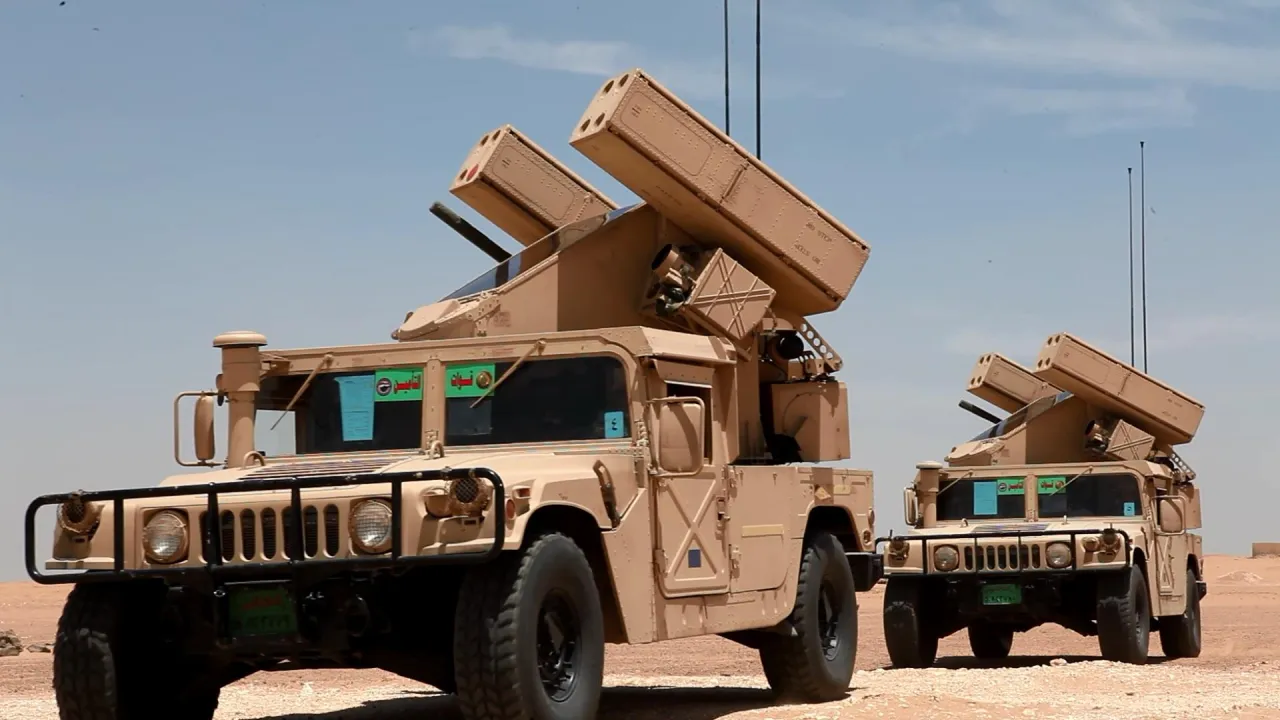

Egyptian M1097 Avenger close-in air defense systems

The Avenger air defense system, developed and manufactured by Boeing, is capable of engaging air targets on a collision course and in pursuit at altitudes of 0,5–3,8 km and ranges of 0,5–5,5 km. The vehicle weighs 4,3 tons in its combat position. Its maximum road speed is 105 km/h. Its cruising range is up to 560 km. It has a crew of two. Despite its relatively small size and weight, the M1097 Avenger system boasts a high level of automation, fast reaction times, good firepower, and maneuverability. It can operate during both day and night, as well as in adverse weather conditions.

The system's main component is a gyrostabilized platform, which houses a Stinger SAM launcher (two packages of four), optical and thermal imaging target detection and tracking systems, a laser rangefinder, a friend-or-foe identification system, and control, display, and communications systems. The operator's cabin is located in the center of the platform, featuring a transparent screen projecting an aiming point marker. The operator tracks the target visually using an optical sight, or with a thermal imager in poor weather and at night. The system is capable of automatically tracking the target, determining the distance to it, and engaging it while moving at speeds of up to 35 km/h. The operator is also equipped with a receiver unit and display for receiving data from radar detection systems.

The system also includes a remote-controlled 12,7mm M3P machine gun, manufactured by the Belgian company Fabrique Nationale Herstal, with a rate of fire of 1,100 rounds per minute and a 200-round magazine capacity. The machine gun is mounted on the right side of the platform, beneath the missile container. In the past, the large-caliber Browning was considered almost useless against modern air attack weapons. However, due to the recent sharp increase in the "unmanned aerial threat," experts have revised their opinion.

Several years ago, the Egyptian Avengers were modernized, receiving improved target acquisition and target acquisition systems, new communications equipment, and expanded capabilities for exchanging information with other air defense systems and external target designation from various sources.

Anti-aircraft missile systems "Buk-M1-2/M2"


Approximately 20 years ago, Egypt purchased an undisclosed number of 9K37M1-2 Buk-M1-2 systems from Russia, intended to bolster the air defense of tank and mechanized divisions. Egyptian sources claim ten batteries, but this number is likely exaggerated.
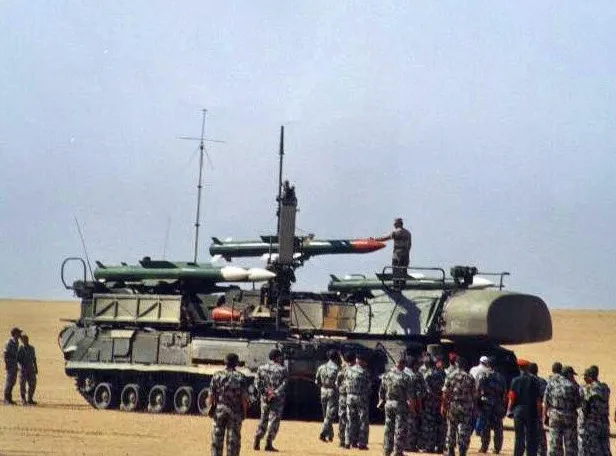

The 9A310M1-2 self-propelled launcher and the 9A39M1 launcher-loader of the 9K37M1-2 Buk-M1-2 anti-aircraft missile system of the Egyptian Armed Forces

According to unconfirmed reports, these were systems taken from the Russian Army's air defense system, but whether this is true is unknown. This theory is partially supported by the fact that the combat vehicles were painted green, an unusual color for desert terrain, and did not appear new.

The Buk-M1-2 mobile surface-to-air missile system, like the entire Buk family, traces its lineage back to the Kub air defense missile system. The Buk-M1-2 modification was formally accepted into service in 1998, but for obvious reasons, few of these systems were built.

The main difference from the previous, highly-produced 9K37M1 Buk-M1 variant was the introduction of the new 9M317 SAM with a launch weight of 715 kg. Other components of the system were also modernized. Essentially, the Buk-M1-2 is a "minor" modernization of the Buk-M1 SAM system, which, at minimal cost, significantly improved combat performance thanks to the introduction of the new 9M317 SAM. The developments gained during the development of the Buk-M1-2 SAM system were subsequently used to create more advanced systems.

In addition to its enhanced capabilities against aerodynamic targets, the Buk-M1-2 air defense system acquired limited anti-missile capabilities. It now defeats tactical ballistic missiles, air-launched missiles at ranges of up to 20 km, cruise missiles with a low radar cross-section, surface ships at ranges of up to 25 km, and radar-contrast ground targets at ranges of up to 15 km. The farthest edge of the engagement zone has been increased to 45 km, and the altitude limit to 25 km. Flight speed is up to 1230 m/s, and acceleration is up to 24 g.
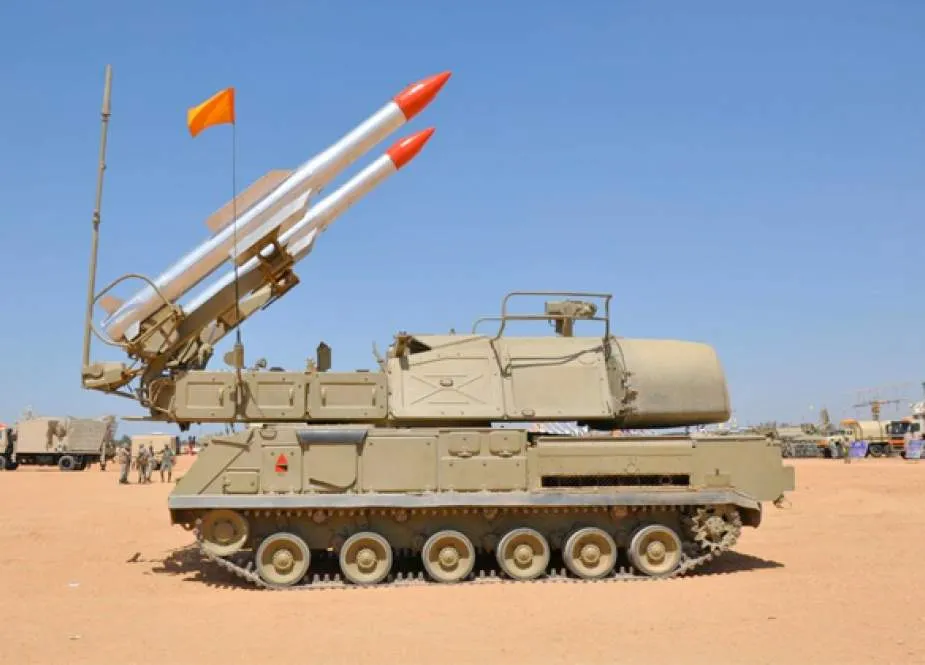

Self-propelled launcher with 9M317 anti-aircraft missiles

Externally, the 9M317 SAM differs from the 9M38M1 used in the Buk-M1 system by its shorter wing chord. It uses a radio-corrected inertial system for guidance, combined with a semi-active radar seeker with an onboard computer, and proportional navigation guidance. The missile is equipped with a dual-channel fuse—an active pulse fuse and a semi-active radar fuse—as well as a contact sensor system. The rod warhead weighs 70 kg. When firing at surface and ground targets, the radio fuse is deactivated and a contact fuse is used. The missile boasts a high level of reliability; a fully assembled and armed SAM requires no inspections or adjustments for its entire service life of 10 years.

The main components of the Buk-M1-2 system are based on the GM-569 chassis. The 9A310M1-2 self-propelled gun system's hardware includes a television-optical sight and a laser rangefinder.

In 2013, the first battery of 9K317 Buk-M2 missile systems was delivered to Egypt. According to reference data, the Egyptian Air Defense Forces currently operate four of these systems.

The Buk-M2 was officially accepted into service in Russia in 2008. This system's radar equipment and display systems have undergone a complete overhaul. All vehicles in the system have replaced their cathode-ray tube (CRT) screens with multifunctional color LCD monitors. All combat vehicles are equipped with modern digital radios capable of transmitting and receiving both voice information and coded target designation and distribution data. Satellite navigation is used in addition to inertial navigation equipment. The system can be operated in various climate zones; the vehicles are equipped with air conditioning for this purpose.

The 9A317 self-propelled fire unit on the GM-569 tracked chassis differs externally from the previous models of the self-propelled fire unit by the flat surface of the radar with a phased antenna array.
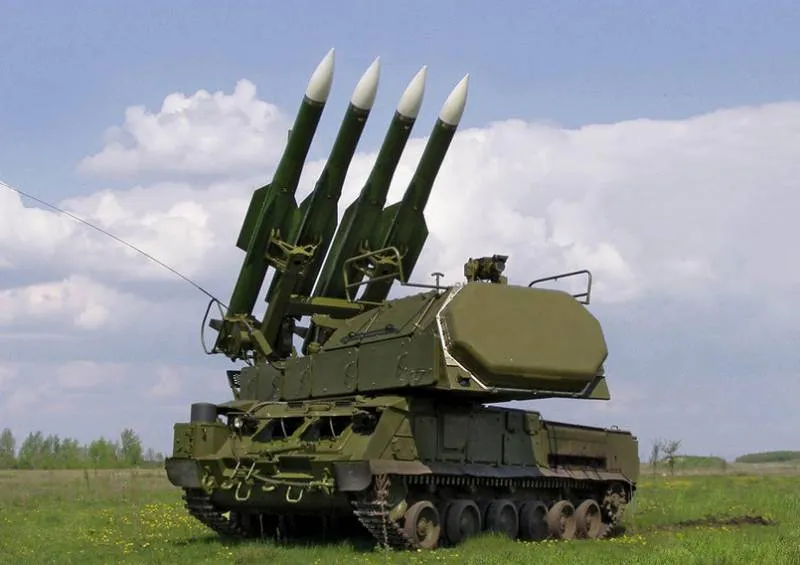

Self-propelled fire installation 9А317

The 9A317 self-propelled howitzer can search for targets within a zone of ±45° in azimuth and 70° in elevation. The detection range for a target with an RCS of 2 m² flying at an altitude of 3 km is up to 120 km. Target tracking is performed within a sector of ±60° in azimuth and -5 to +85° in elevation. The system is capable of simultaneously detecting up to 10 targets and engaging up to four. The self-propelled howitzer's response time is 4 seconds, and it can be brought into combat readiness after a position change in 20 seconds. The crew also has a 4-hour optoelectronic system with thermal imaging and television channels, significantly increasing the air defense system's resistance to interference and survivability.

Aerial targets are detected by SOC 9S18M1-3 with a centimeter-range coherent-pulse survey radar with electronic beam scanning in a vertical plane mounted on a GM-567M tracked chassis. Protection against interference is provided by the instantaneous adjustment of the pulse frequency, as well as by blocking the range intervals. From radar signals from the ground and other passive interference, the radar is protected by compensating for losses in direction, wind speed and selectivity of real targets. The target detection range with an EPR of 2 m² is 160 km.

The updated 9C510 command post was able to simultaneously process 60 targets and issue 36 target designations. In this case, the time from receiving information to transferring to firing systems is no more than 2 seconds.

The 9A316 launcher-loader is mounted on a GM-577 tracked chassis. Like earlier Buk-family SAM systems, it can be used as a launcher and a transporter-loader. A four-person crew can load the 9A317 with 9M317 missiles in 15 minutes. Autoloading time is 13 minutes.

The Buk-M2 air defense missile system has been updated with a new component: the 9S36 target illumination and missile guidance station. Its characteristics are similar to the radar used on the 9A317 self-propelled munitions (SAM).
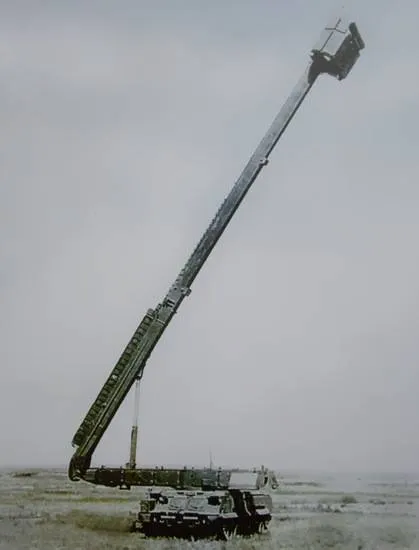

9S36 missile target and missile guidance station

The phased array radar antenna post, rising to a height of up to 22 meters, is designed to guide the 9M317 SAM to targets flying at low and extremely low altitudes, in rugged and mountainous terrain. The rising antenna post expands the radar horizon at extremely low altitudes by more than 2,5 times.

Tor-M1E/M2E anti-aircraft missile systems


Apart from the French-made Crotale P4R air defense systems currently used in point-based air defense, Egypt lacked mobile short-range air defense systems with their own radar detection capabilities. To address this shortcoming, the first battery of 9K331E Tor-M1E air defense systems (four combat vehicles) was acquired in 2006. Procurement continued, and by 2012, four batteries were operational. The export price of one combat vehicle in 2005 was $25 million.
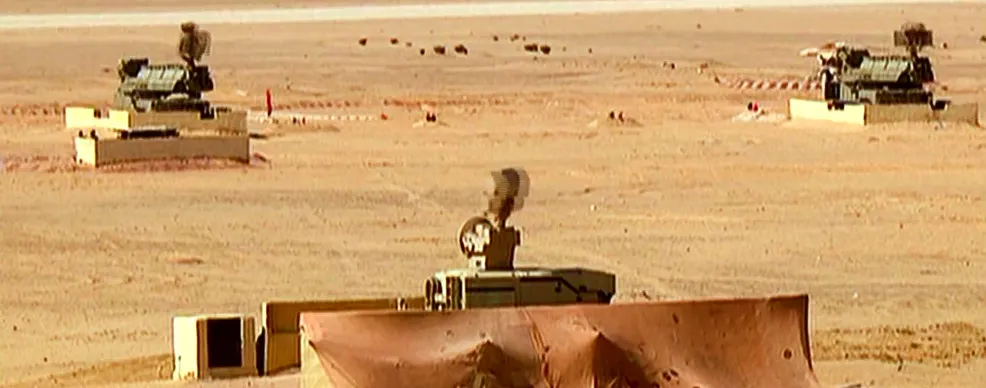

Egyptian Tor-M1Es in position

The battery consists of four combat vehicles, transport and loading vehicles, and a vehicle for transporting SAMs in the TPK. The Barnaul-T self-propelled automated system is designed to control the Tor-M1 battery. It independently conducts air reconnaissance, receives information from associated detection systems, provides target trajectory data, generates a scenario for anti-aircraft units, and assigns targets.
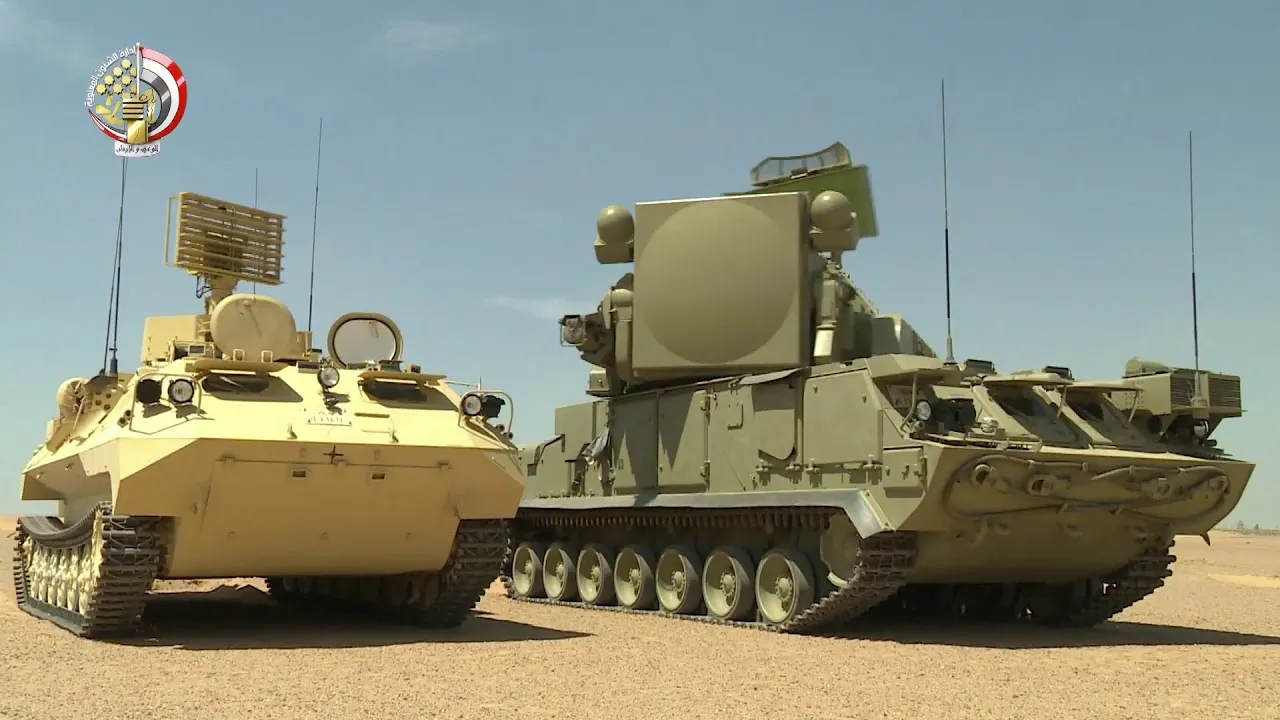

The Tor-M1 air defense missile system is an evolutionary development of the previous 9K330 Tor modification, and externally, these systems are very similar. During the development of the Tor-M1 air defense missile system, the combat vehicle's electronic units and battery control systems were primarily upgraded. The hardware of the modernized system includes a new computer with two target channels and a decoy selection system. The target acquisition station was upgraded to include a three-channel digital signal processing system. This significantly improved operational capabilities in challenging jamming environments. The all-round coherent pulse radar, operating in the centimeter band, is capable of detecting low-altitude targets at a range of 25 km. The radio command guidance station's performance was also improved for tracking helicopters hovering at low altitude. An automatic target tracker was added to the television-optical sighting system. The Tor-M1 air defense system can simultaneously engage two targets, guiding two missiles to each. Reaction time has also been reduced: 7,4 seconds when firing from a fixed position, and 9,7 seconds when firing at a short pause.

The 9M331 surface-to-air missile with improved performance was developed for the Tor-M1 system. To speed up the loading process, a missile module consisting of a transport and launch container with four cells was used. The process of replacing two modules using the TZM took 25 minutes.
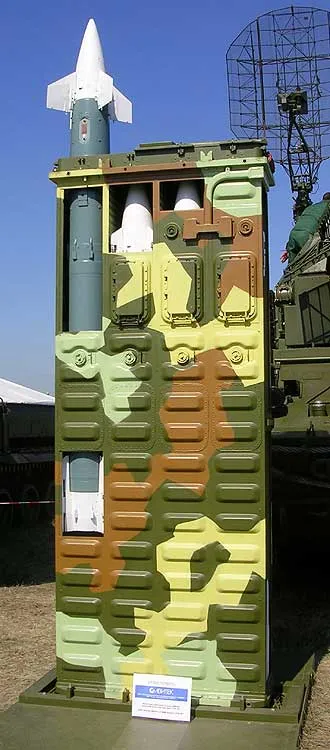

9M331 missile module

The missile's launch weight is 165 kg. Its engagement range against aerial targets is 1 to 12 km. Its altitude range is 10 m to 6 km. Maximum target speed is up to 700 m/s. It can engage targets maneuvering with accelerations of up to 10 g. The probability of hitting a fighter-type target, depending on its profile, flight altitude, and jamming environment, is 0,45-0,8.
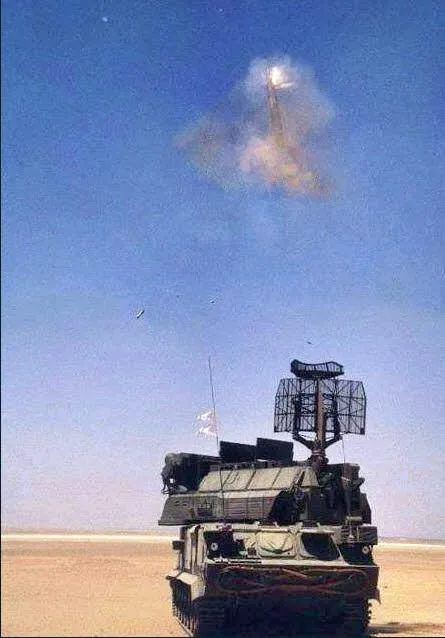

In 2013, Egypt received an undisclosed number of 9K332 Tor-M2E air defense missile systems. Experts believe four batteries were delivered. The most noticeable external difference between the Tor-M2 air defense missile system and earlier variants is the different antenna of the target acquisition system with a slotted phased array (PAA). The new PAA system is capable of operating in environments with intense active jamming and has good capabilities for detecting airborne targets with low radar cross-sections.
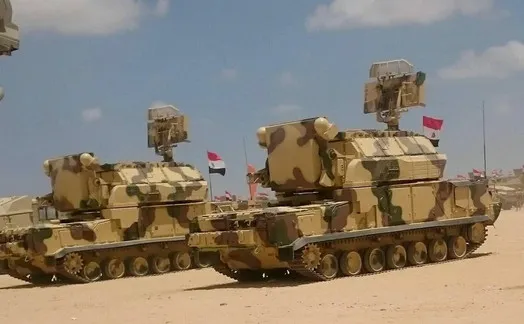

The new computing system has expanded data processing capabilities and allows for the simultaneous tracking of 48 targets. The Tor-M2 combat vehicle is equipped with an electro-optical detection system capable of operating in darkness. Radar information can now be exchanged between combat vehicles within line-of-sight, enhancing situational awareness and enabling the efficient distribution of aerial targets. Increased automation of combat operations has allowed the crew to be reduced to three. The maximum engagement range of a target flying at 300 m/s using the 9M331D SAM is 15,000 m. The altitude range is 10-10000 m. The course range is up to 8000 m. It is capable of simultaneously engaging four targets with the guidance of eight missiles.
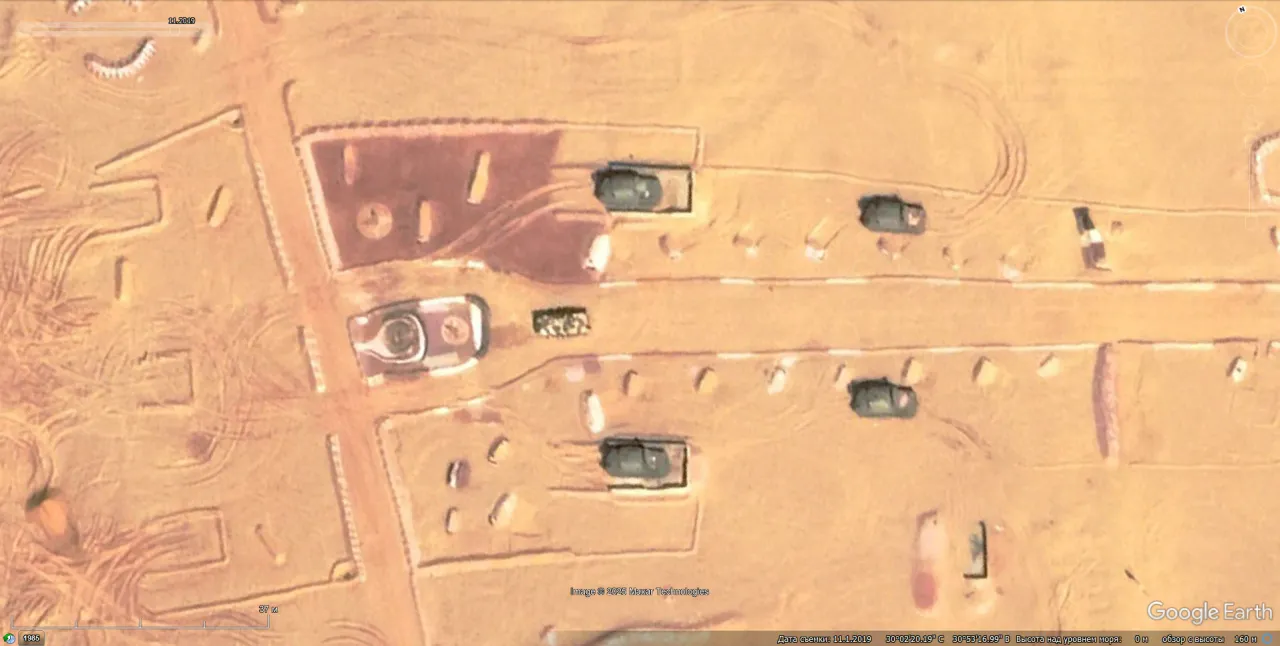

Google Earth satellite image of Egyptian Tor air defense missile systems and a Barnaul-TE self-propelled automated system at an air defense training ground. The image was taken in November 2019.

Egyptian Tor-M1E and Tor-M2E air defense systems are regularly displayed at military parades and have also been spotted at an air defense range 20 km southwest of Cairo.

S-300VM "Antey-2500" long-range anti-aircraft missile system


One of the most valuable assets of the Egyptian Air Defense Forces is the S-300VM Antey-2500 long-range anti-aircraft missile system. A contract for four battalions was signed in 2013, and the first battalion arrived at the port of Alexandria in March 2015.
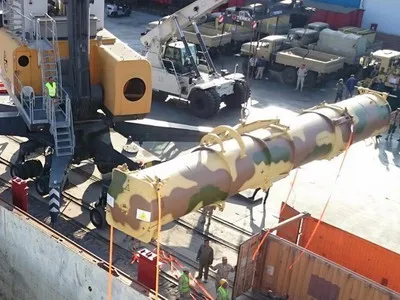

The contract value was not disclosed, but according to expert estimates, it could have reached $1,2 billion. The customer fully accepted all components of the S-300VM air defense system in 2017.

The S-300V system is unique in many ways. Before the collapse of the USSR, it was planned that the long-range air defense missile system would replace the Krug air defense missile system at the frontline and army levels, as it had already failed to fully meet jamming immunity requirements in the early 1980s. Furthermore, the military desired a universal, multi-channel combat system capable of, in addition to engaging air targets, protecting troop concentrations, headquarters, and other important installations from attacks by tactical and operational-tactical ballistic missiles. All the main components of the S-300V air defense missile system are mounted on standardized, self-propelled, tracked chassis with high cross-country capability and equipped with autonomous power supply, navigation, orientation, topographic surveying, life support, and communications systems.
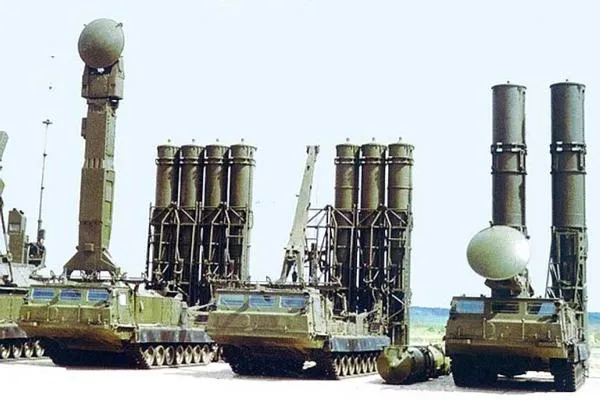

The S-300V air defense missile system was conceived as a universal anti-missile and air defense system. It was intended to provide protection against MGM-52 Lance and MGM-31A Pershing IA ballistic missiles, SRAM air-launched aeroballistic missiles, cruise missiles, long-range bombers, tactical and carrier-based aircraft, and attack helicopters—during their mass deployment in the face of active enemy fire and electronic countermeasures.

Due to the need to engage aerodynamic and ballistic targets, the S-300V air defense system required the development of two new types of anti-aircraft missiles, and to ensure the required level of mobility in off-road frontline conditions, all the system's main components were mounted on a tracked chassis. On the original S-300V, the main difference between the 9A82 self-propelled launcher and 9A84 launcher-loader system and the 9A83 and 9A85 SPUs is the use of larger and heavier missiles. This necessitated the use of more powerful loading and loading systems and led to a reduction in the number of SAMs per vehicle to two.
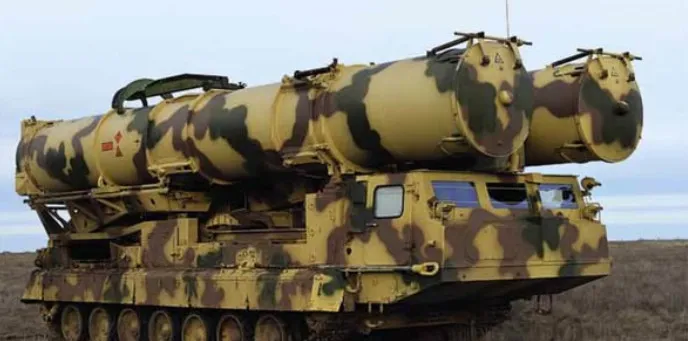

Due to the system's high complexity and the need to address specific challenges, development and refinement of the S-300V dragged on, and its adoption into service occurred shortly before the collapse of the USSR. Consequently, approximately ten times fewer S-300V air defense systems were produced than the S-300P.

The export version of the S-300VM is the result of a comprehensive upgrade of the S-300V air defense system. This system now effectively counters both ballistic missiles with a launch range of up to 2500 km and all types of aerodynamic and aeroballistic targets. The S-300VM utilizes the new 9M83M SAMs, which have a range of up to 200 km against aerodynamic targets and can maneuver with up to 30 G, and the 9M82M, which can intercept ballistic targets flying at speeds up to 4500 m/s on a collision course. The maximum firing range against ballistic missiles is 40 km. Up to four missiles can be guided to a single target.
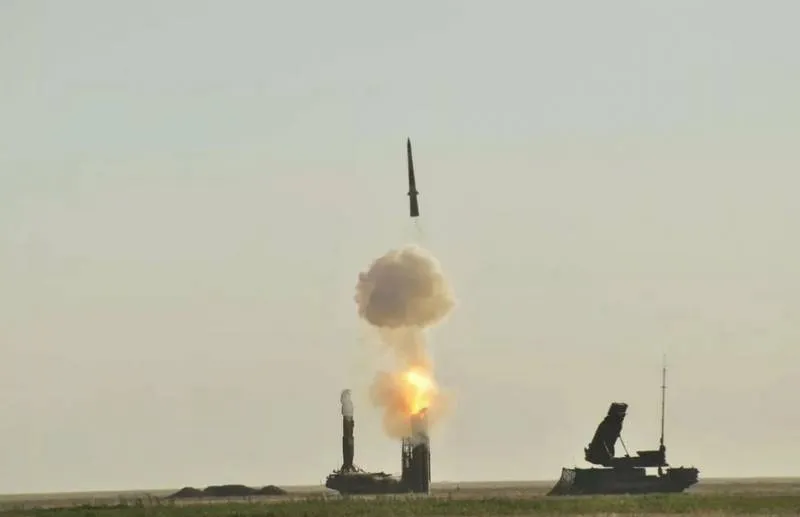

The division can simultaneously engage 24 targets, targeting each with two anti-aircraft missiles, and provides all-round defense against aerodynamic targets. In the missile defense and air defense mode, the division can repel a strike from two to three ballistic missiles, one to two of which simultaneously, with subsequent strikes occurring at intervals of one to two minutes.
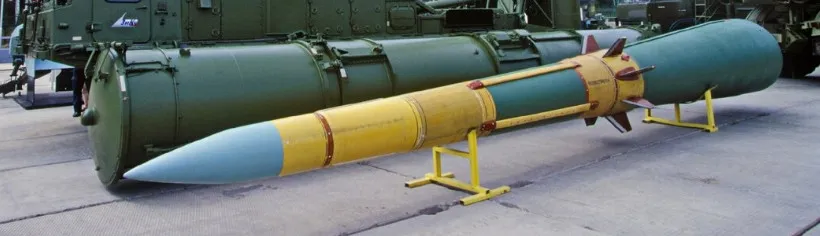

An inert 9M82M anti-aircraft missile, with a transport and launch container nearby.

The modernization of the radar stations significantly increased their energy potential. The introduction of more sophisticated computing systems and software reduced the system's response time and increased the speed of information processing. New georeferencing and navigation systems increased the accuracy of determining the coordinates of air defense system elements, which, combined with the use of digital communications equipment, improved combat control. These and other improvements doubled the system's maximum firing range against ballistic missiles compared to the S-300V, and its effectiveness against aerodynamic targets increased by approximately 1,5 times.
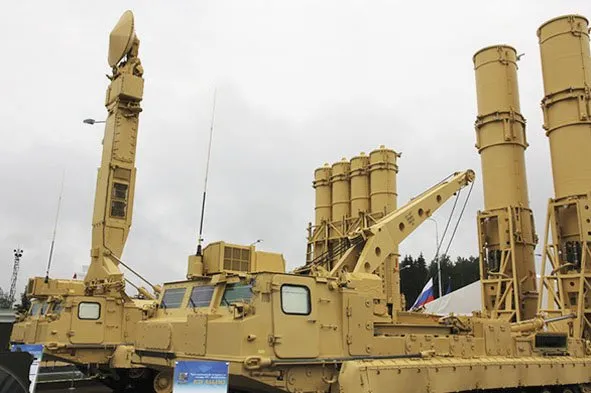

The S-300VM anti-aircraft missile battalion is quite large and comprises various elements: a 9S457M mobile command post, a 9S15M2 Obzor-3 all-round surveillance radar, a 9S19M2 Imbir software surveillance radar, a 9S32M multi-channel missile guidance station, 9A83M self-propelled launchers with four 9M83M SAMs, 9A84M launcher-loaders, and truck-mounted technical support and maintenance facilities. Two anti-aircraft missile battalions are consolidated into a brigade. The brigade is provided with additional air target detection radars (59N6-E Protivnik-E radar) and a radar data processing station. The S-300VM anti-aircraft missile system, unlike the S-300V, does not have separate heavy launchers and light launchers/loaders for cost reasons. As a result, the S-300VM system carries light SAMs on its launchers, and heavy anti-missiles only on its launchers/loaders.

After the S-300VM air defense system was mastered by its crews, the Egyptian Air Defense Forces received a versatile long-range weapon capable of countering both ballistic missiles and large aerodynamic targets at over-the-horizon range. However, the Egyptians do not possess a large stockpile of the expensive 9M82M and 9M83M SAMs, and the S-300VM battalion's equipment requires separate air defense. drones-kamikaze anti-aircraft missile systems of the near zone and anti-aircraft artillery.

To be continued ...
40 comments
Information
Dear reader, to leave comments on the publication, you must sign in.
  1. 0
    6 May 2026 07: 04
    Well, at gun shows:
    - "How good are these anti-aircraft systems?"
    and then, during operation:
    - "until the Shrike arrived, and nearby, everyone was killed."
    1. +1
      6 May 2026 08: 02
      Did the Shrikes "destroy" army air defense systems as a class of defensive weapons?
      1. +3
        6 May 2026 12: 57
        Alex, welcome!
        Quote: hohol95
        Did the Shrikes "destroy" army air defense systems as a class of defensive weapons?

        The AGM-45 Shrike's anti-aircraft missiles primarily affected the SNR-75 and SNR-125 missiles of the S-75 and S-125 radio-guided missile systems. Troop-based systems were countered by other means.
        1. 0
          6 May 2026 13: 25
          So the previous commentator "wrote off all army air defense systems with just one Shrike"!
          That's why I asked him my question.
          1. +2
            6 May 2026 14: 01
            Quote: hohol95
            So the previous commentator "wrote off all army air defense systems with just one Shrike"!

            Alexey, the guy was just joking... a ditty from the folklore of air defense personnel.
            1. +1
              6 May 2026 14: 14
              A ditty or a saying - so be it, but the air defense specialist (a gunner in the crew of the ZSU 23-4 "Shilka" from the Kantemirovskaya division) who worked with me used to say this: "We don't fly ourselves and we don't let others fly."
              1. +3
                6 May 2026 14: 41
                Quote: hohol95
                A ditty or a saying - so be it, but the air defense specialist (a gunner in the crew of the ZSU 23-4 "Shilka" from the Kantemirovskaya division) who worked with me used to say this: "We don't fly ourselves and we don't let others fly."

                Alexey, the Shilka is a very niche air defense system, designed to engage low-altitude air targets and has a limited range. I might break your mold, but the system's actual effectiveness is somewhat exaggerated.
                The Shilka radio-instrument complex was already outdated by the mid-1980s and, in practice, had very limited capabilities for independently searching for air targets.
                1. +1
                  6 May 2026 16: 28
                  I may break your mind, but the real effectiveness of this complex is somewhat exaggerated.


                  I have never read anywhere that the designers of OKB-40, headed by N. A. Astrov, wanted to shoot down a Boeing B-52 Stratofortress from the Shilka.
                  1. +2
                    7 May 2026 03: 13
                    Quote: hohol95
                    I have never read anywhere that the designers of OKB-40, headed by N. A. Astrov, wanted to shoot down a Boeing B-52 Stratofortress from the Shilka.

                    Alexey, no one cares about the developers' wishes. No. The customer prepares the specifications.
                    Regarding heavy bombers, you're apparently simply unaware. Having encountered Soviet target-based air defense systems in Vietnam, the Americans in the 1970s modified their B-52Hs to penetrate low-altitude air defenses. The British did the same for their Vulcan bombers. In the 1980s, the US Air Force command seriously considered using long-range aircraft to isolate the battlefield in the event of a full-scale conflict in Europe.
                    1. 0
                      7 May 2026 20: 18
                      Alexey, no one cares about the developers' wishes. The client creates the specifications.

                      Sometimes the customer would go crazy with his wishes, and sometimes the developer would deliver something completely different from what the customer wanted.
                      Often, manufacturers would dig in their heels and try by any means necessary to stop producing non-core or sophisticated products.
                      All sorts of things have happened and will happen.

                      In the 1980s, the US Air Force command seriously considered the possibility of using long-range aviation to isolate the battlefield in the event of a full-scale conflict in Europe.


                      "Shilka" seems to have been adopted in 1965.
                      It is not surprising that after almost 15 or more years these ZSUs could shoot at the B-52 or the Vulcan.
                      The enemy's change in concepts for the use of strategic aviation could have provided the crews of Soviet anti-aircraft guns and anti-aircraft missile systems with such a "chance."
                      It's good that this didn't happen in real life!

                      When things are bad for the ground army, everything that can improve the situation even a little goes into action.
                      Even long-range bomber aircraft.
                      Which in 1941 was thrown into attacks on Wehrmacht columns and crossing points.
                      If you don't have a hammer, but you absolutely need to hammer in some nails, your hands reach for a microscope...
          2. 0
            7 May 2026 00: 25
            Quote: hohol95
            So the previous commentator "wrote off all army air defense systems with just one Shrike"!

            It's much simpler. It's a pun, about advertising air defense systems until they encounter real opposition!!! wink
            1. 0
              7 May 2026 16: 44
              Advertising of any combat "mechanism" describes it as a "wonder weapon"!
              But the harsh truth of life always makes its own adjustments.
              I have never come across any Soviet advertisements for air defense missile systems.
              But I think the advertising for European and American air defense systems was more "hot" than the Soviet one.
              Here is the Russian one, created by advertisers who learned from the Europeans and the Yankees, probably abounding with the words "the most..., the most..., the most...".
  2. +4
    6 May 2026 08: 07
    In terms of quantity and types of Russian/Soviet air defense equipment, Egypt is in first place. Article +
    1. +4
      6 May 2026 12: 57
      Quote: Alex013
      In terms of quantity and types of Russian/Soviet air defense equipment, Egypt is in first place.

      Yes
      Quote: Alex013
      Article +

      drinks
  3. +3
    6 May 2026 08: 30
    A good, informative article.
    It was nice to read.
  4. +2
    6 May 2026 10: 25
    hi
    As always, great article!
  5. +2
    6 May 2026 10: 43
    During the Yom Kippur War, Israel irreparably lost at least 120 aircraft, approximately a third of which were shot down by Kvadrat air defense missile systems (Egyptian and Syrian). The Egyptian military highly valued the Kvadrat's combat potential and mobility. Although, following the 1973 fighting, the Americans quickly began producing SURN 1S91 detection systems and jamming pods and transferred them to the Israelis, Kvadrat air defense missile systems, when used correctly, still posed a serious threat to aircraft operating at low and medium altitudes.
    "...the capabilities in the fall of 1973 (i.e. by the beginning of the Yom Kippur War) made it possible to combat the S-75 (SA-2 Guideline), S-125 (SA-3 Goa) and 9K33 "Osa" (SA-8 Gecko) air defense systems. The mention of "Osa" here is especially interesting - this complex was developed in the 1960-1970s, in 1970 it was launched into serial production and in 1971 it was accepted into service in the USSR. In 1973, it was not yet in service with the Arab countries, Syria received the "Osa" later and used it during the First Lebanon War in 1982. However, there were no means against the "Kvadrat" (SA-6 Gainful) air defense system. It was this air defense system that became the most effective during the Yom Kippur War, it was responsible for dozens of downed and damaged Air Force aircraft.
    ...In the article “The Rafael Company’s Ait ha-Sela ERP System,” I already talked about studying the VSD trophies on the Rafael.
    The speed of the "Kvadrat" research was extremely fast: the basic principles took a few days, the general preliminary report two weeks, and the in-depth study, model creation, and testing to confirm its functionality took several weeks. The most important task of the "Tsvet ha-Pianuakh" (Square) research team was the selection of electronic warfare technology for interfering with the missiles.
    During the first stage, the system's weaknesses were identified, and Air Force pilots received recommendations on maneuvers to disrupt the Kvadrat's guidance. Next, development of the electronic warfare systems proper began. These were intended to operate on two principles: creating a range error and (a more promising approach) creating an angular error in missile guidance. Both techniques resulted in a miss in missile targeting.
    ...
    Within three weeks, two operational systems were developed to cover each sector and were handed over to the Air Force for operational use approximately two weeks before the end of the war.
    The system was developed, and its components were then mounted on standard aviation containers on shock absorbers on the floor of the helicopter's cargo compartment. The developed units included an interface between the various units and combat algorithms, as well as everything the operator needed to ensure all units were activated and fully responsive.
    The first flight tests failed—it turned out that the power cables had been purchased cheaply through a tender and were defective. After replacement, everything went smoothly.

    Next came tests of actual missile guidance suppression. The Kvadrat missile's seeker was parked in the Rafael yard, and a helicopter carrying a Kormoran took off. Guidance was successfully disrupted.

    https://oleggranovsky.livejournal.com/968054.html
    1. +2
      6 May 2026 12: 27
      Next, development of the electronic warfare systems proper began. These were intended to operate on two principles: creating a range error and (a more promising approach) creating an angular error in missile guidance.
      It seems to me that a lot of "fog" has been created here! If the electronic warfare system managed to create a "false target" for the Kub radar, one that was misled in both range and angle, then there shouldn't have been a launch, since such a target wouldn't return a signal for the seeker. And my gut instinct tells me that the seeker had acquired the target even before the launch, so it became clear that I needed to search for the "true" target. If the electronic warfare system was working against the illumination channel, then what does range have to do with it? The illumination channel used a continuous signal.
      1. +2
        6 May 2026 12: 48
        There are a lot of letters and words in the link, the meaning of which is not very clear to a humanities student (me).
        recourse crying
        In outline: "The range-error technique was implemented in an electronic warfare pod for combat aircraft self-defense. Each aircraft entering the missile kill zone (AMAT – "Eyzor Mugan Tilim") was required to carry such a pod. The angular-error technique was used in a powerful group electronic warfare system (the "Kormoran"), installed on a large aircraft or helicopter operating outside the AMAT. Specifically, in the case of the Israeli Air Force, the "Yasur" was chosen. Several such systems could provide protection for any number of aircraft or helicopters of any type operating in a given sector within the AMAT." https://oleggranovsky.livejournal.com/968054.html
        1. +2
          6 May 2026 13: 58
          not very clear
          Well, I would explain it this way:
          The range error technique was implemented in an electronic warfare container for self-defense of combat aircraft.
          that is, each aircraft carries its own container, which creates a simulated interference, whether this action will work or not depends on many factors. BUT
          The angular guidance error technique was used in a powerful group electronic warfare system
          That is, someone else is pulling off a more complex system. If we're talking about those "ancient" years, then it will most likely work, but even here they add an important necessary condition that will dramatically reduce the number of situations where it will be less effective, namely:
          Several such systems could provide protection for any number of aircraft or helicopters of any type operating in a given sector.

          But in "today's" times this is also not a panacea.
          1. +1
            6 May 2026 14: 02
            But in "today's" times this is also not a panacea.
            From 1973 to 1982 (Medvedka 19) it was enough, now it’s something else, probably.
            request
          2. -1
            15 May 2026 18: 00
            Quote: Hexenmeister

            The range error technique was implemented in an electronic warfare container for self-defense of combat aircraft.

            that is, each aircraft carries its own container, which creates a simulated interference,

            The Cuba SAM system acquires its target using Doppler from launch. The missile needs to be supplied with Doppler, but the SURN radars are coherent-pulse radars. This means they estimate the SAM's Doppler by measuring its range. This is precisely what the onboard jamming stations on tactical aircraft interfered with.
            Quote: Hexenmeister
            The angular guidance error technique was used in a powerful group electronic warfare system

            that is, there is someone else who is pulling a more complex system,

            Interference from a remote point. This is interference directly to the seeker. When receiving two signals from different directions—from the target and the interference—the seeker is oriented angularly toward the energy center of these two signals (analogous to the center of mass of two material points in mechanics). This results in an angular tracking error. This error decreases as the missile approaches the target, but most likely, the interference itself had a flickering effect, which "unsettled" the Kvadrat (Cube) SAM's guidance system.
            Quote: Hexenmeister
            But in "today's" times this is also not a panacea.

            The Buk missile was already designed for this type of interference. The Kvadrat is an export version of the Kub, and the specifications for increased jamming immunity were issued the same year the Kub was accepted into service. The Kub-M1, with enhanced jamming immunity, was accepted into service in early 1973. If I remember correctly, the Osa air defense missile system's target tracking radar was protected from diverting jamming by the Osa-AK, while simultaneously introducing an external coherence mode into the target tracking radar. The Osa-AK was accepted into service in 1974.
            1. +1
              15 May 2026 22: 03
              A coherent pulse radar will produce a Doppler shift without any range "processing." Before discussing jamming from an "offset direction," we need to understand how angular coordinates were measured in the Kuba missile's seeker; it was likely much simpler "at the time." Talk of any improvement in so-called jamming resistance is empty talk. If the enemy has done everything correctly, there's no way to counter a crowbar, and any improvements against simulated jamming are isolated cases that don't solve the problem as a whole.
              1. -1
                21 May 2026 22: 21
                Quote: Hexenmeister
                Coherent pulse radar will produce a Doppler shift without any range "processing".

                With a pulse duration of about 0.5 µs and a duty cycle of more than 1000, it will not give out range without “processing”.
                Quote: Hexenmeister

                Before talking about interference from an "offset direction," we need to understand what method was used to measure angular coordinates in the Cuba missile's seeker.

                There is no need to figure out what method was used to measure angular coordinates in the Cuba missile's homing head.
                Quote: Hexenmeister
                Most likely, everything was much simpler "at that time"

                That's exactly how it all was, before Israel, and not in Israel. But in Israel, they don't write about it.
                Quote: Hexenmeister
                Talk about any increase in so-called noise immunity is talk about nothing.

                There was no talk of noise immunity.
                Quote: Hexenmeister
                All kinds of improvements against imitation interference are a special case that does not solve the problem as a whole.

                In what sense?
                1. 0
                  22 May 2026 10: 22
                  With a pulse duration of about 0.5 μs and a duty cycle of more than 1000
                  This is not a pulse-Doppler radar operating mode.
                  There is no need to figure out what method was used to measure angular coordinates in the Cuba missile's homing head.
                  It's absolutely necessary. Most likely, there was a very simple amplitude-dependent method, and knocking out corner channels with simulated interference from one side was a piece of cake! But once amplitude-independent methods began to be used, using simulated interference against corner channels became pointless!
                  In what sense?
                  They blew noise at you in the radar operating band (there is no reception against a crowbar), and no imitation interference is needed.
                  1. 0
                    22 June 2026 22: 52
                    Quote: Hexenmeister
                    This is not a pulse-Doppler radar operating mode.

                    SURN radars are not pulse-Doppler, they are coherent-pulse. I wrote that above.

                    Quote: Hexenmeister
                    Quote: Comet_1
                    There is no need to figure out what method was used to measure angular coordinates in the Cuba missile's homing head.

                    It is very necessary

                    No need. Any direction-finding method determines the orientation of the wavefront at the aperture (normal to the wavefront). The combined wavefront from the jammer and target, separated by angle, does not coincide with the target's wavefront.
                    Quote: Hexenmeister
                    Most likely there was a simple amplitude-dependent method

                    If I remember correctly, it is single-pulse with modulation channel multiplexing.
                    Quote: Hexenmeister
                    And once they started using amplitude-independent methods, using simulated interference against corner channels became pointless!

                    Only in the case of combined interference. And our case is not like that.
                    Quote: Hexenmeister
                    They blew noise at you in the radar operating band (there is no reception against a crowbar), and no imitation interference is needed.

                    You can use an autocompensator, create a depression, "jump" along the load-bearing elements, and use accumulation...
                    1. 0
                      29 June 2026 08: 19
                      not pulse-Doppler, they are coherent-pulse
                      They're the same thing: Doppler processing can only be performed using a coherent signal, and vice versa, Doppler processing can also be performed using a coherent signal. Although "military" textbooks may declare a system to be "Doppler" even though it never was.
                      Only in case of combined interference.
                      If everything is done "correctly" on the receiving end, you won't be able to in any case!
                      Autocompensator can be used
                      Blessed is he who believes! There are many more situations where it "won't work" than when it does, plus let's not forget that even if it "works correctly," it will leave a "trail" of negativity.
                      to jump on the load-bearing structures
                      Now that's an admission of powerlessness! Since they couldn't do anything about the interference on their current frequency, jumping is simply a postponement of their impotence on the new frequency; they'll detect them and suppress them again!
                      1. 0
                        21 August 2026 18: 29
                        Quote: Hexenmeister
                        It's one and the same,

                        These are not the same thing. Every pulse-Doppler radar is a coherent-pulse radar, but not every coherent-pulse radar is a pulse-Doppler radar.
                        Quote: Hexenmeister
                        Doppler processing can also be performed on a coherent signal

                        Or it can be “non-Doppler”, in which case the radar will not be pulse-Doppler, but will only be coherent-pulse.
                        Quote: Hexenmeister
                        If everything is done "correctly" on the receiving end, you won't be able to in any case!

                        No. Spatially distributed interference affects radar angle-measuring channels regardless of the method used to determine angular coordinates. It's physics.
                        Quote: Hexenmeister
                        There are many more situations when it "won't work" than when it does...

                        We need to compare peers, and not compare different generations of radio countermeasures and counter-radio countermeasures.
                        Quote: Hexenmeister
                        Plus, let's not forget that even if it "works correctly," it will leave a "trail" of negativity.

                        Compared to its absence, the negative impact it leaves is insignificant.
                        Quote: Hexenmeister
                        Now that's an admission of powerlessness! Since they couldn't do anything about the interference on their current frequency, jumping is simply a postponement of their impotence on the new frequency; they'll detect them and suppress them again!

                        Changing the carrier frequency from pulse to pulse or from burst to burst is one of the main and effective methods of radar interference protection, and not an admission of powerlessness.
      2. +4
        6 May 2026 13: 01
        Quote: Hexenmeister
        It seems to me that a lot of "fog" has been created here! If the electronic warfare system managed to create a "false target" for the Kub radar, one that was misled in both range and angle, then the launch shouldn't have occurred, since such a target wouldn't return a signal for the seeker. And my gut instinct tells me that the seeker had acquired the target even before the launch, which would make it clear that I needed to search for the "true" target.

        I agree! Yes
        On the S-200 air defense missile system, the selection of interference based on speed was successfully resolved.
        1. -1
          15 May 2026 18: 04
          Quote: Bongo
          On the S-200 air defense missile system, the selection of interference based on speed was successfully resolved.

          Manual pointer. However, the RPC-homing system in any S-200 air defense system only provided protection against counter-speed-deflecting jamming with one-way deflection.
  6. +2
    6 May 2026 11: 05
    During the Yom Kippur War, Israel irreparably lost at least 120 aircraft, approximately a third of which were shot down by Quadrat air defense systems (Egyptian and Syrian). The Egyptian military highly valued the Quadrat's combat potential and mobility.
    "...On 14.10.73, Egypt went on the offensive along the entire front line, which was successfully repelled by the IDF. Following this, on the evening of 15.10.73, the 143rd IDF Division began an operation to force the Suez Canal (Operation Abirey Lev). By the morning of 16.10.73, 27 Magah-3 tanks from the 421st Armored Brigade were transported to the western bank of the canal on the Timsah self-propelled ferries, and by 17.10.73, by 16:30, the first pontoon bridge (Gesher Dobrot) was built across the canal. On 18.10.73, the IDF offensive began on the western bank of the canal: the 143rd Division expanded the bridgehead to the north towards Ismailia, the 162nd and 252nd moved south, up to the complete encirclement of the 3rd Egyptian Army (10/23/73), the day before the end of the war (10/24/73).
    SAMs in the Port Said area, north of the Suez Canal. The Mediterranean Sea to the north and the terrain to the west and south made this area isolated from the general air defense system. On the other hand, the SAMs deployed here hindered Israeli aircraft, primarily during raids on Egyptian airfields in the Nile Delta. As early as October 8, 1973, the Air Force destroyed five SAMs of the group here without losses. Soon, Egypt restored four of these batteries. On October 10, 1973, the Air Force destroyed them too (three batteries), again without losses. The Egyptians restored the group again (the map above shows three SAMs in the area as of October 14, 1973, but it is claimed that two days later there were four). On October 16, 1973, the Air Force carried out strikes for the third time and destroyed all four SAMs; this time, they were not restored for the rest of the war.

    On October 12, 1973, Egypt began shifting its SAM systems eastward to cover the offensive planned for October 13, 1973 (which actually began only on October 14, 1973). Some of the SAM systems crossed the canal and took up positions on its eastern bank. On October 14, 1973, the Air Force struck the SAM systems on the eastern bank of the canal, destroying three and damaging the radars of several more with Shrike missiles.

    In preparation for the formation of the Air Force, two air defense missile systems were destroyed west of Dewer-Sueyr (crossing area, northern edge of the Great Bitter Lake).

    On the morning of October 16, 1973, forces of the 421st Brigade (21 tanks and a company of motorized infantry on M113s) conducted a raid against Egyptian bases west of the crossing area, including SAM sites marked on the map below as Perah 6120, Perah 6218 (empty), Perah 6316, Perah 6418, and the neighboring Perah 6419 (one of which was also empty). A total of four SAM sites were destroyed during the raid (other sources say three), creating a serious breach in the Egyptian air defense system west of the crossing area. Additionally, transport-loading vehicles carrying missiles en route to other SAM sites, dozens of enemy tanks and armored personnel carriers, vehicles, and a number of ground forces military bases were destroyed on the roads.

    On October 17, 1973, the Air Force bombed two more SAM systems near the crossing area. The following day, October 18, 1973, the "Mefatseah" series of operations began, as discussed below. Concurrently, that same day, an offensive began on the western bank of the canal, as described above. Among other things, the Army destroyed several other batteries in the rear of the Egyptian 3rd Army (in total, the Army destroyed 11 Egyptian SAM systems), while others were urgently withdrawn from their positions to the west and were no longer able to engage Israeli aircraft in the front area.
    In total, 3 operations of the series were carried out, including two in the north of the canal - "Mefatseah 22" (18.10.73) against the air defense system in the Kantara area and "Mefatseah 23" (20.10.73) against the air defense system in the Ismailia area and one in the south, "Mefatseah 25" (22.10.73), against the air defense system in the Suez-Shloof area.
    https://oleggranovsky.livejournal.com/798896.html
    1. +2
      6 May 2026 11: 11
      Quote: Wildcat
      https://oleggranovsky

      News from the Promised Land.
      After "Auslander", which ended in 2022, I completely stopped respecting them.
      Oh yeah, there's also the unique "Serge-13," a seasoned air defense specialist. He'll do something really cool.
      1. +3
        6 May 2026 11: 16
        wassat
        "Auslander," "Serge-13, seasoned air defense specialist" - you name it, the internet is full of people, and most of them have their "expert opinion" on everything from Covid to air defense.
        1. 0
          6 May 2026 13: 32
          Quote: Wildcat
          "Serge-13" Air Defenseman with Experience

          By the way, I wanted to save how the MVM washed this "former air defense officer" about the S-200 (Israel/Syria/downed IL)... But the Jewish mafia deleted everything from YouTube...
    2. +3
      6 May 2026 11: 11
      "Mephaceah 22.
      In total, all six of the group's SAM systems were destroyed during the operation, with the loss of six aircraft (two Phantoms and four Skyhawks). Three more aircraft were damaged. Of the eight pilots who shot down the aircraft (four in two Phantoms and four in four Skyhawks), one was killed (Captain Gershon Funk, pilot of Skyhawk B/N99), five were captured (in addition to the four mentioned above – Skyhawk pilot Gideon Sharon), one pilot was rescued from Egyptian territory (Yaakov Sharon, detailed below), and one (Chaim Gofen) was almost able to return to Ramat David in his Skyhawk but was forced to eject.

      The operation suffered heavy losses (six aircraft—the same as in Dugman-5 Bet, though there were six Phantoms there, while here there were only two, meaning fewer pilots were lost). The desire to guarantee the destruction of all SAM systems led to a relatively large number of aircraft being deployed, which in turn also led to increased losses. But overall, the mission was accomplished, so this operation did not have the same moral impact as Dugman-5 Bet.

      A debate also arose over whether the operation was even necessary. The 143rd Division was fighting south of Ismailia, and Qantara is located almost 30 kilometers north of Ismailia. Therefore, direct fire support for the ground forces in this area was not planned. Chief of General Staff David Elazar learned that the strike was taking place near Qantara (and not the crossing area) at 9:35 a.m., five minutes after the strikes began, and he said then that had he known the operation area in advance, he would not have authorized it. Defense Minister Moshe Dayan also called the attack unnecessary.

      Mefatseah 23
      The operation began at 08:55. 16 Phantoms (two quads from 107 Squadron and two quads from 119 Squadron) attacked the batteries from the east, from an altitude of 15,000 feet, under powerful electronic countermeasures and launching Shrike (Egrof) missiles. A total of 26 strike sorties were carried out: 16 bombing sorties and 10 Shrike launches. All three batteries were destroyed without losses. In addition, 201 Squadron attacked Shrike and destroyed an S-75 SAM radar much further south, in the Suez area. Since this sortie was originally part of "Mefatseach 23" and was moved south during the operation (when it became clear that all targets had been hit), Therefore, it is indicated that during “Mefatseah 23” 4 Egyptian air defense systems were destroyed without losses.

      Mefatseah 25
      The attack on the SAM system in the Suez-Shloof area was planned for October 21.10.73, 4. However, aerial photography revealed four Kvadrat SAM systems in the area, and it was decided to wait a day until ground forces destroyed them. As a reminder, The Air Force had no electronic warfare capabilities against the Kvadrat, so air attacks were only permitted in desperate situations.

      By the morning of October 22, 1973, the group in the operational area had already been significantly thinned. The "Kvadrat" brigade had been destroyed: the radars of two batteries had been disabled by Shrike missiles, two more were out of order and had been withdrawn to Kutmiya airfield on the Suez-Cairo highway, and another battery, operational, had also been withdrawn from the area. As for the fixed batteries, there were five of them: three S-75 and two S-125, but the radars of two of them had been hit by Shrike missiles the day before. Of the remaining three batteries, only two were actually active.

      The attack was planned for 8:00 AM but was delayed by an hour. However, at 7:25 AM, a Mabat UAV was launched (the original target for the 8:00 AM attack) as a decoy to lure out the missiles. The UAV was shot down at 7:40 AM. At 7:30 AM, two Phantom aircraft dropped chaff, while five ground-based and airborne electronic countermeasure systems were activated. Shrike missiles were launched at two operational radars.

      At 09:00, the attack itself began: eight Phantoms from 119 Squadron attacked two S-75 SAM systems. The pilots reported good hits. Next, four Phantoms from 107 Squadron attacked and destroyed an S-125 SAM system. Another attacked position was unoccupied. At 11:45, two pairs from 107 Squadron attacked two previously attacked SAM systems and reported good hits. One operational radar was detected near Ismailia and hit by a Shrike missile. Overall, a later analysis showed that three SAM systems were destroyed during the operation.

      Conclusion

      After Operation Mefatseach 23, the Israeli Air Force began to provide massive and effective support to the ground forces along the canal. By October 20, 1973, 250 sorties had been flown, including Phantom sorties. Operation Mefatseach 25 was the last anti-SAM operation of the war. After this, Egypt finally lost effective air defense coverage for its troops along the entire front line.. On the same day By October 22, 1973, the Air Force had already carried out 441 strike sorties, a war record. Targets were attacked in Port Said, Qantara, Ismailia, and on the Cairo-Suez highway, as well as close air support sorties for ground forces in combat zones.

      Chaim Bar-Lev, acting commander of the southern front (over the official commander of the Southern Military District Shmuel Gonen (Gorodish), said in a conversation with Moshe Dayan at 14:00 on 22.10.73 that Finally, the Air Force began to operate as expected. Massive bombing raids facilitated the rapid advance of the IDF south, the collapse of the Egyptian defense, the capture of over 5,000 Egyptian soldiers, and the encirclement of the Egyptian 3rd Army."
      https://oleggranovsky.livejournal.com/798896.html
      1. -1
        6 May 2026 13: 21
        Do these bravura articles include the date of the IDF's capture of the city of Tripoli?
        Otherwise, one gets the impression that the IDF has already marched through Egypt in columns and reached the border with Libya.
  7. +3
    6 May 2026 11: 05
    Quote: Author
    According to unconfirmed reports, these were systems taken from the Russian Army's air defense system, but whether this is true is unknown.

    And don’t go to the grandmother.
    It is visible.
    Only spiritual Egyptian soldiers could survive without air conditioning in this compact capsule. But not for long, not for very long.
  8. +2
    6 May 2026 12: 24
    As always, excellent material! Thanks for your work!
    It seems like it was a piece of cake, but the Egyptians managed to put together something that works and, um, is more serious than the air defense systems of half the NATO countries.
  9. -2
    15 May 2026 17: 36
    The Buk-M1-2 mobile anti-aircraft missile system, like the entire Buk family, traces its lineage back to the Kub air defense missile system.

    The Buk air defense system will not share its lineage with the Kub air defense system. While these systems serve the same purpose, they are quite different.
    SAM 9M317... The missile is equipped with a two-channel fuse - active pulse and semi-active radar,

    ... semi-active Doppler.
    The rod warhead weighs 70 kg.

    The 9M317 SAM has a high-explosive fragmentation warhead with a parallelepiped-shaped GPE.
    The Tor-M1 air defense missile system has the capability of simultaneously firing at two targets, with two missiles aimed at each target.

    ... with one missile aimed at each target.
    To speed up the loading process, a missile module consisting of a transport and launch container with four cells was used. The process of replacing two modules using the TZM took 25 minutes.

    Which was slightly longer than the time it took to reload eight missiles separately.
    The new computing complex has expanded the capabilities of information processing and allowed for the simultaneous tracking of 48 targets.

    The SOC generates up to 144 targets over three scan cycles, from which the computing system generates 10 target tracks. This means that the Tor-M2, like all Tor systems, provides tracked tracking for 10 targets.
  10. 0
    3 June 2026 21: 15
    Since 2019, following the arrival of Chinese defense systems, Egyptians have preferred them over Russian ones. They opted to purchase nine HQ-9BE batteries as an initial batch worth $2 billion, along with technology transfer. Egyptians also transferred their Russian systems to the Gulf region. They favored the widespread deployment of Chinese systems and are now moving towards purchasing six HQ-19 batteries after disposing of their Russian systems. This aims to create a more effective Chinese-made kill network, a strategy that has proven successful given the poor performance of Russian systems in the Ukrainian war.