The Constitution That Never Was: The Fundamental Laws of 1906
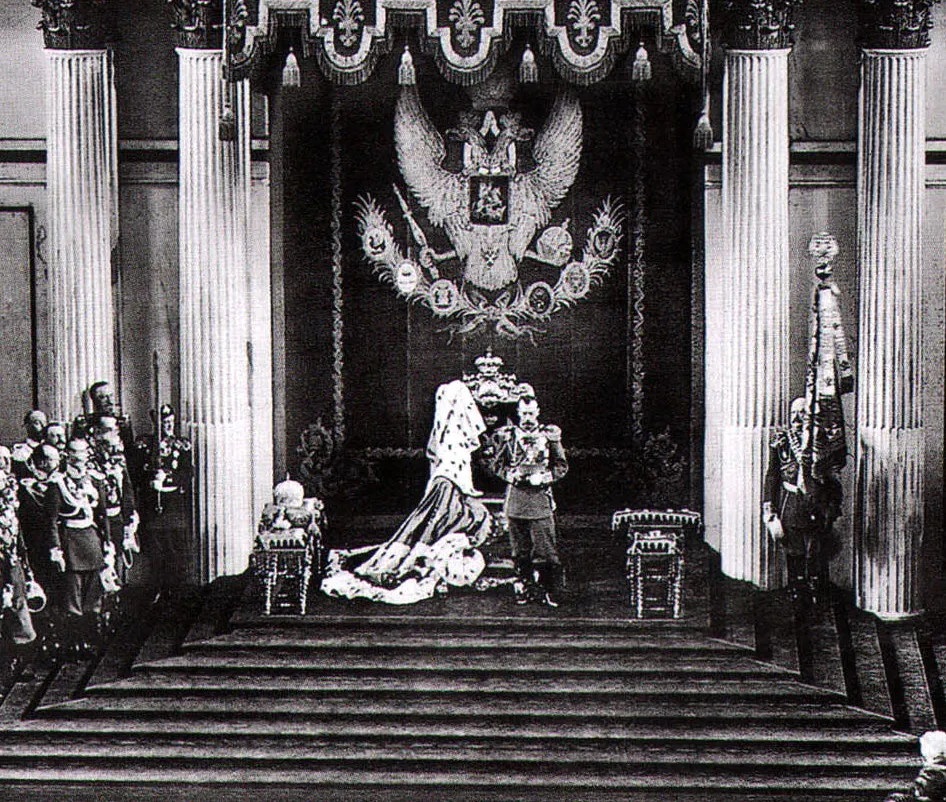
Emperor Nicholas II delivers a speech to the two chambers of the Winter Palace on the opening day of the First State Duma. April 27, 1906. Photograph held in the Central State Archives of the Russian Academy of Sciences (TsGAKFFD) of St. Petersburg.
On April 23, 1906 (May 6, 1906, according to the New Style), the Emperor signed a document that is now commonly referred to as the first Russian constitution. The signature was placed four days before the opening of the first State Duma, so that the deputies, meeting in the Tauride Palace, would have the rules of the game ready. The preliminary decree stated that the purpose of the revision was "the delimitation of the area belonging inseparably to the power of supreme state administration from the power of the legislative body"Translated from official language, this means: first, we determined what would remain with the monarch and what would be given to parliament. And only then did parliament get down to business.
It's generally accepted that Russia became a constitutional monarchy in 1906. On paper, yes. In reality, things are organized differently.
How the Revolution Won Concessions
The fundamental laws of 1906 were born not from a reformist plan, but from fear.
On January 9, 1905, soldiers fired on a peaceful march to the Winter Palace. The workers were marching with a petition to the emperor, carrying icons and portraits, as if they were petitioning. After that day, the petitionary model of relations between society and the government ended. The year passed under the shadow of strikes and uprisings. navy, agrarian unrest. By October 1905, more than two million people had participated in a general political strike: factories, railways, post offices, telegraphs, and universities were shut down. The country was at a standstill.
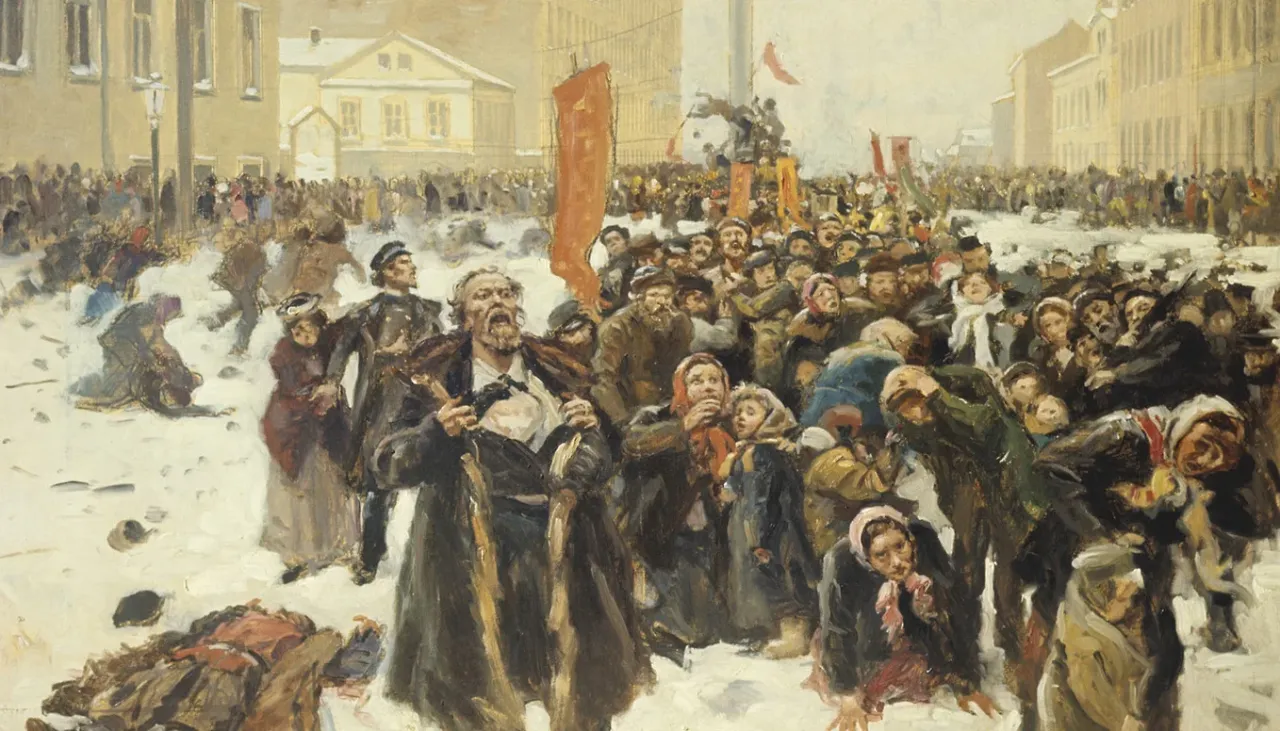
Vladimir Makovsky. "January 9, 1905 on Vasilievsky Island"
Sergei Witte, just returned from peace negotiations with Japan, presented Nicholas II with a choice without a third option. Either a military dictatorship with the full mobilization of the army for suppression, or constitutional concessions. According to contemporaries, the formulation was almost literal: "The sovereign, or the constitution, or the dictator".
Nicholas II chose concessions. On October 17, 1905, the Manifesto on the Improvement of State Order was issued. It promised civil liberties: personal inviolability, freedom of conscience, speech, assembly, and association. It established "as an immutable rule"that no law would come into force without the approval of the Duma. He guaranteed the population "the possibility of actual participation in overseeing the legality of the actions of the appointed authorities"The manifesto was a sensation: for the first time in a century, an autocrat acknowledged that he must share power.
In the classic work of V. V. Leontovich “History In the book "Liberalism in Russia," the concessions of October 1905 are described as a turning point: for the first time in two centuries, the monarch did not complement the existing order, but agreed to limit himself. But this agreement was forced, and therein lies the root of subsequent contradictions.
In family correspondence, the emperor, according to memoirists, wrote about the concessions of October 17 with bitterness: he felt they had been "snatched away." This detail is important. From the very beginning, the monarch perceived the document not as a program, but as an unavoidable loss—and he structured the work of turning the manifesto into legislation in a way that minimized this loss.
What was promised in October and what was confirmed in April
Six months passed between the Manifesto of October 17, 1905, and the Fundamental Laws of April 23, 1906. During these six months, street activism subsided, the army remained loyal, and the revolutionary threat receded. And legal work proceeded in the opposite direction: not expanding the Manifesto's promises, but narrowing them.
The document approved by Nicholas II in April consisted of an introductory section and five chapters, which included 82 new or amended articles. The full version, published as part of the Code of Laws of the Russian Empire, was more extensive: two sections, seventeen chapters, and 223 articles. The second section retained the provisions on succession to the throne, regency, ranks, and titles from the Fundamental Laws of 1832. Continuity with the pre-reform system was built into the document's very architecture.
The chapters were arranged in a characteristic order. The first was "On the Essence of Supreme Autocratic Authority." The second was "On the Rights and Duties of Russian Subjects." The third was "On Laws." The fourth, the most extensive, was about the State Council and the State Duma. The fifth was about the Council of Ministers.
This order is no accident. Before defining the rights of subjects and the structure of parliament, the document established that supreme power remains inviolable. The hierarchy is established from the start: first the monarch, then everything else.
The Manifesto of October 17 stated that no law could be passed without the Duma. The Fundamental Laws added a significant clarification: the Duma, too, could not be passed without the Emperor.
Autocracy in a constitutional package
Article 4 of the Basic Laws of 1906 read as follows: "The Emperor of All Russia holds supreme autocratic power. God himself commands us to obey his authority, not only out of fear but also out of conscience.".
This formulation repeated the pre-reform text almost verbatim. The word "unlimited," admittedly, had disappeared, but contemporaries disputed this disappearance, and it changed little in practice.
Further in the first chapter there were about two dozen articles that deciphered what “supreme autocratic power” meant. Article 8: legislative initiative on all matters belonged to the sovereign; revision of the Fundamental Laws themselves was possible only on his initiative. This meant that parliament could not change the constitution, even with the unanimous vote of both chambers, unless it was the monarch's will. Constitutional revolution through parliament was legally excluded.
Article 9No law comes into force without the Emperor's approval. This is an absolute veto—not a suspensive one, like the German Kaiser's, not limited by time or conditions: a simple refusal, without explanation and without the possibility of overriding it.
Article 10 reserved war and peace to the monarch. Article 12 granted him the right to issue decrees in the exercise of supreme governance. Article 15 granted him the right to declare any area of the empire under martial law or a state of emergency. The statutes governing the armed forces assigned supreme command, the organization of the army and navy, and all military strategy to the emperor. The appointment and dismissal of ministers was also the monarch's exclusive responsibility. Ministers were responsible to him, not to the Duma.
The resulting structure was strange. The document proclaimed that legislative power was exercised by the emperor. "in unity" With the State Council and the State Duma. This is the wording from Chapter Three. But Chapter One had previously established that supreme power rests solely with the monarch. Supporters of the constitutional interpretation clung to the word "unity." Opponents pointed to Article 4. Legally, both sides were correct, because the document indeed contained both theses. Practically, the one with the army behind him was right.
Freedoms with reservations
The chapter on the rights of subjects was revolutionary for Russia. For the first time in the history of the empire, it contained formulations that we recognize today as standard constitutional text.
Article 77: property is inviolable, forced alienation is permitted only for "fair and decent remuneration". Article 78: subjects have the right to hold meetings "for purposes not contrary to the laws, peacefully and without weapons»Individual articles enshrined the right to express thoughts. "orally and in writing, and also to distribute them by means of printing", freedom of faith and conscience, the right to create societies and unions.
For a country where just a few years ago any gathering without a police permit was considered a riot, this was a turning point. For the first time, citizens had the right to appeal to the law, not to the mercy of their superiors. For the first time, freedom of speech was not tolerated, but recognized.
But almost every one of these rights was accompanied by a caveat: "within the limits established by law" or "for purposes not contrary to law." This formulation made the entire structure dependent on subordinate legislation. What exactly "freedom of the press" meant was determined not by the constitutional text itself, but by individual acts—on censorship, on assemblies, on associations. These acts were issued by the government and could be as restrictive as desired.
The result is a strange situation: the right to free speech formally exists, but actual freedom of speech is limited to the extent permitted by current legislation. There is a right to assemble. There is no right to assemble without permission.
This does not negate the historical significance of the chapter on subjects. The very emergence of these formulations paved the way for human rights arguments, for references to the constitution in the courts, and for the development of political parties. But the distinction between the proclamation of rights and their actual content in the Fundamental Laws of 1906 was deliberately established.
Parliament without parliamentarism
Chapter Four defined the structure of the bicameral parliament. The lower house was the State Duma, elected by the people under the curial system for a term of up to five years. The upper house was the State Council, transformed from the previous advisory body. Half of the members were appointed by the emperor, the other half were elected from zemstvos, noble assemblies, universities, stock exchange committees, and the clergy.
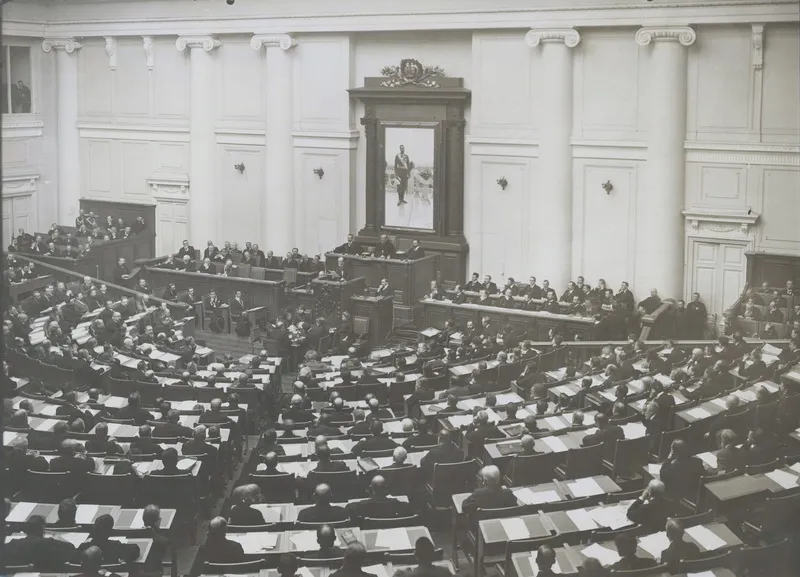
State Duma of the Russian Empire of the 1st convocation
The curial system of Duma elections was designed so that the vote of a landowner would carry far more weight than that of a peasant or worker. The plan was to secure a conservative majority. This plan failed: right-wing parties boycotted the first elections, the peasant curia proved more active than expected, and the first Duma opened on April 27, 1906, in the Tauride Palace with a clear predominance of leftist and liberal deputies. According to party statistics, the Cadets won approximately 179 seats, the Trudoviks approximately 97. The Duma's total membership was approximately 478 deputies.
The Duma was granted the right to legislative initiative, but not individual initiative: a proposal had to come from at least 30 deputies. After the Duma's approval, all bills were sent to the State Council. If the Council rejected the text, a conciliation commission was formed. If there was no agreement, the law died.
The main limitation lay not in the procedure, but in the architecture itself. The Duma had no control over the executive branch. Ministers were appointed by the emperor and were accountable only to him. There was no vote of no confidence. Parliament could not dismiss the government, could not change its course, and could not block its personnel decisions. Matters of war and peace, foreign policy, and the organization of the army and navy were excluded from the Duma's purview. In other words, everything that typically forms the core of parliamentary oversight in a constitutional monarchy was marginalized in Russia.
There was also a more specific mechanism for curtailing the Duma's powers—the so-called "reserved" budget items. The regulations of March 8, 1906, removed entire blocks of state expenditure from the Duma's jurisdiction: the maintenance of the Imperial Family, the expenses of the Ministry of the Imperial Court, payments on state loans, and military expenditures according to special lists approved by the supreme government. If the Duma refused to grant a loan for these "reserved" items, the government could spend funds up to the amount of the previous budget. In other words, a key part of the budget—what in any constitutional monarchy served as the main lever of parliamentary pressure—was removed from the deputies' control in advance.
And finally: the monarch could dissolve the Duma at any time. Without explanation, by decree. The First Duma lasted 72 days. On July 8, 1906, Nicholas II signed a decree dissolving it; it was made public on July 9. The accompanying manifesto stated that the Duma "deals with matters outside its purview" and what her actions "undermine the state order"The deputies attempted to address land reform, the central issue of the era. The government considered this an abuse of power.
Article 87 and Stolypin's agrarian reform
After the dissolution of the First Duma, an article was discovered in the Fundamental Laws that became the most sought-after instrument of Russian executive power. Article 87 permitted the Emperor to issue decrees during the Duma's recess, if "extraordinary circumstances" demanded urgent measures. The decrees were to have the force of law until they were submitted to the Duma after its resumption of work.
The design seemed sensible: an emergency mechanism for urgent decisions. In practice, it turned into a workaround. Between the dissolution of the First Duma in July 1906 and the convocation of the Second in February 1907, the government issued several dozen decrees under Article 87. The exact number varies among sources, but this is the order. Among them were acts of great significance for the entire structure of the state.
The most famous is the decree of November 9, 1906. "On the amendment of certain provisions of the current law concerning peasant land ownership and land use"With this decree, Pyotr Stolypin launched the agrarian reform, which he considered the main goal of his premiership. The decree granted peasants the right to leave the commune and secure their allotment land as personal property. The idea was to create a class of peasant property owners as a bulwark against revolution.
The reform was profound and affected millions of farms. And it was implemented through Article 87, meaning it bypassed parliament. The Third Duma, elected under the new, even more restrictive law of June 3, 1907, only approved the decree as law in July 1910, almost four years after its publication. By the time it was approved, the reform was already in effect, surveyors were traveling throughout the districts, and peasants were leaving their communes. The Duma was putting its signature on the act.
This is how the actual legislative process worked. Parliament would adjourn, a decree would be issued, and then parliament would return and sign the completed document.
The change to the electoral law on June 3, 1907, carried out by Stolypin himself after the dissolution of the Second Duma, went down in history as the "June 3rd coup." According to the letter of the Fundamental Laws, the electoral law could not be changed without the consent of the Duma. The law was changed without its consent. The Third Duma, elected under the new rules, proved much more conservative than its predecessors and served for almost its full term. Parliamentarism began to function precisely to the extent that parliament ceased to contradict the government.
The most conservative constitution in Europe
Comparing the Fundamental Laws of 1906 with European constitutions of the era, a clear picture emerges. In terms of the scope of powers vested in the monarch, the Russian document was closer to the Prussian model of 1850 than to later European constitutions. The Prussian Constitution, adopted after the 1848 Revolution, was considered the benchmark for 19th-century conservative constitutionalism: it preserved the king's broadest prerogatives, an absolute veto, control over the army, and a government not accountable to parliament. It was this model, rather than the more liberal models of the early 20th century, that proved to be the closest legal relative of the Fundamental Laws of 1906.
As noted by researchers (A. Kudinova, A. N. Medushevsky), "For its time, the Fundamental State Laws of 1906 were one of the most conservative constitutional acts in the world."This is not a journalistic exaggeration, but a conclusion drawn from a comparative analysis. A. N. Medushevsky, in his work "Constitutional Projects in Russia in the 18th – Early 20th Centuries," classifies the Russian model as "sham constitutionalism"—a type in which the monarch formally agrees to restrictions but retains actual power through reserve mechanisms.
But it wasn't just the scope of authority. There was another parameter that placed the Fundamental Laws of 1906 in a unique position: their mandated nature.
Most European constitutions of the 19th and 20th centuries were either adopted by constituent assemblies elected for that purpose or developed through lengthy parliamentary deliberations. They relied on the legitimacy of the popular will. The Russian Fundamental Laws were granted. The monarch, as the holder of supreme power, issued a document partially limiting his own powers.
Authorization meant revocability—revokability. What was given could also be taken away. The source issuing the document, by the same logic, could revise it: a new manifesto could theoretically change its terms at any time, and there was no legal impediment to this. All participants in the process understood this, and it is precisely here that the key feature of the parties' attitudes toward the Fundamental Laws lies. The monarch did not consider himself definitively bound by the document he himself had granted; society did not consider the document a definitive guarantee of the rights it proclaimed. The "June 3rd Coup" of 1907 was the best confirmation of this logic: the rules were changed in the same way they were given.
As a result, the Fundamental Laws of 1906 were not perceived by either side as definitive "rules of the game." They were perceived as an interim state—with some hoping for expansion, while others were eager to roll back at the first opportunity. A constitution, in the true sense of the word, is a document to which both sides appeal as the highest authority. Russia's Fundamental Laws never played such a role.
When the structure collapsed
From 1906 to 1917, four State Dumas functioned in Russia. The third served until the end of its term, and the fourth was convened in 1912 and continued its work during World War I.
Historian F. A. Gaida demonstrates that between 1910 and 1914, a semblance of a working dialogue developed between the Duma and the government in a number of areas: the Third Duma, despite its conservatism, began to internalize the constitutional structure, and the government began to take its opinions into account on non-politicized issues. The structure, despite its contradictions, was beginning to work. The war interrupted this process before it could take institutional shape.
The war exposed the weaknesses of the structure. As military setbacks piled up, the monarch increasingly deferred to the Duma; government changes occurred chaotically; Article 87 was invoked with increasing frequency. By 1916, a significant number of deputies openly declared the government's inability to govern the country. In February 1917, when unrest erupted in the capital, the Duma was one of the last institutions retaining a semblance of legitimacy. But by this point, the Fundamental Laws were no longer functional in any but formal sense.
The 1917 Revolution abolished both the Fundamental Laws and the empire itself. The document ceased to be valid law and became a subject of historical study.
If we were to formulate the conclusion without moralizing or rhetorical flourishes, it would be this: the Fundamental Laws of 1906 proved to be incomplete on two counts. For society, they were too restrictive: they failed to establish genuine parliamentarism, failed to make the government accountable, and failed to ensure genuine freedom of the press and assembly. For the monarchy, they were too binding: for the first time, they introduced restrictions into the system that had not existed before, and accustomed society to the idea that other restrictions were possible.
The document could neither be further developed, because the monarch was unwilling to share power further, nor could it be restored to the pre-reform state, because society already knew it had rights, albeit conditional ones. When the structure began to fall apart, everything began to fall apart at once.
The Constitution and Fundamental Laws of 1906 were just paper documents. The hybrid model—autocracy with parliamentary elements—didn't live to see its full maturity. And it went down in history not for what it achieved, but for what it revealed: the limits to which autocracy was willing to restrict itself proved narrower than the system could survive.
Information