Artificial Intelligence as a Nuclear Risk Multiplier
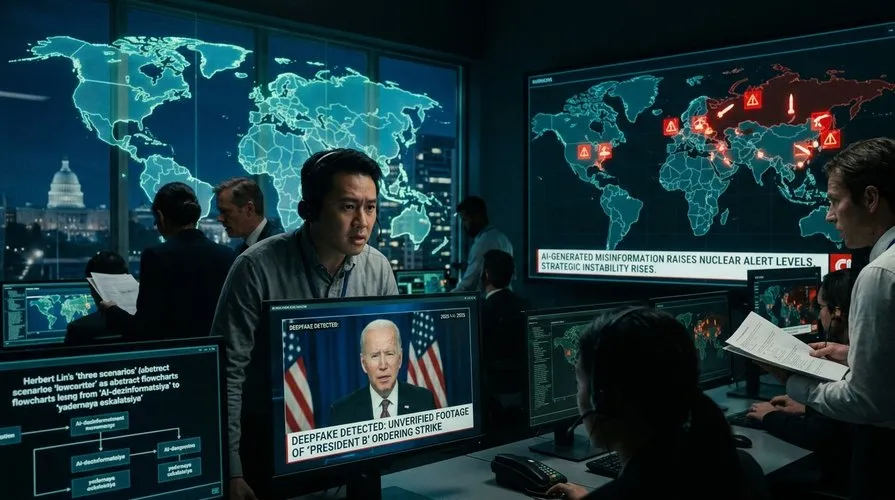
Large language models and deepfakes are transforming the information environment into a factor of strategic instability. Stanford researcher Herbert Lin illustrates, using three near-future scenarios, how AI-powered disinformation could push the world toward nuclear escalation.
About the author. Herbert Lin is a senior fellow at Stanford University and a former member of the editorial board of the journal Bulletin of the Atomic Scientists, one of America's leading researchers at the intersection of cybersecurity, information warfare, and nuclear policy.
In recent years, analysts have increasingly pointed out that Corruption or dysfunction of the global information environment can increase nuclear riskThis includes not only disinformation and deliberately false messages, but also provocative content, technically reliable but misleading information, and deliberate distraction.
The rapid development of artificial intelligence – primarily large language models (large language models, LLM, – systems like ChatGPT or Grok) has dramatically changed the landscape. The automatic generation of massive amounts of text, and increasingly images and videos, has made LLM perhaps the most effective tool for those interested in distorting the information environment. These systems significantly outperform previous approaches to producing such content, and the barrier to entry has significantly lowered: opportunities are available to a significantly larger number of potential attackers.
In his article, Lin examines three hypothetical but plausible scenarios of how AI-enhanced information corruption could lead to an increased risk of nuclear escalation. Some elements have already been observed in reality—albeit without the involvement of AI. Each scenario takes place after the departure of the current US administration in January 2029.
By this point, few experienced intelligence professionals remain in the new US government. Junior and mid-level officials, seeing the consequences for the authors of "inconvenient" reports, are quietly adjusting their conclusions. Traditional analytical methods are gradually being abandoned. Retired senior military and intelligence officials who question official White House statements face public censure and personal pressure, greatly amplified by new AI tools—not to mention congressional investigations and tax audits.
Scenario 1: Invasion of Taiwan (2029)
The scenario centers on platforms and services that facilitate communication between citizens of different countries: informal chats, dating apps, online platforms, and gaming platforms. All of these provide direct – albeit rather “noisy” – access to local perspectives. Language exchange sites and international forums allow foreigners to ask locals questions about everyday life and crises, while voice channels Discord provide multi-voice dialogue in real time.
These channels have long been used spontaneously to verify information: users share information about blockages, price hikes, or military activity with their foreign contacts, along with ordinary everyday events.
End of 2029. China imposes a blockade on Taiwan. American signals intelligence assets are detecting signals off the coast of Fujian Province, the closest province to Taiwan, indicating possible mobile phone launches. missilesChinese social media is filling up with messages purportedly from Fujian residents. Using local photos and slang, they describe missile trucks rolling through the streets of Fuzhou toward the sea.
These accounts are operated by Chinese military cyber units using sophisticated chatbots trained in regional dialects. The goal is to create the impression of high military readiness and deter the US from interfering. Loosely controlled, patriotic contractors and volunteers operate in parallel, providing Beijing with "plausible deniability" but weakening its centralized control over the information space.
The accounts use the personas of professionals or students "isolated" by the crisis. They attract journalists, analysts, and even mid-level Pentagon officials seeking "unfiltered" information. In one episode, a bot impersonating 28-year-old engineer "Li Wei" reports:
I saw columns of launchers heading east, probably DF-26s.
The reference is to Chinese medium-range ballistic missiles, capable of striking targets up to 4,000 kilometers away and carrying both conventional and nuclear warheads. A little later, the bot adds:
Sirens are everywhere, evacuations are beginning.
Then the X network (former Twitter) is filled with screenshots distributed by coordinated fake accounts.Bots flexibly adapt to queries, matching them in real time with open American sources. Dating app user tinder from Washington meets "Wang Mei," a fictitious nurse from Xiamen. In her messages, she describes her panic: explosions near the port, preparations for the use of hypersonic weaponsThis coincides with disruptions of American satellites caused by Chinese jamming and is beginning to cast doubt on US intelligence assessments.
In the United States, some of the materials are making their way into expert discourse. Open source intelligence analysts (OSINT), journalists and think tank experts incorporate screenshots and chat logs into maps, timelines, and situation reports, presenting them as independent confirmation of missile movements. Congressional staffers and allied governments cite this data. A vicious circle is created: fabricated correspondence is transformed into "multi-source evidence."
The US President convenes the National Security Council (NSC). However, like his predecessor, he is deeply suspicious of the intelligence community and places unusually high value on his own intuition and social media posts. Elected on a platform of "tough on China," he is surrounded by NSC staffers who are prone to seeking confirmation of Chinese aggression.
For several days, these reports have dominated crisis briefings. Hawkish advisers claim that signs of military activity point to an impending missile strike. American bases critical to Taiwan's defense—Kadena Air Base in Okinawa and Yokosuka Naval Base in Japan—are within range of Chinese medium-range missiles. Uncertainty is mounting and gradually turning into intent attributed to the enemyIncreased US surveillance—electronic reconnaissance aircraft—offer signals intelligence near Chinese territorial waters is being recorded by Beijing and interpreted as preparations for preemptive strikes.
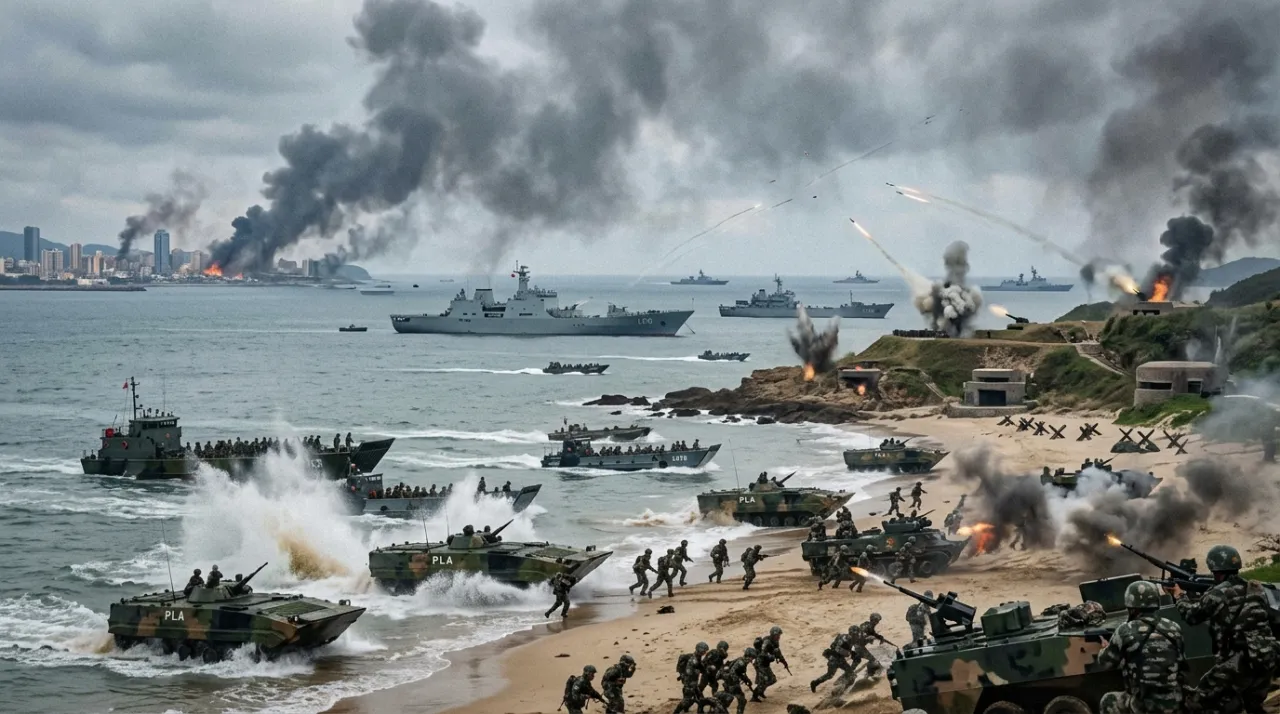
Under pressure from viral videos and an agitated political base, the president authorizes the deployment of B61-12 non-strategic nuclear bombs to the Pacific Ocean and emphasizes the presence of nuclear-capable F-35A fighter jets.
Chinese missiles are moving - America won't wait to be hit.
Leaks and satellite images document the deployment of dual-use weapons. Commentators point out that the B61-12 can also be installed on strategic bombers, heightening uncertainty about whether Washington is planning a full-scale nuclear war. Chinese analysts warn that tactical deployments, bomber sorties, and the president's rhetoric signal a shift to first-strike planning. China is also increasing its combat readiness. Allies in Japan and South Korea, unsure whether the US actions are defensive or escalatory, are publicly hesitant.
As fears grow, bots shift to narratives of "Taiwanese provocations" and "aggressive surfacing" by American submarines. The feedback loop accelerates: public agitation peaks, allies lose confidence, and de-escalation channels become clogged with denials drowned in digital noise. What began as algorithmic background noise develops into a strategic impulse, pushing the crisis toward an irreversible exchange of blows.
Scenario 2. A sequel to "The Interview" that goes into crisis
In 2014, Seth Rogen's comedy The Interview, which depicted the fictional assassination of Kim Jong-un, sparked a sharp rise in tensions between the United States and North Korea. Pyongyang called the film an "act of war" and threatened retaliation. A cyberattack on Sony Pictures: data leak, paralyzed systems, canceled theatrical release due to threats. The film was later released online, amid US sanctions and declarations of protection for free speech. There was no military mobilization, but the crisis was almost full-scale.
By 2029, analysts in Washington and Pyongyang viewed this episode as proof that popular culture can intersect with harsh statecraft. American policymakers saw it as justification for sanctions. For the North Korean elite, it was proof that even B-movie Hollywood satire could mobilize US attention. Concerns grew that cultural products were signaling preparations for regime change, rather than remaining harmless mockery.
In the late fall of 2029, the new US administration attempts to ease tensions with Pyongyang. As a gesture of goodwill—and also addressing the record grain surplus facing American farmers—the president authorizes large grain shipments to North Korea. A month later Sony announces a sequel, "The Interview 2: Sequel Fury," a rebooted metasatire, this time built around deepfakes of Kim Jong-un in absurd situations.
With the release of the trailers, advanced AI agents flood the X network and other social media with fake videos featuring North Korean officials. Bots trained on regime rhetoric publish fake "decrees" declaring the film a "cyber-nuclear provocation." Simultaneously, fabricated videos appear showing Kim allegedly authorizing the launch of a Hwasong-18 intercontinental ballistic missile at Hollywood. Actual footage of the 2026 test is mixed with synthetic inserts. The chatbot material goes viral. Grok, built into the X network, initially fools even experienced fact-checkers.
This campaign is being waged by a transnational network of hardliners against North Korea who view warming as a betrayal. Their goal is to poison the atmosphere, provoking an overreaction from Pyongyang, Washington, or both.
Seth Rogen retweets a bot-generated "warning" about North Korean submarines off the coast of California:
Round 2: Kim has torpedoes for my failures.
Cameo appearances by Elon Musk and Donald Trump enhance the spectacle. Musk, live on the X network, sets the tone Grok question about the "likelihood of an invasion of North Korea" and receives AI assessments distorted by poisoned data.
В news tapes are also breaking through and other materials are being released - for example, footage from drone, where reactors in Yongbyon are allegedly "increasing plutonium production." They would later be linked to radical North Korean groups using generative adversarial networks (GAN) – machine learning models for creating realistic synthetic data. Markets are falling amid the #SequelDoomsday trend on social media, combining cryptocurrency panic with a surge in demand for essential goods.
On the fourth day after the announcement Sony The president is convening the National Security Council. Social media is engulfed in a frenzy fueled by media personalities and celebrities; it is this frenzy that shapes the context for policy decisions. Posts by Rogen and other celebrities citing fabricated fragments from the Korean Central News Agency (KCNA) don't directly influence the National Security Council, but they lend the fabrications a veneer of credibility. Musk's public dialogue with his AI system is driving expectations toward a crisis scenario, pressuring leaders to take action—even as analysts discuss underlying uncertainties.
In Washington, analysts disagree on North Korea's actual preparedness, interpreting satellite images and signal intercepts through the distorting prism of the fabricated Yongbyon images. National Security Council leaders fear that inaction will be perceived by allies and adversaries alike as weakness. As a signal, they endorse the deployment of two American aircraft carriers to the Yellow Sea for a "deterrent patrol."
In Pyongyang, the leadership, having observed for years the "decapitating" statements of American officials and remembering the lessons of Iraq and Libya, is succumbing to the influence of several factors at once: a fabricated video of the US president approving the flyovers of B-2 strategic bombers; real movements of naval forces; and a hostile – and therefore understandable for the North Korean side – interpretation of the plot of "Sequel Fury."
Convinced that Washington is rehearsing regime change under the guise of comedy, the North Koreans release footage of Kim inspecting several nuclear warheads on a single intercontinental missile and conduct an unscheduled launch of a satellite into low Earth orbit. Externally, it appears indistinguishable from the prelude to a nuclear strike. nuclear electromagnetic pulse weaponsThis type of munition detonates in the upper atmosphere and disables electronics over a vast area.
On both sides, denials of aggressive intent are drowned in suspicions amplified by AI. AI-powered disinformation doesn't create a crisis, but it risks pushing it toward war, adding a dangerous layer of escalation to an already fragile exchange of signals.
Scenario 3. "Smart Archer" with artificial intelligence (2033)
In 1981, the USSR, fearing a full-scale nuclear first strike from the Reagan administration, launched Operation RYAN (Nuclear Missile Attack) – an early warning program for a Western nuclear attack. The USSR Ministry of Defense monitored changes in indicators considered strategic by the General Staff: blood supplies, population movements, logistics and food supplies, and the organization of medical care in the event of a nuclear strike.
The conceptual basis was the Soviet concept of "correlation of forces"—a holistic measure of relative power encompassing political, economic, and ideological factors, not just military potential. By comparing changes in these indicators, RYaN was intended to identify moments of heightened danger of a massive nuclear attack.
It is this framework that has transformed NATO command and staff exercises Able Archer 83 into a major crisis. Realistic maneuvers, including nuclear escalation procedures and the participation of senior leadership, took place against a backdrop of tense relations between the USSR and the United States. According to available information, Soviet forces increased combat readiness and possibly loaded nuclear weapons onto aircraft, while NATO remained unaware of the extent of the threat Moscow perceived their actions to be. This holistic, multi-domain assessment continues in Russian military strategy today.
By 2033 year In Lin's scenario, Russia deploys RYAN-II, an AI-controlled early warning system for a first nuclear strike. It automates the logic of the original program and focuses on systemic competition: information control, regime stability, resilience to sanctions, and technological sovereignty are viewed as key axes of advantage and vulnerability. The approach is inherently conservative: it assumes that official government sources and Western media systematically generate disinformation directed toward the East and favors worst-case scenario interpretations.
RYAN-II relies on large language models and predictive analytics, processing tens of thousands of data streams. These include political elite behavior (leader movements, speech analysis), military posture (comparison of exercises with baselines), civil and economic mobilization (procurement and financial flows), and cyber activity (attempts to probe nuclear weapons control systems). Public and private data—from satellite imagery to social media and diplomatic traffic—is transformed into structured indicators and anomaly alerts. RYAN-II does not issue launch orders, but its rigorous risk assessments significantly influence the threat perception of the Russian military leadership.
Crisis unfolds during NATO exercises Able Archer 2033, including cyber operations, space maneuvers, and the deployment of hypersonic missiles dark eagle in Germany. These actions resemble high-risk scenarios embedded in the RYAN-II training data. The system assesses the situation as extremely serious.
The information environment is simultaneously becoming polluted with AI-based disinformation. NATO memos about strikes on Kaliningrad are being distributed through Russian channels—according to Russian sources, fabricated by CIA and NSA agents. The Western information space is being flooded with synthetic reports about Russian mobilization. Most of these materials are labeled as false, but some leak onto the dashboards of Russian analysts, undermining the credibility of all assessments.
Based on conservative system assessments, Russia is dispersing its strategic forces and increasing combat readiness. These steps are doctrinally justified, but NATO perceives them as escalation. Analysis of Western AI systems leads some analysts to overestimate Russia's first-strike readiness. A dangerous vicious circle is emerging.
As tensions escalate, the US president initiates talks with the Russian president, but cyberattacks degrade the quality of the video link—frequent interruptions, frozen frames, and audio loss. The White House Situation Room deploys an AI tool to detect deception in the video feed. It hasn't been tested on low-quality video and is of questionable reliability. Despite warnings from staff, the president insists on its use. Neither leader is convinced by the other's assurances; the conversation ends without any concrete commitment to de-escalation.
NATO will deploy batteries in two days dark eagle to field positions. This weapon is capable of reaching Moscow in 10-14 minutes. Shortly after deployment, an industrial accident occurs with a powerful explosion. A Russian early warning satellite detects an infrared signal corresponding to the launch. dark eagleThe intensity and 100-second duration are consistent with the parameters of a rocket booster, and atmospheric conditions create the impression that the thermal plume is moving like a missile. Ground-based radars do not confirm the trail, but it appears consistent with the behavior of a maneuvering hypersonic weapon evading radar detection.
In the midst of a hasty evacuation to a secure location, the Russian president asks high-ranking military officials:
How confident are you in the attack?
They answer him:
The computer shows 95 percent certainty. The satellite detected the launch. We couldn't wait for the radar signal. And remember: two days ago, the US President announced that hypersonic weapons could be used as part of the exercises—even though you warned that would be a serious escalation.

In conditions of extreme time pressure, the Russian president is considering the possibility of using "Perimeter" – an automated "dead hand" control system. It is designed to ensure the transmission of launch orders to nuclear forces even if the leadership is destroyed. Perimeter is normally in sleep mode; when activated, it can automatically transmit a launch order if it detects nuclear explosions and loss of communication with the General Staff. The President discusses:
There's no harm done. If there's no attack, we can cancel the order.
He gives the order to activate.
This decision triggers processes within Russia's nuclear command system, some of which could be detected by American intelligence and interpreted as dangerous escalation, fueling another spiral. The third scenario is the most catastrophic.
What do these scenarios have in common?
At first, none of which rely on AI per se to be a high-impact scenario. Large language models and sophisticated chatbots became widely available in 2022, and disinformation was known as a powerful disruptive force long before that. Just recall Operation Fortitude – an Allied disinformation operation during World War II. The simulacrum of a huge fictitious army group in southeast England, ready to strike at Pas-de-Calais, successfully convinced Hitler to delay the transfer of reinforcements to Normandy, where the real landing took place on June 6, 1944.
Secondly, disinformation efforts are more successful when they exploit cognitive vulnerabilities target audience. In high-pressure crises, even reserved leaders tend to act quickly and take visible escalatory steps based on incomplete or ambiguous information. In the scenarios described, raising the alarm level, redeploying troops, and distributing nuclear weapons to units become reflexive reactions to perceived threats rather than the result of a deliberate choice. This tendency compresses decision-making time and makes it difficult to change course once the situation has gained momentum.
Meanwhile, one side's precautionary measures—missile movements, alert level changes, aircraft carrier deployments—are perceived by the other as preparations for an offensive. Distinguishing a defensive stance from genuine preparations for a missile strike becomes extremely difficult, and managed tension escalates into a risky nuclear standoff.
Another cognitive distortion is visibility effect: a tendency to focus on the most salient attribute of a choice, even when other factors are equally significant. In the scenarios under consideration, American analysts prioritize reports of "missile convoys" generated by bots over ambiguous radar data. The National Security Council (NSC) casts doubt on the real threats from North Korea, prioritizing positive signals. The Russian side overrelies on RYAN-II assessments while paying insufficient attention to radar data. Leaders overemphasize the most obvious and emotionally charged threat indicators, ignoring contradictory or less compelling data.
Third factor AI is dramatically exacerbating an already complex situation. Advanced LLMs and deepfakes create content that looks and sounds highly realistic, making it more persuasive and harder to refute. In scenarios, it's precisely this persuasiveness that leads analysts and decision makers to overemphasize AI-generated videos, chat logs, and risk assessments, viewing them as reliable evidence rather than as potential targets for manipulation.
Worse, AI disinformation is adaptive, scalable, and designed to exploit the vulnerabilities of nuclear command and warning systems. Synthetic content shapes preliminary assessments, crisis briefings, and political narratives, often exerting greater influence than traditional intelligence. Information manipulation is becoming a direct factor in nuclear risk.
Overall, deepfakes, synthetic "intelligence," fabricated eyewitness accounts, and manipulated satellite data don't just mislead—they systematically overload analytical capabilities and compress decision-making timelines. The information environment is becoming overwhelmed with plausible but false leads that analysts must consider potentially significant.
In such conditions, it intensifies automation biasDecision makers seek clarity in a flood of true and false signals and are forced to make important choices under increased time pressure, relying on more incomplete assessments than in typical crises.
Fourthly, growth personalist regimes It further distorts the information environment by subordinating institutional expertise to the leader's personal characteristics—his intuition and emotional reactions. Intelligence agencies cease to function as independent analytical structures and begin to reflect the national leader's views. Processes designed to filter noise and correct biases are reoriented toward legitimizing the leader's predetermined preferences.
In disciplined analytical systems, ambiguous signals and synthetic content would be viewed as noise to be filtered. However, when intelligence is politicized and agencies shape judgments to suit the leader's expectations, these filters are neutralized—and these same ambiguities are more likely to be interpreted as genuine signs of hostile intent.
Partly due to a distrust of professional intelligence, political leaders rely more on their own judgment and unfiltered information: social media, open discussions, AI-generated content. Attention is focused on what is most dramatic or personally significant: a single, effective but potentially misleading signal can prove decisive. Subordinates have little incentive to challenge a leader's bias, making rational decisions even less likely.
To the four factors listed above, a more general methodological observation should be added. The problem of AI disinformation is not solved by AI systems that determine whether information is AI-generated, false, or both. The fundamental question is how to make such a determination in an environment where truth itself is unstable and uncertain. Given only the information element itself and dealing with systems capable of producing results that are increasingly difficult to distinguish from human ones, the analyst is forced to rely on an assessment of the plausibility of its origin. Relief is possible with the availability of channels that are particularly resistant to compromise—but such sources are always partial, not universal. The traditional search for "truth" is replaced by a persistent state of uncertainty: analysts operate in a gray zone dominated by probabilistic uncertainty regarding the origin and reliability of supposed evidence.
Conclusion
Making rational decisions in the face of disinformation is difficult enough. Cognitive biases that distort information processing make the task even more challenging. The idiosyncrasies of current Western political leaders add another layer of complications. And the inclusion of AI greatly amplifies the distortion of the information environment.
The scenarios presented indicate that AI-induced information dysfunction has enormous potential to pollute the ecosystems in which decisions about war—and sometimes even nuclear war—are made. At the same time, they demonstrate that AI acts primarily as threat multiplier: the primary threat is the dysfunctional information environment in which the world lived long before the advent of ChatGPT in 2022 year.
Two practical conclusions follow from this. There's a: the information environment will always be polluted and, to one degree or another, uncertain – this must be accepted as a given. SecondLeaders remain human and, therefore, have cognitive blind spots that require institutional procedures to manage. And these rules must be followed—even, and especially, when pressure arises to circumvent them.
Information