Korean War: Jets Are Your Way Out!
15 416 53
Korean War: Jets Are Your Way Out!
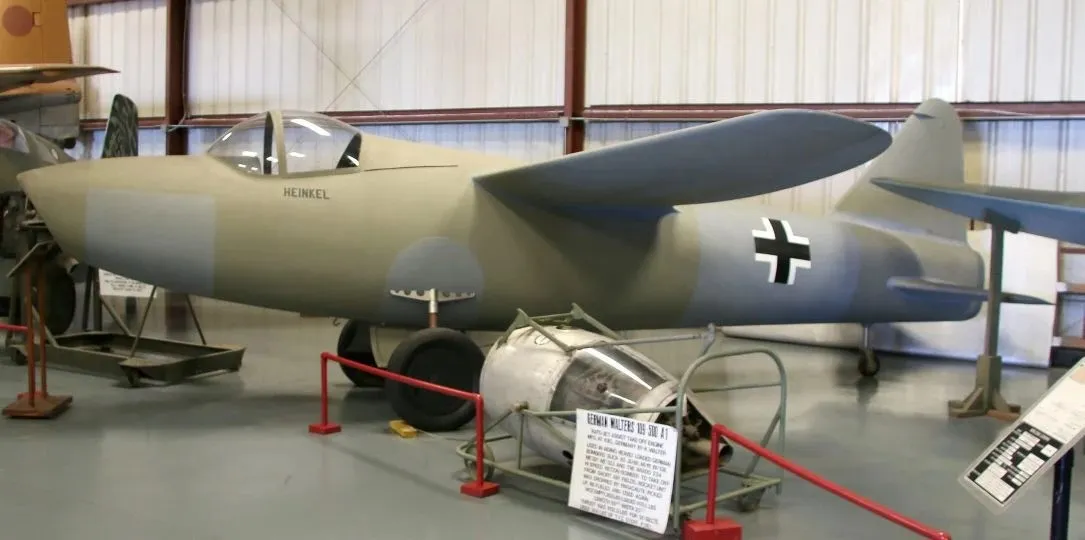
Не-178 - the firstborn of a new era

Although Soviet and American pilots first encountered each other in the skies over Korea, it was the Germans and British who were the first to usher in the jet age. The He-178 was powered by the HeS 3 engine, designed by Hans von Ohain, but he wasn't the inventor of the turbojet engine. British test pilot and Flight Captain Frank Whittle patented his engine design back in early 1930, but the distance from patent to hardware was considerable: the Royal Air Force wasn't interested. In fact, this was to Whittle's advantage: he retained the rights to the idea, and after securing funding, the inventor, along with two partners, James Tinling and Rolf Williams, founded Power Jets Ltd.
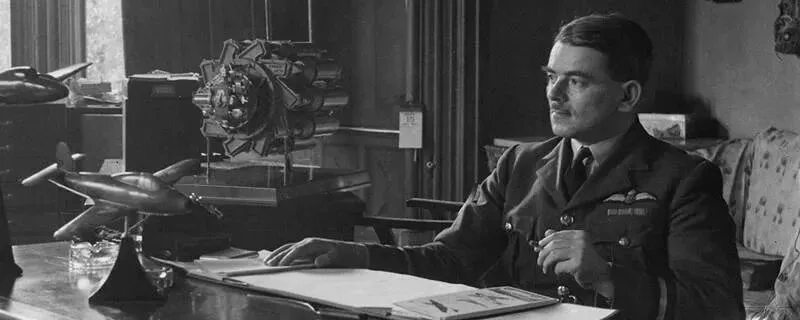

Flight Captain Frank Whittle

It's not that the Luftwaffe generals were fond of jets. aviation, but at least the drag was less. As a result, the Germans beat the British by nine months. However, the quality of the early engines varied: the German production Junkers Jumo 004 produced 950 lbf of thrust (the Germans measured it in kgf, but I'm converting to imperial units for comparison) versus 860 lbf for the British, but due to a cobalt shortage, its service life was only 25 hours. Nevertheless, the He-178 and He-280 were the first jet aircraft, and the British Gloster E.28/29 was only the third. However, all of these were just prototypes...
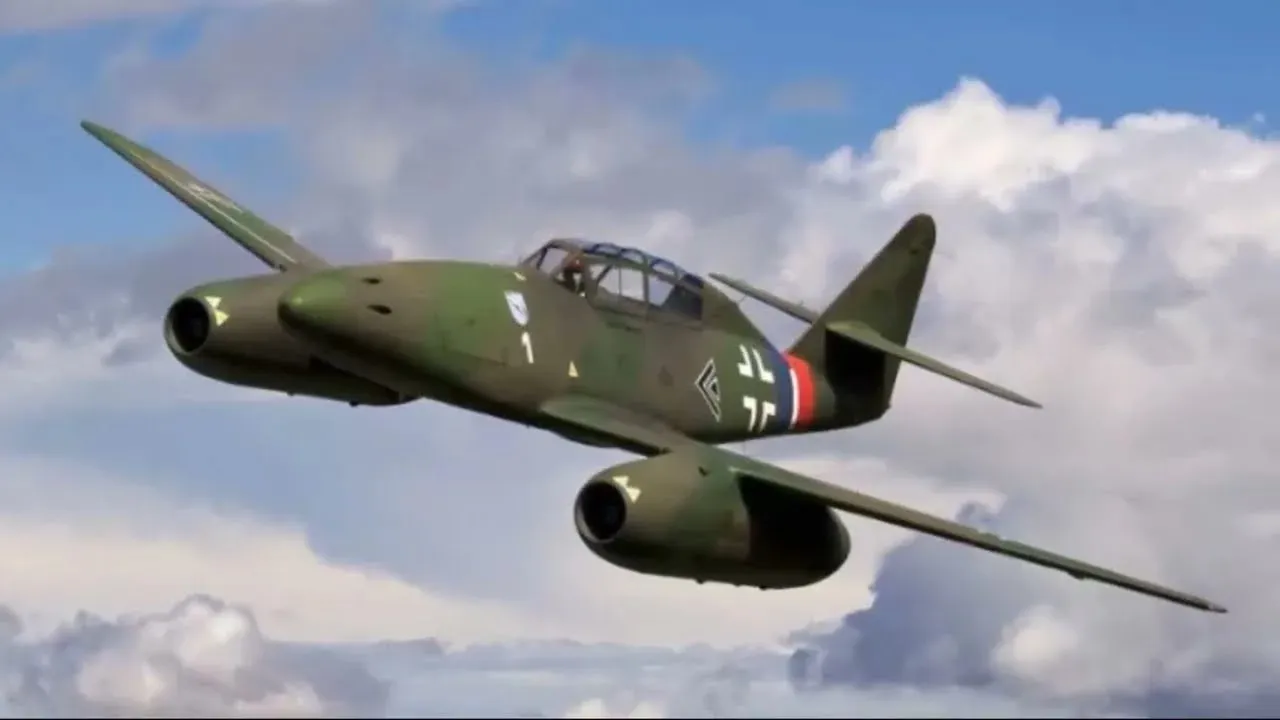


Me-262 "Schwalbe"

Since this story is about the Korean War (has anyone forgotten that?), and the Me-262 Schwalbe didn't participate in it, it's not worth dwelling on this aircraft at length. However, it's worth mentioning that the Lastochka featured such innovations as swept wings (the sweep wasn't great, but it was there!), a delta-shaped fuselage, and an ejection seat, and most importantly, the Junkers Jumo 004 engine, which became the prototype for the first Soviet turbojet engines, the RD-10. Copying this German engine gave rise to the Soviet school of jet engine engineering, which today is one of the most advanced in the world.
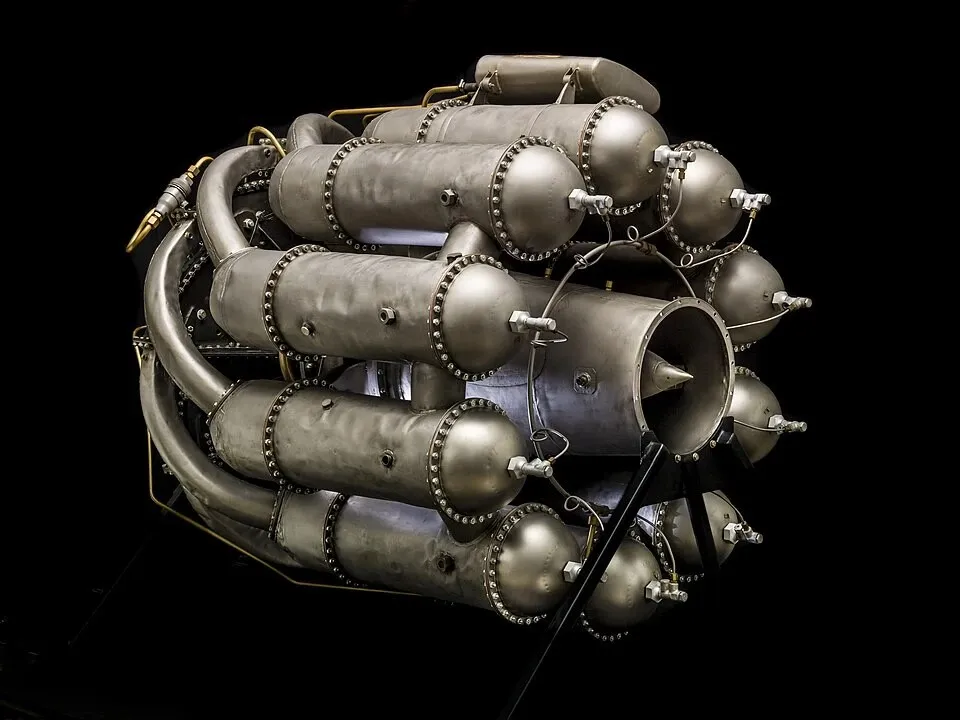

Power Jet W.1

The British Gloster Meteor fighter deserves a closer look! Whittle's Power Jets Ltd. had been working on its engines since 1936. The first prototype, the Power Jets WU, began testing on Cosmonautics Day, April 12, 1937. The engine produced a staggering 2950 horsepower. Why staggering? The piston-powered Rolls-Royce Merlin, in production at the time, produced 1290 horsepower. However, this model was experimental and was never installed in aircraft. The next, the Power Jets W.1, was installed on the experimental Gloster E.28/29, which made its maiden flight on May 15, 1941. During testing in February 1942, the aircraft reached a speed of 430 mph (690 km/h). By comparison, the hero of the Battle of Britain, the Spitfire Mk.V, could reach a maximum of 375 mph (602 km/h). Now all that was left was to build a jet fighter!
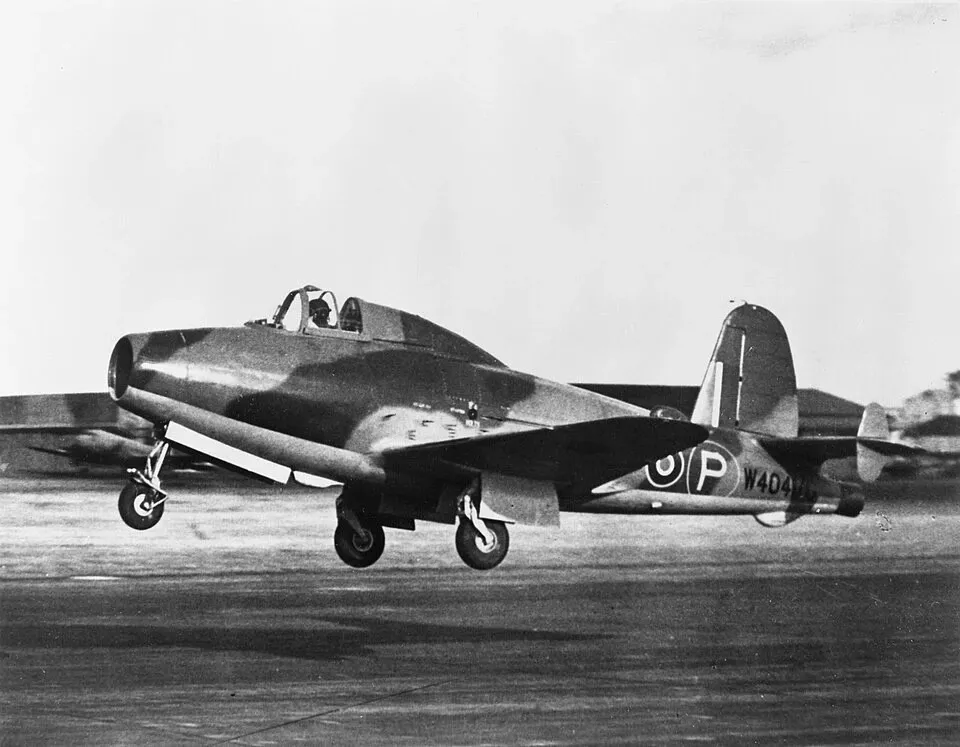

Experimental Gloucester E.28/29

On February 7, 1941, Gloster received an order for 12 prototypes of the aircraft, but this number was subsequently reduced to eight. Initially, the aircraft was planned to be called the Thunderbolt, but the Americans had already transferred the P-47 Thunderbolt to the British, and to avoid confusion, the future aircraft was christened the Meteor. The prototype, designated the Gloster Meteor Mk.I, made its maiden flight on May 15, 1941. However, development of the aircraft continued until 1944. Nevertheless, on July 12, 1944, the jet aircraft was accepted into service with the Royal Air Force. The first batch of 20 fighters was delivered to 616 Squadron. On October 10, a series of training battles was conducted: the Meteors attacked a formation of a hundred Fortresses, covered by Mustangs and Thunderbolts. The result was exactly the same as what Soviet pilots would demonstrate in Korea: escort fighters were unable to stop the jets' attack, and the bombers suffered heavy losses.
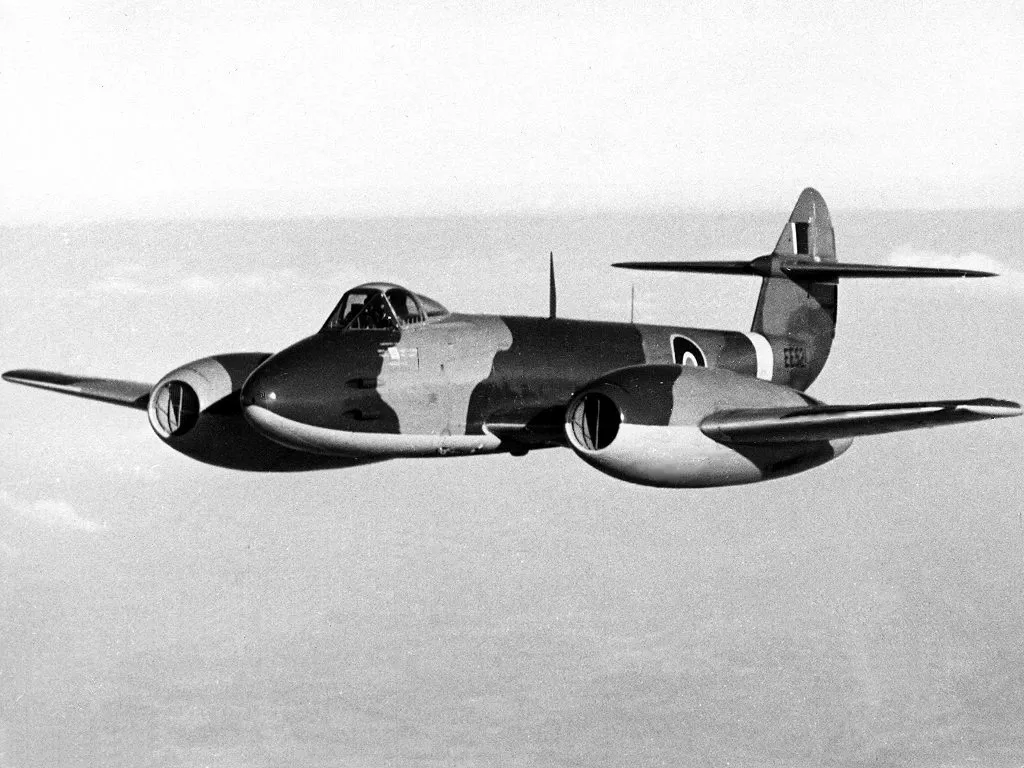

Gloucester Meteor

The Gloster Meteor Mk.I was powered by two W.2B/23C Welland engines in wing nacelles and had a top speed of 4 mph (660 km/h). Four 20mm Hispano cannons were mounted in the nose, a significant advantage over piston-engine fighters whose armament was spread across the wings. Was the Meteor a good aircraft? Absolutely not! A full list of its flaws would fill several A4 sheets. It's worth mentioning landing gear issues, weak brakes, yaw in flight, the lack of an ejection seat, and cannons that jammed after the first shot or refused to fire at all... But it existed, and it flew!
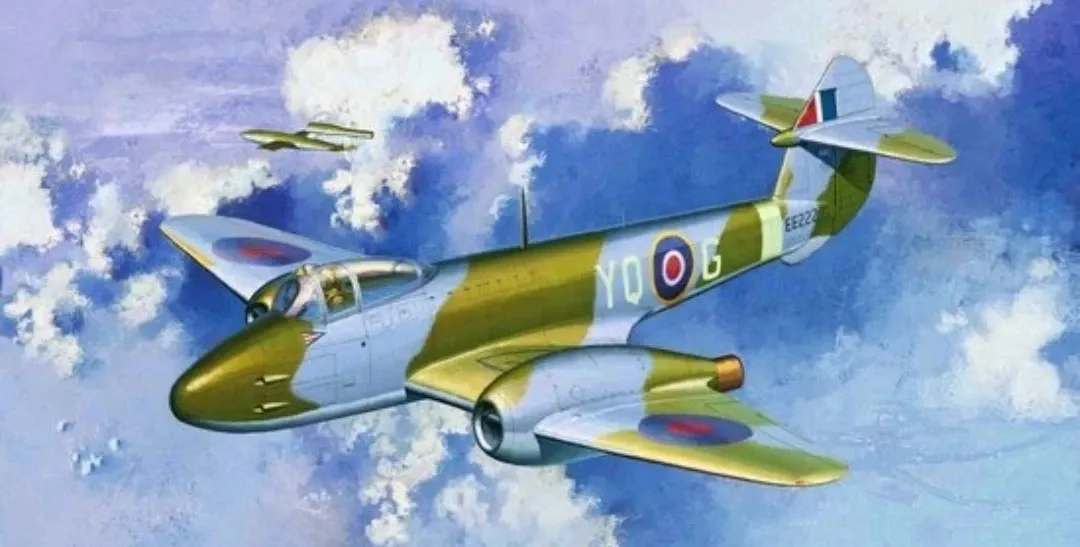

Gloster Meteor and V-1 - made for each other!

True, Meteors weren't allowed to engage enemy aircraft. Moreover, jet fighter pilots were strictly forbidden from flying over enemy-occupied territory, lest a shot-down (or simply crashed) top-secret aircraft fall into enemy hands. Tellingly, Me-262 Schwalbe pilots were also forbidden from flying over enemy-occupied territory for exactly the same reasons! In short, for this reason, there were no combats between jets in World War II. What did Meteors do? Well, they found something to do: shoot down V-1 bombs. However, given the poor performance of their cannons, they did this using the "rolling strike" method: the pilot carefully approached the very edge of the aircraft. rocket, then carefully (after all, the V-1 carried almost a ton of explosives!) he would tuck his wing under the rocket's wing and lift off. The rocket would flip over and fall. In total, 616 Squadron pilots shot down 13 V-1s, of which only J.C. Rogers managed to do so with a cannon...
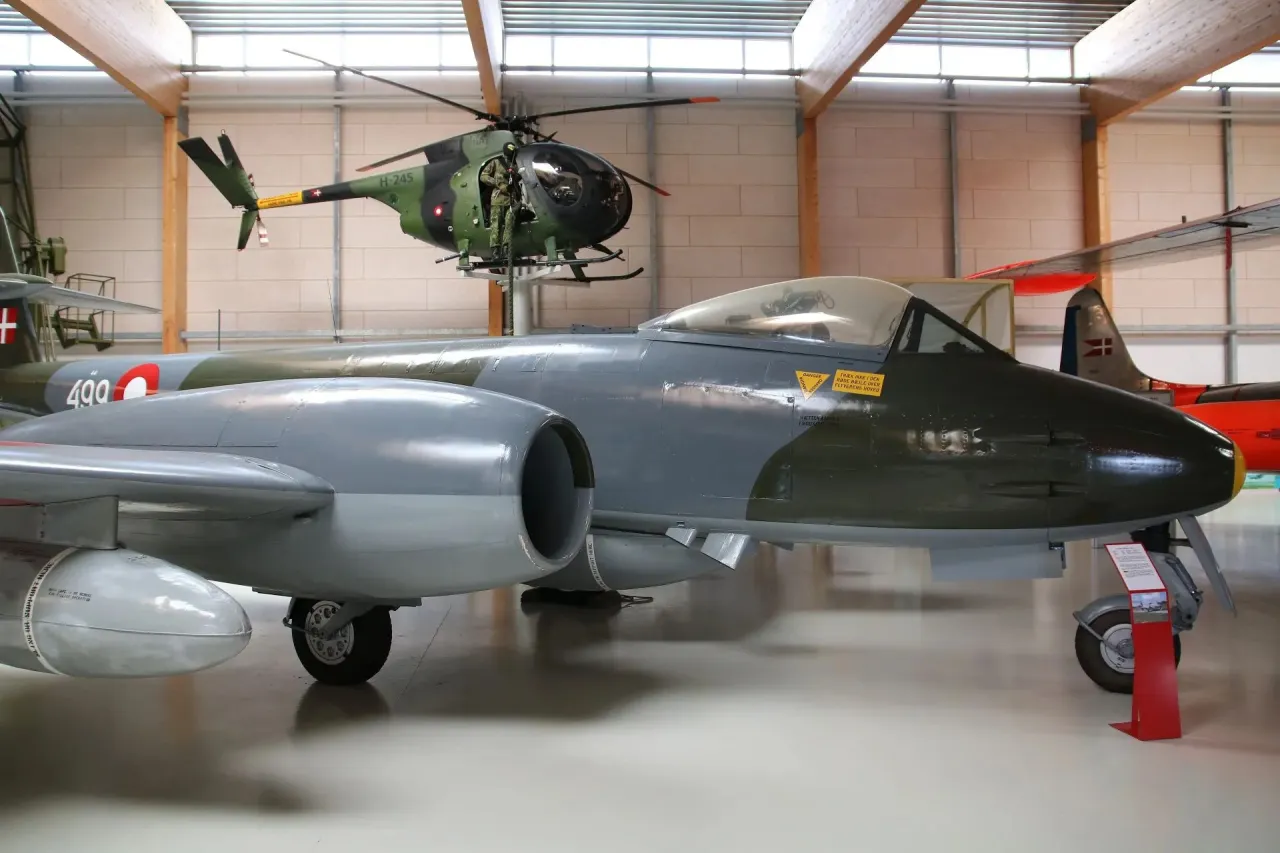

Danish Air Force Gloster Meteor Mk.8

But World War II is not the topic of this story. Afterward, the aircraft's development continued: the Welland engines of the Meteor F.Mk IV were replaced by Derwent engines, which produced twice the thrust and increased speed by 179 km/h. On November 7, 1945, a specially modified Meteor F.Mk I set a world speed record of 969,6 km/h. The Meteor F.Mk 8 became the most numerous model, with 1183 aircraft built. This aircraft made its maiden flight on October 12, 1948. The aircraft was equipped with a catapult, a gyroscopic sight, and an additional fuel tank with a capacity of 432 liters, and the Derwent 8 engines produced 1633 kg of thrust.
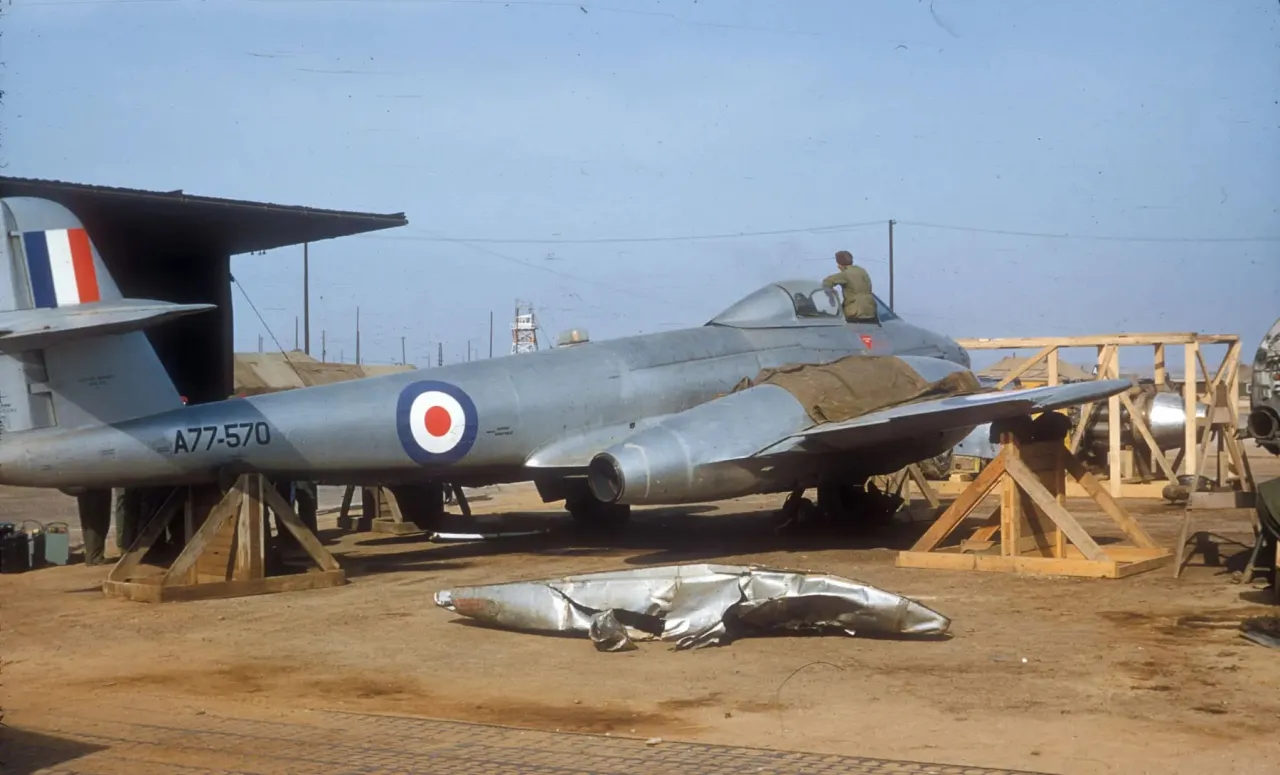

An Australian Gloster Meteor undergoes maintenance during the Korean War.

Meteors fought in Korea, flown by pilots of No. 77 Squadron of the Royal Australian Air Force. Their mission was to escort B-29 Superfortress bombers. Meteors also encountered Soviet MiG-15s. Soviet pilots claim to have shot down 26-28 Glosters, while the Australians admit to losing three. However, both sides agree that the Meteors failed to shoot down a single Soviet MiG (they allegedly managed to down a couple, piloted by inexperienced Chinese pilots): by 1951, the aircraft were already obsolete. Meanwhile, according to Australian data, the RAAF lost a total of 54 aircraft out of 90 available in Korea. How do these figures reconcile? Excellent! Meteors were easily destroyed without outside intervention: of the 3875 Meteors produced, across all modifications, 890 crashed, killing around 450 pilots. However, one shouldn't be so harsh on the pioneer of British jet aircraft: all early jets were more dangerous to their own pilots than to the enemy—new engines allowed for high speeds, and the same criteria were applied to the airframe design.
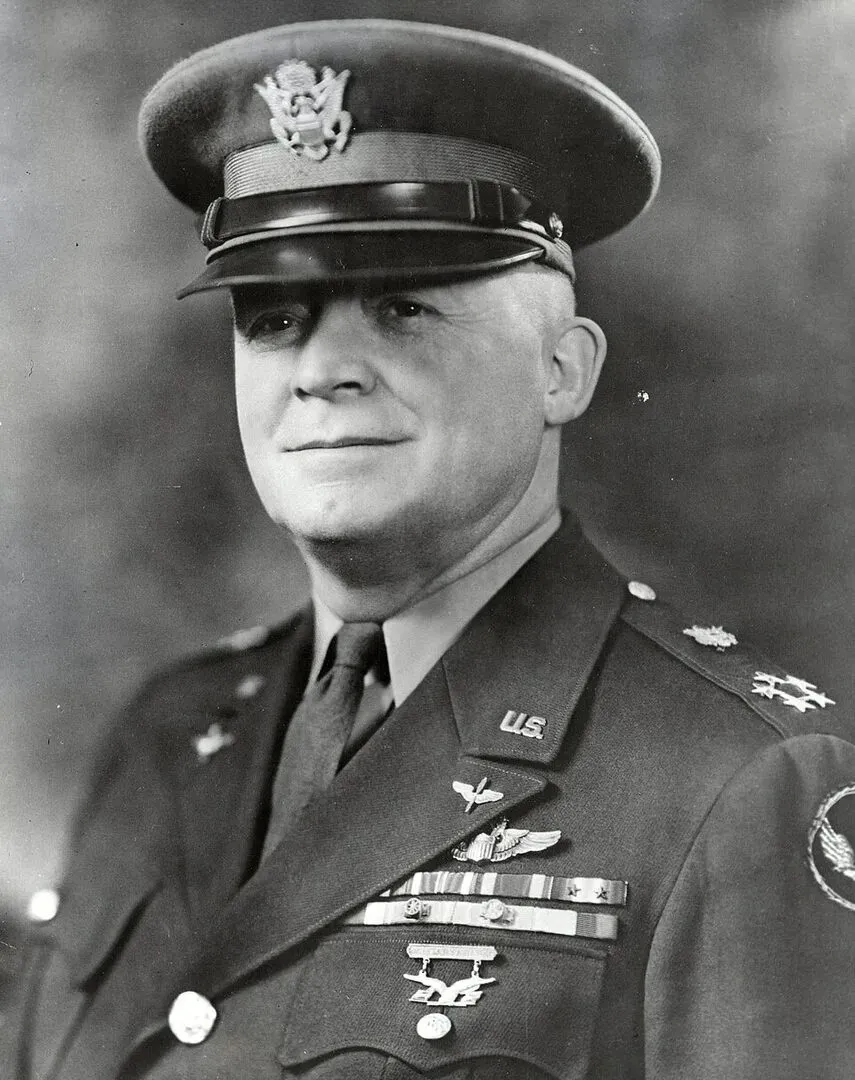

General Henry H. Arnold

But that was the British. And what about their "overseas cousins"? Well, in the US, things were very bad in terms of jet aviation! Because in terms of piston engines, they were doing very well... To rectify the situation, the American Air Force commander, Lieutenant General Henry Arnold, flew to the islands in 1941. Thanks to his efforts, a Liberator flew from England to the US, carrying a carefully packed Whittle W.1X jet engine and plans for the more powerful W.2B/23. A team of engineers from Power Jets accompanied the cargo...
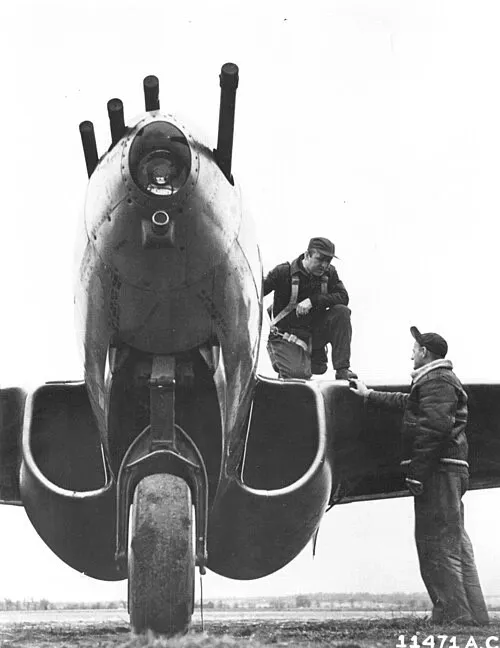

R-59 Aircomet

Soon, General Electric received a contract to develop its own engine based on British designs. It took American engineers 28 weeks to produce their Type 1. On May 18, 1942, testing of the Type 1-A began, producing 1250 pounds of thrust. Once the engine was accepted into service, aircraft construction was not an issue: Bell produced the P-59 Aircomet, which took to the air on October 1, 1942. In July 1943, the US Air Force placed an order for 100 of these aircraft (later reduced to 50).

Technically, the Aircomet was a fighter: it even carried armament. Some had a pair of 37mm cannons, others a single cannon and three heavy machine guns. In reality... In reality, the performance characteristics of these aircraft were inferior to the piston-engine Mustangs and Thunderbolts! Didn't I write that the Americans were doing very well in terms of piston-engine aircraft? In short, their conventional aircraft were so good that the P-59 immediately became a trainer: everyone knew the jet age was ahead, and Bell's firstborn aircraft weren't good for much more. But the outlines of a completely different machine were already taking shape on the drawing boards. The one that Soviet pilots would eventually encounter in Korea.
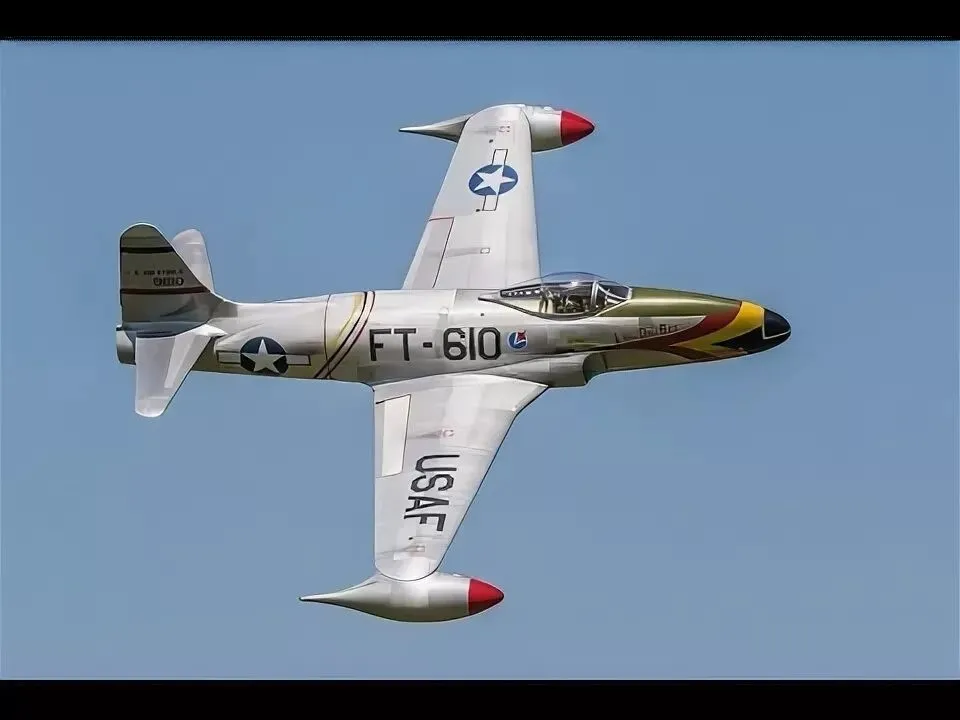

R-80 Shooting Star

"Shooting Star" is the American nickname for the meteor. In fact, the American P-80 Shooting Star, developed by Lockheed, was the Meteor's equivalent. Design work began on June 26, 1943, with Frank Halford's British Halford H-1 engine, later designated the de Havilland Goblin (later, a more powerful General Electric engine with 4600 pounds of thrust was installed). The aircraft made its maiden flight on January 8, 1944, and by the end of the year, the US Air Force had received 12 pre-production aircraft. A pair of pre-production P-80s even flew over Italy during World War II, but they did not see combat.
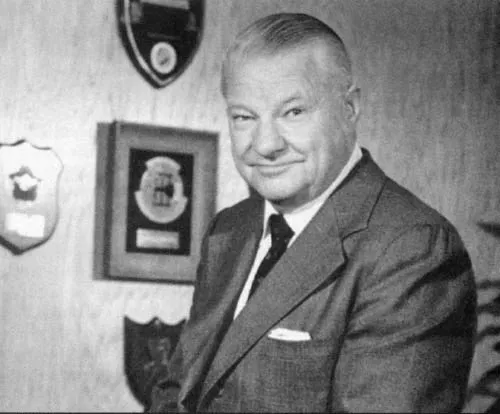

Clarence Leonard "Kelly" Johnson - the "daddy" of the P-80

The aircraft was accepted into service by both the US Navy and Air Force, which redesignated it the F-80. It was still a piston-engine aircraft, with a straight wing, so its lifespan, in an era of rapid aviation development, was short: the Shooting Star was decommissioned in 1959. However, the aircraft did manage to see combat in Korea! Interesting fact: the aircraft was designed in a hut covered with a rented circus tent—all for the sake of speed and secrecy. Speaking of secrecy, of the 130 people working on the project, only five knew they were developing a jet. Project designer Clarence "Kelly" Johnson promised to have a prototype ready for testing within 180 days. They did it in 139—when necessary, Americans know how to work fast...
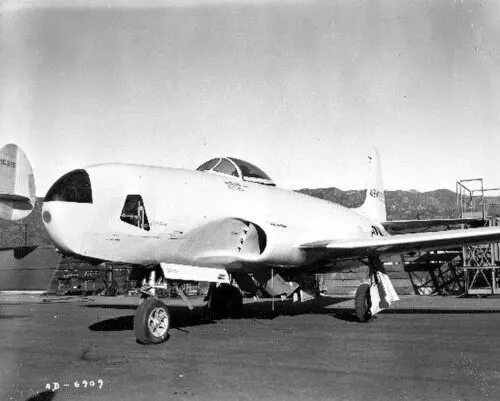

FP-80A photo reconnaissance aircraft

The P-80 was an all-metal aircraft with a lower wing and tricycle landing gear. For the first time, the engine of a production fighter was located inside the fuselage; previously, engines lacked power and were installed in pairs in nacelles under the wings (except for experimental aircraft). Initially, the Americans designed the air intakes too weak, which was pointed out to them by a British colleague. His advice was ignored, and during testing, both air intakes were sucked into the engine, causing it to die. A second engine had to be ordered from England. The cockpit was pressurized with a relatively simple instrument panel. Additional fuel tanks could be mounted on the wingtips. The aircraft became the first in the US Air Force to exceed 500 mph (800 km/h), reaching 504 mph (811 km/h). Later modifications reached speeds of up to 956 km/h. Armament: 6 machine guns of 12,7 mm caliber, 8 unguided rockets of 127 mm caliber, 2 bombs of 450 kg.
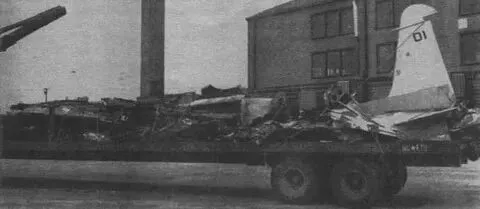

A destroyed R-80 "Shooting Star"

The aircraft became notorious for its extremely high accident rate—the highest of any American fighter. But, to be fair to the aircraft, the cause of the accidents was the pilots' lack of familiarity with jet aircraft—they were accustomed to piston engines and didn't understand the "voice" of jet engines. The P-80 entered service in February 1945, with initial plans for a massive 5000 jet fighters! But the war ended, and the "sturgeon" was cut back to 2000 units. The first modification was the P-80A, the P-80B was designated a racing model, and the most numerous in the family was the P-80C, with 927 produced. A total of 1714 P-80s were built.
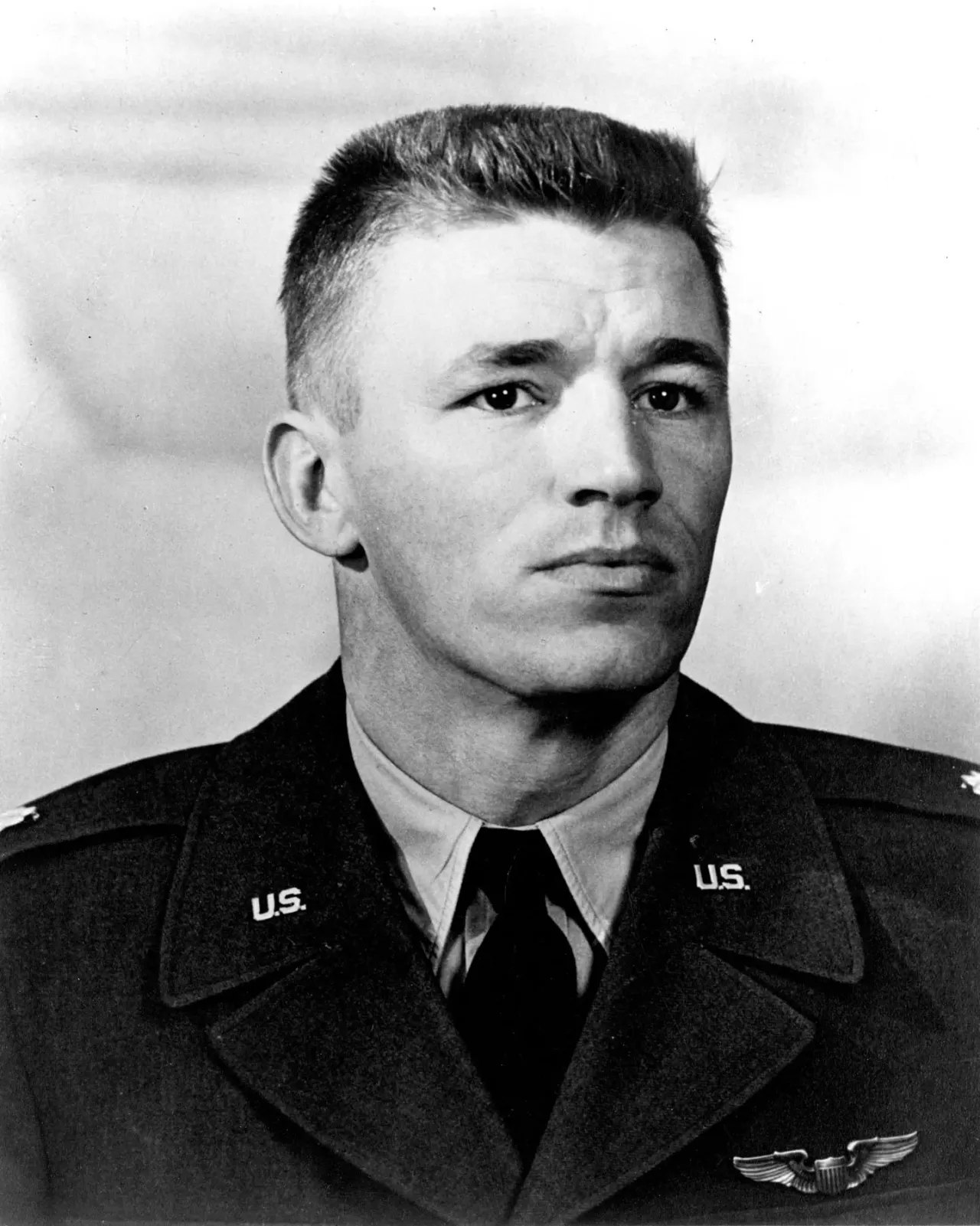

Major Charles Loring Jr., a P-80 pilot who repeated Gastello's feat

By the start of the Korean War, the P-80 was already obsolete: in occupied Germany, the Americans (though not only them!) had acquired German swept-wing designs, and the next aircraft, the hero of this story, was built with them in mind. During the war, the aircraft served primarily as a photo reconnaissance and attack aircraft; it wasn't particularly effective as a fighter. 368 F-80s were lost, 277 of which were damaged by shells, while the rest crashed. Interestingly, it was in a Shooting Star that Major Charles Loring Jr. repeated Nikolai Gastello's feat on November 22, 1952, by diverting his damaged aircraft into a Chinese battery and destroying it, for which he was posthumously awarded the Medal of Honor.
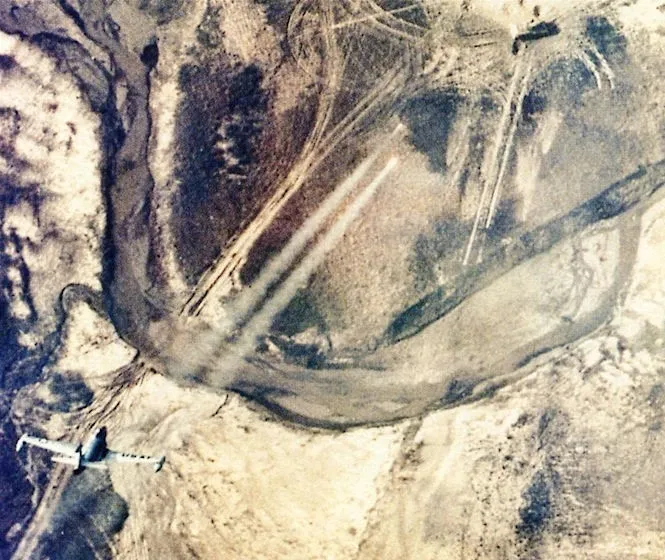

R-80 as an attack aircraft

The role of the primary fighter for the "UN forces" in Korea went to the next aircraft. Of course, it was the F-86 Sabre! The aircraft was designed after the war, taking into account German developments in swept wings. However, American engineers initially tried experimenting with a forward-swept wing. Nevertheless, the Me-262's straight-swept wing design prevailed. Early models were equipped with a General Electric J47-GE-3 engine producing 5200 pounds of thrust, while later models were equipped with a J47-GE-7 engine producing 9250 pounds of thrust. The combination of a powerful engine and a swept wing resulted in increased speed: on September 15, 1948, Major Richard Johnson's F-86A set a world record, reaching 671 mph (1080 km/h).
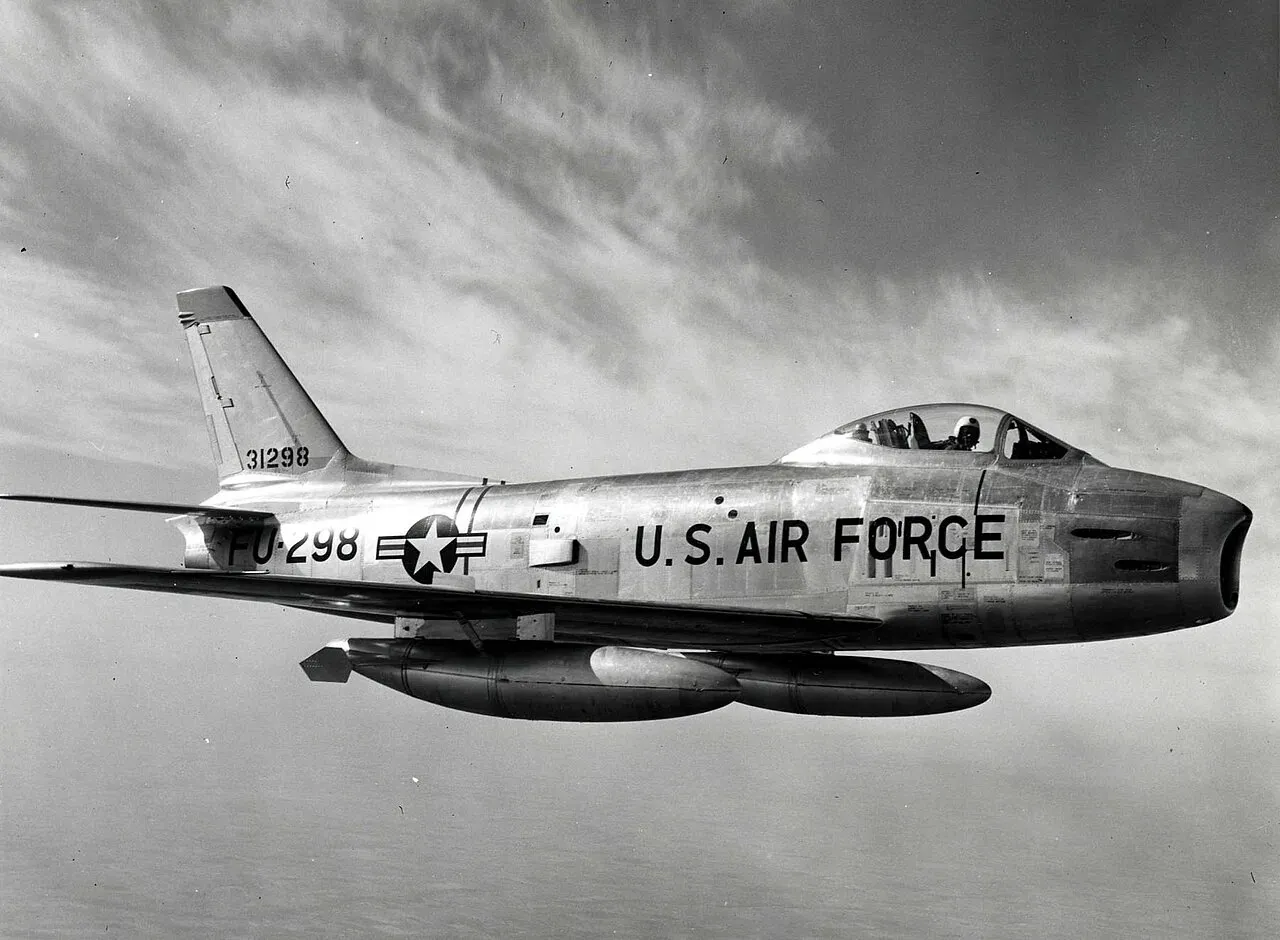

F-86 Sabre in the skies over Korea

The aircraft was produced in two versions: a fighter-interceptor and a fighter-bomber. The bomber version could carry 2000 pounds (910 kg) of bombs (including napalm tanks) and 127 mm rockets. Both versions were armed with six 0.50-inch M3 Browning machine guns. On the F-86H, after close encounters with MiGs, the machine guns were replaced with four 20 mm cannons. Early models were equipped with a Mk-18 manually aimed gunsight, while later models were equipped with an A-1CM radar sight that automatically calculated the range to the target.
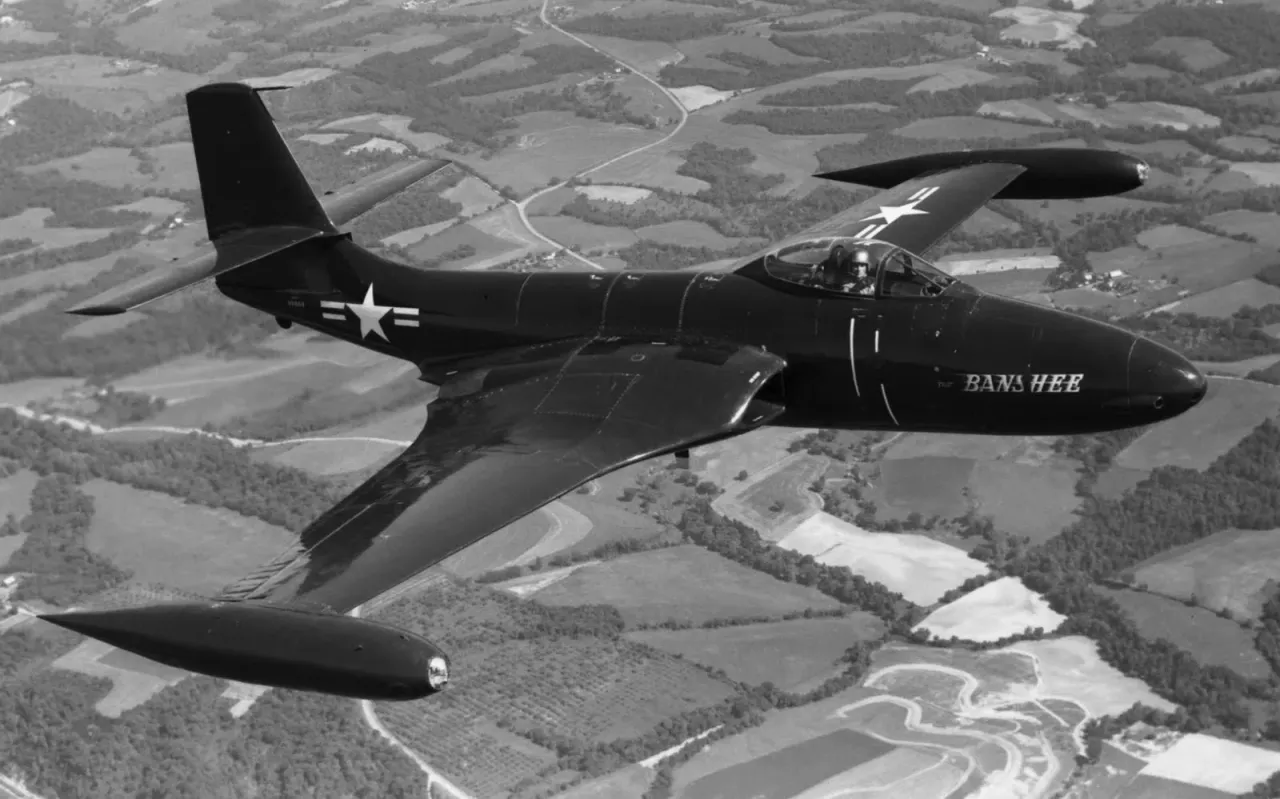

Test pilot Edward Schoch pilots the F-2H Banshee.

The American air force's fleet in Korea wasn't limited to Sabres and Shooting Stars, but the other aircraft are worth a brief mention. The F-2H Banshee was a development of the McDonnell FH Phantom (not the "bullet-fast" one, the Phantom II)—a carrier-based jet fighter developed for the US Navy at the end of World War II. The Phantom itself had a surprisingly short service life—62 of these aircraft entered service in August 1947, and by the end of 1949 they had been transferred to the Navy Reserve, where they gathered dust until 1954. However, the Banshee served longer—the sailors were significantly more satisfied with its 1168-mile (1880 km) range versus the Phantom's 690 miles (1110 km)—an important factor for a carrier-based fighter! The aircraft's maximum speed was 930 km/h—frankly slow for a swept-wing aircraft. However, naval command was initially hesitant to deploy such aircraft from carriers, so it deliberately opted for slower, straight-wing aircraft. The Banshee was armed with four 20mm Colt Mk 12 cannons and could carry eight 60-pound unguided rockets or six 500-pound bombs. Due to their poor performance, these aircraft operated outside the MiG range during the war, so they never claimed a single victory, though three were shot down by anti-aircraft fire.
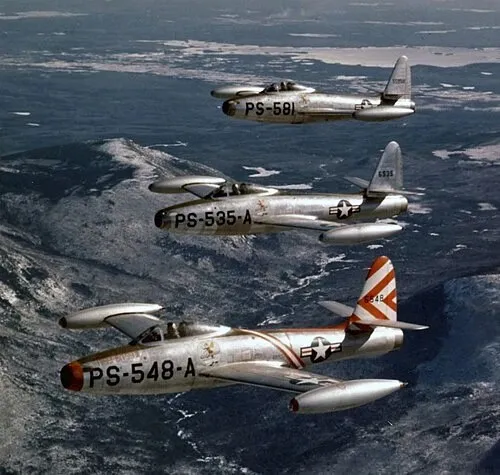

P-84B Thunderjet fighters of the 48th Fighter Squadron, 14th Fighter Group, 1948

F-84 Thunderjet. Development of this fighter began in 1944, so the straight wing—detected! Strictly speaking, it was simply an attempt to equip the P-47 Thunderbolt with a jet engine. The aircraft wasn't particularly fast, with a top speed of 977,6 km/h (600 mph), compared to 985,7 for the Meteor. However, for the US in 1946, this was a record. The first model to be mass-produced was the F-84B, which was delivered to the troops beginning in the summer of 1947. The aircraft's 0,8 mm-thick skin was patently weak and deformed in flight, and the aircraft itself was dubbed a "mechanic's nightmare" by Air Force wits. The aircraft was modernized, resulting in the F-84C, which also received an offensive nickname, this time - "pilot's nightmare": at speeds up to 800 km/h, the aircraft behaved perfectly, but then... It turned into an unguided projectile: external fuel tanks shifted the aerodynamic focus, increased the angle of attack, as a result, the effort on the control stick dropped to zero. It was necessary to modernize the aircraft again, increasing the thickness of the wing skin, which prevented its twisting. The next modification was the F-84D. This was the Arctic version of the aircraft, designed to shoot down Soviet Tu-4s bringing heat and light to the United States across the pole (usually, American aircraft are very heat-loving, and special models have to be cut for the Arctic). There is no need to go into detail about the other models - they did not make it to the Korean War. Perhaps we should mention the F-84G, designed to use nuclear weaponsThe Thunderjet was, to paraphrase a classic, "like a carpenter versus a joiner" against the MiG, but it was actively used as an attack aircraft—the aircraft arrived in Korea just as the Chinese People's Volunteers arrived in the theater.
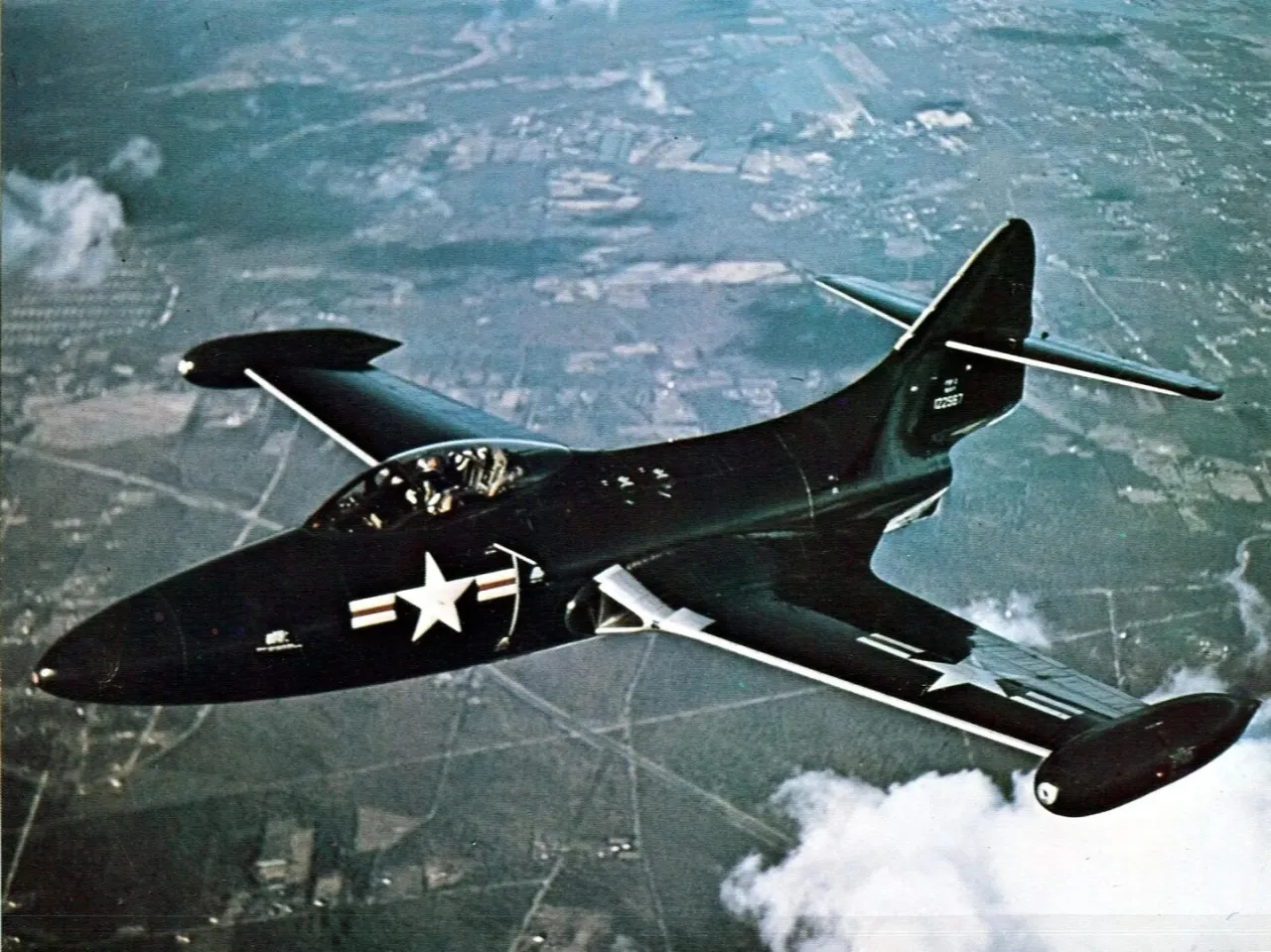

No, it's not an F-2H Banshee, it's an F9F Panther, find 10 differences...

What else? The Grumman F9F Panther carrier-based fighter... It looked a lot like a Banshee, but it's worth mentioning if only because it scored the first aerial combat victory of the Korean War, shooting down a North Korean Yak-9 piston-engine aircraft. These aircraft flew 78 sorties during the war, but were used primarily as attack aircraft. However, with a good pilot, they could also fight against the MiG-15, and reportedly even shot down a few. A total of 1382 of these aircraft were built.

How many times have I mentioned MiGs here? Perhaps it's time to finally move on to the jets of the Soviet Air Force...
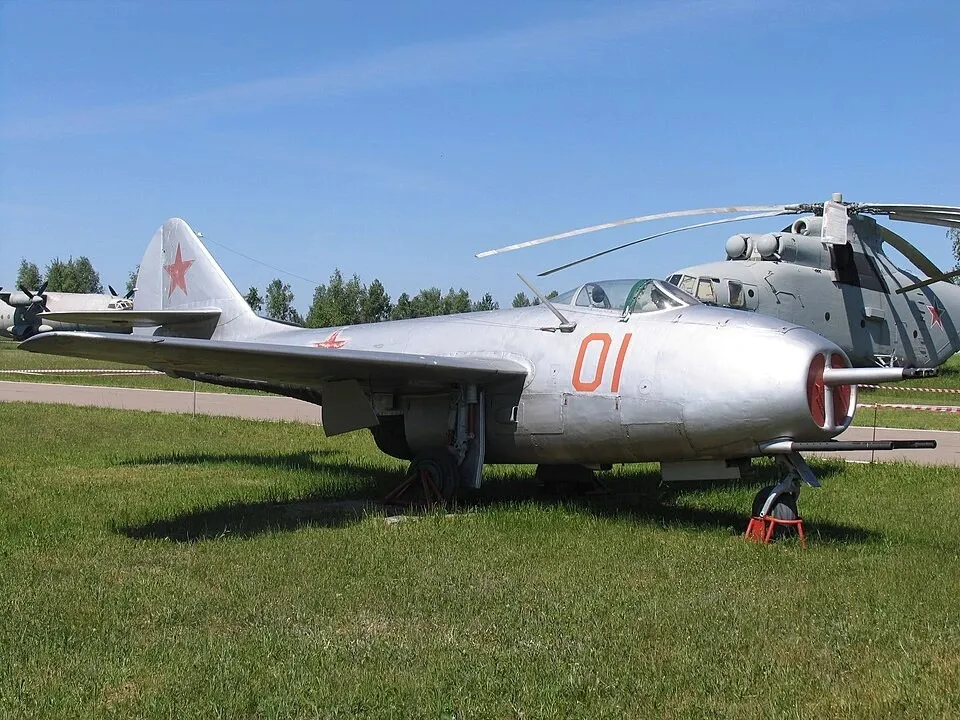

The MiG-9 was the first Soviet jet fighter. One of two...

On April 24, 1946, within hours of each other, two aircraft took to the air: a MiG-9 piloted by test pilot Alexei Grinchik and a Yak-15 piloted by Mikhail Ivanov. Both aircraft were powered by RD-10 engines—Soviet copies of the German Jumo 004. Two venerable aviation design bureaus took different paths: Mikoyan and Gurevich built a new aircraft, while Yakovlev... The cunning Deputy Minister of the Aviation Industry realized that jet aviation was a new thing, and the main thing was not to scare off pilots. And, of course, to ensure rapid transition to the new aircraft. Therefore, Alexander Sergeyevich took a difficult path: he decided to install the RD-10 on the Yak-3, which had proven itself during the Great Patriotic War.
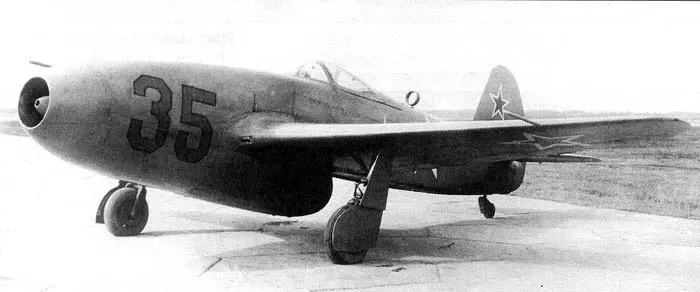

size=2]Yak-15 - a Soviet school desk for retraining from piston-engine aircraft to jet aircraft

Crossing a "horse and a timid doe" proved challenging—designing a new aircraft would have been easier—but the result was worth it: 280 Yak-15s were built, allowing pilots to quickly retrain for jets. Once in the cockpit, pilots felt at home, making the transition to the new technology easier. On May 1, 1947, two flights of unusual aircraft, their engines whistling rather than roaring, flew over Red Square. These were the Yak-15 and the MiG-9, showing the world that the USSR had entered a new, jet-powered era. Their service life was short—just three years! And then, the time came for the hero of this story...
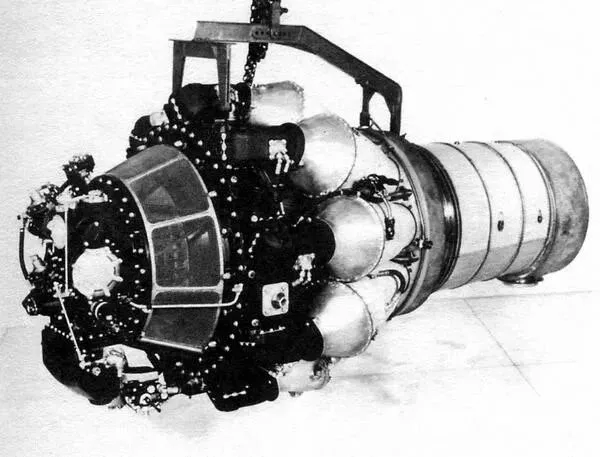

RB.41 Ning turbojet engine

In 1946, the Labour government granted Rolls-Royce permission to sell 55 of its latest engines, including the RB.41 Nene and RB.37 Derwent, to a Soviet delegation led by Artem Ivanovich Mikoyan. The reason for this "kindness" was likely that the British themselves were relying on the more advanced and significantly more successful AJ.65 Avon engine, which was produced from 1950 to 1974 (and the Cold War hadn't yet begun, so the USSR was perceived as an ally in Britain). Although, of course, it's possible that the Soviet representatives simply took the blame for this decision. Legend has it that when negotiations reached an impasse, Mikoyan proposed settling the matter with a game of billiards: if he won, the engines would be sold; if his opponent won, they wouldn't. Artyom Ivanovich won... Either way, once in the USSR, the Nin was subjected to what's now fashionably called "reverse engineering": Vladimir Klimov's design bureau disassembled the engines down to the last screw, producing the original, homespun Soviet RD-45 (aka VK-1). Engine production in the Soviet Union quickly became standard, and aircraft designers began designing aircraft for them.
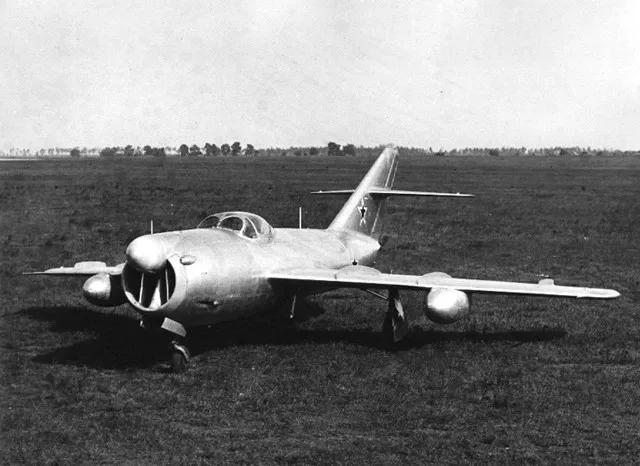

Mikoyan and Gurevich's I-320 variant

In addition to the MiG Design Bureau, the Lavochkin and Yakovlev Design Bureaus received similar orders. Mikoyan and Gurevich initially began developing the I-320, which was simply a version of the MiG-9 with a new engine, but simultaneously, a completely new aircraft with swept wings, the I-310, was accepted for development. The wing sweep itself had been studied in Germany in 1935 by Albert Betz and Adolf Busemann and even used on the Me-262, and after the war, the idea was creatively reworked at TsAGI.
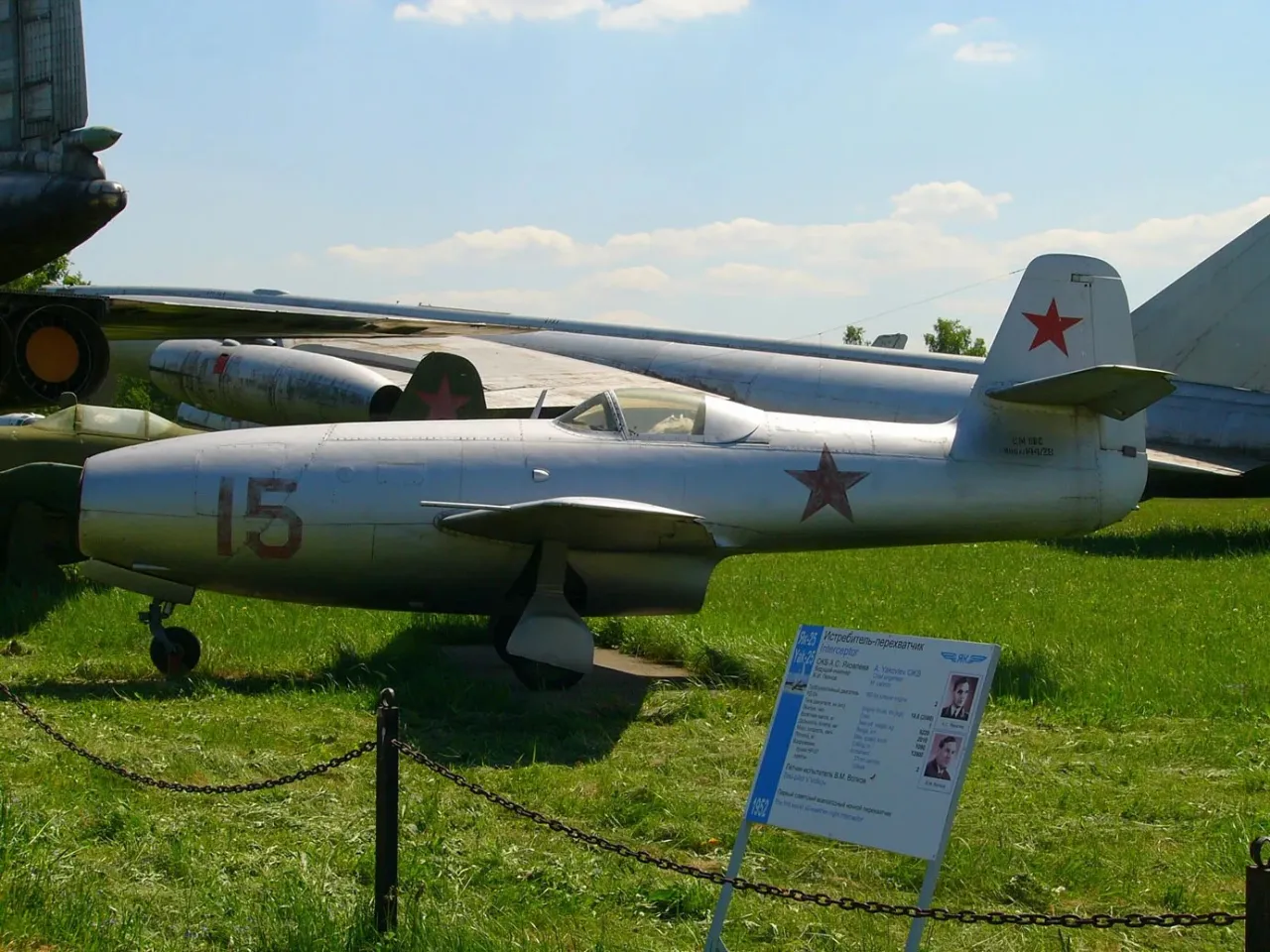

Yak-23 - alternative from Yakovlev

Interestingly, Lavochkin and Yakovlev began designing their aircraft for the lighter RD-500 engines—a copy of the British Derwent—while Mikoyan and Gurevich immediately chose the heavy but powerful RD-45 Nin, intended for bombers. This predetermined the victory of Mikoyan's aircraft. During the design process, operational experience with the MiG-9 was utilized. For example, it was taken into account that, when firing, propellant gases from the fighter's three cannons could enter the air intake and cause engine surge. Therefore, all three were mounted on a single mount below the air intake.
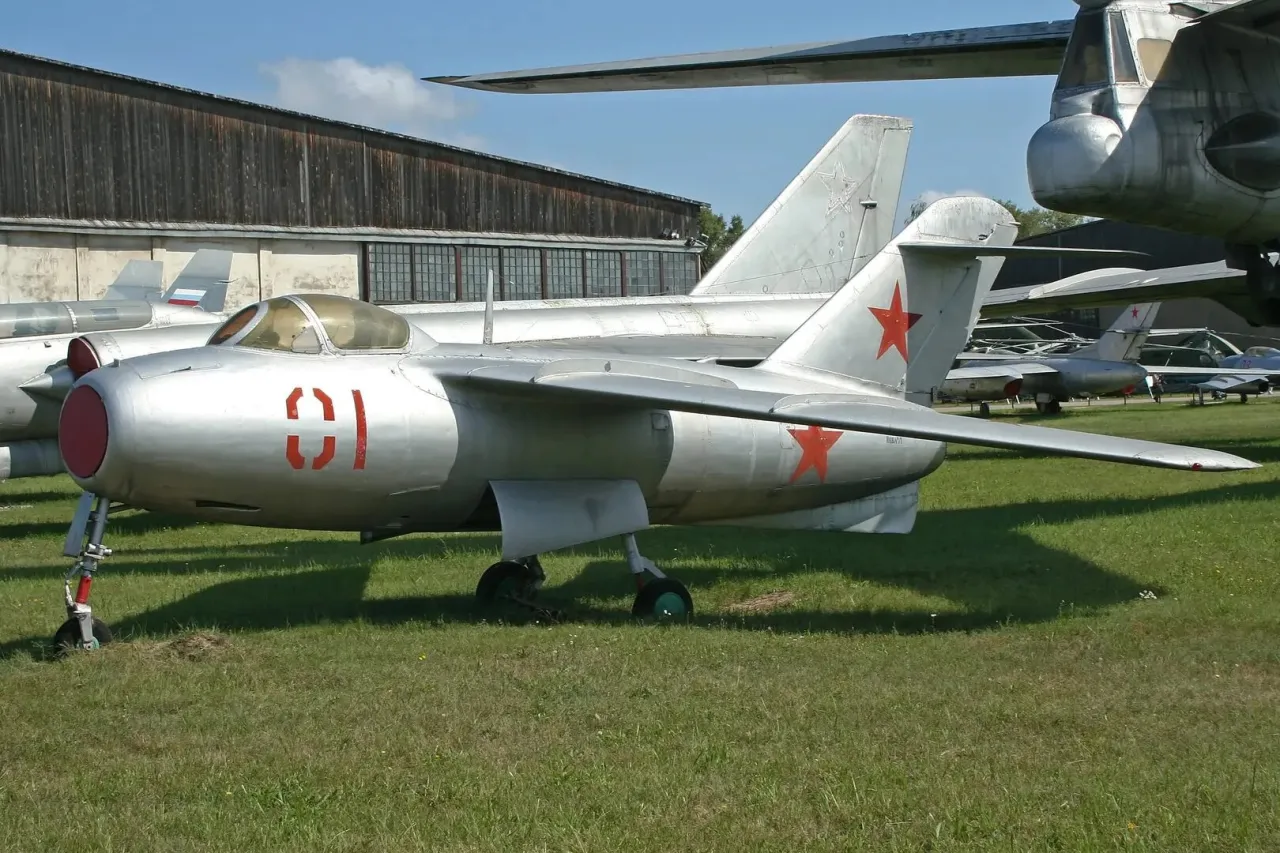

La-15 - an alternative from Lavochkin

Test pilot Viktor Yuganov performed the first flight of the S-01 prototype on December 30, 1947. In May 1948, the second prototype, the S-02, made its maiden flight. In July 1948, the third prototype, the S-03, took to the air, becoming the basis for the production fighter. State testing was completed in December 1948, and the aircraft was recommended for serial production. The MiG-15 entered production alongside the La-15, designed by Semyon Lavochkin and similar in performance to the future hero of the Korean War. The MiG had superior takeoff and landing performance, although pilots reported that the La-15 was easier to control. In any case, Lavochkin's aircraft was soon discontinued.
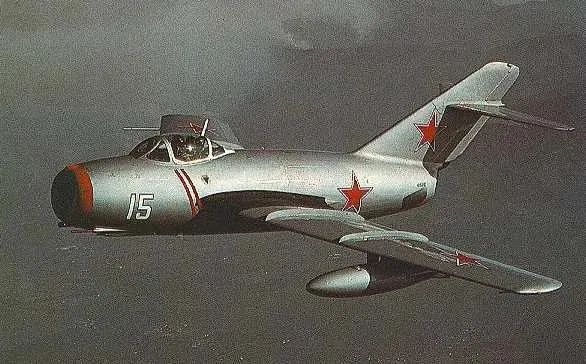

MiG-15 - a classic of the genre!

What was the MiG-15 like? It was an all-metal mid-wing monoplane with swept wings and a cruciform tail. Most of the aircraft's structure was made of aluminum alloys, but steel was also used. The air intake was located in the nose, and it fed air to the engine in the rear through two ducts that curved around the cockpit. The landing gear was retractable and tricycle-type, the nose wheel was self-orienting, the braking system was air-braked, and the landing gear was extended and retracted hydraulically. The latest modifications incorporated hydraulic booster control into the control system.
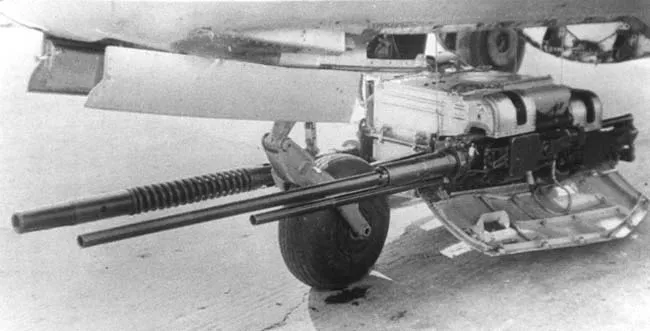

MiG-15 nose "battery"

The MiG-15 had a formidable armament! Two 23mm NS-23 cannons with 80 rounds per gun and a 37mm H-37 cannon with 40 rounds. This combination was well suited for engaging bombers, but for air combat with enemy fighters, the ammunition load was clearly inadequate. Additionally, a pair of 100-kg bombs could be suspended under the wings. The cockpit was equipped with an ejection seat: parachuting from the aircraft at such speeds was unrealistic for the pilot. The canopy provided excellent visibility—an important quality for a fighter! The aircraft could reach a speed of 1042 km/h and an altitude of 15100 meters. The aircraft had a range of 1335 km without external fuel tanks.
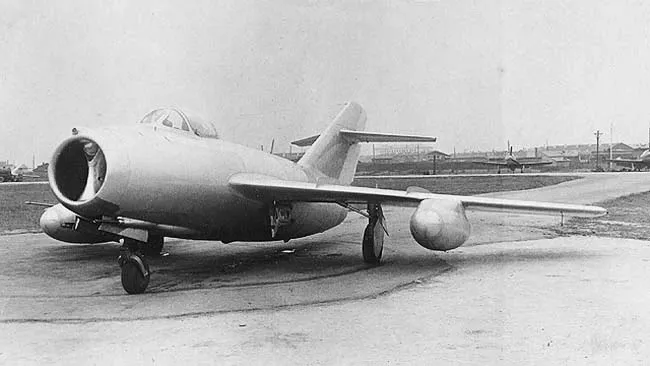

MiG-15R - photo reconnaissance aircraft

In addition to the original MiG-15, there were also the MiG-15 bis, a more powerful engine, the MiG-15R, a photo-reconnaissance version, and the MiG-15P, an interceptor. And, of course, the MiG-15UT, a trainer. In the winter of 1948-49, the fighters began to enter service with the Soviet Air Force. The Korean War wasn't the aircraft's first "foreign assignment." As early as the first half of 1950, several squadrons were deployed to China to protect Shanghai from Kuomintang air raids. However, the aircraft didn't get to perform much heroically on this trip. Korea awaited them!
53 comments
Information
Dear reader, to leave comments on the publication, you must sign in.
  1. + 10
    April 25 2026 07: 19
    Thanks for continuing, Georgy!
    As always - fascinating and quite informative.
    In fact, when the current generation in power is forced to once again criticize the USSR, Stalin, and his era, it's worth understanding the fierce competition that reigned in that world. And the price of a mistake could have been the very life of the state.
    And speaking of personnel: they readily took other people's developments and breathed new life into them in our conditions! And behind this ease lies the great feat of the first five-year plans and the crucible of the Great Patriotic War.
    1. +6
      April 25 2026 11: 37
      The USSR had its good and its bad. As the IVS put it (quoting from memory from Yakovlev's "The Goal of Life"): "Every person has strengths and weaknesses, the main thing is to have a positive balance." Maintaining a positive balance worked for a long time, but then it began to shift toward weaknesses. It wasn't a critical shift, in my opinion, but it unnerved the people...
  2. +3
    April 25 2026 08: 32
    a very good article for general information
    1. +2
      April 25 2026 12: 14
      Quote: vitaliy20091959
      a very good article for general information
      Let's start off with...
      began testing on Cosmonautics Day, April 12 1937 years.
      You're right, for general information... well, for general information, jet engines were divided into centrifugal (compressor) and axial, in the end, axial won, although at that time the centrifugal compressor was simpler... Well, and the rest, well, for general information... Of course, thanks to the author for his work.
      1. 0
        April 25 2026 16: 05
        The Germans and the British were the first to step into the jet age.
        Strictly speaking, the Italians were the first. Carponi's plane (if I'm not mistaken) flew in the 30s. True, it didn't have an axial or centrifugal compressor, but a separate piston compressor driven by a separate piston engine. A dead end, but the Italians were first!
        1. +2
          April 25 2026 16: 26
          Quote: Good evil
          True, its compressor was neither axial nor centrifugal, but a separate piston compressor driven by a separate piston motor.

          It was centrifugal, but driven by the engine, and since gasoline engines couldn't provide sufficient rotational speed, they acted as a brake on the entire cycle. And yes, that was the design. It would have been possible (and likely was) to increase the rotational speed with a gearbox and, consequently, increase the compression ratio and air flow, but the efficiency of a piston engine proved insufficient. It's not that a piston engine couldn't handle the increased power—it could—but the materials and technologies for such turbine operating modes simply weren't there. And then, when turbine power (and, excuse me, over 10000 rpm and combustion chamber temperature...) was already in the additional piston support, the need for additional piston support became irrelevant. And to this day, engine (jet) efficiency is the only way to improve its performance. Even on the first (NIN) analogs, they couldn't increase the generator output from the distribution box and provide the radar sight with sufficient power, but now this is no longer a problem. The power takeoff is needed because efficiency has increased significantly, whereas at one time, the first AWACS aircraft used a separate power plant for this purpose.
  3. -1
    April 25 2026 08: 46
    The MiG-15's armament is the most controversial issue.
    Given that the main mission was intercepting enemy bombers, the 37mm caliber was preferable. As for light guns, three ShVAKs would have been much better than two VYa-23s. For close combat, rate of fire is much more important.
    And we shouldn't forget about the 130mm NURS with a radio-controlled fuse. This, again, is for use against bombers.
    1. +7
      April 25 2026 10: 11
      It's not a VYA, but an NS-23. Two 23 mm cannons are no worse than a single 37 mm cannon against bombers, and better against fighters.
      1. 0
        April 25 2026 11: 33
        IMHO, for fighters, a 6x12,7 would have been better, like the Americans (they have a high firepower density and can carry more ammunition). But our Air Force customers understood that the main job of fighters is to bomb, not to perform spectacular aerobatics in combat with their own kind...
        1. +4
          April 25 2026 12: 29
          The Soviet Air Force and the American Army Internal Troops, Naval Air Force, and Marine Air Force had different experiences in the past war.
          1. 0
            April 25 2026 14: 10
            Well, if you consider that the Americans didn't participate in the Battle of Britain, and the .50 caliber proved itself excellent against the Japanese (both fighters and Betty_zazhigalka), then... although it's unclear HOW they were going to stop the Soviet Tu-4s (or rather B-29s made in Russia) flying over the North Pole... with NURS???
            1. +3
              April 25 2026 17: 09
              At that time, the opposite scenario is more likely.
              Soviet fighters meet armadas of B-29s.
              The Battle of Britain is not an indicator.
              At the time of this air battle, German bombers were not as equipped with passive protection as they were afterwards.
              And the British fighters were armed
              6 - 8 Browning rifle caliber.
              At that time, these machine guns were enough for the British.
              But after that they started to switch to guns.
              Then
            2. 0
              April 26 2026 03: 46
              Quote: WapentakeLokki
              to stop Soviet Tu-4s (or rather Russian-made B-29s) flying over the North Pole

              The Tu-4 has a range of 5100 km.
              It was never intercontinental.
              It is for Europe and all sorts of Englands.
              🥱 To Alaska, via the North Pole, if taking off from the coast: 4800 km
              1. 0
                April 26 2026 07: 24
                This is how Stalin thought exactly as you described:
                Preemptive strikes against threatening nuclear bases are to be carried out, followed by clearing the area with ground forces. The few enemy bombers operating from the continent are to be intercepted over coastal seas.
                1. +1
                  April 26 2026 13: 22
                  Well, what I'm actually talking about is that the guy wrote "T-4 through the North Pole to bomb America."
              2. 0
                April 26 2026 13: 22
                That's exactly why airfields for jumping off ice were built and...then a "one-way road" for the Red Army Air Force was not something...forbidden, no???
                1. +2
                  April 26 2026 13: 55
                  Quote: WapentakeLokki
                  This is exactly why airfields for jumping off ice were built

                  They were not done, although Major General Mikhail Vasilyevich Vodopyanov suggested it.
                  Landing a 60-ton Tu-4 with a nuclear bomb, refueling, and taking off onto an ice floe somewhere out there: a technical gamble. And never even tested.
                  And, let me remind you: RDS-1 Series since 1949. By the end of 1951, 19 bombs had been produced. In 1952-1953, all bombs were converted to RDS-2 (series -501M) - Series since 1951.
                  RDS-3/3-I: as of 01.01.1953 - 18 RDS-3 sets, as well as 4 sets of main charges "OZ" for RDS-3

                  Quote: WapentakeLokki
                  For the Red Army Air Force it wasn't something...forbidden, no???

                  Examples?
        2. -2
          April 27 2026 08: 23
          Definitely not. More ammunition is possible, but the effectiveness of the 12.7 is clearly insufficient. American pilots themselves considered their standard armament suboptimal. Aircraft cannons are definitely preferable, as they have twice the effective range. The insufficient range of the Sabres' onboard weapons largely negated the advantage provided by their highly sophisticated radar sights. What good are such sophisticated sights if you can only guarantee damage to the enemy at a range of 500-600 meters? And the enemy can hit you at 1000 meters.
    2. +5
      April 25 2026 11: 38
      Quote: Victor Leningradets
      37mm caliber is preferred
      This caliber is for the masters: they fired practically single shots, and it was difficult to hit.
      1. 0
        April 27 2026 08: 26
        It was entirely possible to hit a bomber that wasn't particularly maneuverable. Even a single 37mm hit could, if not shoot down the plane, at least force it to abort its combat mission.
        And such targets would not be attacked by single fighters.
    3. +2
      April 25 2026 16: 32
      You're right about the 37mm, and bombers are the main thing. As for the 23mm and the ShVAK, it's a contentious issue, and I'll just give one. The larger the caliber, the greater the firing range. Besides, the ShVAK was already obsolete, so to speak. I agree that six 12.7mm machine guns are effective, but at what range? It wasn't for nothing that America switched to cannon armament.
      1. +2
        April 25 2026 23: 09
        Range means nothing when the probability of hitting is zero—modern air defense systems didn't exist back then. Large caliber was needed for hunting "elephants"—strategic bombers. In the States, the 20mm was accepted as the optimum between effectiveness and probability of hitting (rate of fire + ammunition), ultimately representing the evolution of heavy machine guns. The issue of range and target "heaviness" was initially resolved by salvo launches of rockets.
        1. +1
          April 26 2026 08: 07
          Long-range fire is essential for firing beyond the range of bombers' Brownings. Two or three hits from 37mm shells can cause damage to a B-29 that would render it incapable of carrying out its mission. Five or six hits are highly likely to destroy the aircraft entirely.
          It was the 30mm cannons that made the Fw-190 and Me-262 bomber killers.
          But the 23mm caliber is weak against a formation of bombers and does not fire quickly enough against fighters.
    4. +1
      April 26 2026 03: 55
      Quote: Victor Leningradets
      37mm caliber is preferred

      🥱 The NS-37 had a recoil force of about 2,400 kg
      The maximum thrust of the RD-45F engine on early modifications of the MiG-15 was 2270 kgf.
      Of course, it’s “preferable”: 37 mm could slow the MiG-15 to zero and into a tailspin, even with 49% recoil impulse absorption
      1. 0
        April 26 2026 07: 27
        The firing impulse lasts a few milliseconds, with a pause of more than 0,1 seconds. Therefore, the motor's work outweighs the recoil work by a factor of 10. Nevertheless, it is essential to take the braking factor into account when firing.
        1. +1
          April 26 2026 13: 42
          Quote: Victor Leningradets
          The shot impulse is several milliseconds

          H*s is the impulse force, at the same time the engine thrust acts
          There is no point in “taking into account” here: physics.
          You need to understand clearly: you don’t have a frame, shock absorbers, or a slab/foundation to absorb the enormous energy.
          However, the gun's recoil problem was never fully resolved, as the average recoil force for the 37mm automatic aircraft cannon was approximately 2230 kg, reaching 7500 kg at the moment the bolt struck the butt plate. Significant recoil was felt both at the end of the barrel's recoil and at the end of the bolt's roll. It should be noted that, for example, when firing this cannon mounted on a Yak-9 fighter aircraft at speeds of up to 350 km/h, the aircraft swayed violently, and accurate fire was only achieved with the first shot; subsequent shots were subject to severe dispersion.
      2. 0
        April 26 2026 16: 43
        The MiG-15 was not equipped with the NS-37 cannon, it had the N-37, and accordingly, the ammunition there was different and the recoil force was significantly lower.
        1. +2
          April 26 2026 18: 02
          I know what was “put” there and how much.
          Quote: KERMET
          the recoil force is significantly lower

          How much exactly in grams?
          Without "below"
          1. -1
            April 27 2026 11: 54
            If you know, then why write nonsense that "37 mm could slow the MiG-15 to zero" while citing the recoil force of a gun that was never installed on the MiG-15?
            How many grams?: 1100-1200 kg
            1. +2
              April 27 2026 13: 43
              You write nonsense.
              "Mog" and "37mm", recoil force is given in comparison with thrust.
              A 700 kgf impulse can “stop” (bring down) a MiG-15, everything depends on its speed at the moment of firing and the angle of attack.

              If you don’t have enough brains to build a primitive logical chain, then the question is not for me.
              The recoil force is a force in Newtons, or kg*s, and the impulse is, respectively, *sec
              Mass is measured in kilograms, as Newton intended.
              🥱 and the figure is incorrect, far-fetched, from the wrong source
              1. -1
                April 27 2026 16: 46
                Once again, why the hell are you mentioning the recoil force of a cannon that was never installed on the MiG-15? Admit you're talking nonsense and don't embarrass yourself.
                1. +1
                  April 27 2026 16: 56
                  Once again: you've disgraced yourself, I admit, you're writing nonsense, and your brain isn't working at all. Complexes and ego.
                  Please unstick and don't disturb me.
                  1. -2
                    April 27 2026 17: 35
                    Hmm..., you clearly forgot to take your pills...
                    Right here, everyone can read your stupidity - no matter how hard you try to get out of it.
  4. +2
    April 25 2026 12: 55
    "The MiG-15 had impressive armament! 2x23mm NS-23 cannons with 80 rounds per barrel and a 37mm H-37 with 40 rounds."
    I have seen videos with MIG 15 firing those guns,they look and feel very impressive!
  5. +8
    April 25 2026 13: 37
    First of all, thanks to the author for his work!
    After reading the article, I really agree with the site participants. vitaliy20091959 (vitaliy) и NIKNN (Nikolay), that the material presented in the article and the form of its presentation looks like "a good article for general information".
    That's probably exactly what the author intended. Personally, I find it a bit superficial and somewhat frivolous for a specialized website, which doesn't necessarily mean it's low-quality or bad!
    In this regard, I would like to slightly correct some of the not entirely correct data, for example, on the Me.262. Fighter (also known as a fighter-bomber and reconnaissance aircraft) never mass-produced with an ejection seat for the pilot. The He.219 was equipped with them in production.
    The world's first jet fighter with an experimental ejection seat was the He.280.
    In 1942, one of the first successful ejections was carried out (test pilot Helmut Schenk).
    Another inaccuracy: Me.262 pilots were never prohibited from flying over enemy territory due to the aircraft's secrecy. Me.262s regularly operated over territory occupied by both the Soviet Red Army and the Allies, particularly as interceptors against bombers, but they were also used to strike targets behind enemy lines.
    But unspoken guidelines, developed from the practice of using the Me.262, forced pilots to reduce the radius and time of flights.
    The reasons:
    - Aircraft shortage and value.
    - Low reliability of Jumo 004 engines, and as a result, a high risk of failure.
    - A trivial fuel shortage. The engines ran on special J2 jet fuel, and their service life was a maximum of 10-25 hours.
    As a result, pilots were often advised to stay close to their airfields and their missions were planned to minimize the risk of losing aircraft and pilots.
    Well, and about the Yak-15.
    Although it was officially in service from 1947 to 1949, it was primarily a training aircraft, as you wrote, "allowing pilots to quickly retrain for jet aircraft." However, it had a very short flight time (15 to 40 minutes), was twitchy in control, had a nose-dive, and required constant adjustments.
    At low speeds it was difficult to control, the engine responded poorly to the throttle, the steering wheels did not work effectively enough, and the landing was especially “nervous”.
    In addition, there are many other problems that are absolutely unsuitable for a “flying desk”.
    Here is what I would add from my side to your work.
    Best regards hi
    1. +1
      2 May 2026 12: 47
      Good afternoon! I agree with the comments, but... Entire books have been written about the aforementioned aircraft; it's impossible to fit everything into one article... It's impossible to embrace the immensity! An entire series of articles could be written about the first jet aircraft alone. If you noticed, I didn't even mention our BI-1, not only because it was a rocket plane (just like the Me-163), but also to avoid overloading the text with mentioning another machine unrelated to the Korean War. That's why, as for the Me-262 and Heinkel creations—galloping across Europe, as you can imagine—there was so much more that could have been mentioned. The machines mentioned here have influenced the birth of Soviet and American jet aviation, but did the Volksjager He-162 have any influence on it? I seriously doubt it... Especially since the first flights of Soviet jet aircraft began even before the expert commission that studied this aircraft had issued its conclusions. As for the ejection seats on the Me-262, at least the later models had them (and they were actively used; this was particularly true on the Me-262, as seen in the photo), although Heinkel undoubtedly had the upper hand. Incidentally, according to Yakovlev's recollections, he tried to sell this device to the Soviet delegation even before the war. I don't recall whether they bought it back then, though. Most likely not, since after the war, seats from the He-162 were used for ejection seat testing.
  6. +3
    April 25 2026 14: 38
    The Korean War...It was a wonderful time, and regarding the article - it was quite good, I liked it.
    The only thing that is the MAIN confrontation of the Korean War MiG-15 vs. F-86 - Author... well, you did it somehow cursorily, in terms of, you limited yourself to listing the performance characteristics and general phrases about "superiority" or "obsolescence"
    I would like to see the key factors that determined the actual balance - such as pilot training, tactics, guidance systems, etc.

    On my own behalf, to everyone interested in the Korean War, I recommend the book "The War in Korea 1950-1953" on militaire.
    1. +4
      April 25 2026 15: 01
      Egor hi As I understand it, the author is planning a continuation specifically on the topic of the confrontation between the MiG-15 and the F-86.
      I hope that, given the friendly comments and remarks, this will be interesting and we will learn something new.
      1. +3
        April 25 2026 15: 03
        If so, I take my words back.
        I'm not familiar with the author or his series of articles, but judging by this work, it's quite good.
        1. +1
          April 25 2026 15: 28
          I'll take this opportunity to "advertise". Read mine. wink
    2. +1
      2 May 2026 12: 13
      Good afternoon! This article is about aircraft. The material about aerial combat has been written and is currently being moderated.
  7. +4
    April 25 2026 17: 59
    On the F-86H modification, after close acquaintance with the MiGs, the machine guns were replaced with 4x20 mm cannons.


    It should be clarified here for inexperienced readers that the 20mm cannons appeared on this modification ONLY AFTER THE WAR; this modification entered service in September, and the conflict ended in July. During the war itself, they (the cannons) were supposedly "tested" on a very limited modification designated the F-86F-2 (four T-160 cannons) and F-86F-3 (four Oerlikon cannons) (the 16-week GUNVAL program, beginning in 1953).
    1. 0
      1 May 2026 18: 19
      Wasn't it in the spring of 1952 that the Yankees were concerned about re-arming a dozen F-86s from machine guns to cannons?
      And three cannon-armed Sabres remained in Korean lands forever.
      336th Fighter Squadron (336th FIS)
  8. +1
    April 25 2026 18: 35
    In addition to the jet aircraft of the DPRK Air Force, the Soviet Air Force and UN forces actively used piston-engine aircraft from World War II and the early post-war years!
    The USA had a lot of similar aircraft.
    And they were sent to "defend democracy, American style."

    Douglas A-26/B-26
    So, out of 198 known and possible candidates, after removing cases of incomplete data (no serial numbers, no event dates), damaged aircraft, and no fact of write-off, 166 aircraft remain.

    60 Invaders were lost in accidents and disasters. Among other things, this category honestly includes all landing incidents involving the loss of an aircraft (unless combat damage was clearly stated as the cause). He didn't try to make friends with the globe.

    58 aircraft were lost for unknown reasons, which is unsurprising given the article's subjects' largely nocturnal lifestyle, especially over enemy territory. The vast majority were classified as MIA (Missed In Action) by the Yankees themselves.
    For one vehicle (serial number 44-34378), the reason for receiving fatal damage was not specified (simply battle damage).

    Well, 47 Invaders were shot down by ground fire.

    Technically, the Yankees didn't lose a single Invader to enemy fighters. But it's not that simple.

    First, about our Korean comrades.

    On June 30, 1950, according to North Korean sources, a Yak-9P damaged B-26B serial number 44-34277. According to American sources, the aircraft was damaged by ground fire, but further details vary: some sources claim the aircraft was repaired, while others claim it was written off.

    On July 12, 1950, Invader 44-34263 was attacked and damaged by a pair of Yak-9Ps (again, according to the North Koreans), and subsequently, on July 14, 1950, destroyed at the airfield to avoid capture. The Americans suffered almost the same fate, except the aircraft was damaged by ground fire.

    The first known collision occurred on September 14, 1951, near Anshu. Accounts of the incident vary. According to one, the most widespread, a lone B-26 was attacked successively by two pairs of MiG-15s from the 176th Guards Fighter Aviation Regiment. First, by Captain S.P. Subbotin's pair, and then by Captain G.I. Ges's pair, who finished off the bomber. In reality, the damaged B-26, serial number 44-34547, returned home, having been promptly covered by Sabres. Karma caught up with the aircraft two weeks later, on September 29, 1951, when it failed to return from a night raid.

    All further requests and mentions are related to the 351st IAP, equipped with Lavochkin La-11 fighters.

    ...


    https://dzen.ru/a/ZeOVwlK8VTfGs_iT
  9. +2
    April 25 2026 18: 44
    In 1946, the Labour government gave Rolls-Royce permission to sell 55 of its latest engines, including the RB.41 Nene and RB.37 Derwent, to a Soviet delegation that included Artem Ivanovich Mikoyan.
    One of the few moments in history when we can say thank you to the English wink Thanks to the author for the article, I read it with pleasure.
  10. +2
    April 25 2026 19: 14
    In the Royal Air Force there is no rank of flight captain, but there is the rank of flight lieutenant, which is equivalent to an army captain or an RN lieutenant.
  11. -1
    April 25 2026 21: 26
    Speed ​​in aviation has always been measured in nautical miles, and 504 is not 811 km/h, but 933.
    1. +1
      April 26 2026 12: 41
      - Speed ​​in aviation is measured in knots, while range markers on radar screens and airborne radars are measured in nautical miles...
    2. 0
      13 July 2026 10: 34
      There's a series of excellent books on the history of aircraft manufacturing. Land-based airplanes' speeds were measured in ground miles. More precisely, that's it. If in miles, then in ground miles; if in knots, then, accordingly...
      By the way, I apologize for getting off topic, but riverboats also measured speed in land miles. We ran into this when ordering patrol boats during WWI. Source: the relevant issue of the Marine Collection. Too lazy to look it up.
  12. 0
    1 May 2026 23: 24
    Thank you for another interesting publication!

    Here's about "Major Charles Loring Jr. - the P-80 pilot who repeated Gastello's feat"...
    In every country, there are heroes and non-heroes. It doesn't depend on the economic system or politics. It depends only on the individual. And on how their life decisions will be judged later.
  13. Eug
    +2
    9 May 2026 09: 31
    Is the MiG-15 definitely a UT and not a UTI?
  14. +1
    13 July 2026 10: 30
    The Soviet school of jet engine building grew out of copying the German engine,

    Actually, the American one is in many ways the same. In any case, General Electric's chief designer for many years was the German Neumann. Details can be found in Valery Avgustinovich's excellent book, "The Battle for Speed: A History of Aircraft Engine Manufacturing."
  15. 0
    4 October 2026 06: 39
    Spell it correctly, not MiG-15UT, but MiG-15UTI, this is the index assigned to the twin-engine aircraft.