The "Theory of Generations" and the Causes of Positional, or Firing, Deadlock
6 423 48
The "Theory of Generations" and the Causes of Positional, or Firing, Deadlock
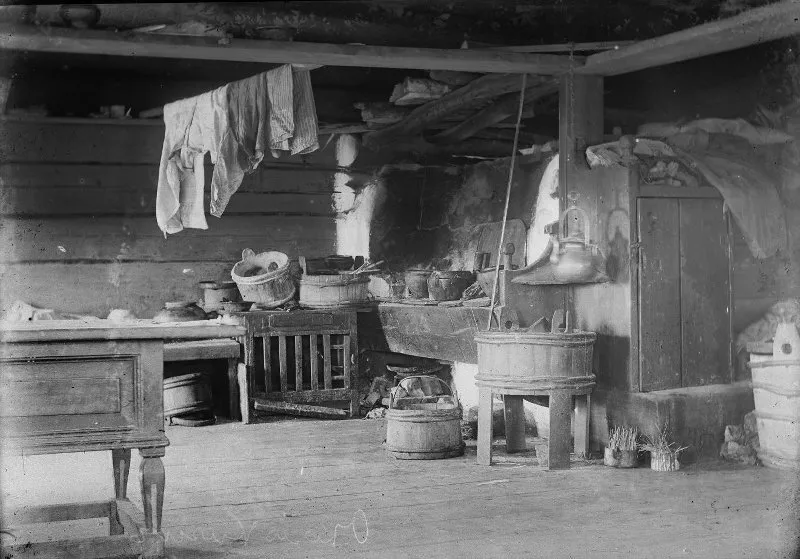
Interior of a hut near Kizhi. Petrozavodsk district, Olonetsk province, circa 1900.


The first is overly narrow specialists. Our entire leadership team has a higher education, and many, if not most, even hold advanced degrees in various fields. However, starting around the 1970s, higher education has become dominated by the approach of training highly specialized specialists. …Such an overly narrow specialist may be willing, but he or she is unable to accomplish major tasks. …This phenomenon exists in the military, in science, and in industry. Leaders simply lack the breadth of knowledge to grasp a complex problem as a whole.


"The Reasons for the Positional, That Is, Firing Deadlock." Dmitry Verkhoturov


From stories about the little-known. This article is the 2500th the author has published on the Military Review website since 2015. Therefore, it was only natural to want to write something, shall we say, more significant than the others. And then, our author Dmitry Verkhoturov's article on the current "positional stalemate" and its causes came to my aid. I really enjoyed the article, but, as the English say, "many hands make a better work." Therefore, I took the liberty of expanding on the topic he raised in his article and examining the problem from a broader perspective. At the same time, the idea arose to expand it not in one but in several articles, thus turning it into a short series that would conclude a number of my previous publications devoted to the socioeconomic problems of the Russian Empire, the USSR, and modern Russia.

Let me remind you that here at VO, I have already written about the problems of Russian and Soviet journalism as part of the "Poisoned Pen" series. Then there were articles about publications in the pages of the newspaper Pravda, articles about the Russian and Soviet peasantry, drunkenness in the 20s, the working class of the Russian Empire, newspaper materials about the Civil War, and, finally, articles in which, verbatim, without clarification, were quoted the speeches of Comrade Stalin at various congresses of the RCP(b) in the 20s and 30s, which allowed us to clearly imagine the very vector of development of our country that was set by Stalin's course in those years.

In these materials, as well as in responses to our readers' comments, the author has repeatedly emphasized that our ancestors at that time were ignorant of much in the field of sociology, unable to explain it, and often acting entirely intuitively, relying on theories that rigidly determined the process of social development. This was not their fault, for one cannot know what no one else knows. However, it was precisely this lack of knowledge on many issues we know today that led to the events that shaped our modern society. historyThe question is, what are these theories, how valid are they, and what impact do they have on the past from the perspective of our present-day hindsight? Let's take a look and see that our current knowledge is quite sufficient to answer the most pressing questions of our history, including the events of 1991. So, what is this knowledge, what is its field, and what does it tell us?

Let's start with the so-called "generational theory," proposed by writers Neil Howe and William Strauss. In 1991, they published "Generations," which vividly demonstrated the differences in worldviews among people of different ages in the United States, beginning in 1584. The ironic thing is that neither psychologists nor sociologists officially recognize this generational theory. However, if we apply "common sense" (which, by the way, many commentators on this site frequently suggest doing), we cannot deny that if a person lives in a given society, their personality cannot help but be influenced by the social, economic, and political conditions of their social environment and their country. Therefore, if the overwhelming majority of its citizens share certain traits, they can quite easily be considered fairly general.

Furthermore, generational theory suggests that people of different ages have distinct characteristics and values ​​because they grew up in different times. Thus, our grandparents have completely different life experiences, and therefore often think very differently from their children and grandchildren. In my opinion, no matter what psychologists and sociologists say, this is perfectly obvious.

In other words, generational theory is a concept that suggests that people within a generation share similar values, beliefs, and corresponding behaviors due to their shared historical reality and the sociocultural environment in which they grew up. Therefore, generational theory helps explain the differences between generations over the years and understand how these differences can impact society as a whole. It is believed that generations change every 20 (25) years, and in recent years, every 15, due to the rapid introduction of new technologies and the corresponding changes in society.

People have always intuitively understood that this is the case, but they couldn't clearly articulate what was going on and choose an appropriate periodization, which, by the way, we won't touch on here, since it's unnecessary for our purposes. Turgenev's novel "Fathers and Sons" didn't appear out of nowhere, nor did Ostrovsky's "The Storm." However, they approached the problem of "fathers and sons" from a literary, not a scientific, perspective.
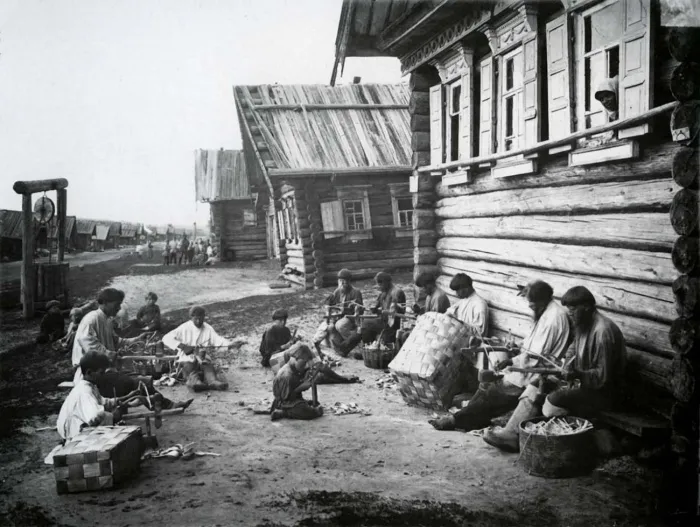

Spoon production in the village, 1900-1910.

Now let's answer this important question: within what framework does the most significant process of socialization of "Homo sapiens" occur, if the age of 25 is the period of their greatest social activity and significance? The science of pedagogy, and its subfield of "age-specific pedagogy," will provide us with an answer: before the age of five, a child learns more about life than in the rest of their life, and it is during this time that the most fundamental changes in their personality occur. They master speech, become familiar with the concepts of good and evil, learn to lie and tell the truth, like a sponge absorbing knowledge about the world around them. Again, our ancestors understood this, although they formulated it somewhat peculiarly: "Teach a child while he lies across the bench, but once he lies lengthwise, it is too late to teach him." Later, already, let's say, at a more conscious age, and as an adult, this person will learn a lot and acquire specific behavioral habits of an adult, which will help him effectively survive in society and... reproduce, but the experience of his first five years will remain the basis for all of this for the rest of his life.

Now let's remember that at the time of the abolition of serfdom in 1861, Russia had a population of nearly 63 million people, 46 million of whom were... serfs, essentially "slaves with huts." Roughly speaking, they were "white savages," little different from Papuans, except that they wore trousers in summer and fur coats in winter. To be convinced of this sad circumstance, a consequence of the persistence of feudalism in Russia, one need only read the study "The Life of Ivan: Essays on the Everyday Life of Peasants in One of the Black Earth Provinces" by Russian ethnographer Olga Semenova-Tyan-Shanskaya, based on her surveys of peasants in the Ryazan Province at the turn of the 20th century.

One only needs to read her description of the peasant huts in which our peasants lived not even in 1861, but at the turn of the century, to understand how little a child growing up in such an environment could learn and how truly terrible their upbringing was. These were people of serfdom, according to N.A. Nekrasov, capable of rebellion, yes, but unable to imagine themselves in any other life due to their poor intellectual development. And... they remained virtually the same after their "liberation," although many, some from poverty, some due to innate inclinations, began moving to the cities after 1861.
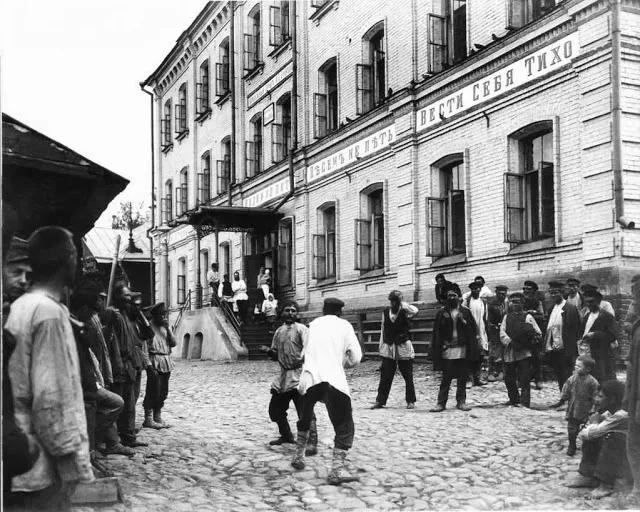

Urban entertainment. Fist fight near a shelter.

Now let's look at the change in their consciousness from the perspective of "generational theory." The first generation of settlers from the village to the city remained almost 100% peasants, becoming city dwellers only to a limited extent. The city broke them; it was mentally alien, but it offered many temptations and opportunities. That's why they stayed. Their children, before the age of five, learned many things they would never have learned in the village. They were already half-city dwellers, and although they were raised by former slaves, their consciousness was already different. And the children, of course, had no knowledge of the village at all. The city was their habitat, their cultural center, and their measure of success. Finally, there were the grandchildren—the third generation. These were already 100% city dwellers, whose only memory of the past was that their ancestors had come from the village. That is, the complete change in the psychology of the settlers who moved from villages to cities in Russia immediately after 1861, according to the “generation theory,” should have been fully completed in 1961.
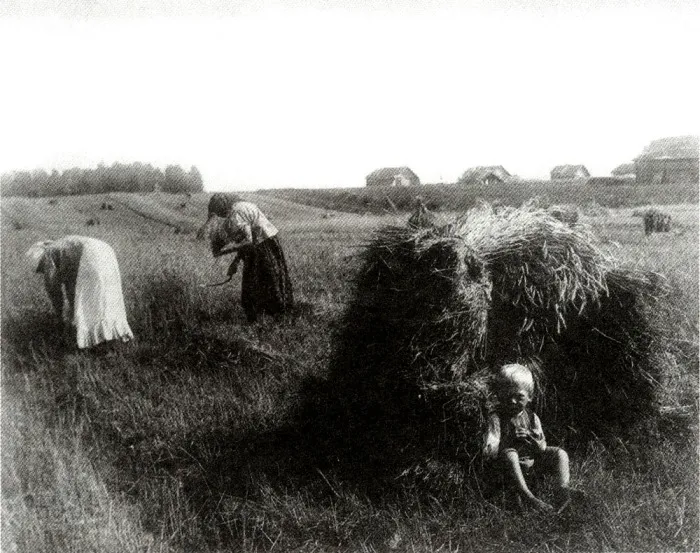

Women and children in the fields during harvest time. Vladimir province, 1900-1910.

According to the 1897 census, Russia had 932 cities, with a total population of 16,579,694, or 13% of the empire's total. Here's the social structure of the urban population at that time:

1. 11% - representatives of the big bourgeoisie, landowners and high-ranking officials who moved to the city;
2. 13% are fairly wealthy entrepreneurs and traders;
3. 24% are very small artisans and shopkeepers;
4. 52% - workers;
5. 13,4% - commoners and intelligentsia;
6. 10,7% - the bourgeoisie, and in Russia, artisans, small traders, owners of small workshops, home-based workers, minor employees, unskilled workers, etc. were recorded as bourgeois in their passports. That is, it was the bourgeoisie, and not the workers, who constituted the most numerous layer of the urban population.
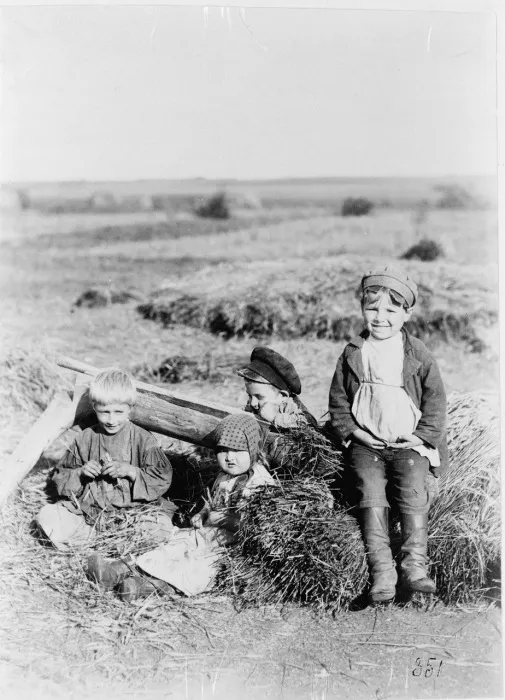

Just children who don’t yet know their destiny...1900-1910.

By 1913, the workforce in Russia had reached 18 million. However, the hereditary factory proletariat numbered only 3 million. A very high proportion of artisans and agricultural workers were employed, and female and child labor was heavily utilized. Thus, despite the growing share of hereditary workers in society, the bulk of them were still closely tied to the village. They were first-generation or, at best, second-generation settlers. Fourth-generation workers could probably be counted on the fingers of one hand.

As for city dwellers professionally engaged in intellectual labor and cultural development, their number was less than 1 million at the end of the 19th century, but by 1917, their number had grown to 1,5 million. However, this social stratum constituted less than 1% of the total population, and its representatives were concentrated in large cities. Russia's educated and spiritually advanced intelligentsia sympathized with the nation's plight and, yes, approved of the ideas of socialism. However, Russian intellectuals lacked any significant authority among the masses. Most people of the time simply did not understand their intellectualism and considered it mere whims.

To be continued ...
48 comments
Information
Dear reader, to leave comments on the publication, you must sign in.
  1. +2
    April 2 2026 03: 25
    Theory of Generations

    We look forward to continuing ... hi
    1. +5
      April 2 2026 07: 46
      Quote from Uncle Lee
      We look forward to continuing ...

      The second article has already been written and is being moderated.
  2. +3
    April 2 2026 03: 29
    The past is returning to Russia again... I am watching with great concern the growth of irreconcilable contradictions in our society.
    Hard times await us.
  3. +2
    April 2 2026 03: 50
    The majority of people at that time simply did not understand their intellectualism and considered it a whim...

    And now, what, is everyone all intellectuals?
    1. +3
      April 2 2026 03: 53
      Quote: cat Crush
      Are they all intellectuals?

      It came from somewhere: Lousy intellectual
  4. +3
    April 2 2026 03: 55
    The production of essential goods, food, and means of production is all complex.
    Generalizing the behavior of entire generations, exploring the problems of journalism, and answering the "burning" questions of the past is a dead end for a country where journalists, researchers, experts, and directors of various levels and levels are plentiful.
  5. + 12
    April 2 2026 04: 10
    Quote: Rolaf
    This is a dead end for a country where there are journalists, researchers, experts, directors of various levels and plans like "uncut chickens".

    It's a dead end for the country when the State Duma deputies are all athletes, artists, and cosmonauts...they're doing such crazy things with the laws that it makes you scratch your head...they're completely out of touch with the people.
    1. +3
      April 2 2026 05: 21
      Everything will be difficult, believe me. Peace and comfort won't last forever. So, keep in mind: the world is not carefree; dangers await.
    2. 0
      April 2 2026 16: 53
      We had scientists in our leadership—Berezovsky, Nemtsov, and others. I also know one scientist in the Duma now, about whom they say that after nothing was built with the money allocated to the university, he had two options: jail or become a member of parliament, with immunity.
  6. +2
    April 2 2026 07: 06
    the so-called "generational theory" of writers and journalists Neil Howe and William Strauss, who in 1991 published the book "Generations", in which they clearly showed the difference in the worldview of people of different ages in the United States, starting from 1584.

    They are partly right.
    The funniest thing is that neither psychologists nor sociologists officially recognize the theory of generations.

    And they’re doing it right.
    By using "common sense", we cannot deny that if a person lives in a certain society, then his personality cannot but be influenced by the social, economic and political conditions of his social environment and his country.

    So-called "common sense" should dictate that the above conditions are certainly important, but they all stem from one thing: access to information. Today, people are presented with such a vast amount of information that even the most inquisitive person cannot grasp it all, and specialization is inevitable, because even within a single specialization, the volume of accumulated information can be so vast that it could take a lifetime to comprehend it.
    Yes, in the past, generations could be distinguished because the volume of available information grew slowly. Oral stories, books, periodicals, radio—all of this developed slowly, and the so-called generational shift was quite visible. But today... To what generation would one assign a person who, at the dawn of his youth, built a crystal radio, and at 75, mastered ChatGPT? Born in 1950, he was fascinated by radio engineering, studied at the institute, worked with vacuum tube radio devices, then the first computers occupying two floors of the research institute building, then moved on to the first PCs with 10 MB of memory, and so on, so on... Today, he has a PC with specifications that would have seemed fantastic just 30 years ago, and in his pocket he has a mobile phone, which is no longer a phone at all, but a mega-universal device with the rudiments of artificial intelligence, giving him access to an immeasurable amount of information. Clearly, not everyone is like that. Everyone manages the opportunities afforded to them, and therefore, among those born in 1950, there may be people who belong to different generations. Therefore, the "generation theory" doesn't work today.
    1. 0
      April 2 2026 07: 40
      Quote: Puncher
      That's why the "generation theory" doesn't work today.

      But it worked in the past, didn't it? And the article is about that, not today...
      1. +1
        April 2 2026 07: 51
        Quote: kalibr
        But it worked in the past, didn't it?

        No, it didn't work, it was just a bit suitable.
        1. 0
          April 2 2026 07: 59
          Quote: Puncher
          No, it didn't work, it was just a bit suitable.

          It is the same...
    2. 0
      April 2 2026 07: 55
      Quote: Puncher
      from access to information.

      That's all true, but I'm not interested in the distribution of people by generation in this case. I'm simply interested in the fact that a century is the lifespan of four or three generations (sociologists, by the way, say three), and "generations" are four. That's the only thing I'm interested in in this theory. And in any case, since all these generations will have different life experiences before the age of five, they will continue to differ, if only at a subconscious level.
      1. +2
        April 2 2026 08: 34
        Quote: kalibr
        the fact that a century is the lifespan of 4-3 generations

        As I understand it, this generation embraces an active lifestyle? In terms of work and creativity?
        1. 0
          April 2 2026 08: 41
          Quote: Puncher
          Quote: kalibr
          the fact that a century is the lifespan of 4-3 generations

          As I understand it, this generation embraces an active lifestyle? In terms of work and creativity?

          Yes! In generational theory, it's 25 years. In sociology, it's 33 years.
          1. +3
            April 2 2026 09: 46
            Quote: kalibr
            Yes! In generational theory, it's 25 years. In sociology, it's 33 years.

            Hmm... 33 means you're no longer fit for 53? Even here, with poor healthcare, low-quality food, and so on, it's entirely possible to lead an active lifestyle into your 50s. And in developed countries, turning 60 isn't the end of life; people live, work, and create just fine. Regarding your introduction, I think the article "Reasons for a Positional, or Firepower, Deadlock" draws the wrong conclusions, and the thesis that "overly narrow specialists" are to blame is fundamentally flawed. And I can't grasp the essence of your development of this thesis. You begin with some axiom that a person is defined by the first five years of their life, even though that's not true at all. Well, let's say. So the conclusion (as I understand it) is that each new generation, initially living in different conditions for the first five years than the previous generation, experiences differences that influence their development?
            1. 0
              April 2 2026 09: 52
              Quote: Puncher
              From this we can conclude (as I understand it) that each new generation, initially living for the first five years in conditions different from those of the previous generation, receives a difference that influences the development of this generation?

              Exactly! It's also true that turning 60 doesn't mean the end of life. But you don't quite understand how and what happens. Look, a person spends the first 25 years being "created," then 25 years actively participating in life. And he's already 50... Then, for 25 years, his life begins to decline, although he's still active (I judge from my own experience), but not as much as before. And having more children... that's a problem. That's why the middle is considered optimal. And most often, this is when he reproduces and raises a replacement. And I didn't come up with this. And what's more, it works and has been tested in practice.
              1. +2
                April 2 2026 10: 28
                Quote: kalibr
                Look, a person's first 25 years are spent "being created," then 25 years are spent actively participating in life. And then he's already 50... Then 25 years are spent in decline.

                Well, I'm also going through a period of decline along that line. But I know from personal experience that my perspective on reality has changed repeatedly throughout my life. I'm different at 15 than I was at 25, and I'm different at 35 than I was at 25. I'm not afraid that my children don't fully align with certain values, because they're not constant. A state that imposes its own values ​​(even if they're the best in the world) on its citizens, demanding that they adhere to the "course" is totalitarian because it requires breaking a person's will. By imposing your values ​​on a child, you either won't achieve your goal, or you'll have to break their will, turning them into an obedient doll.
                1. 0
                  April 2 2026 12: 07
                  Quote: Puncher
                  Well, I'm also going through a period of decline along that line. But I know from personal experience that my perspective on reality has changed repeatedly throughout my life. I'm different at 15 than I was at 25, and I'm different at 35 than I was at 25. I'm not afraid that my children don't fully align with certain values, because they're not constant. A state that imposes its own values ​​(even if they're the best in the world) on its citizens, demanding that they adhere to the "course" is totalitarian because it requires breaking a person's will. By imposing your values ​​on a child, you either won't achieve your goal, or you'll have to break their will, turning them into an obedient doll.

                  I fully agree with you!
                2. +1
                  April 2 2026 12: 13
                  Quote: Puncher
                  By imposing your values ​​on your child, you will either fail to achieve your goal, or you will have to break his will, turning him into an obedient doll.

                  Recently, my wife and I were reminiscing about our childhood in front of our granddaughter. We discovered that the key phrase in our upbringing was: "Who did I tell?!" I remember hating it with all my heart. And... my granddaughter, 23, didn't understand what that phrase meant and, what's more, said she'd never heard it from us or anyone else... Well, my wife and I explained it all to her... So much for the differences in upbringing and outlook on life.
            2. 0
              April 2 2026 09: 54
              Quote: Puncher
              And I can’t grasp the essence of your development of this thesis.

              Wait until the end of the cycle.
              1. +2
                April 2 2026 10: 28
                Quote: kalibr
                Wait until the end of the cycle.

                Undoubtedly.
    3. +3
      April 2 2026 09: 13
      Quote: Puncher
      There may be people who can be classified as belonging to different generations. Therefore, the "generational theory" doesn't work today.

      I have a gut feeling it's not all about the "technological trinkets"... I built a tube headphone amp, repaired tube TVs, did a term paper on a BESM-6 (not two stories, but still a cabinet), and at work I'm already working on my first CAD programs on an IBM-XT... On the other hand, one of my grandfathers saw Lenin, another saw the Kaiser, and both of them were wows...

      It's hard to convey what I'd like to say, but I'll try... in my personal understanding, a single generation is like a bridge between the past and the future, and when this connection is broken, there's no point in talking about a classic generation anymore. "Ivans who don't remember their ancestors" turn the solid line of society's development into a dotted one. Society turns into a layered cake, where each layer is not connected to the others and represents a "snapshot" of a rapidly changing reality, and not a "film strip." Moreover, the interval between these "snapshots" is shrinking, which is taken as a reduction in the time of generational change... it seems to me that it's not the "theory of generations" that has stopped working, but the very meaning of generations has changed, become emasculated, if you will... something like that
      1. +1
        April 2 2026 09: 25
        Quote: Rodez
        A single generation is like a bridge between the past and the future, and when this connection is broken, there's no longer any point in talking about a classic generation. "Ivans who don't remember their ancestors" transform the solid line of societal development into a dotted one. Society turns into a layered pie, where each layer is disconnected from the others and represents a "snapshot" of a rapidly changing reality, rather than a "film strip." Moreover, the interval between these "snapshots" is shrinking, which is taken as a shortening of the time between generations... It seems to me that it's not the "theory of generations" that has stopped working, but the very meaning of generations has changed, become emasculated, if you will...

        It's like that!
      2. +3
        April 2 2026 10: 01
        Quote: Rodez
        "Ivans who don't remember their kin" transform the continuous line of development of society into a dotted line, society turns into a layered cake, where each layer is not connected to the others and represents a "snapshot" of a rapidly changing reality, and not a "film strip", and the interval between these "snapshots" is shortening, which is taken as a reduction in the time of generational change

        Why do you think the generation gap affects societal development? And what do we perceive as a generation gap? Is it the next generation's rejection of previous values, or a lack of understanding of why these old values ​​are needed, or whether they even have any value at all?
        1. +1
          April 2 2026 12: 04
          Quote: Puncher
          Is it the next generation's denial of previous values ​​or a lack of understanding of why these old values ​​are needed, or whether they are even a value as such?

          In my personal opinion, is it already a denial, a rethinking, or an understanding of the "need", i.e. everything! You listed is precisely this "connection" with the past, projecting it into the future (I mean the process itself without assessing the degree of "need" or the constructiveness of "denial", for example)... now very many do not remember (or do not want) what was "yesterday" (what to give up and what to keep) and what "tomorrow" (what to take with you and what to add along the way) they are going to... "there will be a day - there will be food" and that's it
    4. 0
      April 2 2026 20: 39
      Exceptions only prove the rule.
      From my experience. I work as a technical staff member at a large educational institution. An older woman comes in with an iMac, a gift from her loving grandson. So, the problem was solved with the help of the collective wisdom of "help from the audience."
  7. +3
    April 2 2026 07: 36
    Sometimes (especially in our time) people simply adapt to conditions (when moving), rather than change.
    You don't have to look far for examples...
    1. +1
      April 2 2026 07: 42
      Quote: Deadush
      Sometimes (especially in our time) people simply adapt to conditions (when moving), rather than change.
      You don't have to look far for examples...

      Exactly. I know a migrant from a village in 1962. He's a city dweller, but he still boasts that he's only read four books. Has he adapted? Yes, quite well! But the mentality remains the same...
      1. +3
        April 2 2026 08: 40
        Quote: kalibr
        from the village in 1962. Completely a city dweller, but still boasts that he has read only four books

        I have a very good friend who doesn't "boast", but doesn't read books... his father was a doctor, his mother was an accountant, his uncle, how can I compare it... let's say, was a regional governor... and where would I put him?..
        P.S. This is just an isolated and rare observation... I don't have an answer to how it is that one person "reads everything" and another "reads nothing"... You could also mention Lomonosov, but you don't see those people very often either :)
        1. 0
          April 2 2026 08: 43
          Quote: Rodez
          I have a very good friend who doesn't "boast", but doesn't read books... his father was a doctor, his mother was an accountant, his uncle, how can I compare it... let's say, was a regional governor... and where would I put him?..

          Where do you mean? What generation of city dweller is he? 1st, 2nd, 3rd, 4th, 5th, 6th... Our governor, V.K. Bochkarev, also came from a village... And he definitely lived there until he was 5...
          1. +1
            April 2 2026 09: 18
            Quote: kalibr
            What generation of city dweller is he? 1,2,3,4,5,6

            at least 3rd... his father didn't become a doctor from the plough either
            1. +1
              April 2 2026 09: 20
              Quote: Rodez
              Quote: kalibr
              What generation of city dweller is he? 1,2,3,4,5,6

              at least 3rd... his father didn't become a doctor from the plough either

              Third. So there were reasons for what you're saying...
              1. +2
                April 2 2026 09: 23
                Quote: kalibr
                So there were reasons

                Of course... he honestly admitted that he doesn't know how this happens, and his opposite number, Lomonosov, also doesn't know "where they get them"
  8. +3
    April 2 2026 08: 25
    About 20 years ago, I saw young people having fun with fistfights. It wasn't exactly a fight. And even now, you read the comments and see that they've learned to push buttons, but they can't think.
  9. +1
    April 2 2026 08: 46
    Quote: Gardamir
    You read the comments and see that they have learned to press buttons, but they can’t think.

    Of course! Especially if you read the comments in the news.
  10. +2
    April 2 2026 10: 08
    Dear Vyacheslav Olegovich, dear friends, good afternoon! )))
    I completely agree with the article.
    In reality, the abolition of serfdom left the peasants with little land, but allowed the "extra mouths" to migrate to the city. Those who remained, unable to support their families due to their small landholdings, continued to work for the landowner and were subjected to the same repressions, including floggings in the stables. In some cases, local law required them to work three days a week for the landowner. This was because landholdings were not distributed freely, and the family tax remained in effect until it was abolished by Nicholas II after the 1905 vossiya.
    1. +1
      April 2 2026 12: 10
      Quote: depressant
      Lyudmila Yakovlevna

      Dear Lyudmila Yakovlevna! Glad to hear from you again.
  11. +2
    April 2 2026 18: 34
    Vyacheslav gets to the root of the matter. wink I hope that in the sequel it will show the way. drinks

    And it's simple. Why are savages grumbling in the Congo, while in Russia it's civilized people (mostly laughing ) people? What is the key difference?

    EDUCATION. Only in this.

    If, instead of a bunch of nuclear submarines, tanks, airplanes, and other junk, at least half of the defense budget had been invested in education over the course of five years, we would now be living in the most highly developed country in the world. hi
    1. +2
      April 2 2026 20: 02
      Quote: Arzt
      We now lived in the most highly developed country in the world.

      Yes! But this was impossible because everything in our country was run by yesterday's peasants with a minimal education. And even if they had any quality education, it was still narrow, usually military. Hence the commitment to simple and obvious solutions and a dislike of complex "intellectualizing." Stalin was the son of a shoemaker, Khrushchev was the son of a peasant, Brezhnev was born in a village, although his father was a worker. Gorbachev was a peasant... What more could you want?
      1. +1
        April 2 2026 21: 10
        Quote: kalibr
        A commitment to simple and obvious solutions and a dislike of complex "intellectualizing." Stalin was the son of a shoemaker, Khrushchev was the son of a peasant, Brezhnev was born in a village, although his father was a worker. Gorbachev was a peasant.

        Stalin, however, had a strategic vision and a strategy for its implementation... without complex "intellectualizations" here one cannot get by, and all this "not for the sake of self-interest, but only" for the state for... naturally, I abstract from the "technology" (methods), simply, like in the "black box" of control systems theory, there is an entry point - the position of the state before, and an exit point - the position of the state in the world after...

        All the others only confirmed the rule, rounding up and eating up his inheritance... Khrushchev became attached to the dollar, Brezhnev wanted to be good to everyone and collected stars, Gorbachev, he generally destroyed everything that was possible, naturally, wanting only the best, but after all, it is precisely "all the stupid things on earth are done with precisely this expression on the face" @Munchausen :)
        1. 0
          April 3 2026 14: 03
          Stalin, however, had a strategic vision and a strategy for its implementation... without complex "intellectualizations" here one cannot get by, and all this "not for the sake of self-interest, but only" for the state for... naturally, I abstract from the "technology" (methods), simply, like in the "black box" of control systems theory, there is an entry point - the position of the state before, and an exit point - the position of the state in the world after...

          All the others only confirmed the rule, rounding up and eating up his inheritance... Khrushchev became attached to the dollar, Brezhnev wanted to be good to everyone and collected stars, Gorbachev, he generally destroyed everything that was possible, naturally, wanting only the best, but after all, it is precisely "all the stupid things on earth are done with precisely this expression on the face" @Munchausen :)

          How did he get his strategic vision? Did they study the actual history of our nuclear weapons development, for example? All the real action began after the results from Hiroshima and Nagasaki, and for all other types of weapons and beyond.
          Who gave republics to the Kazakhs and Kyrgyz?
          And so it is with everything, in 41, until bombs started falling on my head, I didn’t believe it)).
          A typical slow-witted person with a late ignition.
  12. 0
    April 3 2026 12: 14
    Finally, the grandchildren—the third generation. These were already 100% city dwellers, whose only memory of the past was that their ancestors had come from the village. This means that, according to the "generational theory," the complete transformation in the psychology of the settlers who moved from villages to Russian cities immediately after 1861 should have been fully completed by 1961.
    The arithmetic in the article is somewhat off. The grandson is 50 years younger than his grandfather, and, according to the author, he is already a full-fledged city dweller. But in Russia, according to the same author, this transition somehow took a hundred years. So, either there's something wrong with the generational theory, or it's being applied inappropriately.
  13. 0
    April 3 2026 14: 11
    Russia = a myth, a fairy tale. A fairy tale of life and existence that doesn't fit into the Procrustean bed of scientific and philosophical approaches. There was the "Russian-Orthodox" fairy tale—there was the Russian Empire. When the fairy tale disappeared, the Empire perished; even God and the Tsar couldn't help. Similarly, the Union perished with the "Russian-Soviet" fairy tale; neither the KGB nor the Army saved it.

    What is the West's strength? It's that there, among great-grandfathers, grandfathers, fathers, sons, and grandsons, there is a SINGLE TRUTH OF LIFE. But in Rus', every new generation invents its own, replacing the eternal, unwritten Russian Truth with "correctness." Moreover, due to the laziness of the powerful, this correctness is sometimes borrowed from foreigners without understanding.

    The meaning of all living things is one and universal, from the individual to society, the state, and the world as a whole. It was long ago expressed simply and clearly by the Unknown Magi: "Live and prosper and acquire wealth." By replacing the scientific-philosophical approach to government with a more practical one, we will, as if by magic, obtain correct laws based on truth and justice, a national economy focused on ensuring prosperity (not wealth or efficiency), and a normal human society.
  14. +1
    April 5 2026 19: 55
    As my boss taught me at the dawn of my working life - "everything must be questioned." That's why I doubt your article. I noticed that you, the first generations of peasants who moved to the city, consider yourself as slaves, serfs, savages. This is partly true, but only partly. On the other hand, serfdom did not cover all of Russia, but only its central provinces located: in the east - from the Volga to the so-called national republics in the west, in the north and south of the European part of Russia there was no serfdom, and in Siberia and the Far East there was no serfdom either. But people in those regions had to somehow survive, and they did survive, and still paid a quarter of their income into the treasury. And now imagine how slaves, savages, and serfs could survive in those regions. To survive there and at least exist successfully, you need a high level of intelligence, knowledge of agricultural technology and veterinary science, and a connection between generations. And one cannot judge the peasantry in Siberia by the works of Odna Semenova-Tyan-Shanskaya and N.A. Neerasova. Siberian peasants are quite a freedom-loving people. And the Siberian peasants had their own kind of rich people. My maternal grandmother was married to a young man and lived with his parents, and these parents had so-called “carriage horses,” which is like having luxury cars today. My paternal great-grandfather owned an inn on the Siberian highway before the advent of the railway. It was like having a hotel on a federal highway and having a lot of cattle. Ah, but they were just peasants. This means that there is no need to judge the peasantry based on these two sources; life is more comprehensive. I also thought this was important. I live in a private sector, and when emergency vehicles drive past the houses with their sirens on, all the domestic dogs, both purebred and non-purebred, immediately start howling along with the sound of the siren. And take into account that since the time when primitive man tamed wild wolves and they became domestic animals, several tens of thousands of dog generations have passed, and this has been preserved deep in their subconscious. And a person, no matter how intelligent he is, as a part of living nature, has that same wild ancestor sitting deep in his subconscious. In men, the male is a hunter, in women, the female is a gatherer. A striking example: L.I. Brezhnev, the first person of the USSR, is a great fan of hunting and high-speed cars, similar to the Tanzanian wild tribes of hunters, where there is the same speed and hunting. Another example, you probably encountered this when you came with your women, i.e. mother, wife, daughter, granddaughter to a women's clothing store. With what fire, excitement, passion they begin their search, and continue until everything changes or they get tired. In the subconscious, the very same gatherer awakens, which allowed us to survive in the most difficult conditions. Until recently, the skill of gathering was necessary as a supplement to the table of mineral and vitamin complexes, as well as supplies for the winter, and as a home first aid kit. Now this skill is doing harm, pushing young people away from marriage, like “I’m not an oligarch, and I can’t cope with her demands.” Another example: let's say a girl, a city dweller in the tenth generation, studied for many years, got a job at a university teaching a foreign language, well, everything is as it should be, during the day she is an exemplary teacher and in general a model of decency, but when she returns from work, that same village woman from the essays of Olga Semenova-Tyan-Shanskaya wakes up in her. Another example: at one time, students in a construction team behaved no better than in the photograph, the same drinking, the same fistfights, and so on, although several generations had already passed since the resettlement of their ancestors. And the main characters of the series "Univer" probably have their own real prototypes, perhaps less exaggerated than the characters, but still there. This all means that it doesn’t matter how many generations have passed to become a worthy leader of a country, region, district, enterprise, and so on. I believe that positive qualities either exist or they don’t, and that’s it. I remembered the example of the reigning Romanov dynasty. How many generations have passed since the accession of Mikhail Fedorovich, and all of them seemed to be more or less worthy heirs, but the last emperor, i.e. Nicholas II, although noble, was not very bright, which became the reason for the collapse of the empire. Somehow this doesn't fit with the evolution of generations.
  15. -1
    April 8 2026 09: 39
    When will the sequel be published?
  16. -1
    April 8 2026 10: 04
    Quote: The same Lech
    Quote: Rolaf
    This is a dead end for a country where there are journalists, researchers, experts, directors of various levels and plans like "uncut chickens".

    It's a dead end for the country when the State Duma deputies are all athletes, artists, and cosmonauts...they're doing such crazy things with the laws that it makes you scratch your head...they're completely out of touch with the people.

    They are very convenient figures for the current authorities. They are convenient because of their lack of professionalism in public administration, and also because they are simply beautiful:
    famous, renowned, and not some kind of lawyers, economists, or twisted scientists.
    The very archaic name "Duma", in my opinion, is, they say, a centuries-old tradition is being observed.
    In short, everything beautiful is for the people.))