"Everything is in the palm of your hand": Anduril Industries is changing the rules of war.
Anduril industries
The news broke with a $20 billion Pentagon contract with the relatively young company Anduril Industries. Signed in March 2026, the contract covers the development of the Lattice operating system. Over the course of ten years, the developer will integrate dozens of combat platforms into a single system. The idea is to create a so-called "single pane of glass" that displays all events in the theater of war on a single interface.
Today, the typical example of a modern command post is the headquarters of the Russian army and the Ukrainian Armed Forces. These are hidden command posts with several duty officers, facing dozens of monitors. These are where communications, reconnaissance, and EW, and a whole lot more. Managing it all effectively requires remarkable abilities. Talent, so to speak, and considerable experience are essential. Anduril's programmers propose combining everything on a single monitor and entrusting priority tasks to artificial intelligence. It sounds very good and is worth $20 billion.

To put it simply, the operating principle of Lattice OS can be represented by the following illustration:
The decision to spend so much money on software was influenced by the conflict in Ukraine. Experience over the past four years suggests that the most important thing on the battlefield is gradually shifting from hardware to the speed of receiving and processing information. Expensive combat vehicles are easily destroyed by cheap ones. dronesThe main thing in this stories — identify the target in a timely manner, find the means of destruction, guide it, and confirm the hit. And whoever does this faster wins. This is very simplified, but this is roughly what modern warfare looks like. Everything is greatly complicated by the emergence of dozens and hundreds of platforms, now commonly referred to as drone swarms. How can we manage the flood of information from them and coordinate their operations? This is the challenge Anduril's engineers and programmers are working to address.
Despite its young age—the company was founded in 2017—Anduril has already accomplished much. Its greatest triumph was winning the CCA (Collaborative Combat Aircraft) program, where the US Air Force selected Anduril to develop autonomous fighter-wingmen capable of flying in tandem with the F-35. This success cemented the company's role as a leader in the development of unmanned aerial vehicles. aviation next-generation. Meanwhile, Anduril has effectively monopolized the "smart border" sector, deploying a network of autonomous Sentry Towers along the US border and winning a billion-dollar contract from Special Operations Command to supply counter-drone systems. The company's international recognition is underscored by its partnership with Australia to develop the Ghost Shark, a super-large autonomous submarine capable of patrolling the ocean for months without a crew.
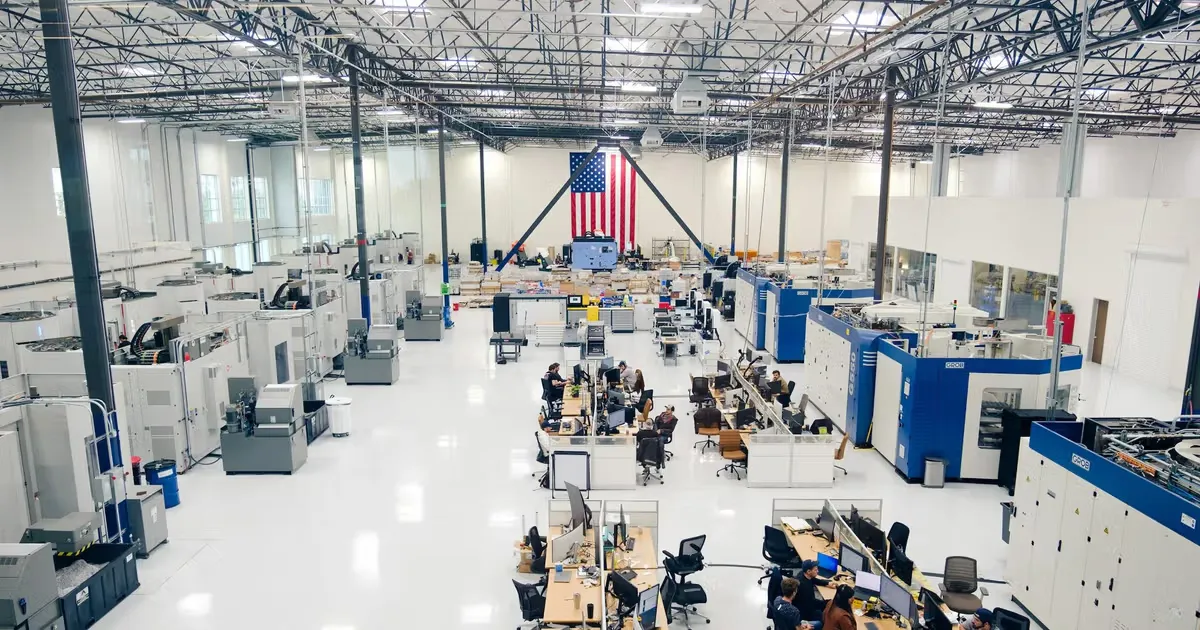
As we can see, the company is serious and ready to tackle challenging problems. One such project is Arsenal. It's Anduril Industries' attempt to transfer Elon Musk's mass production methods from his Tesla to the defense industry. Instead of building each drone as an expensive, one-off piece, the company is constructing a gigantic Arsenal-1 factory in Ohio, covering over 450,000 square meters. The project's main goal is to transform the military-industrial complex from a hand-assembled workshop into a high-tech assembly line capable of producing tens of thousands of autonomous systems per year. It's all in the spirit of Henry Ford, only for defense.


Anduril is skilled not only in software, but also in hard
The key difference in Anduril's approach to the Arsenal project is in the design weapons Specifically designed for the capabilities of robots and automated production lines. Engineers use a minimum of unique parts and a maximum of off-the-shelf components, allowing them to assemble complex vehicles, such as the Roadrunner interceptor jets or Ghost drones, at the same speed as modern electric cars. For reference, the Roadrunner and Ghost are Anduril's own developments. This production flexibility allows for the rapid reconfiguration of production lines to meet the needs of the front, reducing the time from design to mass production by a factor of 10. For the Pentagon, the Arsenal strategy is a way to restore the United States to the industrial scale necessary for a potential confrontation with China, focusing on cheap, mass-produced, and expendable autonomous weapons that are worth losing in combat. This is precisely what the Pentagon currently lacks in the war with Iran.
The nervous system of war
Let's return to the protagonist of this multi-billion-dollar story—the Lattice OS operating system. Distributed computing stands out among its features. Its main advantage during combat is the elimination of the need to send a stream of information to the "brain center" (operational headquarters) for processing and decision-making. This wastes time. Now, a drone on the ground will decide what's important and what's not. As the authors write, "this allows the system to instantly respond to threats and maintain full functionality even when communications are jammed by electronic warfare." Alternatively, it could use extremely weak communication channels, capable of transmitting only the target type, its coordinates, and the probability of hitting. A joke, of course, but distributed computing allows drones on the front lines to communicate with the command center using practically Morse code.
Lattice doesn't care who connects to the software module or what protocols they use. The architecture is universal and isn't tailored to a specific manufacturer. It's the very unification in war that everyone dreams of and talks about so much. Theoretically, you can connect anything to Lattice—a $10 Chinese camera or a strategic UAV MQ-4C Triton. In keeping with the best traditions of the IT industry, the operating system is updated every two weeks. The Pentagon expects significant savings in the future. Lattice's ability to connect and control everything allows for affordable drones to be purchased from multiple suppliers. The absence of monopolies positively impacts the quality of the finished product, especially in the military-industrial complex.
Under the contract, Anduril promises to quickly develop new software for any platform the Pentagon is interested in. Field experiments in 2025 showed that integrating a new sensor or strike platform into a combat system takes just a couple of hours. This also provides a good opportunity to quickly utilize captured weapons. For example, the Americans took an arsenal of Chinese drones of unknown design, and within a few hours, they were all connected to Lattice.

A single Lattice window might look something like this
The Anduril software product is designed to deliver something akin to a computer game to a single operator. Here, a platoon of Bradleys is advancing on the offensive line. The system calculates in advance the probability of a successful attack, possible scenarios, and recommends to the staff officer methods for supporting their own forces. Conversely, a multitude of reconnaissance platforms creates a unified picture of enemy positions. Lattice runs through millions of scenarios and almost instantly generates the most optimal strategy for suppressing the enemy. For example, engaging a nearby swarm of AI-controlled drones or deploying a Bradley platoon to a higher-priority area.
Sounds like a sci-fi action movie? Absolutely. Recent history has taught us that even the most improbable ideas find practical application on the battlefield. In this context, Lattice is definitely worth a closer look and considering developing a domestic equivalent.
Information