Why can't Russia create a Starlink analogue?
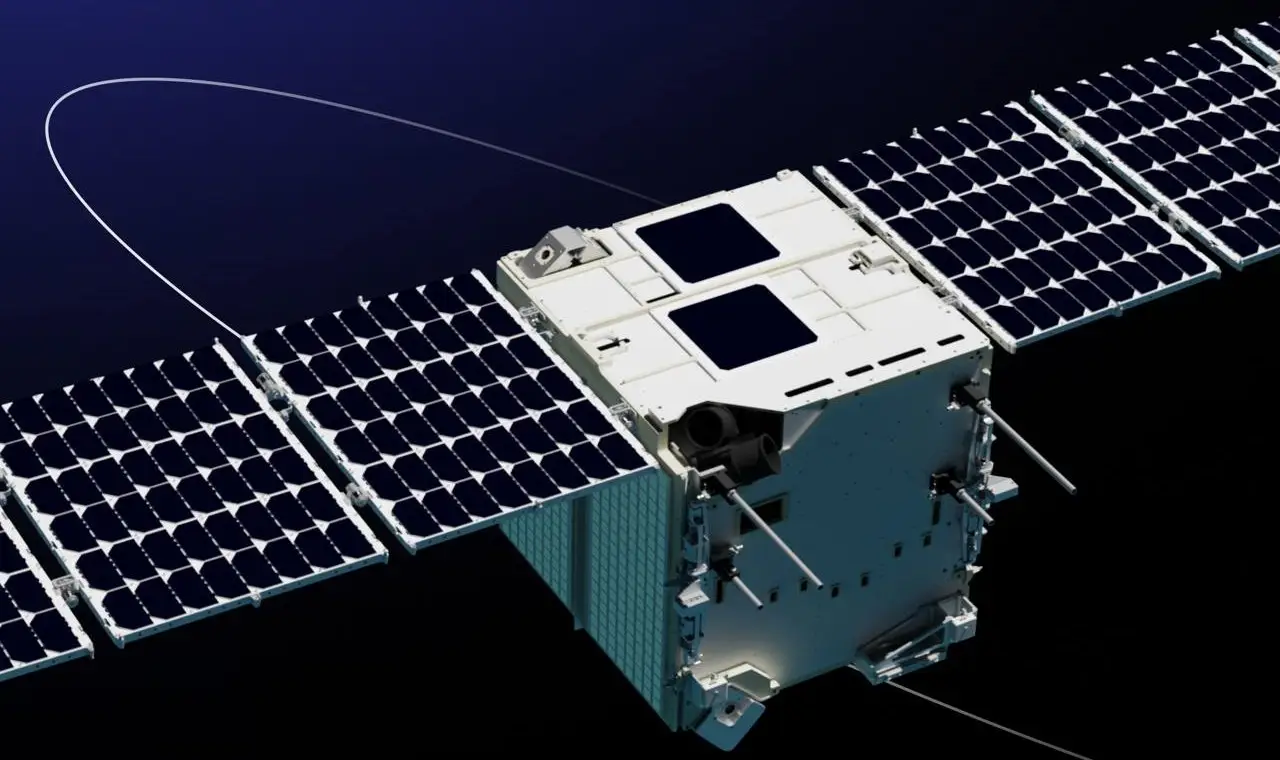
Image t.me/bureau_1440
While many eyes are on Iran and the fighting unfolding around that country, we should be far less concerned about this – the Special Military Operation in Ukraine continues, with heavy ground fighting and exchanges of precision strikes. weapons long range.
Lack of choice
Elon Musk recently shut down Starlink terminals in Ukraine that were not verified on special "whitelists." According to senior Russian Defense Ministry officials, the shutdown of the Starlink terminals had no impact on the quality of communications for Russian ground units.
However, we are currently primarily interested not in communications, but in the possibility of using Starlink terminals or their analogues to carry out strikes using long-range kamikaze UAVs, with high "manual" targeting accuracy at the final stage, with the ability to further search for and verify targets, as well as objectively monitor the results of strikes in real time.
Do we have the ability to directly control kamikaze UAVs from hundreds of kilometers away?
The author does not have a precise answer to this question, but it will most likely be negative.
Communication satellites located in geostationary orbit have high latency and low interference immunity; using such communications is possible and necessary, but only in certain scenarios.
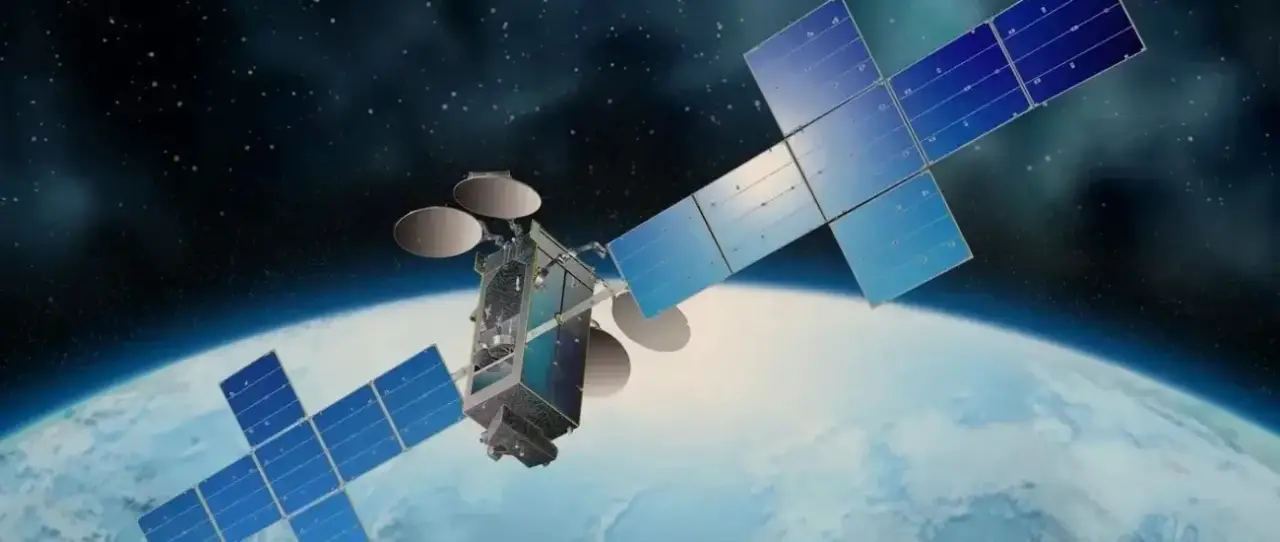
The largest private geostationary communications satellite ever built is Jupiter 3, weighing over nine tons, developed by Maxar Technologies and L3Harris Technologies for Echostar Hughes Network Systems.
It seems like they're currently trying to do something with mesh networks, but how long can the signal chain be? What will be the signal transmission delays, especially as the number of intermediaries increases?
It can be assumed that mesh networks will work at a depth of a couple of hundred kilometers, but beyond that, there will most likely be delays and signal interruptions, especially if the enemy knocks out the “chain links.”
Starlink for the Poor: Communications Based on Stratospheric Balloons and Stratospheric UAVs – the author is also skeptical about this direction, at least in terms of organizing high-speed communication networks, both due to the low carrying capacity of UAVs and the difficulty of keeping the balloons in a given area.
In other words, the Starlink high-speed satellite communications system can only be replaced by a similar domestic high-speed satellite communications system.
It seems that one of the projects closest to reality is the low-orbit communication system of the company "Bureau 1440", but the exact time frame for the commissioning of this system is still unknown.

Image 1440.space
So what's stopping us from creating a domestic high-speed satellite communications system?
Disposable "trampoline"
Despite the fact that Russia is seriously behind in terms of creating partially reusable missiles-carriers, we have all the capabilities to launch artificial Earth satellites (AES) into orbit.
Yes, it will be more expensive than the US, but it's not yet critical. Let's not forget that Russian launch vehicles launched some of the satellites for OneWeb, a British project competing with Starlink.
Nevertheless, the creation of partially and fully reusable launch vehicles should become one of the national priorities, and, in the author's opinion, at least three projects must be implemented in parallel.
The first project is the partially reusable Soyuz-7 (formerly Amur-LNG) methane-fueled rocket from JSC Progress Rocket and Space Center, which could become a lighter-lift equivalent of SpaceX's American Falcon 9 rocket.

A model of the Soyuz-7 launch vehicle. Image: commons.wikimedia.org / F.Alexsandr
The second project is the fully reusable launch vehicle "Korona" from JSC "GRC Makeyev".
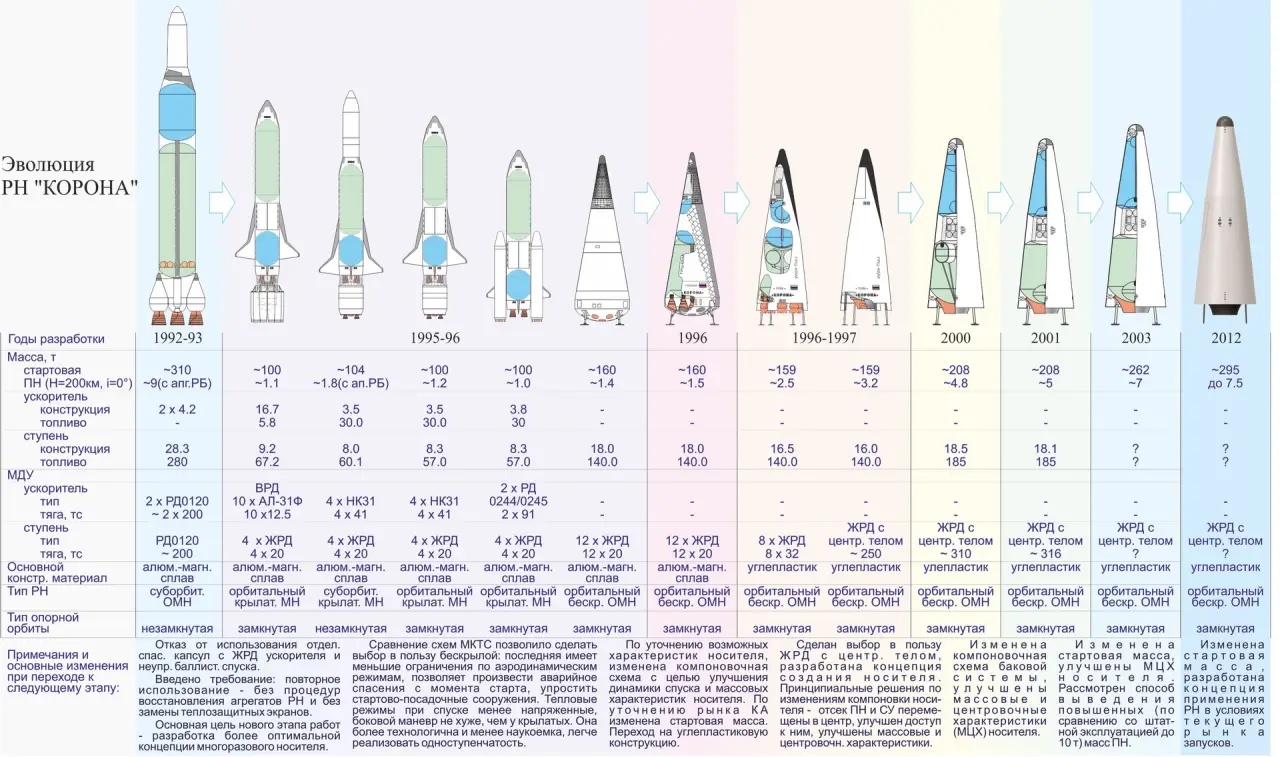
The evolution of the Korona launch vehicle concept. Image by makeyev.ru
The third project is a strategic, fully reusable heavy-lift launch vehicle-spacecraft system, which is worth stealing from SpaceX, at least conceptually – the country's survival is at stake, so there's no room for complacency here.
It will still not be possible to completely borrow SpaceX's solutions, since this would require copying the entire plant; we will have to adapt the project to our technological capabilities.
If anyone says three projects simultaneously would be too expensive, let them imagine the cost of the SVO—with a domestic equivalent of the Starlink network, the war would have ended long ago. It's easier to abandon the orbital station and some scientific projects—later, partially reusable, and especially fully reusable, launch vehicles will more than compensate for all of this.
If private business gets involved in the creation of reusable rockets, this area also needs to be supported, for example, by tax exemptions.
For now, we shouldn't forget about the well-deserved Proton launch vehicles. You never know how things will turn out, and these products have long demonstrated very high reliability and, for a disposable launch vehicle, are relatively inexpensive.
However, it seems that our main problems are with the satellites themselves.
Electronic component base
Let's start with one of our most pressing issues: radiation-resistant electronic components. We have a problem with that, but at least it's almost always available, despite the sanctions—it's produced and sold in very large quantities all over the world. Radiation-resistant electronic components, however, are a much more rare and proprietary commodity.
It's important to understand that ECB, while resistant to terrestrial radiation, is unsuitable for satellites. At a nuclear power plant, the primary radiation is gamma rays, and at worst, neutron fluxes. Cosmic radiation, on the other hand, is a flux of charged particles—protons, electrons, and atomic nuclei—moving at near-light speeds.
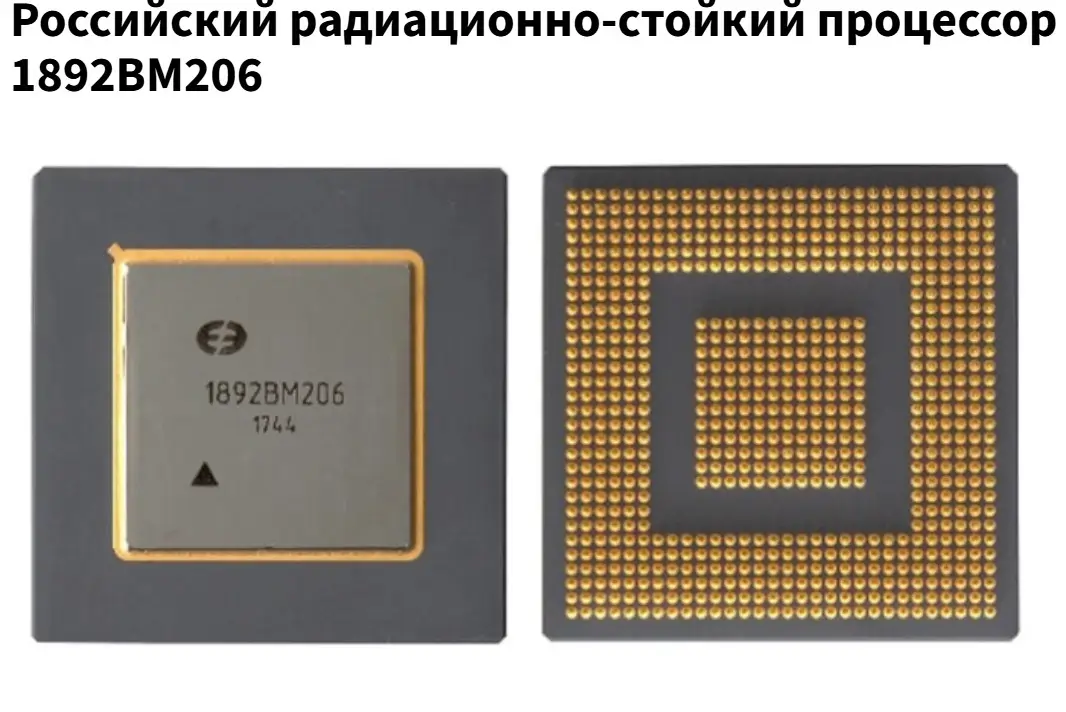
Image from support.elvees.com / tehnoomsk.ru
Even fast neutrons in the reactor core don't accelerate beyond 40,000-45,000 kilometers per second, while the speed of light, at which protons, electrons, and atomic nuclei can travel in outer space, reaches nearly 300,000 kilometers per second. The energy of fast neutrons in a reactor reaches 10 MeV (megaelectronvolts), while cosmic particles reach 1,000,000 MeV and even 1,000,000,000,000 MeV (for "aliens" from deep space).
Russia has specialists in radiation-hardened electronics. Much of their work depends not only on the electronic component base but also on design schemes that enhance reliability.
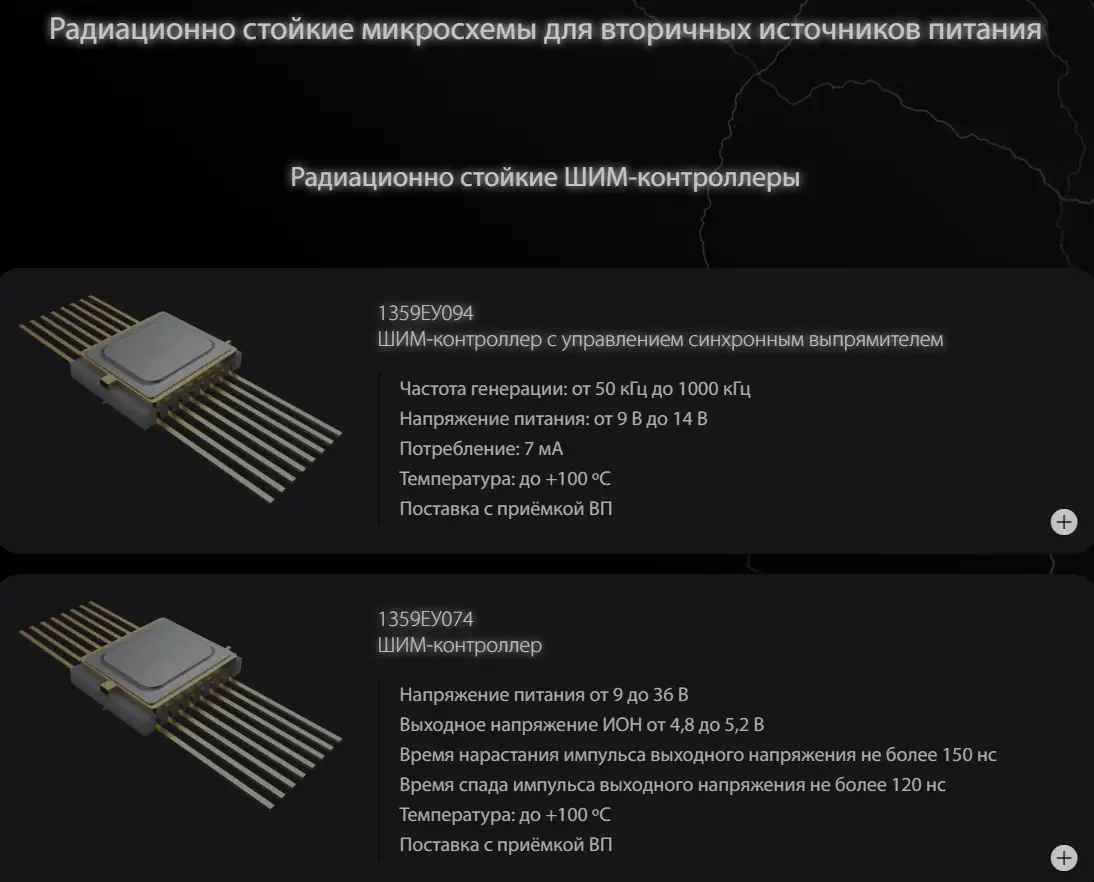
Image by niiis-micro.ru
Protection can be partially increased by using passive shielding – not lead, which itself becomes a source of induced radiation when hit by fast particles, but materials rich in hydrogen – polyethylene, plastic, and composites with the addition of boron.
There's another interesting way to produce radiation-hardened electronics. Each microchip is currently unique in many ways, so their radiation resistance varies greatly from batch to batch, and even from sample to sample. Some companies purchase large batches of microchips and test them for resistance using a special method; the samples that pass the test are sold as radiation-hardened.
And of course, we need our own radiation-resistant electronic component, especially since it doesn't require any "fine" manufacturing processes. Even if we can't manufacture something ourselves, the chances of ordering such products from somewhere in China will be an order of magnitude higher than the most modern "terrestrial" chips.
AFAR
In addition to the satellite's internal components, they must also be equipped with antennas, which are active phased array antennas (APAA). Not only the satellites, but the terminals themselves also have APAA antennas.
We're only just starting to get things right with military AESAs, but here we need to produce hundreds of satellites operating in outer space, as well as tens to hundreds of thousands of small-sized user terminals.
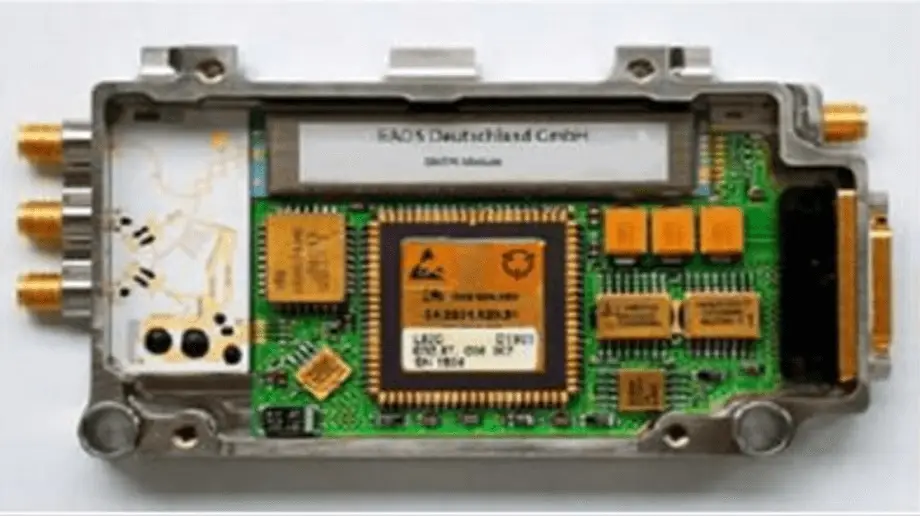
X-band microwave phased array antenna module. Image courtesy of apni.ru
AESA is a complex technology, and it's impossible to deny our lag in this area, but it is a critical technology for communications and radar, for both civilian and military systems, so we need to catch up as quickly as possible.
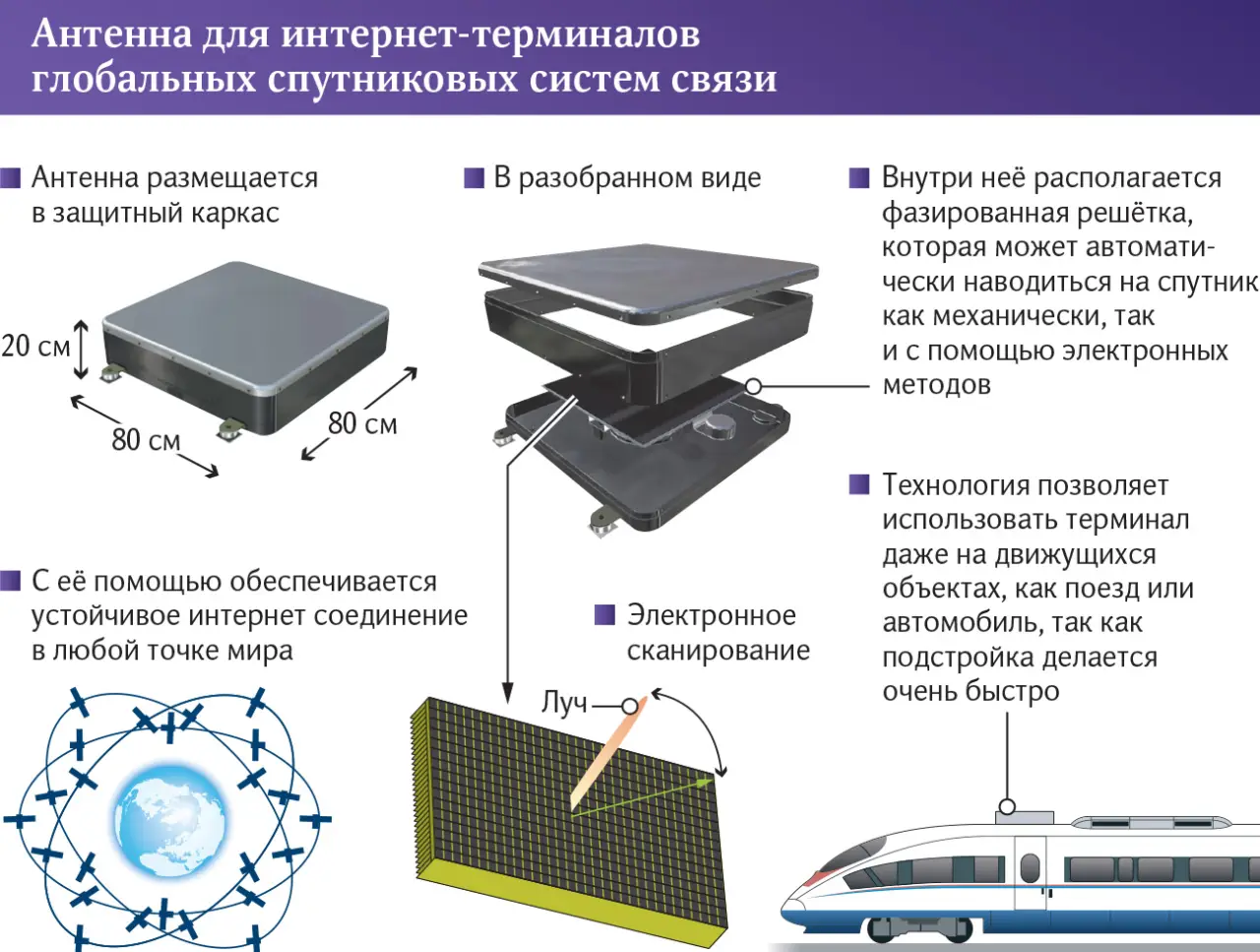
Image by aftershock.news
Software
The communications satellites planned for deployment by Bureau-1440 are to be placed in an 800-kilometer orbit. In such an orbit, the satellites move at a speed of approximately 7,5 kilometers per second. At this speed, it is necessary to communicate with terminals, which can also move, lose signal, or be obstructed by obstacles.
Solving this problem requires complex software, and luring programmers into space projects is far from easy. It's possible that Bureau-1440 will have a better chance than Roscosmos, at least because, based on personal observations, programmers dislike the formality of state-owned companies—permission to wear shorts and flip-flops, and a fridge stocked with Coke, can be a significant recruiting tool.

Recruiting personnel into IT has its own specifics
Furthermore, any software requires debugging, and not all of it can be done here on Earth. Debugging software on existing satellites, meanwhile, carries the risk of bricking them. What happens with a bricked system in orbit? Taking it to a service center is somewhat difficult.
Inter-satellite communications, positioning and ground component
High data transfer rates can only be achieved by providing inter-satellite communication – optical (laser) communication channels are usually used for this, and for such communication to work, the satellites must know their coordinates with minimal error.
It seems that such laser inter-satellite communication has already been tested at Bureau-1440, but it is one thing to connect two or three satellites, and quite another to do the same when there are hundreds of them.

Image 1440.space
Also, for the reliable operation of the satellite network, a ground component is necessary, both for transmitting traffic to the global network and for increasing the accuracy of satellite positioning – the more such ground stations, the better.
We have a large territory, but it would be desirable to have ground stations abroad, but who will allow us to build them now?
North Korea, some African countries, perhaps we will be able to reach an agreement with Vietnam or Myanmar, and that’s probably all.
We spent so much money helping God knows who all over the planet, just so our little ship could pay them a visit or our little planes could fly over. And then the Americans came and simply took it all for free. Have any conclusions been drawn from this? It's still unclear.
Conclusions
As we can see, creating a high-speed communications network based on low-orbit satellites is far from a simple task.
It’s no wonder that no one took it on before SpaceX – not because they didn’t want to, but because they couldn’t.
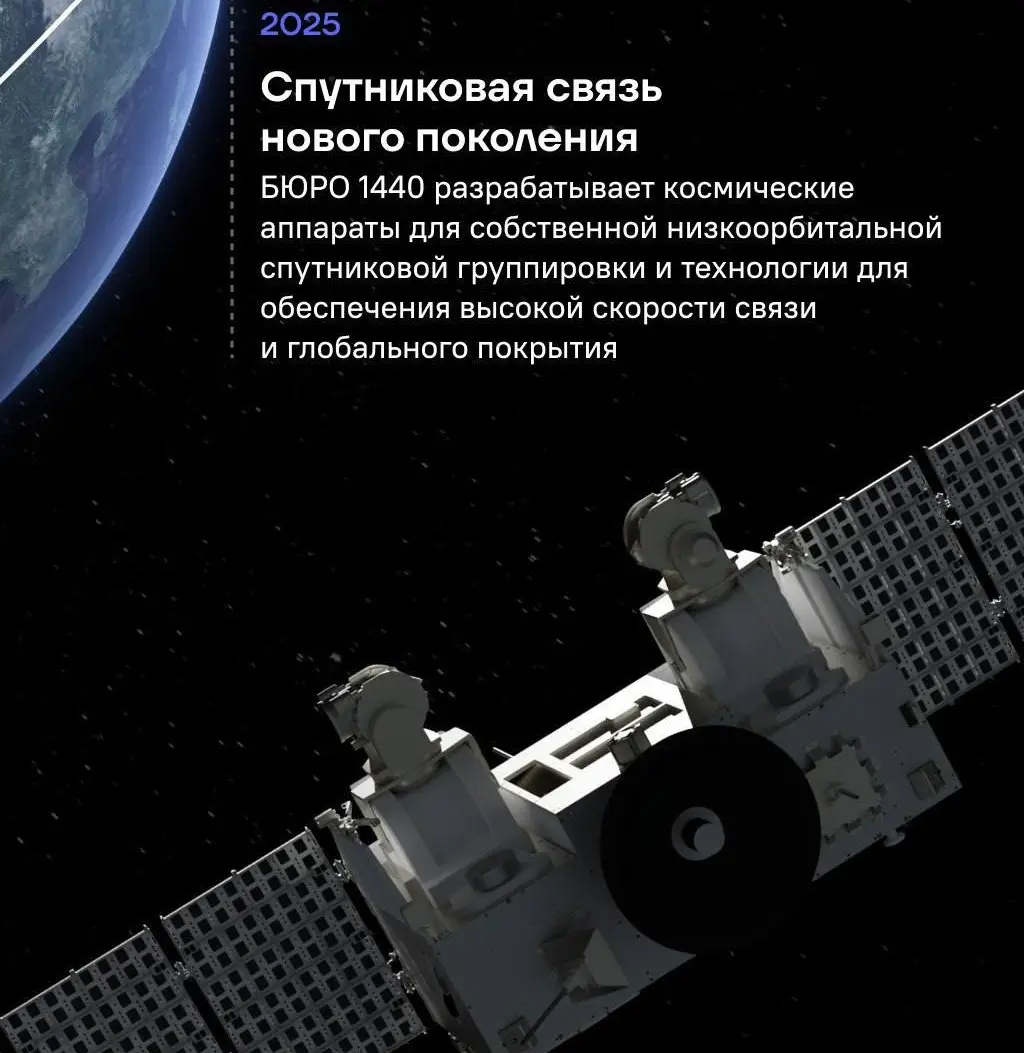
Image t.me/bureau_1440
For us, this is one of the critical areas that ensures the competitiveness of the state and the survival of the armed forces.
Information