TPG1000C Electromagnetic System: Chinese Science vs. Communication Satellites

A TPG1000C prototype in laboratory conditions. Photo by SZIYAT
The rapid development and widespread use of satellite communications has necessitated the development of means to suppress them. Various systems and complexes have been proposed for disrupting enemy communications, and China recently developed another such prototype. The TPG1000C prototype is claimed to demonstrate record-breaking technical performance and is capable of achieving its intended objectives with increased effectiveness.
Record-breaking performance
The development of a new "electromagnetic weapon" for countering enemy electronics was conducted at the Northwest Institute of Nuclear Science and Technology (Xi'an). The necessary research and design work was conducted by specialists from the Microwave Technology Laboratory, led by Wang Gang. The project's key findings were presented in a paper for the peer-reviewed journal High Power Laser and Particle Beams and published in late December of last year.
The goal of the new SZYaT project was to develop a promising electromagnetic system suitable for use in electronic warfare and related fields. Such a system would generate a highly powerful and long-duration directed electromagnetic pulse capable of suppressing or damaging the electronics of a target.
Similar systems have already been developed in China and other countries, but they all had certain drawbacks. The main one was an unfavorable balance between operational and service characteristics. For example, the high pulse power came at the cost of increased size and weight, as well as corresponding energy consumption.
A team of Chinese specialists led by Wang Gang studied domestic and foreign experience in the field of electromagnetic weaponsNew technical solutions were proposed aimed at optimizing the design and improving overall performance. These proposals were confirmed both theoretically and through rig experiments.
SZIYAT specialists then built a full-scale prototype of the "electromagnetic gun," designated TPG1000C. The device passed tests and confirmed its design characteristics. Furthermore, it was used to demonstrate the correctness of the chosen technical solutions.
During testing, pulse power of up to 20 GW was demonstrated. Continuous operation lasted up to 1 minute. The system can generate up to 3 pulses in a single activation. During testing, it generated a total of 200 pulses. However, full details of these tests are not being disclosed.

Starlink communications satellites during launch. Photo: SpaceX
Technical features
For obvious reasons, SZIYAT scientists chose not to disclose all the details of their project. Even the complete design of the prototype "gun" is not subject to publication. For example, the article in the scientific journal included a photograph showing only a portion of the TPG1000C, with some of its components obscured. Whether the entire device will ever be revealed remains to be seen.
The photograph depicts a complex metal casing composed of a series of cylinders and cones. It has access hatches and various components of unknown purpose. Apparently, the system is subjected to high loads during operation, necessitating increased metal thickness and the use of numerous fasteners.
Full details of the TPG1000C design are not disclosed, but it can be assumed that this system is fundamentally no different from similar developments. It is expected to include a device for energy storage and output, a microwave generator, and a set of auxiliary equipment. Control devices, etc., are also required.
The system must operate using an external power source. Using built-in technology, it must accumulate energy and then use it to generate powerful electromagnetic pulses.
The TPG1000C in its current form is approximately 4 meters long. Its weight without additional systems and devices is approximately 5 tons. However, the "gun" requires various additional components, which increase the overall size and weight of the system.
The developers note that the prototype system could have been even larger and heavier. The length was reduced by implementing a new layout. Typically, such "guns" are built using a linear layout with the units positioned one behind the other. The TPG1000C project uses a U-shaped layout, which reduced the length by almost half. The new design reduced the overall weight of the system. Aluminum was also used instead of steel. This material change reduced the weight of the system by approximately a third.
Other solutions have also been implemented. For example, grooved insulator plates, which demonstrate greater efficiency, are used. A new oil composition is also used as insulation. These measures have significantly improved the energy performance of the TPG1000C.
Practical perspectives
Currently, the TPG1000C system exists only as a prototype used in laboratory conditions. It is a fairly large and heavy device, requiring placement on a special stand and movement on rails. However, in the future, this prototype may be used to develop a system suitable for practical use.
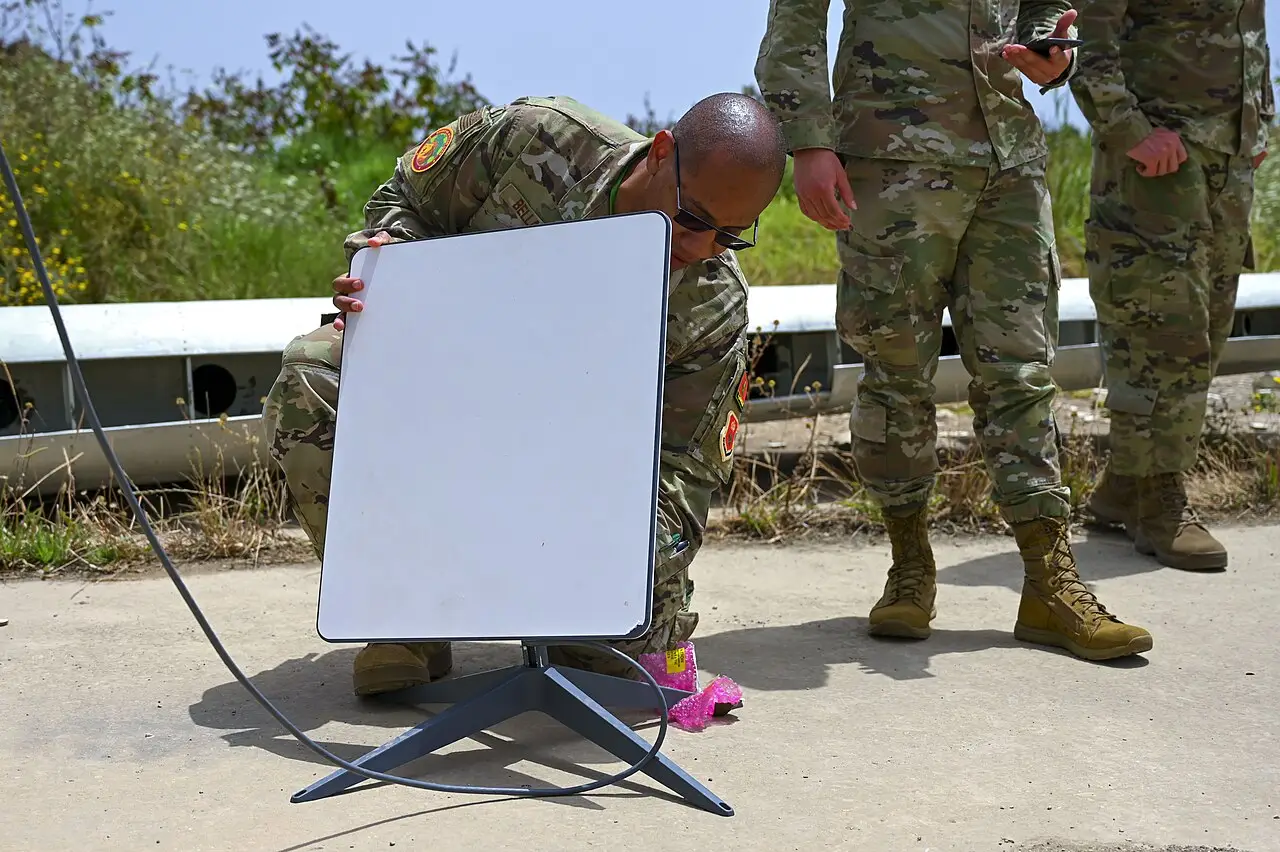
The antenna assembly of the Starlink user terminal. Photo: US Department of Defense
A recent SZIYAT publication mentions the possibility of mounting the TPG1000C or a similar system on a ground-based self-propelled platform. Such a system could be built on a truck, a semi-trailer, or in a container. The possibility of creating a aviation modifications or variants for placement on spacecraft. The last two proposals are of particular interest.
An "electromagnetic gun" with a power of up to 20 GW is capable of solving a wide range of combat missions involving the suppression or destruction of enemy electronics. Using pulses of varying power, frequency, and duration, it can affect various electronic systems. However, for obvious reasons, the TPG1000C system is of greatest interest when used at maximum power.
A gigawatt-power pulse can strike hardened targets and/or do so at long ranges. Specifically, the system's developers openly claim its ability to jam communications satellites in low orbits. Broadband internet access systems such as Starlink or OneWeb are being considered as such targets.
A mobile, airborne, or space-based system based on the TPG1000C will be able to disable or destroy satellite electronics, thereby disrupting enemy communications systems. However, orbital altitude or resistance to interference will not provide protection against electromagnetic interference.
It's worth noting that SZYaT's new "electromagnetic gun" design is based on well-known and proven solutions. These were scaled up as required, achieving high performance characteristics. New ideas were used only to optimize dimensions and weight.
The new SZIYAT project has demonstrated that even available technologies can achieve record-breaking performance. Furthermore, it offers at least a theoretical possibility of creating new "weapons" of this kind with the required level of parameters and combat capabilities in the foreseeable future.
Accordingly, in the future, the Chinese army may order and receive electromagnetic combat systems capable of solving various tasks. With these systems, the PLA will be able to suppress or disable enemy communications systems, including the most modern and effective ones.
It's worth noting that the PLA has long shown interest in weapons based on so-called new physical principles. At a minimum, several such systems have reached the point of field and field trials. Now, it can be expected that the army will take an interest in SZYAT's developments and initiate their development into a fully-fledged system for practical implementation.
Information