The question of price and confidence in dollars for the US

17 175 53
The question of price and confidence in dollars for the US

interesting news from the other side of the world: american fleet started receiving weapon new generation against unmanned aerial vehicles. Apparently, the slaps received in the Red Sea from the Houthis did their job, and the additional armament of American ships began urgently.

A newly released image of the Arleigh Burke-class destroyer USS Bainbridge clearly shows the ship's new Coyote drone interceptor launchers. Earlier this year, the U.S. Navy announced that destroyers assigned to escort the aircraft carrier USS Gerald R. Ford would be armed with countermeasure systems drones from Raytheon "Coyote" and/or Anduril "Roadrunner-M".


Besides the fact that Coyote and Roadrunner-M are cheaper than traditional missiles class "surface-to-air", they have a loitering function, which allows them to more effectively counteract approaching unmanned aerial vehicles. The idea is good. An anti-drone munition that meets an enemy UAV as it approaches the target area is quite effective, even if you look at it with bias.

The U.S. Navy has released a photo of the USS Bainbridge sailing in the Ionian Sea between Italy and Greece, taken July 27, 2025. The ship is one of three Arleigh Burke-class destroyers currently assigned to the Gerald R. Ford Carrier Strike Group, along with sister ships USS Winston S. Churchill and USS Mitchell. The Winston S. Churchill serves as the strike group’s air defense commander, a role that the Arleigh Burke-class destroyers are increasingly taking on as the fleet of aging Ticonderoga-class cruisers dwindles.


The destroyer USS Bainbridge in the Ionian Sea, July 27, 2025. A new drone interceptor launcher is visible on the aft superstructure.

The new drone interceptor launchers are mounted on the port side of Bainbridge's aft superstructure adjacent to the aft Mk 41 vertical launch system (VLS).


This image of the ship leaving port in June 2025 shows the new Bainbridge drone interceptor launchers, but they are partially obscured by personnel on deck.
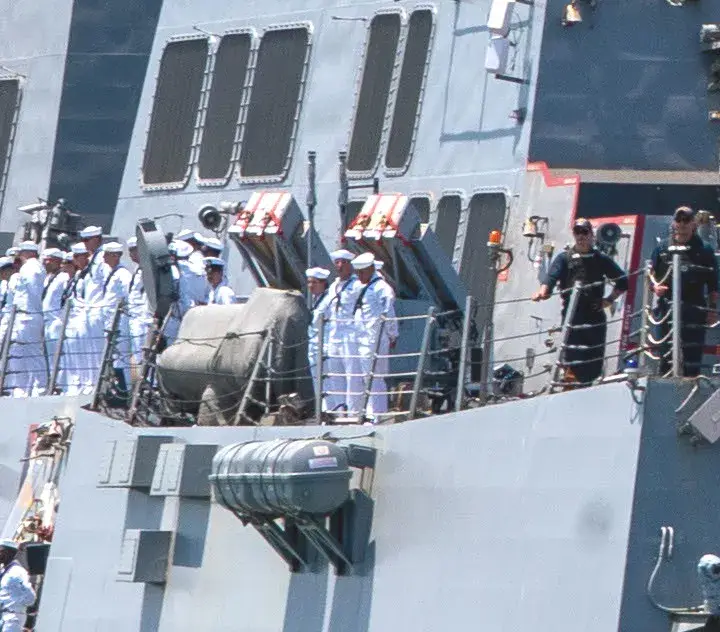

A close-up of the launchers in a photo taken in June 2025.

Further examination of other photographs of the Gerald R. Ford carrier strike group released by the Navy since its current deployment began in June reveals the same launcher aboard the Winston S. Churchill. There is a possibility that the Mitcher also has one, albeit an older version of the Arleigh Burke, while the Bainbridge and Winston S. Churchill are newer IIA variants, but it appears that the introduction of new countermeasure capabilities drones Applies to all Arleigh Burke variants.


USS Winston S. Churchill transits the Adriatic Sea on July 29, 2025
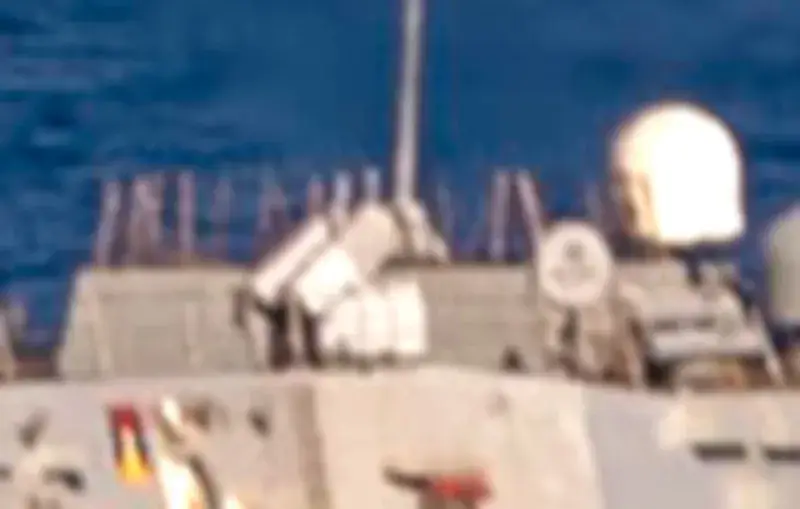

A close-up of the new launchers on the destroyer Winston S. Churchill

All Arleigh Burke-class destroyers are equipped with Mk 41 VLS launchers, but with varying numbers of launch cells depending on the model. They can be loaded with a variety of surface-to-air and surface-to-surface missiles, including the Standard Missile (SM), Enhanced Sea Sparrow (ESSM), and Tomahawk missiles.

Some versions have additional launchers for Harpoon or Naval Strike Missile (NSM) anti-ship cruise missiles. Depending on the specific version, Arleigh Burke ships are equipped with RIM-116 Rolling Airframe Missile (RAM) launchers or 20mm Vulcan cannons mounted on Mk 15 Phalanx Close-In Weapons Systems (CIWS), or in some cases both, to defend against air threats, including drones.

The US Navy is currently replacing the Phalanx on all of its destroyers with RAM launchers. The 5-inch gun in the turret on the bow of each destroyer can also be used against air and surface targets, but the larger caliber is becoming increasingly questionable in terms of effectiveness.

The launchers shown in the photographs of Bainbridge and Winston S. Churchill are clearly similar to existing land-based launchers for the Coyote Block 2.
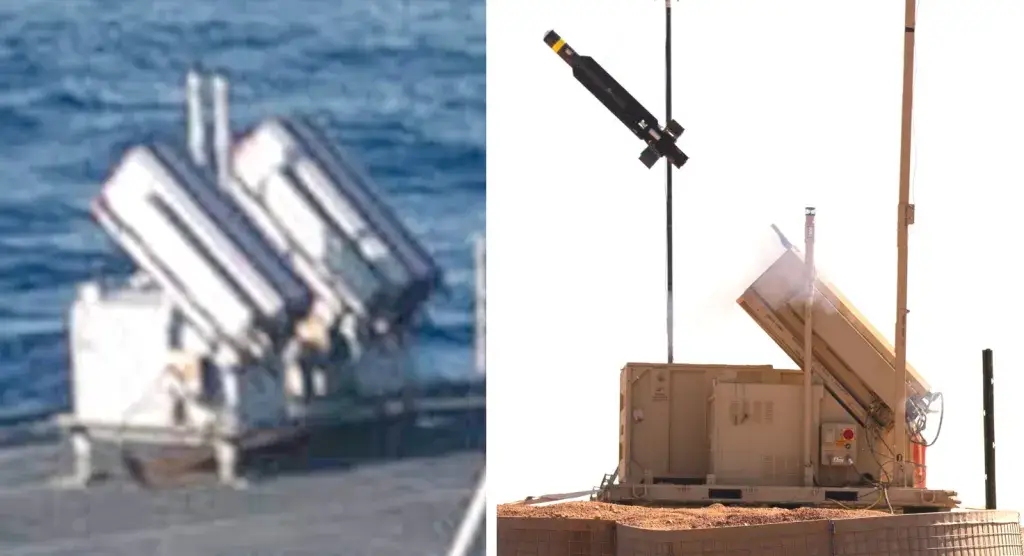

Comparison of the launchers on the USS Bainbridge (left) and the land-based Coyote Block 2 launcher

To date, Anduril has only demonstrated a box-type “nest” for the Roadrunner-M, which launches the interceptor vertically, as shown in the video. Launchers matching this design are not visible, at least at first glance, in available photographs of any of the destroyers assigned to the Gerald R. Ford carrier strike group. But that doesn’t mean they aren’t there.

So what's inside these launchers?
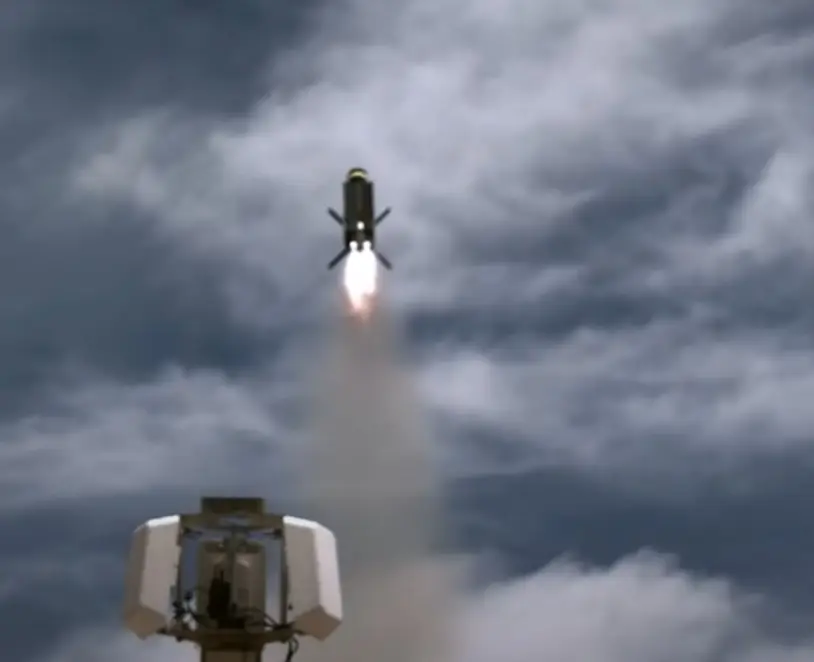


The Coyote Block 2 and Roadrunner-M are drone-like jet interceptors with varying degrees of autonomy. Both interceptors must be targeted at an object or a general kill zone (if detonating at a certain distance from the target) using various sensors before their onboard guidance systems take over.

The U.S. Army has been using the Coyote Block 2 for years as part of its LIDS (Low, Slow, and Unmanned Aircraft Defense System), which comes in both mobile and fixed-wing configurations. The Army has deployed LIDS systems in the Middle East, Africa, and Europe, and used them in combat in at least some of those regions. Newly released images suggest that the U.S. Air Force has also begun operating a fixed-wing version of the LIDS.
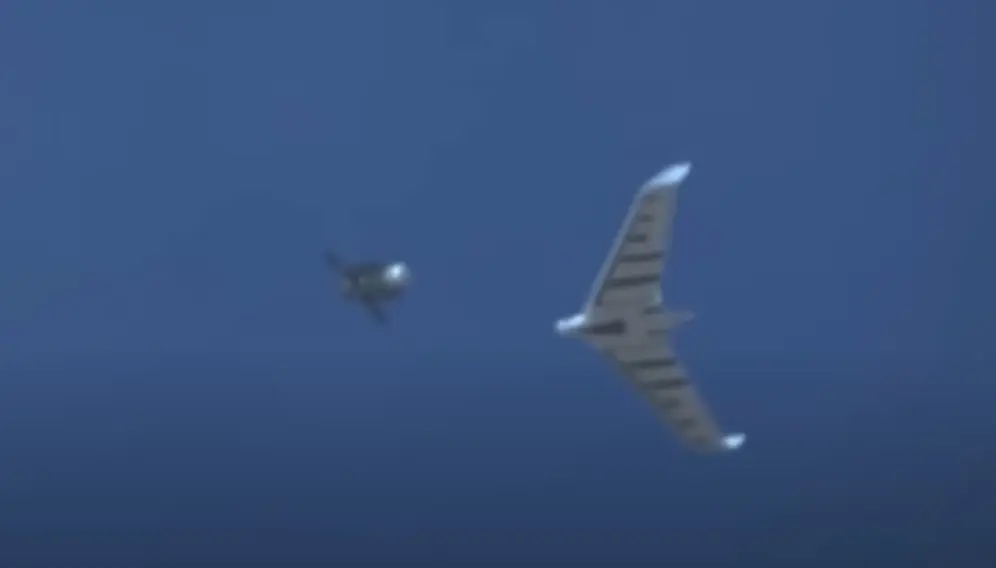


It should be noted that the US Army and Marine Corps are quite satisfied with the results of operating anti-drone systems and even plan to significantly increase their arsenal of Coyote interceptor drones, launchers and radars for them in the next five years. According to department representatives, they want to buy 6000 Block 2 jet drones, which carry a high-explosive fragmentation warhead, and another 700 Block 3 drones, which use some kind of “non-kinetic” payload, which has not yet been widely announced.

The U.S. Army disclosed details of its Coyote procurement plans for fiscal years 2025–2029 in a sole-source contract award notice to Raytheon released earlier this month. In addition to the Block 2 and Block 3 interceptors, the Army plans to acquire 252 fixed launchers, 52 mobile launchers, 118 fixed Ku-band radars, and 33 vehicle-mounted radars. As part of the deal, Raytheon will also provide maintenance and repair support for the Coyote systems both in the United States and around the world.
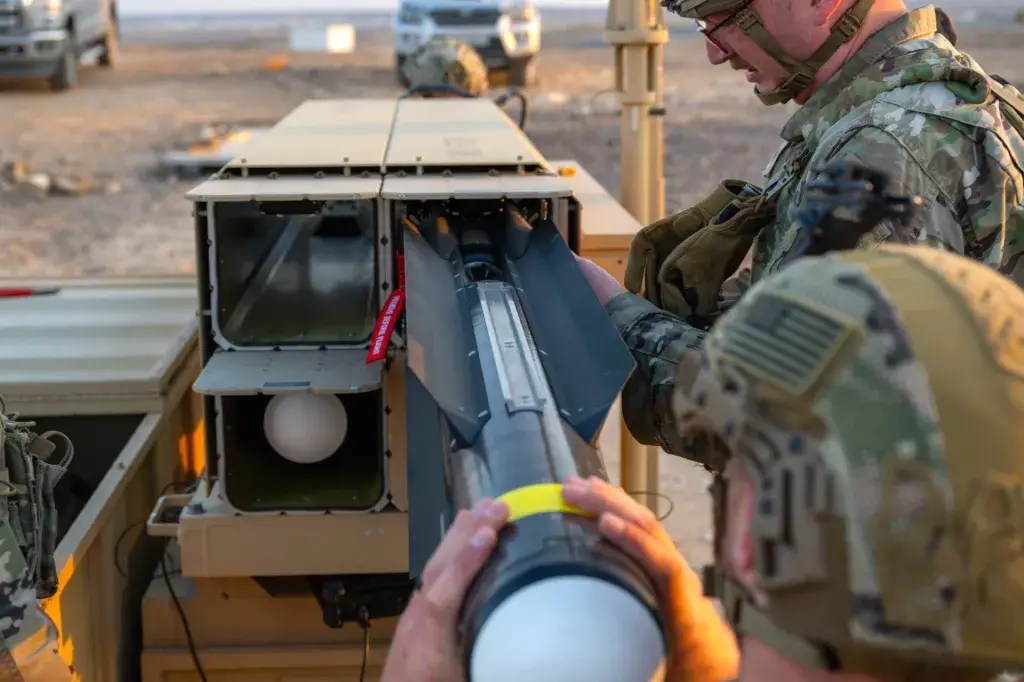

Members of the U.S. Air Force's 332nd Expeditionary Security Forces Squadron train with the Coyote counter-drone system. 2025.

US Special Forces are known to use the Roadrunner-M in a ground configuration, although details on its use are limited to date. A large order by the US military for additional Roadrunner-M systems last year indicates that the system is expanding its use.


As noted, a key advantage of the Coyote and Roadrunner-M is their ability to remain in a standby mode while in flight. This provides additional flexibility to task, cancel, and re-task in real time in response to sudden changes in the tactical environment. They can also be launched preemptively to combat potential threats.

The Roadrunner-M was specifically designed with this deployment model in mind, and has the added capability to recover, refuel, and re-launch. These are capabilities that traditional surface-to-air missiles simply do not have and that are currently unavailable to naval crews.

The capabilities offered by the Coyote Block 2 and Roadrunner-M are important for warships, given their limitations both in terms of the size of the ammunition carried (not critical, modern ships have many launch cells) and in terms of the ability to quickly reload during combat operations (very critical). The latter is indeed very important for ships, as the practice of combat operations with the Houthis has shown. It is precisely by overloading and discharging the systems Defense ships participating in the operation, the Houthis calmly launched their missiles into a tanker and dry cargo ships.

The Navy is working separately to implement new at-sea reload capabilities, in large part because of lessons learned from shooting down Houthi drones and missiles in and around the Red Sea and destroying Iranian missiles aimed at Israel. The experience fighting Houthi drones was a major reason for installing new counter-drone systems on the destroyers of the Gerald R. Ford carrier strike group.

In fact, UAVs as a new type of weapon did not appear yesterday. But in recent years, a huge leap forward and upward has been made, so the fact that the US Navy has already recognized the threat and is beginning to develop methods of counteraction is normal.

As mentioned, the Coyote Block 2 and Roadrunner-M have a huge added benefit: they are a cheaper means of defending against drones than existing ship-based surface-to-air missiles.
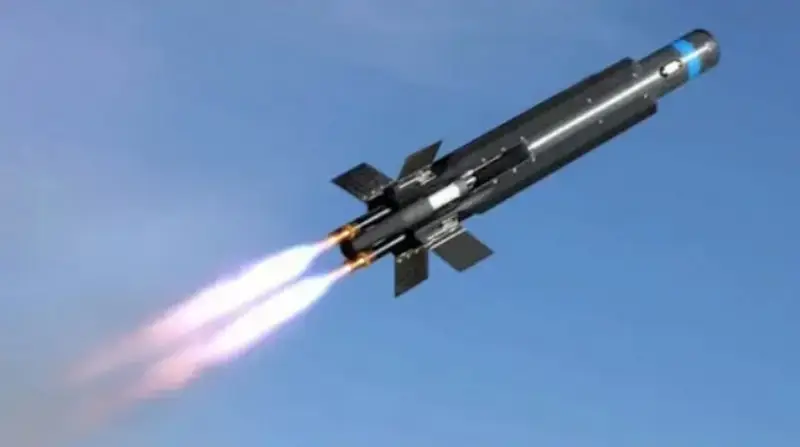

A single Coyote Block 2 reportedly costs about $100. Anduril said each Roadrunner-M costs between $000 and $150, depending on what’s inside. By comparison, the SM-250 Block IIIC, the primary air defense weapon for the Arleigh Burke-class destroyers, has an average unit cost of about $000 million, according to the service’s fiscal year 2 budget request. The estimated price of a single ESSM, another air defense weapon on U.S. warships, is about $2 million per unit.
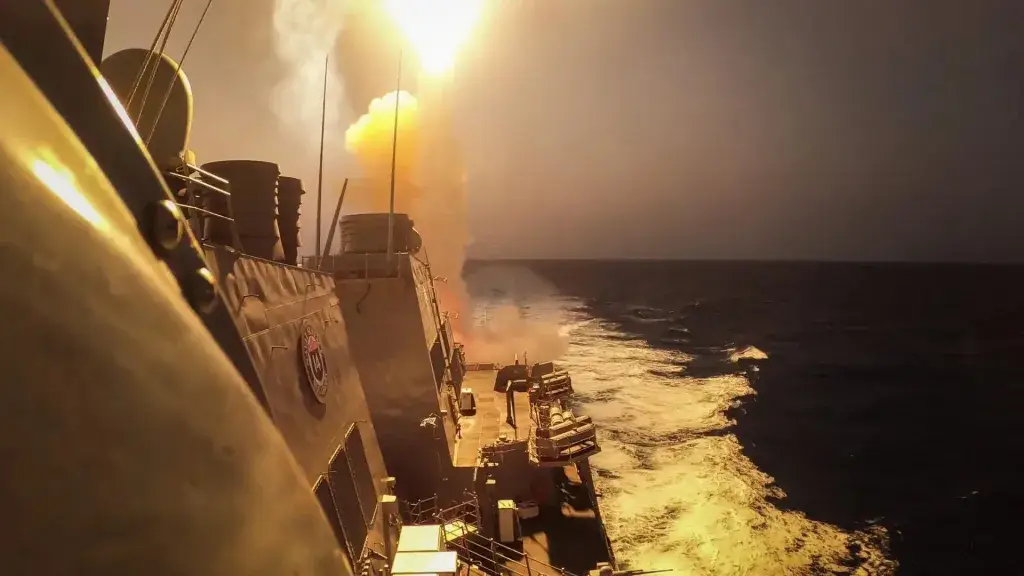

The Arleigh Burke-class destroyer USS Carney fires an SM-2 missile at a Houthi target in October 2023.

The need to add different types of drones, including those capable of operating in swarms, to Navy ships to provide additional layers of defense, as well as to enhance strike, electronic warfare, intelligence gathering, and networking capabilities, has been discussed extensively in recent years.

In reality, no country in the world can afford to destroy drones worth $50 to $100 with missiles costing 10 to 20 times more on a mass scale. Given that missiles tend to miss the stealthy plastic drones, the cost of destroying the latter could increase several times.

Whether the Coyote Block 2 and/or Roadrunner-M launchers will become standard issue on the Arleigh Burke-class destroyers or other Navy ships is unknown, though it is believed they will be. The Navy has tested at least one or both of these systems on two other Arleigh Burke-class destroyers, the Jason Dunham and The Sullivans, and installation of the launchers has begun, if not in large numbers, but will continue, according to Naval News.

The Navy is separately developing a number of other capabilities to enhance the air and missile defenses of its surface ships, including new directed-energy weapons, electronic warfare suites, and advanced network decoys. The question is how quickly and effectively the systems can be developed.

Lockheed Martin is also offering launchers for the AGM-179 Air-to-Surface Missile (JAGM), which can be used as a surface-to-air missile to supplement the destroyers’ arsenal. The company showed models with JAGM launchers located in the same location on the aft superstructure where the Bainbridge and Winston S. Churchill now have new anti-drone capabilities. At least some of the Navy’s Freedom-class littoral combat ships (LCSs) are now capable of engaging drones as well as surface threats with the AGM-114L Longbow Hellfire millimeter-wave radar-guided missile, one of the weapons that JAGM is set to eventually supplant as a ship’s weapon.
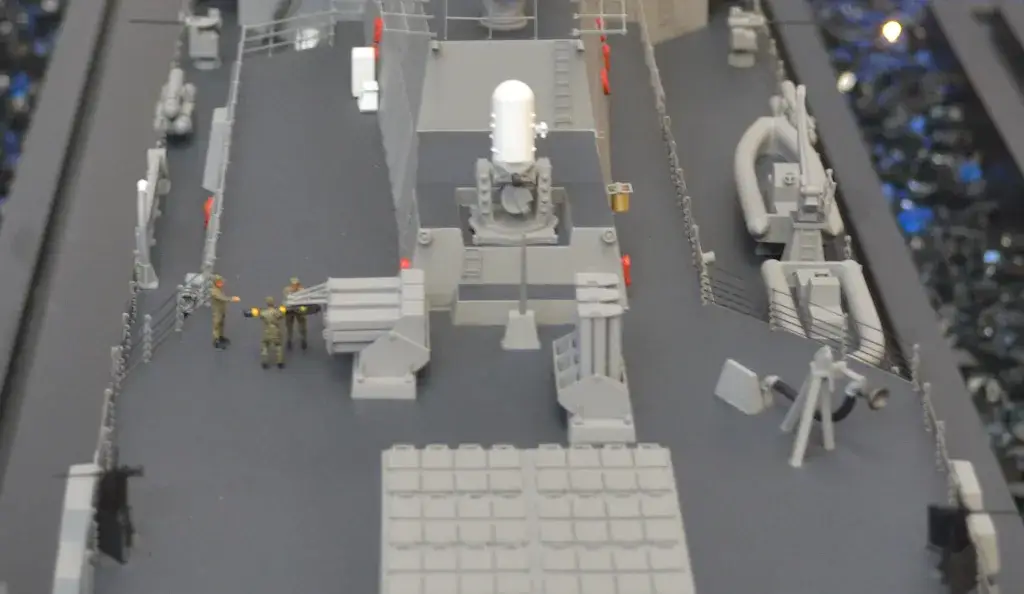

A close-up view of the JAGM launchers on a model of an Arleigh Burke-class destroyer.

Indeed, who, if not the United States, should start a new round of the arms race? In principle, this is a classic of the genre - the United States comes up with something new, the whole world begins to study and create its own. This was the case with atomic and nuclear weapons, missiles, nuclear submarines, and so on.

But in terms of attack drones and countermeasures, things are not going so well, although the American sailors have gained excellent experience in fighting various devices. Hundreds of millions flew into the hot sky of the Red Sea and eventually flew away. And the ships returned to their bases. True, the confrontation with the Houthis did not calm the latter down much, but the law enforcers from among the European NATO countries have certainly calmed down. At least the Germans and Danes, whose ships returned empty of ammunition from the campaign, will definitely not decide to send their ships to that region again anytime soon. There is no money.

Of course, sooner or later, but a cheap opponent to a cheap means of destruction was bound to appear in almost any country that plans military actions. We are not talking about Russia here, we have everything quite decent with developments, we have cheap small-sized missiles, and interceptor drones have begun to be mass-produced. It is clear that all this will also go to our fleet and get a residence permit.

In general, a new stage of development of unmanned weapons has begun. The only question is efficiency and price, because if the Americans are more or less decent with the former, then in the battle with price the Americans are constantly losing.
53 comments
Information
Dear reader, to leave comments on the publication, you must sign in.
  1. +3
    23 August 2025 05: 40
    Maybe the Americans always lose in the battle with the price. But ours always win. Yeah. True, it didn't work out well with Moscow, and not only with it, as we know. The Americans beat up the Houthis and got by without losses, but they completely dispersed us and locked us in distant bays. So think about who lost and who won.
    1. +8
      23 August 2025 05: 46
      Well, let's give the Houthis full information about the US fleet in real time, give them backs, good missiles and we'll see. Why compare the incomparable.
      And the article is interesting, the main thing is that it is not overwrought, but calm and to the point.
      1. +1
        23 August 2025 10: 31
        That's right! And lock their ships in a puddle 1000x500 km.
    2. +7
      23 August 2025 08: 34
      Ah, the cruiser "Moscow", was it really destroyed by drones?
      1. 0
        16 June 2026 15: 01
        And this is important. The admirals' invincibility surpasses their incompetence/legend/talent. However, everything is much higher - the fleet, team play, and admirals admiralize what they have and how they were trained (anyone who isn't a candidate at the academies is a doctor - and for the last 30 years, everyone has been getting more and more doctoral).
  2. 0
    23 August 2025 05: 53
    Quote: SmollH2
    Well, let's give the Houthis full information about the US fleet in real time, give them backs, good missiles and we'll see. Why compare the incomparable.
    And the article is interesting, the main thing is that it is not overwrought, but calm and to the point.

    Yes, but Iran is behind the Houthis, we shouldn't forget about that either. And Iran is one of the world leaders in missiles and drones. And the Houthis don't know how to refuse weapons.
    1. +4
      23 August 2025 09: 14
      Iran's capabilities to help its "proxies" are somewhat more modest. By the way, how is Iran doing with satellite reconnaissance? Are the US not far behind? Maybe Iran has its own "Starlink" analogue?
  3. +7
    23 August 2025 07: 18
    Has the Black Sea Fleet done anything to protect itself from UAVs?
    1. +3
      23 August 2025 07: 34
      Quote: Mars
      Has the Black Sea Fleet done anything to protect itself from UAVs?
      The ships were taken to the bases... wink
    2. +3
      23 August 2025 09: 15
      Do you have any specific suggestions on how to supplement the standard air defense systems for Black Sea Fleet ships?
      1. +1
        23 August 2025 11: 02
        In the Black Sea Fleet, fairly quickly after the appearance of the BEKs, large-caliber machine guns were installed on ships.
      2. 0
        23 August 2025 11: 54
        An effective means against UAVs are artillery mounts with programmable detonation of shells. But this topic has died down somehow :((
      3. -4
        23 August 2025 14: 05
        Of course there is, copy what the Americans did.
  4. -1
    23 August 2025 07: 36
    they have a loitering function
    I'm terribly sorry, of course, but ........ And where and who saw the "patrolling" drones there???
    and in terms of the ability to quickly reload during combat operations (very critical)
    Manually quickly "reload", and even during a fight??? Well, well
    1. 0
      23 August 2025 11: 05
      not during a fight, but during military operations. These are not the same thing.
  5. +1
    23 August 2025 11: 04
    It is not quite clear. The pictures show that the destroyer is equipped with a Vulcan-Phalanx, a rapid-fire small-caliber artillery mount. Theoretically, it should be effective against drones, as it is designed to defend against anti-ship missiles, including supersonic ones. But for some reason, there are no reports of this. European ships are equipped with Oerlikons with programmable projectile detonation. If Phalanxes are ineffective against drones, then why is there no question of replacing them with Oerlikons, it should be cheaper than missiles?
    1. +3
      23 August 2025 13: 25
      replacements for Erlikons, this should be cheaper than missiles?
      there one projectile with an explosion costs 5+k bucks, they always shoot in bursts, not single shots, since they need to shoot down quickly just in case. So it is not a fact that it will be cheaper in the end. And the missile flies further, you do not have to wait until the target flies to one and a half kilometers and in the last seconds pray - will it fall or will it fly further?
      1. +1
        23 August 2025 14: 52
        there one shell with an explosion costs 5+k bucks, they always shoot in bursts,

        The price of the shells is noticeably cheaper, they have become widespread not only on ships, but also on ground vehicles. They fire in bursts, of course, to cover possible aiming errors.
        The range of the Erlikons is about 3,5-4 km.
        1. 0
          23 August 2025 15: 27
          So how long does the queue cost? I saw on YouTube how the Americans shot down an Iranian cruise missile, they probably blew up about a hundred of those shells. What is the probability of destroying a target with one shell? Plus, both of the drones mentioned fly much further, and the Americans are not like us, that one combat unit must fight alone, because the generals are reluctant to establish any kind of interaction between the branches of the armed forces. And the destroyer must not only cover itself, but also someone a little further from the drones. And such jet anti-drones are quite suitable for this, they will fly around some supply ship.
          I don't know why they would remove the last chance artillery, I would leave it, at least it is not sensitive to electronic warfare, unlike the drones described in the article, which were assembled from the same parts from Aliexpress in a new case
          1. +3
            23 August 2025 15: 39
            I saw on YouTube how the Americans shot down an Iranian cruise missile, they probably blew up about a hundred of those shells.

            The Americans use 20 mm Vulcan-Phalanx, their ammunition is not programmable, due to the ultra-high rate of fire and feedback with aiming line correction.
            1. +1
              23 August 2025 16: 51
              On ships - yes, but they took the ground installations from their vassals to run to protect bases in the Middle East. Perhaps someone there simply drowned the trigger.
              In general, Israeli missiles cost less than a line of projectiles with detonation, the price tag for which is also about 10-15 years old and how much the Swiss make them for now - I don't know. At the present time, weapons from AliExpress cost much less than what the military-industrial complex produces with less efficiency, because someone needs the money. And a tank engine with one and a half thousand horses costs an order of magnitude more than an engine of the same power on a hypercar, which was wiped before installation by eighteen-year-old virgins with some body parts.
              1. 0
                23 August 2025 21: 37
                I don't know how much the Swiss make them for now.

                Weapons of this type have long been made not only by the Swiss or Germans.
                http://btvt.info/3attackdefensemobility/air3.htm
                DEVELOPMENT IN THE USA OF PROGRAMMABLE AIR-BURST MUNITION FOR SMALL-CALIBER ARTILLERY

                https://btvt.narod.ru/4/rarn_airburst.htm

                PERSPECTIVE EUROPEAN SMALL-BURNER AMMUNITION WITH PROGRAMMABLE EXPLOSIVES

                We are talking about using such fuses right up to grenade launchers, so the price cannot be extremely high.
                Ammunition was developed for the 25mm XM25 hand-held grenade launcher, the LW25 and LW30 combat modules, the 30/40mm Mk44 Bushmaster II automatic cannon and the new 35/50mm Bushmaster III cannon.
                1. -1
                  23 August 2025 22: 43
                  Weapons of this type have long been made not only by the Swiss or Germans.
                  are they mass-produced or developed? Have they been adopted by the US Army and are they being purchased in tens of thousands? In the late 2004s, a bullet for a sniper rifle was developed with radio command guidance, so where is it? Or where can you see grenades with programmable detonation for the OICW underbarrel grenade launcher, which you mentioned here, except for Far Cry, which came out in 2007? In Stalker from XNUMX? lol
                  the price cannot be super high
                  Well, a rocket made from an aircraft model engine costs as much as a dozen of these shells, and you don’t even need to build a factory - someone has already made one.
                  1. 0
                    23 August 2025 23: 30
                    They adopted it and are producing it. It's written there.
                    The 30mm MK310 PABM-T (Programmable Airburst Munition with Tracer) and airburst system for the Mk30 Bushmaster II automatic 40/44mm chain-driven cannon were adopted for service

                    There are also reports of MK310 being used.
                    https://topwar.ru/152281-snarjad-s-programmiruemym-vzryvatelem-orbital-atk-northrop-grumman-mk-310-pabm-t-ssha.html
                    https://topwar.ru/178018-v-polshe-voodushevilis-ispytanijami-programmiruemyh-boepripasov-mk310-ssha-imenno-na-ee-territorii.html
                    On the Internet you can find a video of the Polish Rosomak APC with a Mk44 Bushmaster II gun and MK310 ammunition in Ukraine.
                    1. 0
                      24 August 2025 01: 08
                      A whole new type for ground forces, which was even seen in combat once! Which the US can use with some of its strikers and some vessels! fellow But American allies are ready to buy, they are ready to buy a lot of things lol
                      I wonder why they didn't decide to make more of these shells in the US and fire them at air targets? And they're churning out APKSW and all sorts of Andurilov drone interceptors? Maybe because the missiles are cheaper in the end? feel
                      1. -1
                        24 August 2025 10: 52
                        Americans do both. They have a lot of money and the technological capabilities allow it.
                      2. 0
                        24 August 2025 14: 56
                        Where do they make them? For export? You wrote here about calibers that you can't find in the US with a lantern
              2. +1
                24 August 2025 18: 40
                Quote from alexoff
                And a tank engine with one and a half thousand horsepower costs an order of magnitude more than an engine of the same power in a hypercar, which was wiped down with some body parts by eighteen-year-old virgins before installation.

                A tank engine must be resistant to more serious impacts than wiping with virgins))
                1. -1
                  24 August 2025 19: 42
                  I haven't heard of anyone complaining about any Bugatti, like they accelerated to 300 km/h in Riga and it fell apart from the shaking. Hypercars are not bought to blow dust off them, but to fly exhausted at maximum speed towards a Kamaz, and if the engine is weak, then you won't accelerate to annihilation when ramming a Kamaz backwards.
                  1. +1
                    24 August 2025 22: 55
                    Quote from alexoff
                    supposedly he accelerated to 300 km/h in Riga

                    I think that even on a gravel road the Bugatti would not have been able to drive for long at least at 80 km/h, not to mention off-road, and it would hardly have worked after vibrations from hits on the armor or shots from its own cannon, which it does not have, or after the air intakes had caught steppe dust, etc. In the end, it is not for nothing that you cannot simply take and transfer a diesel engine from a diesel locomotive to a sea vessel - different operating conditions, although at first glance it seems not as obvious as the difference between a sports car engine and a tank...
                    1. -1
                      24 August 2025 23: 19
                      So why is a tank engine twenty times more expensive? It doesn't have more sophisticated technologies, it uses a huge amount of diesel fuel, the engine is orders of magnitude heavier and less technologically advanced, it rattles like crazy. Overpayment for cast iron? Or maybe the workers there get paid an order of magnitude more? Or maybe someone's appetites are too high?
                      1. +1
                        26 August 2025 19: 56
                        At the beginning of 2022, according to the court decision on the theft of engines, a new B-92S2 for the T-90 cost 3 million rubles. A new engine for hypercars at the same time cost 150.000? It seems to me that something does not add up....
                      2. -1
                        26 August 2025 20: 09
                        And we don't make hypercars. This is a comparison using foreign models as an example. But you can compare it with a similar KAMAZ engine
                      3. 0
                        26 August 2025 20: 14
                        Then there was no need to compare it with a hypercar. Let's compare it with a KAMAZ engine. Let's start with the main thing - it has a power of 1000 hp?
                      4. -1
                        26 August 2025 20: 31
                        And how did you get carried away from discussing the prices of Western weapons to KamAZ trucks and our tanks? It's as if you got carried away in the argument and decided to change the topic.
                      5. 0
                        26 August 2025 20: 38
                        Original. Anyone who is floating and going off topic will understand, having read our correspondence again, which began with YOUR claim that tank engines are an order of magnitude more expensive than hypercar engines of the same power...
                      6. 0
                        26 August 2025 20: 48
                        Well, first you wrote about special requirements for tank engines with 1,500 horsepower (and where do we have such engines), and then suddenly decided to reduce everything to Russian engines in my message, where I wrote about Israeli and American missiles and not only. It looks like you first decided to suddenly move off topic, and then suddenly shift the blame from a sick head to a healthy one, like I wrote it, and you suddenly decided that it was about Russian engines, in a discussion of an article about the USA winked
                      7. 0
                        26 August 2025 21: 09
                        Quote from alexoff
                        And a tank engine with 1,500 horsepower costs an order of magnitude more than an engine of the same power in a hypercar.

                        If your complaint is that you need to compare the price of an American tank engine, then it is certainly more expensive than a Russian one, but still not an order of magnitude more expensive than a hypercar engine, the prices of which are also very, very high and can exceed a million bucks, and besides, the Abrams now has a gas turbine engine, and this is no longer the same as a gasoline internal combustion engine.
      2. 0
        25 August 2025 08: 55
        There will still be no ideal defense, whether with missiles or with small-caliber anti-aircraft missiles with programmable ammunition. The ammo count is not infinite in any case, the ship's air defense system can be simply oversaturated with a mass of relatively inexpensive drones that will attack from different angles.
        Perhaps a radical solution would be to use lasers or microwave generators, which are capable of frying the electronic components of drones, especially the OES.
        1. -1
          25 August 2025 13: 31
          Lasers can't fry all the time either. Air defense can be oversaturated, but I'm sure the Americans won't just shoot down drones, but will send a couple of fighters to see who's so brave and where they're launching from. And their ships don't go alone. They have a system. We should have something like that...
          1. 0
            25 August 2025 13: 47
            It is more rational to use pulse lasers. They overheat less. They require a higher peak power, but if they are powered by the ship's engines (the power of the control system is tens of megawatts), it is quite possible.
            The range of drones can exceed the range of carrier-based aircraft. A military transport aircraft or an airship can be used as a platform for launching drones. After launching the drones, such a "platform" can move away to a known safe distance.
            1. 0
              25 August 2025 17: 13
              Drones can have a range greater than that of carrier-based aircraft
              How long will they fly? The ship won't float a couple of hundred kilometers during this time?
              It is more rational to use pulsed lasers
              great plan - wait until the target is seconds away from the target! And then it turns out that the drone's creators made it a ceramic fairing with an ablator and it can't be burned through before the hit
              1. 0
                26 August 2025 07: 56
                Maximum - three or four hours. Changing the target's position will not matter, the data about it will be updated in real time.

                The effective range of a laser or microwave weapon is several kilometers. At a target speed of 400-500 km/h, this is not seconds of flight, but tens of seconds. And physical destruction of the drone is not required. It is enough to burn out the electronic filling, first of all, the OES, the guidance system. How do you shield it? It must see the target, otherwise precise guidance is impossible. The withdrawal of the guidance system will eliminate the probability of hitting the target.
                I personally prefer microwave ovens. They are less dependent on weather conditions, which are not always resort conditions at sea.
                1. 0
                  26 August 2025 15: 17
                  And the drone can have a light filter that does not transmit radiation, but reflects it. The last kilometer the drone can fly just straight. Japanese drones with pale young men inside often flew to the target with an already dead pilot, by inertia. Well, here you can teach the drone to fly "from memory", or you can have the correction come from the drones flying behind. Lasers can be effective when no countermeasures have been rolled out against them yet. Suddenly it turns out that the drone needs to be fried for 20 seconds, and there are two lasers, and ten drones are approaching, but the missiles were not launched, they waited for the drones to fly closer request
                  1. 0
                    27 August 2025 09: 23
                    I don't know of any light filters capable of reflecting a megawatt laser pulse beam. Do they even exist? And how can I guess what range the laser operates in? And what if I change the range? And how can I reflect microwave radiation?

                    Well, the Japanese drones had a mass measured in tons, and the inertia was appropriate. Drones or missiles from them will have a smaller mass.

                    Well, if a laser or microwave generator is capable of damaging the electronics of a drone (or a missile or a guided aerial bomb), then there will also be problems with external correction.

                    No, we don't need such lasers, we need other lasers. Which are capable of causing damage in an interval of no more than 0.1 sec. The power, of course, must be high. But the dimensions of the installation will not be an obstacle to placement on a frigate, for example. And there will be no problems with energy supply if we take energy from the ship's engine.
    2. +6
      23 August 2025 13: 32
      Experience has shown that the range of the Vulcan guns is not enough - no captain will risk letting a drone get within seconds of detonation. American ships are equipped with 120 mm Mark 45 guns with programmable ammunition that have a range comparable to short-range missiles (more than 20-30 km). They were used to destroy dozens of Houthi drones, while the Vulcan was used only once.
      1. +1
        23 August 2025 14: 33
        120mm Mark 45 guns

        127 mm guns. Yes, they can also be used as anti-aircraft guns. Although, probably, 76 mm would be better for this - higher rate of fire. And Vulcan is a "last chance" weapon.
        1. +1
          23 August 2025 15: 01
          For a last-chance weapon, missiles have proven to be a more reliable solution, especially against multiple targets. The Vulcan can only fire at one target at a time, and it does so in bursts of hundreds of shells. For a ship's anti-drone cannon, both range and rate of fire are important, as it needs to hit as many targets as possible before they get too close.
          1. 0
            23 August 2025 15: 18
            At long ranges, missiles are preferable, as the reliability of destruction is higher.
            For a ship's anti-drone cannon, both range and rate of fire are important.

            The 127 mm gun has a rate of fire of 10 rounds per minute with guided ammunition (20 with unguided ammunition).
            For 76 mm - 85-120 rounds per minute.
            The dependence on the accuracy of aiming a specific projectile is reduced several times.
            1. 0
              23 August 2025 15: 25
              It is important to consider the effectiveness against different types of targets, including naval drones that have some armor, such as those used by Ukraine against the Black Sea Fleet. However, 76mm guns may prove more effective. The most important thing is that Russia needs to develop similar systems in the near future.
    3. 0
      23 August 2025 17: 24
      Because besides drones, there are a lot of other means of destruction that can reach a ship... and the ammo of these Vulcans (including due to their rate of fire) may not be enough for everything
  6. -1
    23 August 2025 16: 57
    If we have it so cool, why do UAVs fly deep into the country? And gasoline has become more expensive because of the strikes on the oil refineries.
  7. 0
    12 September 2025 09: 26
    Arleigh Burke is an incredibly successful and successful US destroyer project. The latest development of the Cold War era, from 1988 to this day, has been a very powerful support for the fleet for almost 40 years. After this series, the US has not created a single successful series of ocean-class ships - continuous experiments.
    China has only recently begun to build ships comparable to them in combat power.