"Suitcase, station - Russia!"
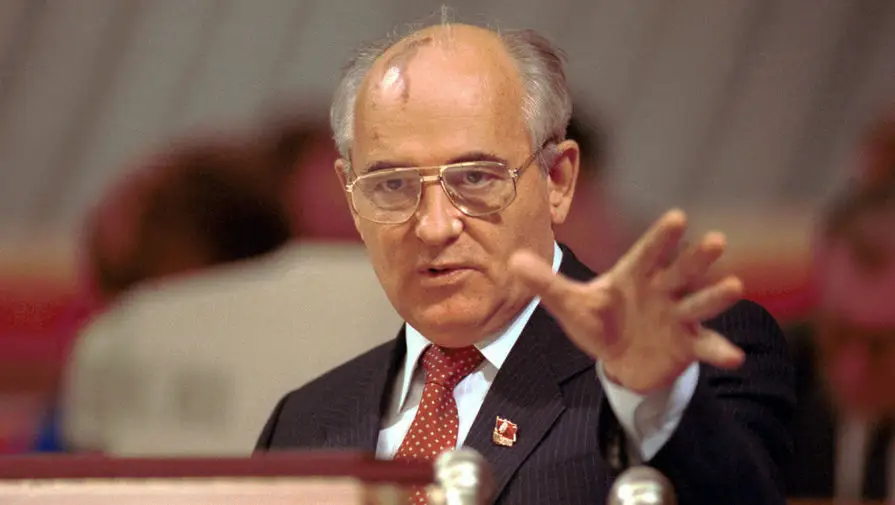
Mikhail Gorbachev during his speech at the 1990th Congress of the CPSU in the Kremlin Palace of Congresses, XNUMX
The disintegration of the political system
In 1988, the first mass political organizations with anti-Soviet and anti-Union programs were formed in the USSR – the “People’s Fronts” in the Baltic republics (Estonia, Latvia and Lithuania). They were created with the support of the leadership of the CPSU Central Committee and initially declared the defense of “glasnost”. But they quickly moved on to radical slogans, first economic (republican business accounting), and then political separatism.
Thus, the dismantling of the USSR was carried out from the very top. It was the so-called "revolution from above", in the interests of the central and local nomenklatura, the elite, who wanted to preserve their position, power and obtain property. This counter-revolution was supported by the intelligentsia, who wanted freedom, "European integration", and the "shadow people" - the criminal layers (How the Soviet Union was broken).
The anti-Soviet opposition at the First Congress of People's Deputies (May - June 1989) created its own organization - the Interregional Deputy Group (IDG). Co-chairs of the group: A. D. Sakharov, B. N. Yeltsin, Yu. N. Afanasyev, G. Kh. Popov, V. Palm. The opposition immediately entered into an alliance with local separatists.
Everything happened openly, that is, if the Kremlin wanted, it could easily cover it all up, put the leaders and activists in jail. The problem was that liberalization (glasnost) came from the very top.
The MDG put forward two main demands: 1) the abolition of Article 6 of the USSR Constitution (on the leading role of the Communist Party); 2) the legalization of strikes. The slogan "All power to the Soviets!" was also put forward as a means of undermining the power of the Communist Party. Later, the Soviets were also dispersed.
The opposition, which after Sakharov’s death was headed by Yeltsin for the duration of the Congress, was unable to push through the issue of repealing Article 6 at the Second Congress of People’s Deputies (December 1989).
At the Third Congress (March 1990), the Communist Party itself, following the decision of the plenum of the Central Committee of the CPSU held the day before, introduced into the draft the "Law of the USSR on Amendments and Supplements to the Constitution of the USSR on Issues of the Political System (Articles 6 and 7 of the Constitution of the USSR)." The abolition of Article 6 was packaged in one package with the decision to introduce the post of President of the USSR. The obedient majority of the Congress adopted the law, according to which the mention of the leading role of the CPSU was excluded from Article 6. This took the core out of the entire political system of the state.
On March 14, a plenum of the Central Committee of the CPSU was held, which nominated Gorbachev as a candidate for president. Prime Minister Nikolai Ryzhkov and Minister of Internal Affairs Vadim Bakatin were also nominated, but they refused to run, and the elections were uncontested. On March 15, 1990, Gorbachev was elected the first President of the USSR by an uncontested vote at the Congress.
The President of the USSR (who was also the General Secretary of the CPSU) got out of the party's control. The Politburo and the Central Committee were almost immediately removed from the country's political life. This freed the republican and local elites from party control. The state apparatus became a complex conglomerate of cooperating or competing, struggling groups and clans.
The legalization of strikes provided a powerful tool for influencing, blackmailing the central government and supporting the political demands of the opposition and separatists. In particular, the leaders of the MDG directly called on the Kuzbass miners to strike. Such strikes played a major role in undermining the Soviet state.
In early 1990, the radical movement "Democratic Russia" (Democrats) was formed. It based its ideology on anti-communism, anti-Sovietism, and liberal democracy.
Interestingly, In the area of state building, the "democrats" put forward the idea of a strong authoritarian government, often with direct praise for authoritarianism and the dictatorship of the executive branch (they loved the Pinochet regime, that is, the Latin American dictators). In their opinion, a strong authoritarian-oligarchic government should suppress the communists, the leftists, and the "unconscious" people.
The second type of anti-Soviet and anti-Union movements were various nationalist organizations. They prepared the ground for conflict with the union center and national minorities within the republics.
For the Russians, who actually created the scientific, cultural, educational and industrial potential of the national republics (and the statehood itself), this meant the slogans "Suitcase, station - Russia", "Russian - go to your Russia!" Plus all the "joys" of the surge of "national consciousness" - the confiscation of property, apartments, open robbery, beatings, abuse, rape and murder. The remaining Russians quickly became second-class citizens in most of the national republics.
The conservative, communist opposition, lacking support and a go-ahead from above, neither in the authorities, nor in the CPSU (19 million people), nor in the security forces, was unable to organize. People brought up in the Soviet system were unable to overcome the psychological barrier and openly speak out for the preservation of the Union.
It turned out to be much easier to destroy than to preserve and create.
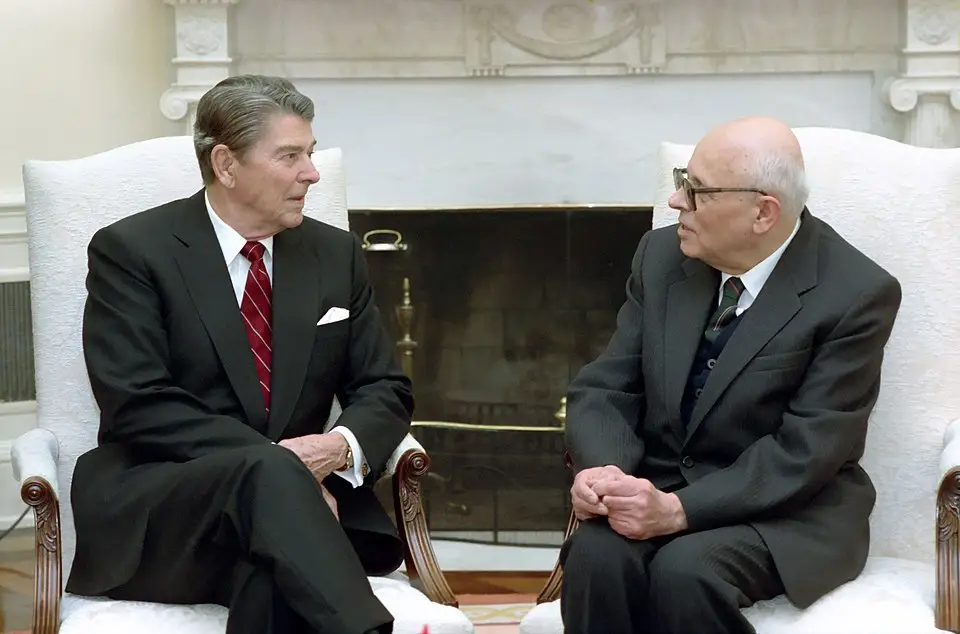
Andrei Sakharov and US President Ronald Reagan, 1988
Pogrom of security forces
The "cleansing" of the Armed Forces and law enforcement agencies of the USSR began under Andropov, who actually created the project of "perestroika" of the Red Empire. Andropov planned not to destroy the Union, but to modernize it, to rebuild it for the purpose of convergence-rapprochement with the capitalist, Western system (Andropov's plan and its failure).
Under Gorbachev, this was no longer a hidden, soft “purge,” but a pogrom of the power institutions of the Soviet state. It all began with a harsh ideological and informational campaign against the KGB, the Ministry of Internal Affairs and the Soviet Army. Denigration and discreditation. The shortcomings and mistakes inherent in any government bodies and institutions, both in the West and in the USSR, were highlighted and exaggerated.
The "siloviki" were the most conservative part of Soviet society, so the ideologists of perestroika tried to psychologically disarm and suppress them. The positive image of the Soviet soldier and officer, policeman, intelligence officer was destroyed. The officer corps was denigrated so that it would not speak out against the collapse of the state. All the generals were portrayed as thieves, the officers as drunkards and slackers, the soldiers as victims, etc.
There was a "cleansing" of the security forces from those people who could prevent the destruction of the USSR. Various pretexts and provocations were used for this. For example, on May 28, 1987 (on the Day of the Border Troops of the USSR), the German amateur pilot Matthias Rust flew a light aircraft from Hamburg via Reykjavik and Helsinki to Moscow and landed on the Bolshoy Moskvoretsky Bridge, having flown more than a thousand kilometers without any obstacles.
Defense was flying the plane and could have shot it down, but there was no order. In Soviet newspapers, Rust's flight was presented as a failure of the air defense system and the entire army. Gorbachev used this pretext to destroy the Ministry of Defense and the air defense.
"Democratization" had a great destructive effect on the army - assertion of the priority of democratic ideals over military discipline. The idea that the military should not carry out orders that go against "universal human values" was actively introduced into the army. Even the highest commanders of the Ministry of Defense were forced to make such statements.
In essence, it was repeated story with the democratization of the army of 1917, after the abdication of Nicholas II and the victory of the Februaryist revolutionaries. As a result, the army was disintegrated, the front collapsed. The officers scattered to the armies of the new "independent" republics, then joined the White armies, the Red Army, and began to hack each other.
Another example of a repetition of the events of 1917 - preparation for the dismemberment of the Soviet Army along national lines. Requirements for conscripts to serve only in their own republics, promotion of national personnel and creation of national units.
The army was also negatively affected by Moscow's political capitulation in the Third World War (the Cold War). Various projects for large-scale disarmament and reduction of armed forces. The withdrawal of troops from Afghanistan. The liquidation of the Warsaw Pact and the withdrawal of Soviet troops from Eastern Europe and Mongolia. The conversion of the military-industrial complex, which resulted in its destruction. The growing economic crisis, which made it difficult to supply and reorganize the army, worsened the situation of the officer corps, including dismissed officers.
Plus political and interethnic conflicts, in which the army was drawn in, in which a split also began along political or national lines.
At the same time, the military leadership and generals were excluded from participation in the adoption of the most important military-political issues. Thus, Gorbachev's decisions in January 1986 on the program of nuclear disarmament of the USSR within 15 years were a complete surprise for the military.
In 1986, an interdepartmental commission on disarmament was formed – the “big five” of the heads of the Ministry of Foreign Affairs, the Ministry of Defense, the KGB, the military-industrial commission of the Council of Ministers and the CPSU. The conflict in it was growing, since the agreements with the Americans on disarmament were not only not coordinated, but were not even brought to the commission.
In fact, Foreign Minister Shevardnadze simply surrendered the interests of the Soviet Union. It was a unilateral capitulation. Therefore, the commission was simply liquidated to stop the noise.
Law enforcement agencies are seeing first punitive units, typical for capitalist countries. In 1987, the Department of Internal Affairs formed special police units (OMON), designed to maintain public order during mass events. In 1989, the police adopted a rubber truncheon, which had an important symbolic meaning. People's power, even with restrictions, came to an end.
In 1989-1991, there was a change in all law enforcement agencies that was little noticeable to society, but important. The exodus of most of the skilled personnel from the Ministry of Internal Affairs, the KGB, the court and the prosecutor's office. There were two main reasons. The first was the loss of status, strong pressure from the media, discrediting and denigrating law enforcement agencies. The second was a rapid relative decrease in wages, which, within the framework of a socialist state, could not be compensated for by side, "shadow" earnings.
This exodus of qualified personnel continued after the collapse of the USSR. But then the security forces were already leaving for business, organized crime groups and new private security structures.
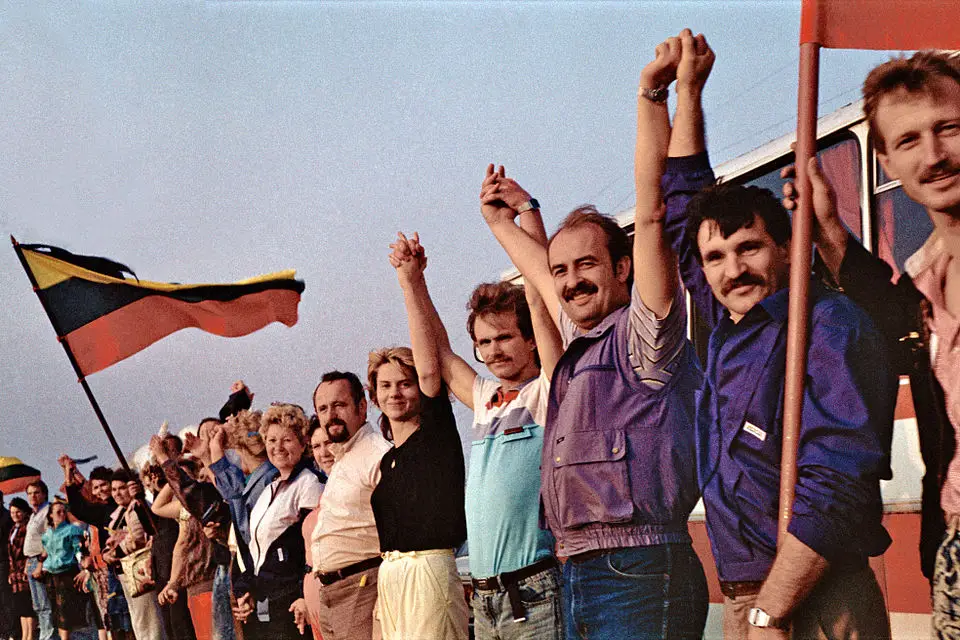
The Baltic Way (Baltic Chain) was a peaceful action in the Baltic republics of the USSR, held on August 23, 1989. Residents of Lithuania, Latvia and Estonia formed a human chain about 670 km long (up to two million people, or about 25% of the population of the three Baltic republics at the time), thus connecting Tallinn, Riga and Vilnius. The action was timed to coincide with the 50th anniversary of the signing of the Molotov-Ribbentrop Pact, the goal of the action was to draw the attention of the world community to the historical events that changed the status of the Baltic countries. The action demonstrated the growing confidence of the forces fighting for the restoration of independence of the Baltic countries. The organizers were the Popular Front of Estonia, the Popular Front of Latvia and the Sąjūdis (Lithuanian Movement) in Lithuania
Information