Rothschilds or Reincarnation of the idea of the East India Company
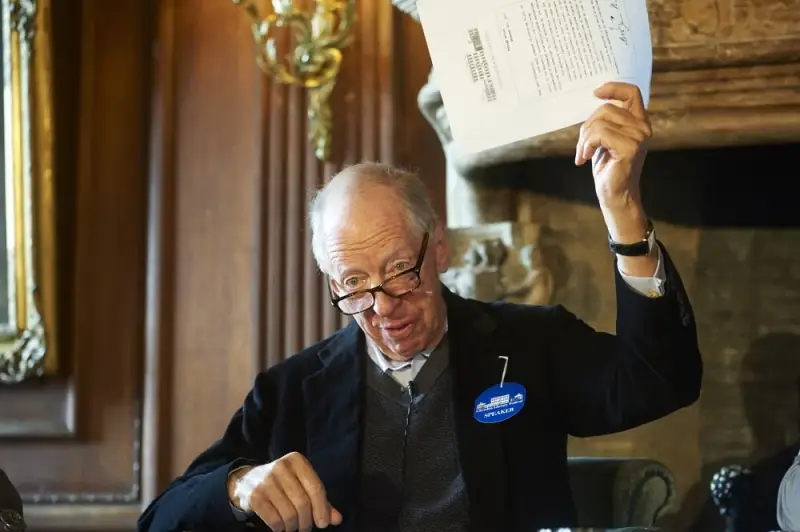
While the author was preparing material about why Central Asia needed the “system of British law”, where a significant part was, for objective reasons, devoted to projects related to the Rothschild “family corporation”, a message came that she had passed away to another world at the age of 87 Head: Jacob Rothschild.
It is clear that this ancient family corporation will not wither away, because it is traditionally rich in personalities, and even after the crisis of 2008, D. Rothschild played rather the role of a patriarch, coordinating the work of a whole network of assets associated with different branches of the family tree.
Apparently, his son N. Rothschild, like other members of the corporation, will continue and strengthen their characteristic conservative policies. And in general, it would be nice to have an idea of what this means, especially given the current upheavals, crises and cataclysms.
Over the decades, the Rothschild surname has acquired a demonic aura and its own conspiracy legendarium.
This is a very extensive layer of different versions of “shadow governance of the world.” In general, one gets the strong impression that phrases such as the one attributed to the wife of the founder of the family name: “If my husband does not want war, then there is no war,” as well as some works of classical literature with their images based on the personalities of the Rothschild house, were created with funds and order of the same family. It is possible that a certain demonization of the image helped and is helping to conduct business.
Disassemble history there is no particular meaning to the surname and its secrets - there is a whole literary corpus for this, we just note that such an aura was beneficial in business, becoming an integral part of the family brand.
Both economic models
But what makes sense in this case is to try to consider the special economic model that this family corporation is promoting and developing. And the practical usefulness here comes not so much from the realm of historical anecdotes, but from the strategy in a specific period: from the financial crisis of 2008 to the present.
The importance of this model and the policies pursued within its framework is determined by the fact that almost the entire geographical perimeter (China, Mongolia, Central Asia, Iran, Pakistan, not to mention Western Europe and Ukraine) and the range of Russian interests interact with it in one way or another ( or forced to join).
However, two historical features will have to be mentioned, since they remain relevant.
The first is the principle of building an organizational structure. The Rothschilds are not a holding company, not a vertically integrated corporation, but rather an analogue of the so-called company. “divisional type”, when units can work in their own areas and with their own staff, with multidirectional and often unrelated tasks.
This, apparently, came from the fact that initially the business was divided according to European geography and in each part it adapted to specific realities. Thus, it developed that different parts of this large financial network could handle all the affairs in the territory, while at the same time having the opportunity for industry specialization.
The second feature is the division of activities into conditionally savings and conditionally investment. “Conditionally” is used here because formally all activities could be classified as investments, but there is a nuance.
Among the whole wave of projects that the family corporation took on, its strong point was currency speculation and speculation in government securities, and later speculation in securities in industries that were in one way or another dependent on government decisions.
Since the Battle of Waterloo, when, having a day of time at their disposal, during which the resourceful clan managed to sharply sell British government bonds on the stock exchange, then buy them, and after Wellington’s victory was announced, sell them again, in fact, little has changed.
Exactly according to the same scheme, six years ago they turned over Ukrainian government securities, raising about $1 billion in the scheme. The basis of such a corporation's business has always been inside information (access to classified information), and inside information has always been based on close proximity to the money of the highest elite. Later they themselves became an organic part of the elite, which greatly simplified their work.
However, the second part of the investment scheme is much more interesting, because the profits from speculation were spent by this family not even on production, although the industrial boom seemed to contribute to this, but on land. And in the literal sense. The principle of preserving the capital of this family is the land and what is in the land.
If we look at the structure of assets of one of the family branches of this surname, we will see wine and vineyards, vineyards and wine. However, it was not so much the love for the noble drink and its production that became the root cause, but the land on which the vineyards grow and increase (and sometimes help maintain in crises) its value.
All these endless “chateaus” are valuable European land. But this is one example, and another example is what is in the ground. The interests of the family are seriously connected with gold, gold mining, coal and coal mining, the mining industry in general, and, of course, with oil assets. The family also did not shy away from commodity trading, having shares in a number of large companies of similar specialization such as Glencore.
This does not mean that there are no other industry assets in the portfolios and trust management of the family corporation - there are plenty of them, but the fundamental direction of interests is important here.
You can often find the Rothschilds described as “bankers”, but this is not entirely true, since banking and speculation are only a method, and the goal is the land and what is in the land.
In this regard, the Rothschilds really became a real European landed aristocracy, the very “old money of Old Europe.” Another thing is that this is not just a rental business, but the same conservative development strategy that was mentioned at the beginning of the material.
While everything revolves around investments in iPhones and artificial intelligence, startups and ventures in Silicon Valley, the Rothschilds did and are doing one thing - buying gold, dealing with gold, working with the land in which the gold lies. And if there is no gold, then with other riches located inside the earth, or with the earth itself “for grapes.”
After the 2008 crisis, D. Rothschild consistently advocated the concentration of family strategy, and the further the contradictions in the financial markets developed, the more he invested in metals and the “real sector”, associated with metals and subsoil. The share of investments in stocks did not sharply, but constantly decreased, while in gold and other “hard assets” it increased.
The third globalist force
If you look at the top 30 transnational investment funds and if you take the average of different estimates, then the participation of this name there is 12–13%. That's not much for a brand with a reputation as a kingmaker. But overall, this reflects well the role of the family corporation as a kind of “third force.”
It is hardly a secret that there are two conceptual globalist projects in the world: the Davos-Rome Club, associated with the name of Karl Schwab, and the American one, sometimes called “ultra-liberalism.”
The first assumes (albeit nominally) global uniformity of management from A to Z, but with the principles of global division of labor, a caste system of society, widespread digitalization and distribution.
The second involves the division of economies into practically self-sufficient value clusters managed through a conglomerate of transnational investment structures. Transgender people and other LGBT agendas here act more like a management option, albeit a rather loud one.
Within these concepts, interest groups and conglomerates of elites are already competing, colliding, mixing, fighting and collaborating with each other depending on the situation. For example, the Vatican, which has already become a household name, advocates representing the interests of Old Europe in the Rome project, and this contradicts the vision of Europe from the United States, where there is no special place for these old elites.
The Rothschilds, as a third force, are not adherents of either the first concept or the second. Although they are an organic part of Old Europe, they financially support all interest groups in the United States that compete with each other. Everyone: from ardent Christians and Trumpists, to US transgender people and Schwab's digital transhumanists. They even had a kind of privilege of giving hints about the ideas that were circulating in the minds of various elite circles. The Economist became something of a hit here.
They cooperate with the US deep state, but at the same time have the most developed contacts with China. At the same time, they are either in synergy or in a neutral position in relation to the British elite projects that are born in the depths of their think tank – MI6.
Observing such a policy, a comparison comes to mind with the policy of the East India Company, such a state within a state. Was it contrary to British interests? In general, no, but has it always been synergistic with them? Also no.
The Rothschilds, with all the ramifications of their structure, very much seem to be building an analogue of such an East India Company. Only instead of silk, tea, spices (including “spices” in quotation marks) there is gold and mineral resources.
This strategy, judging by its activity, is aimed at forming a kind of raw material ring, with a sea route in the south and a land route in the north. The land part goes from China and South Korea through Mongolia, Central Asia to Europe.
In some ways, this repeats the idea of China’s New Silk Road and, interestingly, fits well with Beijing in terms of interests and specific projects. For example, China's interests in the coal industry and metallurgy directly coincide with the interests and projects of the Rothschild family in Mongolia, Russia, and Central Asia. As discussed in the previous article, in Kazakhstan the Rothschilds actually have their own trust, their interests in raw materials extend to Kyrgyzstan, Tajikistan, Uzbekistan and Afghanistan.
In fact, while representatives of two global projects are deciding how to digitalize the world, feed it with bugs, how many dollars a cow’s breath costs, green passages, and so on, these “banking gnomes” are consistently dealing with gold, land and subsoil.
As if realizing that both globalists are walking on rather thin economic ice. And when this ice cracks, the winners will be those who worked under this ice - the Rothschild family.
Actually, it’s not for nothing that their family coat of arms depicts something resembling a lion on one side and an eagle on the other. Even though both animals are not exactly in the colors and images of the Houses of Habsburg or Windsor, there are similarities. And, characteristically, a hand holding five arrows (five branches of the surname) hangs over each image.
So now, there is one conceptual project of the world order, there is another, and five arrows hang over each one. Because when both projects fail, everything will be like the good old days.
Actually, this is why, since the 1930s, the Rothschilds have not been very fond of assets associated with industrial progress, preferring what underlies it: ore, coal, gold, land and, by the way, grain.
Apparently, the family will continue to adhere to a similar strategy in the future; it is possible that even in the face of the top 30 investment monsters it will try to move away from the divisional structure and acquire the features of a full-fledged holding.
For Russia, the specificity of working with this third force is that this force is at least understandable to our elites. The Russian oligarchy was in contact with it, worked and is working, had experience of confrontation (and tough ones) and again experience of work.
Unlike the liberals who are at the helm in today's Europe, the Rothschilds, their approaches and interests are perceived by our elites. By the way, the Trumpists, as raw materials workers at their core, also fully understand this group.
But the disadvantages here are also very serious.
Ukraine and its assets
First of all, it is the closest link to the British deep state. However, the Rothschilds are already part of it, just living somewhat in their own way. You can work with them, you can be neighbors, but you need to understand that the British “deepstate” will come for them everywhere, and that, in turn, looks at Russia as a historical thorn. The toughest point here is Ukraine and its assets.
If we win, the family name will work with us, but if the situation is uncertain, then the resources of the family holding will work synergistically with the British deep state, feeding and strengthening it on this flank. And we all understand what this means. And it is impossible to miss out on Ukrainian mineral resources for this family’s strategy.
When working with China, we will also always be faced with the interests of this family, its influence, and it is much stronger than that of the United States and even its financial circles, although it seems that trade turnover figures should indicate the opposite.
Well, in Central Asia, Russia must finally decide what position it needs to take. Talking about Greater Eurasia is wonderful, but we see the position of the Rothschilds - subsoil and land. And the stronger the contradictions between global projects and elite groups in the West, the more significantly and deeply this family will penetrate into Central Asia, and with it on the shoulders of their companions - the British “deep state”, and fellow travelers - the Vatican.
Now the situation is different from what it was before 2018. After Covid-19, there are no stable trends in the financial markets. They are not falling, but investors do not have a very good understanding of how the value will be formed in the medium term.
But the Rothschilds here have a ready-made, proven strategy - to dig and accumulate metal, and the longer the uncertainty continues, the deeper they will dig, in particular in Central Asia. It is a priority for them, since it closes the trade and raw materials circuit.
Since last year, the EU has also decided to become more active there in defiance of China. For a family corporation, this is generally an ideal combination when Russia “thinks”, and two giants - the EU and China - begin to compete for the region. Given the Rothschilds' strategy and relationship with both sides, there is no doubt that they will take the opportunity to win again as a third party. After all, while two people compete, the third party always wins.
In general, of course, it is regrettable that our work in Central Asia was carried out frankly unsystematically. Sometimes they invested, sometimes they didn’t, sometimes they turned there, sometimes vice versa. For years all efforts have been directed towards Europe, to fight American influence, to preserve markets, and to connect with the industrial capital of the EU.
It may have been useful in the period, but not with the same almost religious fanaticism and the demand from Old Europe for almost blood kinship. Nobody considers us relatives there.
Meanwhile, for 1/4 of the accumulated reserves, Russia, to put it roughly but directly, could simply buy out all the main assets in the region with investments in 7–8 years and form an attractive model for the regional elites.
Now, in conditions where there are fewer funds, we will have to compete with those who have not just a lot of them, but a lot of them. Well, or don't compete.
Information