Combat ships. Such strange three musketeers and Chevalier Xu
We continue about the French. Having worn out with "Duques", in the bowels of the French military department the question arose: "What to do?" For looking for "who is to blame?" - it was part of another department.

It was simply necessary to do something, because the Duquesne did not show anything special and remarkable. And here the Italians - the eternal Mediterranean rivals - showed off their Trento. As ships, the new Italian heavy cruisers were not particularly better than the French, but the advertising power was great. And in France they believed that the Italians had an advantage.
As mentioned in the previous article, "Duquesne" / Classe Duquesne (croiseur) / Duquesne-class cruiser were designed and built not as ships of squadron battle, but as some kind of heavy types of scouts. Hence, there was a complete neglect of protection, which had to be fought.
The cruisers of the "Suffren" / Classe Suffren (croiseur) should have rectified the situation. But with these ships everything turned out more than peculiar. The series was built sequentially, that is, the next ship was laid down only after the previous one entered service. As a result, all four ships were very different from each other, because during construction, amendments were made based on the results of tests of the first ships.
The Dukens were taken as a basis, which by that time had demonstrated very good seaworthiness, speed and were decently armed. The downsides were a small supply of fuel and an almost complete lack of armor. 4,5% for armor - here the Dukens were anti-leaders. The contemporaries of Pensacola (7,5%) and Trento (8,7%) looked, in general, armored monsters in comparison with the French.
In principle, all the first "Washingtonians" were a kind of compromise between desires and possibilities. But "Dukens" stood out from the general crowd for their imbalance, and only competent use aside from naval battles allowed them to survive until the end of World War II.
The new ships were supposed to have characteristics similar to the Duquesne:
- displacement: 10 tons;
- main caliber: eight 203-mm guns in twin mountings similar to the previous type, but with a limit of 120 rounds per gun;
- anti-aircraft artillery: eight single 75-mm guns (500 rounds per gun), eight 40-mm machine guns (ammunition 1 rounds), twelve 000-mm machine guns;
- torpedo armament: two three-pipe 550-mm torpedo tubes with six spare torpedoes;
- cruising range: 5 nautical miles at a speed of 000 knots.

In general, it is similar to "Duquesne", but the main emphasis was placed on armor. And naturally, they immediately began to depart from the initial project. Plus - 40-mm machine guns from "Vickers" (produced under license) were replaced by domestic 37-mm machine guns Mle 1925. The number of spare torpedoes was reduced from six to three.
Armor. Main topic. The booking should have looked like this:
- the hull had to withstand the hit of a 550 mm torpedo or a close explosion of a 100 kg bomb;
- the armor of the vital elements of the ship must withstand being hit by 140 mm shells or 100 kg bombs;
- the power of the propulsion system must provide a ship speed of at least 33 knots.
Compared to the Duquesne, it was decided to reduce the power plant by two boilers and one turbine. Power will drop by 10 hp. with., travel speed by 000 knots, but the released weight can be spent on armor.
There were proposals to reduce the supply of fresh water, provisions, that is, to reduce autonomy. The result was a completely different ship project, on which, oddly enough, they decided to stop.
And the series began to build: "Suffren", "Colbert", "Foch" and "Duplet".

But in Italy, construction began on the first series of new light cruisers of the Condottieri A class. And an unpleasant thing turned out: the 152-mm guns of the Italians could easily penetrate heavy French cruisers at any distance. Only the pretentious cruiser Foch still had some chances, but not very serious ones.
"Duplet" decided to make an urgent reservation. The armor of the artillery cellars and the engine room was brought to the level of withstanding 152-mm shells at a distance of more than 18 km. These changes cost an additional 180 tons of weight, bringing the total booking weight of the new cruiser to 1 tons.
Well, and most importantly: a new approach to interpreting the terms of the Washington agreements made it possible to increase the displacement from the design 12 tons of the cruiser Duquen to 435 tons for the cruisers Suffren and Colbert, 13 tons for the cruisers Foch and Duplet.

There was one trick here. In World War I dreadnoughts, ... coal was used as an additional reservation. It fell asleep between the hull armor and traverse bulkheads and served as a very good protection.
The French used universal boilers in power plants that could operate on both oil and coal. And 640 tons of coal poured into the gaps between the vertical armor plates (in light of the Washington Accords) were considered fuel, not armor. But if necessary, such coal "armor" could be burned in boilers.
As a result, we got the following ships:

Displacement (standard / full): 10 / 000 t
Dimensions (length / width / draft): 194,2 / 20 / 7,3 m
Power plant: 3 TZA, 9 boilers, 90 liters. from.
Speed: 31 knot
Cruising range: 5 miles cruising 300 knots
Crew: 605 people.
Reservation
Belt / side: 54-60 mm
Deck: 22-25mm
Towers: 25-30 mm
Conning tower: 30 mm
weaponry
Main artillery:
- 8 (4 × 2) 203 mm guns
Auxiliary artillery:
- 8 (8 × 1) 75 mm guns
- 8 (4 × 2) anti-aircraft guns 37 mm
- 12 (3 × 4) 13,2 mm machine guns
Mine torpedo armament:
- 6 (2 × 3) torpedo tubes 550 mm
Air group 3 seaplane, catapult.
The ships built were very much like the Duquesne. The location of guns and anti-aircraft guns, aviation catapults, torpedo tubes, structures of masts and pipes. The differences were in the power plant system and in the booking.

The cruisers can and should be viewed in pairs, since the Suffren and Colbert differed from the Foch and Duplet both externally and internally.

The engine room of the first two cruisers of this type was protected by an armored belt of non-cemented steel 50 mm thick. The height of the armor belt was 2,6 m, of which 1 m was located below the waterline. If we take into account that the height of the engine room was 6,1 m, then this is not a very good indicator.
"Foch" and "Duplet" did not have a central armor belt, but the thickness of the traverse bulkheads was increased and amounted to 54 mm for "Foch" and 60 mm for "Duplet". The engine room of these ships was entirely enclosed in an armored room with a height of 5,5 to 6,1 m.
The total weight of the hull armor of the first two cruisers was 670 tons, while on the cruiser Foch the total weight was almost doubled - to 1 tons.
The propulsion system was identical to the Duquesne-class cruisers, with the exception of two "tricky" coal-fired boilers at the Suffren and Colbert. Foch and Duplet did not have such boilers; instead, fuel tanks were installed, increasing the fuel supply by 700 tons.
On the cruisers "Suffren" and "Colbert" the reserves of oil were 1 tons and of coal - 707 tons. On other cruisers, where only oil was used as fuel, the reserves were 640 tons.
The cruising range of the cruisers "Suffren" and "Colbert" at a speed of 15 knots was 8 km, or 519 km at a speed of 6 knots. Coal powered - another 852 km at a speed of 20 knots. Foch and Duplex had a range of 3 km at a speed of 704 knots and 11 km at a speed of 9 knots.
The main artillery armament of the Suffren-class cruisers consisted of four two-gun turret mounts with 203mm / 50 Mle 1924 guns, which were developed specifically for the Duquesne-class cruisers and were used by all heavy cruisers up to the Algerie-class cruisers.

Main battery characteristics:
- gun depression angles: -5˚ / + 45˚
- angles of charging guns: -5˚ / + 10˚
- turret rotation speed: 6˚ / sec
- gun erection speed: 10˚ / sec
- rate of fire: 3-4 rounds per minute.
- firing range: 31,4 km at an elevation angle of 45˚ for armor-piercing shells and 30 km for high-explosive fragmentation shells
- muzzle velocity: 850 m / sec (armor-piercing projectile of 1927), 820 m / sec (armor-piercing projectile of 1936).

The auxiliary artillery consisted of eight 75-mm / 50 single guns of the Mle 1924HA type with ammunition of 500 rounds and eight single 37-mm / 50 Mle 1924АА anti-aircraft guns with ammunition of 1 rounds.
When building the cruiser Colbert, the General Council decided to replace the 75-mm guns with the 90-mm / 50 type Mle 1926. Quite a reasonable step, since the 75-mm guns no longer met modern requirements in terms of armor penetration and could not effectively serve as mine artillery.
Such a replacement, as expected, caused an increase in displacement by 40 tons. Not much, but it was necessary to compensate.
Therefore, the French compensated in a very peculiar way. They did not count one tool and a third of the supply of drinking water and industrial water for boilers.
And we called the Japanese cunning ...
Could it be considered an effective remedy? Defense quadruple Hotchkiss MG machine gun mounts, hard to say. But they were there.
The cruisers' torpedo armament consisted of two triple-tube 550-mm torpedo tubes placed on the side between the tubes. The torpedo launcher on the starboard side could direct torpedoes only to the front of the ship, while the launcher on the left side - only to the rear.

This stupidity was corrected already on the Colbert. And torpedoes could be fired in both directions: towards the bow and towards the stern by 50˚ along the traverse of the ship.
Spare ammunition consisted of three torpedoes, which were located in a special store on the platform between the torpedo tubes.
Torpedoes Mle 1923D differed from others in the original propulsion system. It was a 4-cylinder engine made by Schneider, which ran on alcohol and had two modes of travel: with a range of 9 km at 39 knots and 13 km at a speed of 35 knots.
Perhaps that is why there is no information about torpedo launches from cruisers of this type.
It was planned to place four seaplanes on the cruisers: two on catapults, and two between the chimneys.
But in fact, the cruiser was never carried on board more than two aircraft: one - on a catapult, the other - behind the front chimney.

Attempts to improve the ships took place. But it cannot be said that they were significant. Before the war began, Suffren received six twin installations of the same large-caliber Hotchkiss, new 8-meter rangefinders, and a new catapult for launching more modern Loire 130 aircraft.
Colbert also received 8-meter rangefinders, a new catapult, single 37-mm anti-aircraft guns were replaced by twin new type Mle 1933. And four quad anti-aircraft guns of the same Hotchkiss, plus four single machine guns of the same 13,2 mm caliber ...
And the main acquisition is the installation of a DEM radar. Two transmitting and two receiving DEM radar antennas were installed at the edges of the front mast. There is no reliable data on whether these works were completed by the time the cruiser was self-sunk.
The upgrades on the Foch cruiser also affected the replacement of rangefinders, catapults and single 37-mm assault rifles aft with twin units. Similar replacements were made on the Duplet cruiser.
Nominally considered to be of the same type, all four cruisers had a number of very significant differences from each other. Common to all ships were - the structure of the hull, artillery of the main caliber and the composition of the power plant.

The armoring of ships has undergone very dramatic changes, and in this they can not be called the same type.
In general, in terms of the level of armor, the ships did not go very far from the Duquesne, since the appearance of a 50-mm narrow armor belt did not guarantee the protection of the vital centers of the ship.
"Foch" and "Duplet" were better armored than the first ships of the series, but it cannot be said about them that their level of protection was at the level of ships of other countries.
However, the work on these four ships did the most important thing - experience was accumulated, developments were carried out and technologies were mastered, which allowed the appearance of the white swan of heavy cruisers - "Algeri".
With regard to service and combat use, then everything is more than sad. There was almost no combat service.
"Suffren" proved to be a long-liver. At the beginning of World War II, he took part in the hostilities against Italy as part of the "Compound X". In June 1940, when France surrendered, he was in Alexandria, where he was flooded by the crew.
However, the cruiser was not allowed to die in peace. And in 1942 he was raised and sent to Toulon for repairs. Aviation equipment and torpedo tubes were dismantled there. Instead, they installed radar and additional anti-aircraft weapons. The cruiser was included in the detachment of British ships.
After repairs, he mainly took part in the protection of trade routes in the Indian Ocean from German raiders, in the rescue of the crew of the ship City of Canton torpedoed near Mozambique in 1943.
After the end of the war he again transferred to service in fleet France and took part in the war in Indochina.
In 1947, it was decommissioned and used as a floating barracks. In 1963, it was commissioned as a training ship under the name "Okean". It was finally decommissioned and dismantled in 1974.
"Colbert" served for some time as the flagship of the Raider unit, participated in the "Ultimate Gerasim" operation. Was very seriously damaged by the fire of the British cruiser "Birmingham".
After renovation, he performed a diplomatic mission in Turkey.
Foch and Duplet participated in Operation Pine Forest against Genoa, and patrolled the Atlantic. Duplet hijacked the German ship Santa Fe.

On November 27, 1942, the cruisers Duplet, Foch and Colbert were blown up and flooded by their crews to prevent their capture by the Germans.
The Duplet was raised by the Italians in July 1943, but it did not bring profit. On March 11, 1944, during an Allied air raid, the ship was hit by several bombs and sank again.
This is such an unenviable fate for the three musketeers of the French fleet. And the first of them (which is strange) had a very long life.

But the most important thing, perhaps, in this stories was that, indeed, it was the work on these ships that soon allowed to appear one of the best and most beautiful ships of the first half of the XNUMXth century - "Algeri".

Armor anti-leaders
It was simply necessary to do something, because the Duquesne did not show anything special and remarkable. And here the Italians - the eternal Mediterranean rivals - showed off their Trento. As ships, the new Italian heavy cruisers were not particularly better than the French, but the advertising power was great. And in France they believed that the Italians had an advantage.
As mentioned in the previous article, "Duquesne" / Classe Duquesne (croiseur) / Duquesne-class cruiser were designed and built not as ships of squadron battle, but as some kind of heavy types of scouts. Hence, there was a complete neglect of protection, which had to be fought.
The cruisers of the "Suffren" / Classe Suffren (croiseur) should have rectified the situation. But with these ships everything turned out more than peculiar. The series was built sequentially, that is, the next ship was laid down only after the previous one entered service. As a result, all four ships were very different from each other, because during construction, amendments were made based on the results of tests of the first ships.
The Dukens were taken as a basis, which by that time had demonstrated very good seaworthiness, speed and were decently armed. The downsides were a small supply of fuel and an almost complete lack of armor. 4,5% for armor - here the Dukens were anti-leaders. The contemporaries of Pensacola (7,5%) and Trento (8,7%) looked, in general, armored monsters in comparison with the French.
In principle, all the first "Washingtonians" were a kind of compromise between desires and possibilities. But "Dukens" stood out from the general crowd for their imbalance, and only competent use aside from naval battles allowed them to survive until the end of World War II.
The new ships were supposed to have characteristics similar to the Duquesne:
- displacement: 10 tons;
- main caliber: eight 203-mm guns in twin mountings similar to the previous type, but with a limit of 120 rounds per gun;
- anti-aircraft artillery: eight single 75-mm guns (500 rounds per gun), eight 40-mm machine guns (ammunition 1 rounds), twelve 000-mm machine guns;
- torpedo armament: two three-pipe 550-mm torpedo tubes with six spare torpedoes;
- cruising range: 5 nautical miles at a speed of 000 knots.
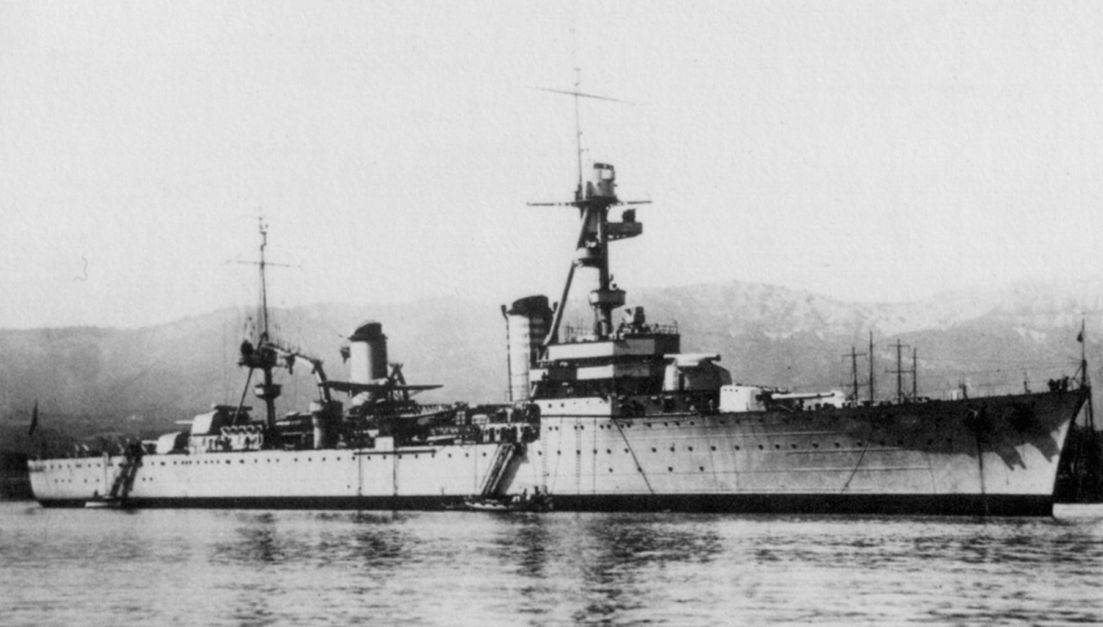
In general, it is similar to "Duquesne", but the main emphasis was placed on armor. And naturally, they immediately began to depart from the initial project. Plus - 40-mm machine guns from "Vickers" (produced under license) were replaced by domestic 37-mm machine guns Mle 1925. The number of spare torpedoes was reduced from six to three.
Armor. Main topic. The booking should have looked like this:
- the hull had to withstand the hit of a 550 mm torpedo or a close explosion of a 100 kg bomb;
- the armor of the vital elements of the ship must withstand being hit by 140 mm shells or 100 kg bombs;
- the power of the propulsion system must provide a ship speed of at least 33 knots.
Compared to the Duquesne, it was decided to reduce the power plant by two boilers and one turbine. Power will drop by 10 hp. with., travel speed by 000 knots, but the released weight can be spent on armor.
There were proposals to reduce the supply of fresh water, provisions, that is, to reduce autonomy. The result was a completely different ship project, on which, oddly enough, they decided to stop.
And the series began to build: "Suffren", "Colbert", "Foch" and "Duplet".

Add coal
But in Italy, construction began on the first series of new light cruisers of the Condottieri A class. And an unpleasant thing turned out: the 152-mm guns of the Italians could easily penetrate heavy French cruisers at any distance. Only the pretentious cruiser Foch still had some chances, but not very serious ones.
"Duplet" decided to make an urgent reservation. The armor of the artillery cellars and the engine room was brought to the level of withstanding 152-mm shells at a distance of more than 18 km. These changes cost an additional 180 tons of weight, bringing the total booking weight of the new cruiser to 1 tons.
Well, and most importantly: a new approach to interpreting the terms of the Washington agreements made it possible to increase the displacement from the design 12 tons of the cruiser Duquen to 435 tons for the cruisers Suffren and Colbert, 13 tons for the cruisers Foch and Duplet.

There was one trick here. In World War I dreadnoughts, ... coal was used as an additional reservation. It fell asleep between the hull armor and traverse bulkheads and served as a very good protection.
The French used universal boilers in power plants that could operate on both oil and coal. And 640 tons of coal poured into the gaps between the vertical armor plates (in light of the Washington Accords) were considered fuel, not armor. But if necessary, such coal "armor" could be burned in boilers.
Equipment
As a result, we got the following ships:

Displacement (standard / full): 10 / 000 t
Dimensions (length / width / draft): 194,2 / 20 / 7,3 m
Power plant: 3 TZA, 9 boilers, 90 liters. from.
Speed: 31 knot
Cruising range: 5 miles cruising 300 knots
Crew: 605 people.
Reservation
Belt / side: 54-60 mm
Deck: 22-25mm
Towers: 25-30 mm
Conning tower: 30 mm
weaponry
Main artillery:
- 8 (4 × 2) 203 mm guns
Auxiliary artillery:
- 8 (8 × 1) 75 mm guns
- 8 (4 × 2) anti-aircraft guns 37 mm
- 12 (3 × 4) 13,2 mm machine guns
Mine torpedo armament:
- 6 (2 × 3) torpedo tubes 550 mm
Air group 3 seaplane, catapult.
The ships built were very much like the Duquesne. The location of guns and anti-aircraft guns, aviation catapults, torpedo tubes, structures of masts and pipes. The differences were in the power plant system and in the booking.

Armored belt of couples
The cruisers can and should be viewed in pairs, since the Suffren and Colbert differed from the Foch and Duplet both externally and internally.

The engine room of the first two cruisers of this type was protected by an armored belt of non-cemented steel 50 mm thick. The height of the armor belt was 2,6 m, of which 1 m was located below the waterline. If we take into account that the height of the engine room was 6,1 m, then this is not a very good indicator.
"Foch" and "Duplet" did not have a central armor belt, but the thickness of the traverse bulkheads was increased and amounted to 54 mm for "Foch" and 60 mm for "Duplet". The engine room of these ships was entirely enclosed in an armored room with a height of 5,5 to 6,1 m.
The total weight of the hull armor of the first two cruisers was 670 tons, while on the cruiser Foch the total weight was almost doubled - to 1 tons.
The propulsion system was identical to the Duquesne-class cruisers, with the exception of two "tricky" coal-fired boilers at the Suffren and Colbert. Foch and Duplet did not have such boilers; instead, fuel tanks were installed, increasing the fuel supply by 700 tons.
On the cruisers "Suffren" and "Colbert" the reserves of oil were 1 tons and of coal - 707 tons. On other cruisers, where only oil was used as fuel, the reserves were 640 tons.
The cruising range of the cruisers "Suffren" and "Colbert" at a speed of 15 knots was 8 km, or 519 km at a speed of 6 knots. Coal powered - another 852 km at a speed of 20 knots. Foch and Duplex had a range of 3 km at a speed of 704 knots and 11 km at a speed of 9 knots.
weaponry
The main artillery armament of the Suffren-class cruisers consisted of four two-gun turret mounts with 203mm / 50 Mle 1924 guns, which were developed specifically for the Duquesne-class cruisers and were used by all heavy cruisers up to the Algerie-class cruisers.
Main battery characteristics:
- gun depression angles: -5˚ / + 45˚
- angles of charging guns: -5˚ / + 10˚
- turret rotation speed: 6˚ / sec
- gun erection speed: 10˚ / sec
- rate of fire: 3-4 rounds per minute.
- firing range: 31,4 km at an elevation angle of 45˚ for armor-piercing shells and 30 km for high-explosive fragmentation shells
- muzzle velocity: 850 m / sec (armor-piercing projectile of 1927), 820 m / sec (armor-piercing projectile of 1936).
Auxiliary / anti-aircraft artillery

The auxiliary artillery consisted of eight 75-mm / 50 single guns of the Mle 1924HA type with ammunition of 500 rounds and eight single 37-mm / 50 Mle 1924АА anti-aircraft guns with ammunition of 1 rounds.
French trick
When building the cruiser Colbert, the General Council decided to replace the 75-mm guns with the 90-mm / 50 type Mle 1926. Quite a reasonable step, since the 75-mm guns no longer met modern requirements in terms of armor penetration and could not effectively serve as mine artillery.
Such a replacement, as expected, caused an increase in displacement by 40 tons. Not much, but it was necessary to compensate.
Therefore, the French compensated in a very peculiar way. They did not count one tool and a third of the supply of drinking water and industrial water for boilers.
And we called the Japanese cunning ...
Defense
Could it be considered an effective remedy? Defense quadruple Hotchkiss MG machine gun mounts, hard to say. But they were there.
Torpedo armament
The cruisers' torpedo armament consisted of two triple-tube 550-mm torpedo tubes placed on the side between the tubes. The torpedo launcher on the starboard side could direct torpedoes only to the front of the ship, while the launcher on the left side - only to the rear.
This stupidity was corrected already on the Colbert. And torpedoes could be fired in both directions: towards the bow and towards the stern by 50˚ along the traverse of the ship.
Spare ammunition consisted of three torpedoes, which were located in a special store on the platform between the torpedo tubes.
Torpedoes Mle 1923D differed from others in the original propulsion system. It was a 4-cylinder engine made by Schneider, which ran on alcohol and had two modes of travel: with a range of 9 km at 39 knots and 13 km at a speed of 35 knots.
Perhaps that is why there is no information about torpedo launches from cruisers of this type.
Aircraft Armament
It was planned to place four seaplanes on the cruisers: two on catapults, and two between the chimneys.
But in fact, the cruiser was never carried on board more than two aircraft: one - on a catapult, the other - behind the front chimney.
Modernization and refurbishment

Attempts to improve the ships took place. But it cannot be said that they were significant. Before the war began, Suffren received six twin installations of the same large-caliber Hotchkiss, new 8-meter rangefinders, and a new catapult for launching more modern Loire 130 aircraft.
Colbert also received 8-meter rangefinders, a new catapult, single 37-mm anti-aircraft guns were replaced by twin new type Mle 1933. And four quad anti-aircraft guns of the same Hotchkiss, plus four single machine guns of the same 13,2 mm caliber ...
And the main acquisition is the installation of a DEM radar. Two transmitting and two receiving DEM radar antennas were installed at the edges of the front mast. There is no reliable data on whether these works were completed by the time the cruiser was self-sunk.
The upgrades on the Foch cruiser also affected the replacement of rangefinders, catapults and single 37-mm assault rifles aft with twin units. Similar replacements were made on the Duplet cruiser.
Differences in the four
Nominally considered to be of the same type, all four cruisers had a number of very significant differences from each other. Common to all ships were - the structure of the hull, artillery of the main caliber and the composition of the power plant.

The armoring of ships has undergone very dramatic changes, and in this they can not be called the same type.
In general, in terms of the level of armor, the ships did not go very far from the Duquesne, since the appearance of a 50-mm narrow armor belt did not guarantee the protection of the vital centers of the ship.
"Foch" and "Duplet" were better armored than the first ships of the series, but it cannot be said about them that their level of protection was at the level of ships of other countries.
However, the work on these four ships did the most important thing - experience was accumulated, developments were carried out and technologies were mastered, which allowed the appearance of the white swan of heavy cruisers - "Algeri".
An unenviable fate
With regard to service and combat use, then everything is more than sad. There was almost no combat service.
"Suffren" proved to be a long-liver. At the beginning of World War II, he took part in the hostilities against Italy as part of the "Compound X". In June 1940, when France surrendered, he was in Alexandria, where he was flooded by the crew.
However, the cruiser was not allowed to die in peace. And in 1942 he was raised and sent to Toulon for repairs. Aviation equipment and torpedo tubes were dismantled there. Instead, they installed radar and additional anti-aircraft weapons. The cruiser was included in the detachment of British ships.
After repairs, he mainly took part in the protection of trade routes in the Indian Ocean from German raiders, in the rescue of the crew of the ship City of Canton torpedoed near Mozambique in 1943.
After the end of the war he again transferred to service in fleet France and took part in the war in Indochina.
In 1947, it was decommissioned and used as a floating barracks. In 1963, it was commissioned as a training ship under the name "Okean". It was finally decommissioned and dismantled in 1974.
"Colbert" served for some time as the flagship of the Raider unit, participated in the "Ultimate Gerasim" operation. Was very seriously damaged by the fire of the British cruiser "Birmingham".
After renovation, he performed a diplomatic mission in Turkey.
Foch and Duplet participated in Operation Pine Forest against Genoa, and patrolled the Atlantic. Duplet hijacked the German ship Santa Fe.
On November 27, 1942, the cruisers Duplet, Foch and Colbert were blown up and flooded by their crews to prevent their capture by the Germans.
The Duplet was raised by the Italians in July 1943, but it did not bring profit. On March 11, 1944, during an Allied air raid, the ship was hit by several bombs and sank again.
This is such an unenviable fate for the three musketeers of the French fleet. And the first of them (which is strange) had a very long life.

But the most important thing, perhaps, in this stories was that, indeed, it was the work on these ships that soon allowed to appear one of the best and most beautiful ships of the first half of the XNUMXth century - "Algeri".
Information