Heavy aircraft carrier of the Pacific Fleet
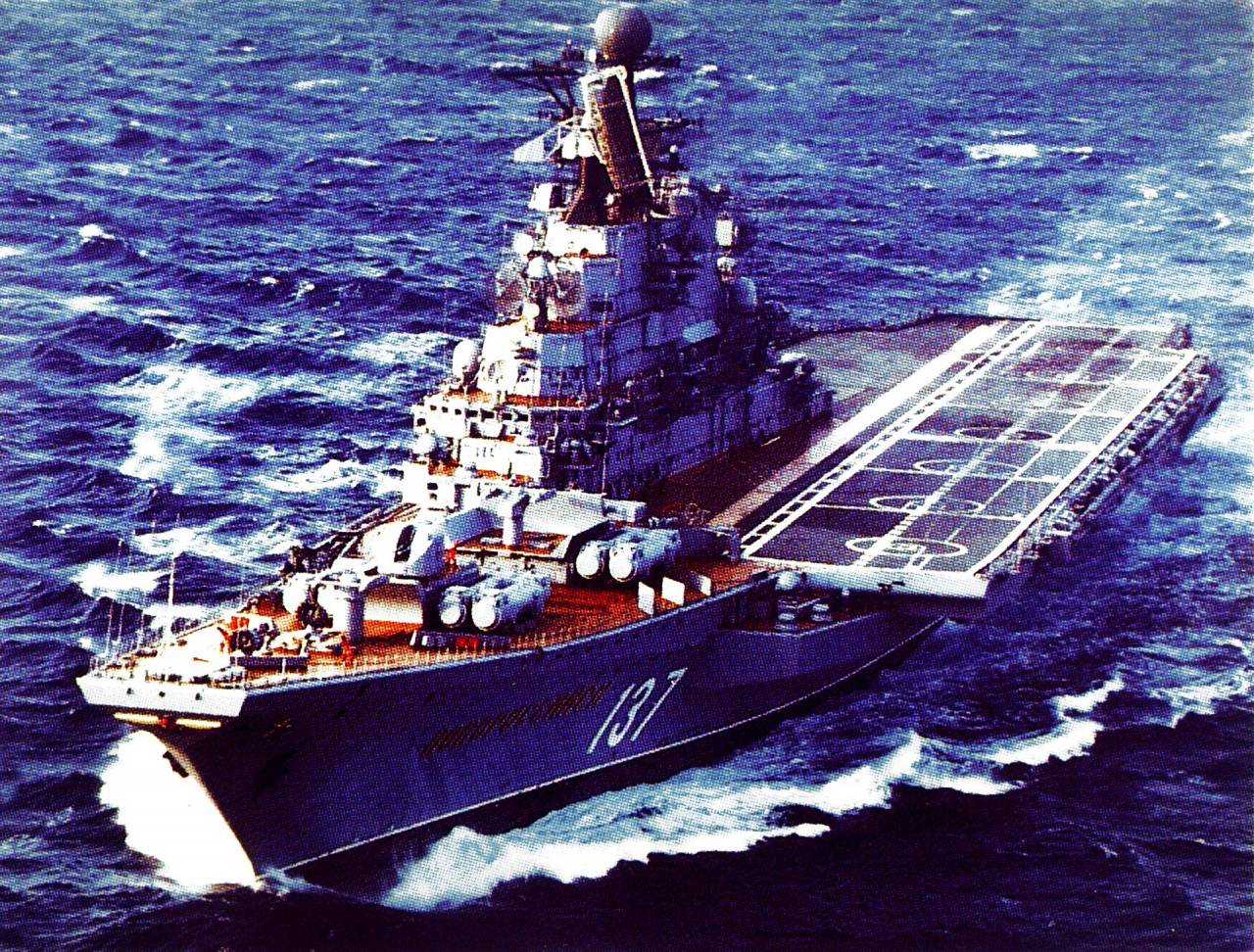
As an author, I consider it my duty to the readers to immediately declare my position on the construction of aircraft-carrying ships for the Russian Navy: first, there is no need to build analogues of the American-type multipurpose nuclear aircraft carriers "Nimitz" or "Ford" with catapults; secondly, it is unacceptable to repeat the experience of building ships for the use of short or vertical takeoff and landing aircraft such as the Soviet "Kiev" or the British "Invincible".
As if it goes without saying that it makes no sense to maintain a heavy aircraft-carrying cruiser, whose tasks are laid down in the design to provide cover for the deployment area and combat duty of strategic missile submarines and ensure the combat stability of a detachment of ships in the transition by sea from air attacks in the Baltic and Black seas ... These operational-strategic formations are simply not burdened with the maintenance of the naval component of the country's strategic nuclear forces, and the second task of the TAVKR in these theaters can be successfully solved by forces aviation these formations themselves in cooperation with parts of the Aerospace Forces. There are two options left: the Northern Fleet, where the TAVKR "Admiral fleet Soviet Union Kuznetsov ", and the Pacific Fleet.
Forty years ago, there was still a problem with submarines with less long-range SLBMs entering the Atlantic from the bases of the Northern Fleet in comparison with modern ones, and for its solution universal ships were created - heavy aircraft carrying cruisers (pr. 11431 "Kiev"; pr. 11434 "Baku ») With vertical takeoff and landing aircraft Yak-38, which could not oppose anything to carrier-based interceptors from the American aircraft carriers of the 2nd Fleet F-14. The situation was similar in the Pacific Ocean with the sisterships of the TAVKR pr. 11432 "Minsk", pr. 11433 "Novorossiysk".
The situation has now changed a lot. Modern SSBNs of Russia do not need to break through anti-submarine lines, trying to get closer to the shores of North America. They could feel comfortable under the waters and ice of the Barents and Okhotsk seas. The problem of air cover is also being solved by creating a regiment of interceptor fighters on the modernized MiG-31 in the Murmansk region. These aircraft, operating in the Arctic from stationary equipped airfields, will be able to perform the task more efficiently in comparison with the deck-based Su-33, which, even being with the aircraft carrier in (or above) the SSBN deployment area, due to weather conditions, will not be able to take off. It may be argued that the P-8 Poseidon anti-submarine patrolmen in such weather conditions will also not be able to search for submarines. Yes, but the root of the problem is that their flights can be performed regularly, which an aircraft carrier with limited autonomy cannot provide. The Northern Fleet has only one of them, and even after modernization, it is unlikely that the operational utilization factor will be brought to 0,4. Apparently, the fleet command is well aware of this. How else to explain the four-month campaign of the flagship of the fleet, an aircraft-carrying cruiser and two BODs to the shores of Syria in the winter of 2016-2017? What, sacrificed a cover for SSBN combat duty for the sake of demonstrating the flag of Russia and the pennants of ships, personifying the power of the entire Navy, coastal Europe and the dust and dust of the barracks and sheds of the notorious ISIS (banned in the Russian Federation)? And having scrolled history service of the ship, it is easy to see that the ship was practically not engaged in this task, except during exercises. To solve it, the command of the fleet was forced to attract cheaper and, I'm not afraid to say, probably more effective forces and means than a heavy aircraft-carrying cruiser in its current state.
The expedition of a detachment of ships to the shores of Syria, according to conservative estimates, cost the country's budget (or MO) 7,5 billion rubles. We can assume that after the modernization, the same group will carry out combat patrols in the Barents Sea on a quarterly basis: 30 days at sea (at the limit of the autonomy of ships in terms of fuel and food supplies) and 60 days inter-voyage repairs and maintenance, training, vacations and other delights of coastal life ... I think that this is unrealistic! Even supporters of full-fledged American aircraft carriers for our fleet have proposed to expel the aircraft carrier into the Mediterranean during the winter months. But the country is preparing for war. But it is difficult to come up with intelligible, realistically achievable goals for such trips. To walk back and forth along the unfriendly shores of Europe, to climb voluntarily into the Mediterranean mousetrap ... Why? I will suggest an alternative offhand. A military-political axis is being created: Moscow - Havana - Caracas (abbreviated for the first two letters of the capitals: MOGAKA)! The allies allocate and maintain a naval base, and we guarantee "people's democracy and freedom of navigation" with a detachment of ships led by an aircraft carrier! Even an uninitiated man in the street will understand whom we are friends against for such money. While the court is on the line, both heavy cruisers ("Kuznetsov" and "Nakhimov") will come out of modernization, add a couple of BOD-frigates of pr. 1155 to them, and all winter you can write eights around Cuba and Haiti ...
And then, with an unsurpassed priority, the second task for which the heavy aircraft-carrying cruiser was built will come to the fore: air defense of a group of ships at sea crossing, giving it combat stability! It is already clear that for the first task, ensuring the security of the SSBN combat patrol area in the Barents Sea (read: in the Northern Fleet), the existing cruiser in its present form is not suitable. As the army wisdom says: if you can't - we'll teach, if you don't want - we'll force you. So, the command of the fleet does not want to either teach or force him to do this, it is troublesome.
And how can our modernized heavy aircraft-carrying cruiser fulfill the role of the foundation of the anti-aircraft defense of the order of ships on the proposed transition to the shores of Cuba and Venezuela, reliably or practically symbolically? In the proposed campaign, we can firmly rely on standard ammunition for missiles and air defense shells of escort ships, on their radar detection zones and a certain number of firing channels. But the typical composition of the air wing of our TAVKR is impossible to predict. Over time and from campaign to campaign, it changed unpredictably. I accept any criticism and options, and yet I would venture to suggest the composition of the ship's air group in the following composition: 14 pieces of Su-33; 16 pieces of MiG-29K; 2 pieces of Ka-31 AWACS helicopters; 2 Ka-27PS helicopters; 6 Ka-27PL helicopters.
To create intrigue, dashingly twist the plot! The command of the US Navy in the Atlantic learns about the overcoming of the Faro-Icelandic border by a group of ships of the Northern Fleet of the Russian Federation from the morning messages marked "lightning" from the Western media ... The search for the KUG (after all, Kuznetsov is a heavy aircraft carrier, but a cruiser) basic patrol aircraft and ships and submarines at sea. Following a course to the southwest at a cruising speed of 18 knots, the order of ships fulfills the tasks of anti-submarine defense and conducts reconnaissance of the surface and air situation in order to timely detect enemy forces. In the air, the Su-33 is used as a reconnaissance aircraft with a universal reconnaissance container - radio-technical (UKR-RT), which took off from the third launch position with the maximum possible supply of fuel, and the Ka-27PL is in operation as planned. On the deck of the cruiser are two MiG-29Ks at the 1st and 2nd launch positions in readiness for takeoff to carry out the task of air interception, a search and rescue helicopter and the next Su-33 and Ka-27PL, ready to change the air patrol. The remaining 33 aircraft are located in the under-deck hangar. If we take the duration of the patrols of the Su-33 and Ka-27PL at three hours, then even with a round-the-clock organization of flights in this composition, their number will be equal to 16 sorties per day - not the most intense mode.
For reasons beyond its control, our aircraft-carrying cruiser successfully avoided real tests for the maximum number of sorties. The authors of the articles raising this topic, with manic persistence, make attempts to calculate the strike capabilities of the TAVKR, naturally, taking the maximum number of MiG-29K aircraft into its wing and reaching the number of 48 sorties per day, respectively, when striking the maximum range in groups of 12 aircraft and up to 52 sorties during strikes in groups of 4-6 aircraft. And we will be guided by these calculations.
So, sooner or later one of the Poseidon patrols will stumble upon an order of Russian ships in the Atlantic, and will be notified about the composition, course and coordinates. Having received such information, what will the American admirals, warmed up by criticism of the Democratic and Republican mass media, act under the watchful eye of the White House administration? That's right: inadequate! This is not an RTO entered the Eastern Mediterranean, it is a "Russian bear" breaking into the backyard of an American ranch! And for escort and observation will be sent not a single supernumerary "Arlie Burke" and not a stupid "Zamvolt", but a full-fledged aircraft carrier strike group, raised by alarm, with the task of showing the impudent who is the boss in the house. Acting on the intelligence of the patrol aircraft, the American AUG will reach the rendezvous point with our KUG and a cacophony of mutual play on the nerves will begin. Our carrier-based air group will be able to work out the possibility of real intercepting an American AWACS aircraft, the possibility of echeloning long-range air defense orders with heavy and light fighters, the prospects of striking the AUG both with long-range anti-ship missiles from ships and various strike groups of aircraft. Finally, a heavy aircraft-carrying cruiser and its crew will have to work hard on the brink of the technical capabilities of the ship and the morale of the crew.
The scenario of a meeting at sea of two friendly squadrons is preferable for us, but unrealistic, but playing on the nerves on the verge of a foul on both sides is fatally predictable and advantageous for the American side for a clear advantage in order to demonstrate both obvious opponents and doubting allies of its superiority and power ... And here it will be very important whose carrier-based aircraft will be the first to fly over the warrant or the deck of an enemy aircraft carrier, as if practicing the task of delivering a preemptive strike at the maximum range and the possibility of breaking through the air defense system. Having practically a threefold advantage in the number of carrier-based aircraft and the ability to provide up to 160 sorties per day against our theoretical about 50, probably it will not be the overarching task to achieve the so-called air superiority of American carrier-based aircraft. And yet: are there any options to avoid the shame of defeat, albeit conditional?
The first and simplest thing that comes to mind is to try to use your speed advantage to break away from your opponent, or at least keep him at a relatively safe distance from you. No one doubts that the American AUG as part of a nuclear aircraft carrier and escort ships such as Ticonderoga and Arleigh Burke is "flying off". The compound is capable of ocean crossings at a cruising speed of 20 knots and, if necessary, a maximum speed of 30 knots. It is worth recalling that the distance from Murmansk to Havana is at least 4600 nautical miles, and there is no doubt that the nuclear missile cruiser, which has undergone modernization, will confidently cope with the task of switching at a cruising speed of 18 knots and, if necessary, can exceed the speed of 30 nodes on a significant time interval. And weather conditions are unlikely to be able to significantly affect the change in these parameters downward. But what about a heavy aircraft-carrying cruiser with a boiler-turbine power plant? The tactical and technical characteristics of the ship confirm the possibility of reaching a maximum speed of 29 knots, and even flying 3800 miles on it! As they say, if youth knew, if old age could! Probably, this was not true in our century and with a tailwind and not a counter current (remember that the Gulf Stream flows from the southwest to the northeast). Probably, the success of the modernization of the ship will have to be considered the achievement of a long combat economic speed of 18 knots with the ability to accelerate to 26 knots during the takeoff and landing operations of the ship's air group. Unfortunately, this is not yet the weakest link in our hypothetical order of ships. Large anti-submarine ships, they are also destroyers according to NATO classification, they are future frigates of the far sea zone and ships of the first rank in their own navy. Correcting for age, we take characteristics from open sources of their distant youth: the maximum speed of 30 knots with a cruising range (miles) / at a speed (knots) - 6300/14 and 3500/18. Simply put, at 18 knots, they will not be able to reach from Murmansk to Havana without refueling, all the more so making jerks with a 30-knot speed on a par with cruisers. With regret, it must be admitted that such a group of four Soviet-built ships on three different types of engines will not be able to either break away from the US AUG, nor fully resist it in the air. An attempt to strike a coordinated strike simultaneously with the use of anti-ship missiles from a nuclear-powered missile cruiser and a group of carrier-based fighters may look like a gesture of despair. But even during the exercises of our fleet, such a scenario of events was not worked out and it is unlikely that its improvisation with a real enemy will be successful.
We will not exaggerate further, delving into a comparison of the performance characteristics of the latest American F-35 and relatively fresh "Super Hornets" with deck products of the Soviet aviation industry. Without sprinkling ashes on our heads, but in all honesty, we recognize as an indisputable fact that in the confrontation with the most probable enemy in the Atlantic and in the Arctic seas accessible for navigation, our KUG led by the TAVKR has practically no real chances to compete on equal terms with the American AUG. Yes, in peacetime the proposed campaign is realistically feasible, yes, there are not only invincible Americans in the sea, but also arrogant British with "Elizabeth", and cocky French with "De Gaulle". It's just that over the past decades the world has changed, the enemy has changed, the circumstances have changed, and, given the whole range of problems and challenges, the purpose of the ship must be changed.
We need an air defense aircraft carrier! And if for the Northern Fleet it is still possible to use the modernized TAVKR "Kuznetsov", then for the vastness of the Far East and the Pacific Fleet it becomes necessary. Multipurpose aircraft carriers of the USA, Chinese clones of the Soviet Varyag, aircraft-carrying “destroyers” of Japan and even South Korea plans to acquire a light aircraft carrier ... It is difficult to refute the argument that such an expensive pleasure as an aircraft carrier can be justified where and when, for whatever reason a country cannot obtain or build a full-fledged airfield to protect its interests. The Pacific Fleet's landing operation or the defense of the island territories of our country will be impossible without gaining air supremacy at least temporarily. In addition, the aircraft carrier is quite flexible. weapon and a universal tool depending on whether we are going to use it in hostilities or for political purposes. We still remember American aircraft carriers in the strike, anti-submarine or multi-purpose configuration of the carrier-based air group.
Anticipating the question of amphibious operations, I will answer: the return of Russia to its natural historical borders in the face of an increasingly tough confrontation with a weakening world hegemon would require the return of St. Lawrence Island (150 km from Chukotka), St. Matthew Island, the western group of the Aleutian Islands (west of the Amchitka Strait , one and a half thousand kilometers from Petropavlovsk-Kamchatsky), but even the same Guam! The anti-submarine version can greatly complicate the service of enemy submarines in the Sea of Okhotsk and on the approaches to it. But all these "Wishlist" means, first of all, ensuring air supremacy. Even in the anti-submarine version of an aircraft carrier, the order of ships should have both aerial reconnaissance and air patrol of aircraft in the air defense version, and, if necessary, a "long arm" in the strike version of fighters.
The long-term development trend of the US Navy does not provide for the conquest of dominance at sea by collision of ship groups with the priority use of ship-based anti-ship missiles, and even more so artillery duels. The emphasis is placed on massive strikes by carrier-based aircraft using massive anti-ship missiles, in order to overload the enemy's air defense capabilities. And in the context of the unprecedented growth of the PLA navy's naval composition, it is planned to involve the planes of the US Air Force Strategic Aviation Command in carrying out such air strikes. One way or another, the main threat to our fleet and coastal infrastructure will come from the air - anti-ship missiles and long-range cruise missiles, carrier-based fighter-bombers and strategic bombers with all possible arsenal of air attack weapons, this is basic anti-submarine aviation. Just as the mobility and maneuverability of the land air defense system is the key to the stability of the grouping of forces in the theater of operations, so the presence of a sufficiently strong air group of heavy air defense fighters on board an aircraft carrier will be the key to the successful conduct of any operation at sea with its participation. The presence in the naval strike group of a cruiser with one long-range air defense missile system (project 1164 "Atlanta") or with two (project 1144 "Orlany") can ensure the defeat of aerodynamic air targets at a distance of up to 200 kilometers, at the same time, the outdated Su -33 in the version of weapons for air combat is capable of patrolling for two hours at a distance of 250 kilometers. Moreover, we will take into account the advantage of not only increasing the radius of destruction, but also the ability to destroy potential carriers of anti-ship missiles before they are launched at the target, as well as the possibility of detecting and engaging anti-ship missiles flying at low altitude even before they appear in the detection zones of shipborne radars.
So what should a Russian aircraft carrier be like? ..
Information