Mortar variety. What to choose?
Mortars are becoming more advanced as they become part of the digital space. Improvements in range, accuracy, and impact increase the value of such systems as powerful fire weapons for small infantry units, and when installed on vehicles as part of a wider (company level and higher) support network by indirect fire.
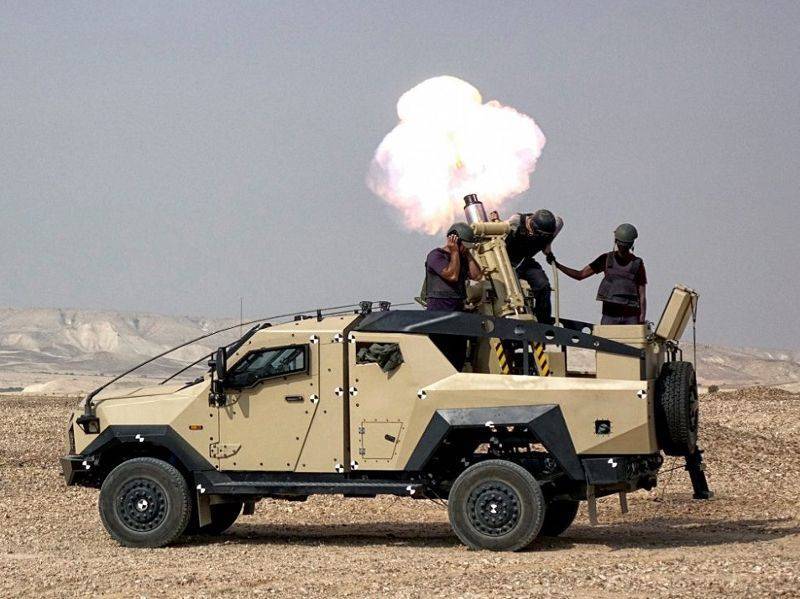
Mortar systems are a key component of military equipment, used by both small and large infantry units. They perform key tasks as weapons to suppression, capable of striking enemy fire with indirect fire at various distances and behind shelters. Mortars are also one of the most affordable and relatively inexpensive weapon systems compared with other direct and indirect fire control systems.
Light and heavy mortars served by calculations can be called “pocket artillery” infantry units. These systems, as a rule, can quickly take up a position and withdraw from it. Mortars are usually not used against mechanized formations and are most effective in cases where it is necessary to disrupt the attack of enemy infantry or to support their infantry with fire. Although their impact is less than that of artillery, which is often used against armored units, the speed and mobility of mortars means that they are not the last in the arsenals of the ground forces.
There are three main types of mortars that perform a variety of tasks depending on the doctrine of individual types and types of troops: platoon level units and special forces usually use the smallest type, 60 mm; at the company level, the caliber 81 mm is most common; and the largest caliber 120 mm serves as a battalion-level support weapon.
In fact, the dimensions and capabilities of light and heavy mortars are related to the way they are applied. 60-mm mortar can hit targets from 100 meters to 2 km; 81 mm is effective at distances 2-3 km, but can send a mine and 7 km; and the 120 mm is capable of hitting targets at a distance from 8 km to 10 km, depending on the ammunition and characteristics of the barrel.
For larger 120-mm systems, mortar barrels are longer, systems for reducing recoil forces are integrated into them and a larger assortment of mortar shells is offered for them. This means that they provide greater range and accuracy, since mass, aerodynamics and propelling characteristics are the determining factors here.
A representative of the company Hirtenberger Defense Systems said that the cost of mortars on the world market increases with size and power and depends on the quality of the implementation of the solution and the included components, such as optics or fire control systems. The cost of an 60-mm mortar ranges from 8000 to 17000 dollars, rising to 9000-22500 dollars for the 81-mm system and 22500-100000 for the 120 caliber mm, punching the top bar when you turn on components such as a trailer.
A representative of Saab Bofors Dynamics explained that a small mass of 60-mm mortar means that it can be carried by hand and does not require transportation by vehicle. The advantage of it is that it “can be involved in work from distant positions without attracting attention, which inevitably occurs when using vehicles. It can be quickly put into action with less effort and with phenomenal freedom of movement. "
The total mass of 60-mm systems is of the order of 20 kg, and high-explosive fragmentation mines weigh 1,8 kg, and therefore a calculation of two to three people is sufficient for their maintenance. Mortars of special operations forces, as a rule, weigh less than 8 kg, which allows one person to serve him, and the second to bring ammunition. Amphibious mortars are carried on the hands and do not have a bipod.
If to compare, then the 81-mm mortar weighs about 60 kg, and the shells to it 5-6 kg. As a result, for the transportation of this system requires the calculation of three or four people. The 120-mm mortar must serve a calculation of at least four people, and if it is deployed outside the vehicle, a base plate and a two-leg are necessary.
Due to the different sizes of the three mortar types, the alert time varies. According to the company, it is less than 1 minutes for 60-mm mortars of special forces and 3-4 minutes for 81-mm and 120-mm systems, although it will take a little longer for the base plate. However, this time also depends on other factors, such as distance, projectile, and the order of actions.
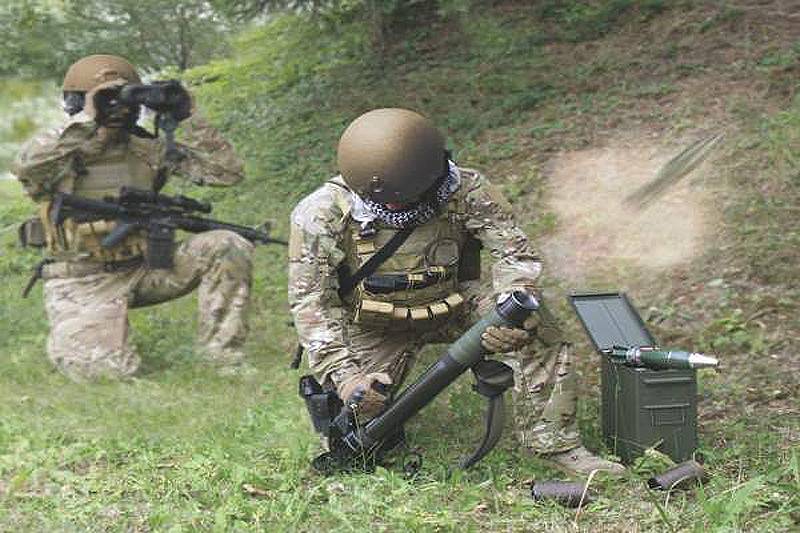
Industry has been tirelessly working to improve these fundamental characteristics of mortars. For example, in order to increase the fire power of 60-mm and 81-mm models, Saab developed a MAPAM grenade (Mortar Anti-Personnel Anti-Materiel - anti-personnel mortar to destroy the materiel), which is designed to increase the explosive impact of the mortar in the target area. The MAPAM technology is as follows: the shell of the projectile is filled with a polymeric binder with 2500 steel balls, which have the same speed when flying and whose dispersion mainly occurs in height, which increases mortality and reduces associated losses. The outer casing adds approximately 1000 shards to the balls. The company said it allows 60-mm weapons to have an impact comparable to that of an 81-mm projectile. In turn, the impact of a grenade caliber 81 mm is akin to the effects of conventional 120-mm mines.
In October 2018, the Swiss 81-mm army chose Expal's mortar for its mortar replacement program worth 116 million dollars. The purchase includes mortars themselves, optics and MSAs. In order to expand the functionality of mortars within a separate project, the company has been developing its own EIMOS (Expal Integrated Mortar System) mortar complex since 2005.
The army doctrine may prescribe that 81-mm mortars belong to infantry, while 120-mm options are more likely to belong to light artillery. While 60-mm systems are mainly transported by soldiers in field conditions, 81-mm mortars can be mounted on vehicles because of their mass.
In order to increase mobility and increase the range, the EIMOS complex allows you to install 60 / 81-mm mortar on the 4x4 configuration machine. However, the installation in this case is not as simple as it seems. Typically, the strength of a shot from a conventional mortar is transmitted through the slab to the ground, but if the mortar is mounted on a machine, problems may arise related to stability and accuracy, since the system does not rest on the ground.
An Expal representative noted that this type of system is “extremely complex and advanced. The goal is to create systems that most effectively cope with the recoil forces - to find a balance between strength and lightness. When firing from a mobile mortar complex, it is necessary to control the recoil to absorb the forces arising from the shot. This always means adapting to the vehicle and its characteristics, although lighter platforms are potentially preferred. ”
The reason for developing EIMOS is to increase survivability due to mobility. When firing from a mortar, his position can be traced by the enemy, which increases the vulnerability of the calculation for return fire. The ability to shoot and leave - shoot back and quickly change position - is very important in mortar operations.
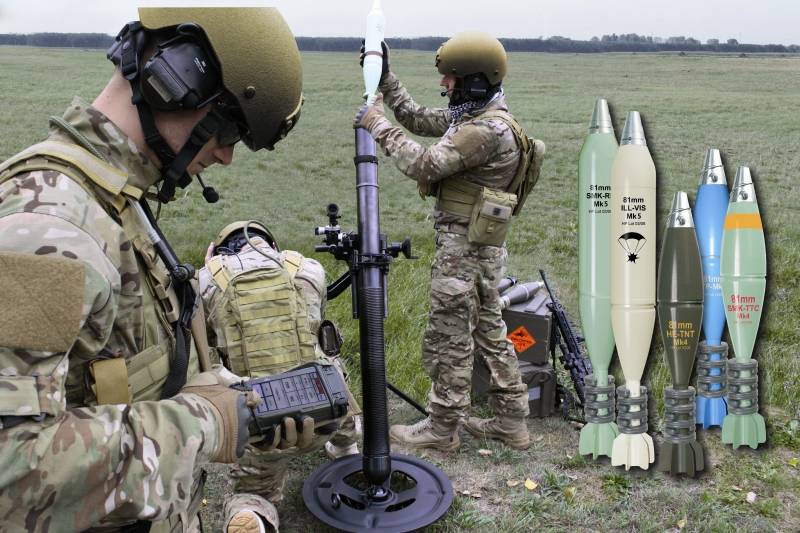
The company sees the EIMOS complex as a “natural evolution” of traditional 60 / 81-mm mortar systems. Using a vehicle means that you can take on extra shells to increase firepower. Systems with a higher level of automation can also be used to reduce the calculation and a greater number of sensors to increase range and accuracy. “To improve the accuracy of onboard mortars, geolocation sensors and navigation systems with very high accuracy are used in combination with electric drives integrated with highly sensitive positioning sensors,” said a company representative.
Problems with installing the 81-mortar are comparable to installing the 120-mm system - much more severe and much more powerful. ST Engineering Land Systems has developed a recoil mechanism to reduce the load on the carrier platform. A company spokesman said that the SRAMS (Super Rapid Advanced Mortar System) recoil system allows you to mount weapons on both tracked and wheeled vehicles, including its own articulated all-terrain vehicle Bronco and 4X4 configurations. Reducing the impact on the platform means less movement, and this in turn has a positive effect on the accuracy of the mortar during prolonged firing.
Typical 120-mm mortars offer long ranges and great firepower. They have a barrel can withstand high pressure in the chamber, which allows you to send larger combat units over long distances. The task of 120-mm systems is to support infantry, but their mass can be a serious problem for the calculation.
“The 120-mm mortar is not ideal for manual transportation, so most of the components of the system are either towed or installed on a mobile platform,” said a ST Engineering representative. - Bringing a towed or conventional mortar into combat position requires at least 10-15 minutes and from four to six people. 120-mm SRAMS is serviced by two people and deployed very quickly. After stopping the platform and determining the coordinates of the target, the first shot can be fired within 30 seconds. ”
The introduction of an automatic loader system and an advanced shooting mechanism made it possible to introduce a continuous fire mode and increase the rate of fire. Although it may raise the temperature of the barrel to dangerous values, the SRAMS complex has a sensor for detecting this limit, which disables automatic charging until the temperature drops to a safe level. In addition, a cooling system may be added in order to avoid reaching extreme temperatures and to maximize the duration of firing.
Ultimately, digital transformation has played a revolutionary role in increasing the effectiveness of mortars of all calibers and sizes. The integration of GPS and network capabilities has simplified the use of this weapon system as a mobile platform for maneuverable forces and increased the accuracy to 10 meters.
“Accuracy is a combination of mortar, ammunition and external ballistics,” said a spokesman for ST Engineering. “The SRAMS MSA allows meteorological data to be calculated in order to improve external ballistics.”
According to the company, to reduce the firing cycle, the SRAMS complex is equipped with an SLA and an inertial navigation unit with GPS. It provides the necessary precise direction (azimuth) for SRAMS, allowing the integrated complex to operate either as a separate unit or as part of a platoon with the ST Engineering’s iBattlefield Management System (iBMS) battle management system connected to the network.
ST Engineering has signed a cooperation agreement with the Austrian manufacturer of mortars, the company Hirtenberger, to promote the SRAMS complex with the SLA and ammunition produced by the latter.
Improved MSA can increase weapon effectiveness; therefore, at Eurosatory 2018, Hirtenberger presented its digital model GRAM (Grid Aiming Mode) for an 60-mm lightweight mortar. When firing mortars of this type of soldier, as a rule, should see the target in line of sight, but the GRAM system allows you to fire from cover. GRAM uses GPS and ballistic data to measure the azimuth and elevation and present the received values to the operator. The soldier can enter the range and type of projectile into the SLA, which then calculates the firing task. The system can be used without GPS and integrated into a larger operational management network, where it can receive target data from other sources.
Hirtenberger’s M60-6 895-mm mortar has been in service with the British Army since 2007, when it was purchased as an urgent need to replace the L51A9 1-mm mortar.
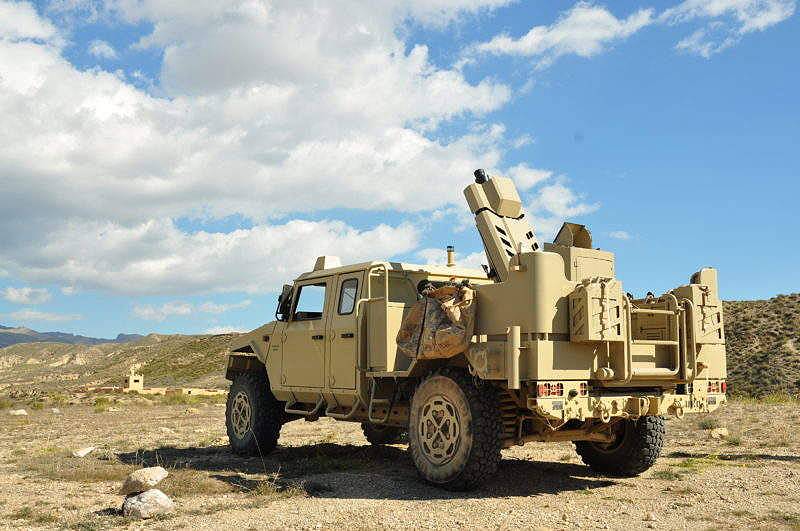
The Israeli company Elbit Systems considers the inclusion of mortar operations in the general network. The company manufactures the Spear Mk120 2-mm system with a fully electric recoil system, which is installed on 4x4 vehicles and other tracked vehicles, such as armored personnel carriers.
A representative from Elbit said that the Spear complex can be connected to a battle management system (SMS), which allows commanders to plan operations, knowing that mortars can quickly switch between fire missions and positions. "A mortar platoon can be distributed on the battlefield, supporting their forces from different angles and different ranges, increasing survivability and efficiency."
Using the SMS allows you to provide fire support with one or more mortars of any unit visible on the network. A company spokesman said in this regard that “targets can be quickly captured by closing the loop between the sensor and the mortar, as in other fire support systems. If you are not online, you will fall out of the clip and help will come much later. ”
According to Elbit, operators are constantly being asked to increase the range of indirect guidance systems. It is desirable that the largest modern 155-mm artillery system reaches 40 km, and the largest 120-mm mortar can send mines to 10-15 km. The company said that its Spear family can reach the 16 km range using GPS, lasers and projectiles with control surfaces.
Elbit supplies its 120-mm CARDOM mortar on a swivel support to Denmark for installation on Piranha V armored vehicles. The contract worth $ 1 million 15,4 must be executed in the 2019 year.
In addition to the technical aspects of firing a mortar from a machine, there is a problem associated with the integration of the system into larger combat formations along with command and control centers and medical and service units.
The main problems associated with the design of the hull structure, so that it better distributes the forces acting during firing, you also need to fit into the transport regulations limiting the length, height and width, and at the same time have sufficient ammunition and volume for the crew of the vehicle. Additional requirements may determine the levels of protection of the cabin from mine explosions, etc.
The approach of the Finnish company Patria was to create a fully protected tower system that could offer a breakthrough leap in technology and capabilities. As a result, the company developed two systems: the NEMO (New Mortar) turret system is a single-barreled automatic 120-mm mortar; and AMOS (Advanced Mortar System) - double-barreled mortar tower, serviced by calculation.
According to a Patria representative, “they, along with intelligent fire control systems and semi-automatic loading systems, open up new ways to use mortars in combat, for example, the“ Flurry of Fire ”shooting mode (eng., MRSI - Multiple Rounds Simultaneous Impact; the angle of the trunk and all projectiles fired at a certain time interval arrive at the target simultaneously), shooting while moving, direct fire, MRSI at different targets, etc.
He explained that when receiving the coordinates of the target, the operator can send data about the target and the firing task in the NEMO or AMOS MSA systems and then everything, including ballistics with vertical guidance angles and azimuth and type of ammunition, is calculated automatically.
Patria believes that the trend of choosing more mobile options, especially tower ones, rather than options on turntables, is getting stronger. As a result, the company has in recent years received several export contracts for its NEMO system. The main reasons for choosing the company calls the protection offered by the tower, as well as ergonomics.
“Compared to traditional companies for the production of large-caliber mortars, our modern tower mortars can provide the same fire power, but at the same time the need for personnel is reduced three times. The AMOS calculation consists of the 4 person and driver, while the NEMO calculation is three people plus the crew of the car or vessel. ”
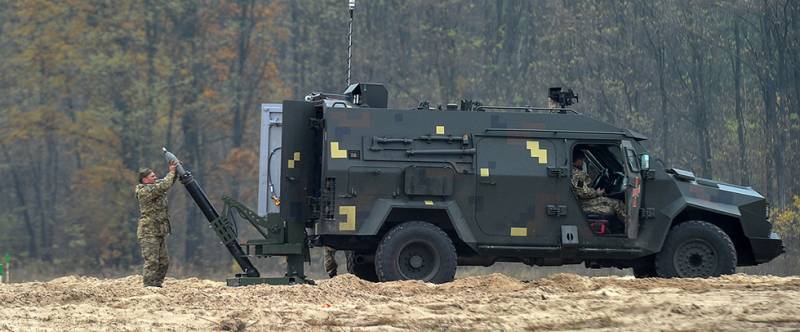
This type of mobility is becoming increasingly important, in particular in areas of active hostilities, such as, for example, in Eastern Ukraine. In 2018, the new 120-mm mobile mortar complex Bars-8MMK, using the Soviet portable mortar 2B11 mounted on the Bars-8 4X4 armored car, was tested in Ukraine with FCS and pneumatic drives. Bars-8 MMK will be supplied to the Ukrainian army and special forces, but it is not yet clear when full-scale production will begin. In 2016, Ukraine completed tests of a portable 82-mm mortar KBA-48M1.
In November, the 2017 of the Year, the Russian Army adopted the 24 XTNUMXC2 “Tulip” self-propelled mortar with modernized communications equipment and OMS. Poland is concerned about Russian aggressiveness and therefore, as part of the modernization program of its ground forces, the Polish army should receive the RN and 4 mortar systems based on the Rosomak 64x32 platform based on the Rak and 8 complex. This will allow you to form 8 mortar batteries. Huta Stalowa Wola plans to complete deliveries by the end of 6, as part of a contract worth 2019 million dollars.
Another country concerned about the actions of Russia is Sweden, which is developing an 120-mm self-propelled mortar Mjolner based on the CV90 BMP. Under a contract worth 68 million dollars issued to BAE Systems Hägglunds in December 2016, the 40 platforms from Mjolner will replace the existing 120-mm mortars hauled by Bv206 articulated all-terrain vehicles.
The tests were completed in December 2018 of the year and the first four systems (platoon components) were delivered in January of this year. The second batch of 4 complexes is expected in August of this year, and the last four cars are to be delivered in October of the 2023 year. The Mjolner mobile mortar complex will allow the Swedish army to perform combat missions in the shortest possible time without fear of being detected by a counterminet radar.
Although progress in mortar technology has affected many countries around the world, the United States is trying to increase the range, putting aside accuracy. The PERM (Precision Extended-Range Mortar) and Marine Corps HEGM (High-Explosive Guided Mortar) programs of the US Army were frozen for several years.
Northrop Grumman Innovation Systems has been working on mortar ammunition for this project, but has stopped its activities as a result of this freeze. However, its representative said that the company remains in contact with the American army.
The army is still using existing XM395 high-precision mines developed by Orbital ATK (joined Northrop Grumman in 2017) in 2012, as part of the Accelerated Precision Mortar Initiative. The company has supplied a precision guidance kit for an 120-mm mortar, in which GPS and control surfaces are combined in one unit. This unit is screwed in place of the standard fuse, after which the accuracy of the mortar projectile significantly increases.
“If the army wants more XM395 kits, we can make them in our factory, where we are currently producing PGK [high-precision kit for 155-mm artillery projectile], and they have quite a lot of identical components,” said a representative of Northrop Grumman. “We recently expanded our PGK line and, if the army is interested, we can increase the production of the APMI kit (XM395).”
As more and more armies recognize the advantages of mortars and want to have them in their arsenals, the industry will likely continue to develop these systems, for example, by increasing the range, improving mobility and interoperability.
120-mm mortar complex Spear Mk2, installed on the machine 4x4. The Mk2 complex is a further development of the Spear complex. The integrated satellite communications system ELSAT 2100 allows you to connect to a single army troop control network
Mortar systems are a key component of military equipment, used by both small and large infantry units. They perform key tasks as weapons to suppression, capable of striking enemy fire with indirect fire at various distances and behind shelters. Mortars are also one of the most affordable and relatively inexpensive weapon systems compared with other direct and indirect fire control systems.
Light and heavy mortars served by calculations can be called “pocket artillery” infantry units. These systems, as a rule, can quickly take up a position and withdraw from it. Mortars are usually not used against mechanized formations and are most effective in cases where it is necessary to disrupt the attack of enemy infantry or to support their infantry with fire. Although their impact is less than that of artillery, which is often used against armored units, the speed and mobility of mortars means that they are not the last in the arsenals of the ground forces.
What to choose
There are three main types of mortars that perform a variety of tasks depending on the doctrine of individual types and types of troops: platoon level units and special forces usually use the smallest type, 60 mm; at the company level, the caliber 81 mm is most common; and the largest caliber 120 mm serves as a battalion-level support weapon.
In fact, the dimensions and capabilities of light and heavy mortars are related to the way they are applied. 60-mm mortar can hit targets from 100 meters to 2 km; 81 mm is effective at distances 2-3 km, but can send a mine and 7 km; and the 120 mm is capable of hitting targets at a distance from 8 km to 10 km, depending on the ammunition and characteristics of the barrel.
For larger 120-mm systems, mortar barrels are longer, systems for reducing recoil forces are integrated into them and a larger assortment of mortar shells is offered for them. This means that they provide greater range and accuracy, since mass, aerodynamics and propelling characteristics are the determining factors here.
A representative of the company Hirtenberger Defense Systems said that the cost of mortars on the world market increases with size and power and depends on the quality of the implementation of the solution and the included components, such as optics or fire control systems. The cost of an 60-mm mortar ranges from 8000 to 17000 dollars, rising to 9000-22500 dollars for the 81-mm system and 22500-100000 for the 120 caliber mm, punching the top bar when you turn on components such as a trailer.
A representative of Saab Bofors Dynamics explained that a small mass of 60-mm mortar means that it can be carried by hand and does not require transportation by vehicle. The advantage of it is that it “can be involved in work from distant positions without attracting attention, which inevitably occurs when using vehicles. It can be quickly put into action with less effort and with phenomenal freedom of movement. "
The total mass of 60-mm systems is of the order of 20 kg, and high-explosive fragmentation mines weigh 1,8 kg, and therefore a calculation of two to three people is sufficient for their maintenance. Mortars of special operations forces, as a rule, weigh less than 8 kg, which allows one person to serve him, and the second to bring ammunition. Amphibious mortars are carried on the hands and do not have a bipod.
If to compare, then the 81-mm mortar weighs about 60 kg, and the shells to it 5-6 kg. As a result, for the transportation of this system requires the calculation of three or four people. The 120-mm mortar must serve a calculation of at least four people, and if it is deployed outside the vehicle, a base plate and a two-leg are necessary.
Due to the different sizes of the three mortar types, the alert time varies. According to the company, it is less than 1 minutes for 60-mm mortars of special forces and 3-4 minutes for 81-mm and 120-mm systems, although it will take a little longer for the base plate. However, this time also depends on other factors, such as distance, projectile, and the order of actions.
Hirtenberger’s 60-mm complex, available with barrels of different lengths and without a bipod, is excellent for special units
Pushing evolution
Industry has been tirelessly working to improve these fundamental characteristics of mortars. For example, in order to increase the fire power of 60-mm and 81-mm models, Saab developed a MAPAM grenade (Mortar Anti-Personnel Anti-Materiel - anti-personnel mortar to destroy the materiel), which is designed to increase the explosive impact of the mortar in the target area. The MAPAM technology is as follows: the shell of the projectile is filled with a polymeric binder with 2500 steel balls, which have the same speed when flying and whose dispersion mainly occurs in height, which increases mortality and reduces associated losses. The outer casing adds approximately 1000 shards to the balls. The company said it allows 60-mm weapons to have an impact comparable to that of an 81-mm projectile. In turn, the impact of a grenade caliber 81 mm is akin to the effects of conventional 120-mm mines.
In October 2018, the Swiss 81-mm army chose Expal's mortar for its mortar replacement program worth 116 million dollars. The purchase includes mortars themselves, optics and MSAs. In order to expand the functionality of mortars within a separate project, the company has been developing its own EIMOS (Expal Integrated Mortar System) mortar complex since 2005.
The army doctrine may prescribe that 81-mm mortars belong to infantry, while 120-mm options are more likely to belong to light artillery. While 60-mm systems are mainly transported by soldiers in field conditions, 81-mm mortars can be mounted on vehicles because of their mass.
In order to increase mobility and increase the range, the EIMOS complex allows you to install 60 / 81-mm mortar on the 4x4 configuration machine. However, the installation in this case is not as simple as it seems. Typically, the strength of a shot from a conventional mortar is transmitted through the slab to the ground, but if the mortar is mounted on a machine, problems may arise related to stability and accuracy, since the system does not rest on the ground.
An Expal representative noted that this type of system is “extremely complex and advanced. The goal is to create systems that most effectively cope with the recoil forces - to find a balance between strength and lightness. When firing from a mobile mortar complex, it is necessary to control the recoil to absorb the forces arising from the shot. This always means adapting to the vehicle and its characteristics, although lighter platforms are potentially preferred. ”
The reason for developing EIMOS is to increase survivability due to mobility. When firing from a mortar, his position can be traced by the enemy, which increases the vulnerability of the calculation for return fire. The ability to shoot and leave - shoot back and quickly change position - is very important in mortar operations.
“In this regard, mortar systems installed on 4x4 or 8x8 machines are a smart solution. EIMOS is a good example of the evolution of traditional systems. The Expal 60 / 81-mm mortar installed on the 4x4 can be ready to open fire in 20 seconds and instantly thereafter you can change position. These seconds are very important on the battlefield. ”
The M81-8 and M1165-8 1365-mm mortars developed by Hirtenberger for the Austrian army are ideally suited for medium-range fire suppression tasks.
The company sees the EIMOS complex as a “natural evolution” of traditional 60 / 81-mm mortar systems. Using a vehicle means that you can take on extra shells to increase firepower. Systems with a higher level of automation can also be used to reduce the calculation and a greater number of sensors to increase range and accuracy. “To improve the accuracy of onboard mortars, geolocation sensors and navigation systems with very high accuracy are used in combination with electric drives integrated with highly sensitive positioning sensors,” said a company representative.
“All this information is processed by the MSA [a ballistic computer], other external information is also processed, for example, weather data. Integrating systems such as Expal's Techfire into mortars and artillery systems automates and accelerates all tasks related to direct and indirect fire, be it a single weapon or battery, improves accuracy and controls fire support processes ... they work as a ballistic calculator , automatic guidance and firing systems, as well as command and control systems. "
Digital transformation
Problems with installing the 81-mortar are comparable to installing the 120-mm system - much more severe and much more powerful. ST Engineering Land Systems has developed a recoil mechanism to reduce the load on the carrier platform. A company spokesman said that the SRAMS (Super Rapid Advanced Mortar System) recoil system allows you to mount weapons on both tracked and wheeled vehicles, including its own articulated all-terrain vehicle Bronco and 4X4 configurations. Reducing the impact on the platform means less movement, and this in turn has a positive effect on the accuracy of the mortar during prolonged firing.
Typical 120-mm mortars offer long ranges and great firepower. They have a barrel can withstand high pressure in the chamber, which allows you to send larger combat units over long distances. The task of 120-mm systems is to support infantry, but their mass can be a serious problem for the calculation.
“The 120-mm mortar is not ideal for manual transportation, so most of the components of the system are either towed or installed on a mobile platform,” said a ST Engineering representative. - Bringing a towed or conventional mortar into combat position requires at least 10-15 minutes and from four to six people. 120-mm SRAMS is serviced by two people and deployed very quickly. After stopping the platform and determining the coordinates of the target, the first shot can be fired within 30 seconds. ”
The introduction of an automatic loader system and an advanced shooting mechanism made it possible to introduce a continuous fire mode and increase the rate of fire. Although it may raise the temperature of the barrel to dangerous values, the SRAMS complex has a sensor for detecting this limit, which disables automatic charging until the temperature drops to a safe level. In addition, a cooling system may be added in order to avoid reaching extreme temperatures and to maximize the duration of firing.
Ultimately, digital transformation has played a revolutionary role in increasing the effectiveness of mortars of all calibers and sizes. The integration of GPS and network capabilities has simplified the use of this weapon system as a mobile platform for maneuverable forces and increased the accuracy to 10 meters.
“Accuracy is a combination of mortar, ammunition and external ballistics,” said a spokesman for ST Engineering. “The SRAMS MSA allows meteorological data to be calculated in order to improve external ballistics.”
According to the company, to reduce the firing cycle, the SRAMS complex is equipped with an SLA and an inertial navigation unit with GPS. It provides the necessary precise direction (azimuth) for SRAMS, allowing the integrated complex to operate either as a separate unit or as part of a platoon with the ST Engineering’s iBattlefield Management System (iBMS) battle management system connected to the network.
“The ultimate goal is for the integrated system to be able to make calculations and point to the target in less than 30 seconds. Since the mortar complex is installed on the machine, the task "shot and drove away" can be completed in less than a minute after the last shell has been shot. "
ST Engineering has signed a cooperation agreement with the Austrian manufacturer of mortars, the company Hirtenberger, to promote the SRAMS complex with the SLA and ammunition produced by the latter.
Improved MSA can increase weapon effectiveness; therefore, at Eurosatory 2018, Hirtenberger presented its digital model GRAM (Grid Aiming Mode) for an 60-mm lightweight mortar. When firing mortars of this type of soldier, as a rule, should see the target in line of sight, but the GRAM system allows you to fire from cover. GRAM uses GPS and ballistic data to measure the azimuth and elevation and present the received values to the operator. The soldier can enter the range and type of projectile into the SLA, which then calculates the firing task. The system can be used without GPS and integrated into a larger operational management network, where it can receive target data from other sources.
Hirtenberger’s M60-6 895-mm mortar has been in service with the British Army since 2007, when it was purchased as an urgent need to replace the L51A9 1-mm mortar.
The 60 / 81-mm EIMOS complex can be installed on any 4x4 platform; Integrated Techfire fire support information system from Expal as a ballistic computer and command and control unit
Staying in touch
The Israeli company Elbit Systems considers the inclusion of mortar operations in the general network. The company manufactures the Spear Mk120 2-mm system with a fully electric recoil system, which is installed on 4x4 vehicles and other tracked vehicles, such as armored personnel carriers.
A representative from Elbit said that the Spear complex can be connected to a battle management system (SMS), which allows commanders to plan operations, knowing that mortars can quickly switch between fire missions and positions. "A mortar platoon can be distributed on the battlefield, supporting their forces from different angles and different ranges, increasing survivability and efficiency."
Using the SMS allows you to provide fire support with one or more mortars of any unit visible on the network. A company spokesman said in this regard that “targets can be quickly captured by closing the loop between the sensor and the mortar, as in other fire support systems. If you are not online, you will fall out of the clip and help will come much later. ”
According to Elbit, operators are constantly being asked to increase the range of indirect guidance systems. It is desirable that the largest modern 155-mm artillery system reaches 40 km, and the largest 120-mm mortar can send mines to 10-15 km. The company said that its Spear family can reach the 16 km range using GPS, lasers and projectiles with control surfaces.
Elbit supplies its 120-mm CARDOM mortar on a swivel support to Denmark for installation on Piranha V armored vehicles. The contract worth $ 1 million 15,4 must be executed in the 2019 year.
In addition to the technical aspects of firing a mortar from a machine, there is a problem associated with the integration of the system into larger combat formations along with command and control centers and medical and service units.
The main problems associated with the design of the hull structure, so that it better distributes the forces acting during firing, you also need to fit into the transport regulations limiting the length, height and width, and at the same time have sufficient ammunition and volume for the crew of the vehicle. Additional requirements may determine the levels of protection of the cabin from mine explosions, etc.
The approach of the Finnish company Patria was to create a fully protected tower system that could offer a breakthrough leap in technology and capabilities. As a result, the company developed two systems: the NEMO (New Mortar) turret system is a single-barreled automatic 120-mm mortar; and AMOS (Advanced Mortar System) - double-barreled mortar tower, serviced by calculation.
According to a Patria representative, “they, along with intelligent fire control systems and semi-automatic loading systems, open up new ways to use mortars in combat, for example, the“ Flurry of Fire ”shooting mode (eng., MRSI - Multiple Rounds Simultaneous Impact; the angle of the trunk and all projectiles fired at a certain time interval arrive at the target simultaneously), shooting while moving, direct fire, MRSI at different targets, etc.
He explained that when receiving the coordinates of the target, the operator can send data about the target and the firing task in the NEMO or AMOS MSA systems and then everything, including ballistics with vertical guidance angles and azimuth and type of ammunition, is calculated automatically.
“The charging projectile charges the charger, and then the operator can perform a fire mission. All this in less than 30 seconds. With the traditional mortar, the same sequence takes a lot of minutes. ”
Patria believes that the trend of choosing more mobile options, especially tower ones, rather than options on turntables, is getting stronger. As a result, the company has in recent years received several export contracts for its NEMO system. The main reasons for choosing the company calls the protection offered by the tower, as well as ergonomics.
“Compared to traditional companies for the production of large-caliber mortars, our modern tower mortars can provide the same fire power, but at the same time the need for personnel is reduced three times. The AMOS calculation consists of the 4 person and driver, while the NEMO calculation is three people plus the crew of the car or vessel. ”
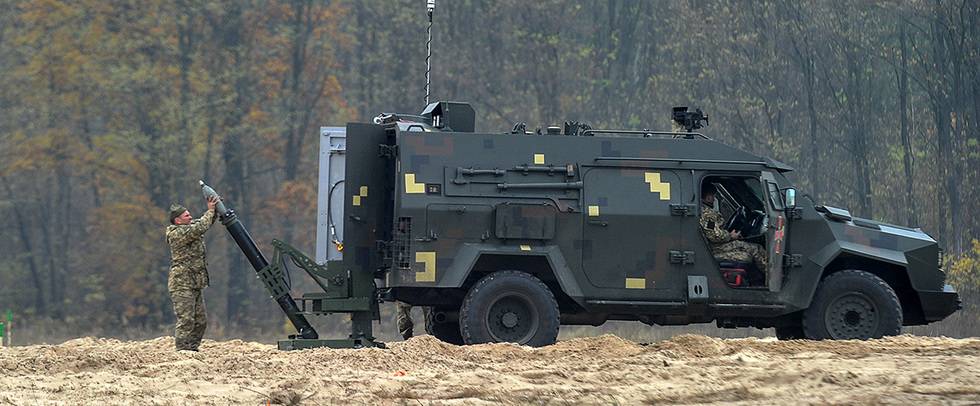
Ukrainian 120-mm mobile mortar complex Leopard-8MMK
Demonstration of concern
This type of mobility is becoming increasingly important, in particular in areas of active hostilities, such as, for example, in Eastern Ukraine. In 2018, the new 120-mm mobile mortar complex Bars-8MMK, using the Soviet portable mortar 2B11 mounted on the Bars-8 4X4 armored car, was tested in Ukraine with FCS and pneumatic drives. Bars-8 MMK will be supplied to the Ukrainian army and special forces, but it is not yet clear when full-scale production will begin. In 2016, Ukraine completed tests of a portable 82-mm mortar KBA-48M1.
In November, the 2017 of the Year, the Russian Army adopted the 24 XTNUMXC2 “Tulip” self-propelled mortar with modernized communications equipment and OMS. Poland is concerned about Russian aggressiveness and therefore, as part of the modernization program of its ground forces, the Polish army should receive the RN and 4 mortar systems based on the Rosomak 64x32 platform based on the Rak and 8 complex. This will allow you to form 8 mortar batteries. Huta Stalowa Wola plans to complete deliveries by the end of 6, as part of a contract worth 2019 million dollars.
Another country concerned about the actions of Russia is Sweden, which is developing an 120-mm self-propelled mortar Mjolner based on the CV90 BMP. Under a contract worth 68 million dollars issued to BAE Systems Hägglunds in December 2016, the 40 platforms from Mjolner will replace the existing 120-mm mortars hauled by Bv206 articulated all-terrain vehicles.
The tests were completed in December 2018 of the year and the first four systems (platoon components) were delivered in January of this year. The second batch of 4 complexes is expected in August of this year, and the last four cars are to be delivered in October of the 2023 year. The Mjolner mobile mortar complex will allow the Swedish army to perform combat missions in the shortest possible time without fear of being detected by a counterminet radar.
Although progress in mortar technology has affected many countries around the world, the United States is trying to increase the range, putting aside accuracy. The PERM (Precision Extended-Range Mortar) and Marine Corps HEGM (High-Explosive Guided Mortar) programs of the US Army were frozen for several years.
Northrop Grumman Innovation Systems has been working on mortar ammunition for this project, but has stopped its activities as a result of this freeze. However, its representative said that the company remains in contact with the American army.
The army is still using existing XM395 high-precision mines developed by Orbital ATK (joined Northrop Grumman in 2017) in 2012, as part of the Accelerated Precision Mortar Initiative. The company has supplied a precision guidance kit for an 120-mm mortar, in which GPS and control surfaces are combined in one unit. This unit is screwed in place of the standard fuse, after which the accuracy of the mortar projectile significantly increases.
“If the army wants more XM395 kits, we can make them in our factory, where we are currently producing PGK [high-precision kit for 155-mm artillery projectile], and they have quite a lot of identical components,” said a representative of Northrop Grumman. “We recently expanded our PGK line and, if the army is interested, we can increase the production of the APMI kit (XM395).”
As more and more armies recognize the advantages of mortars and want to have them in their arsenals, the industry will likely continue to develop these systems, for example, by increasing the range, improving mobility and interoperability.
Information