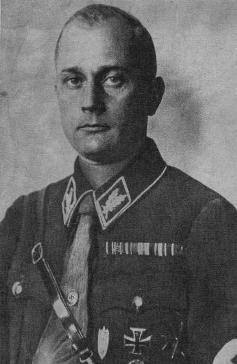
The Nine Lives of Walter Stennes

10 971 19
The Nine Lives of Walter Stennes


Walter Franz Maria Stennes was born on April 12, 1895, in Westphalia, to a family where military service was considered not a profession, but a destiny. His father, Felix Stennes, wore an officer's epaulettes and dreamed of his son joining the ranks of the Prussian military elite. Fourteen-year-old Walter was sent to the Royal Prussian General Cadet Corps, an educational institution that produced men accustomed to command and unaccustomed to asking permission.


The First World War found Stennes as a lieutenant. He fought the way he'd been taught in the cadet corps: tough, calculating, with a cold attention to detail. Four wounds. Awards. He had a reputation as an officer who was excellent at organizing reconnaissance and never retreated without orders. But his reputation with his superiors was different: too independent. Too much of a fixture among the soldiers. Too little inclined to deference.

The war was over. The Hohenzollern Empire had collapsed. Stennes was twenty-three, and he had nothing left but his military experience, his righteous convictions, and the sense of injustice that he carried with him throughout his life.

Volunteer against the revolution


Germany in 1918-1919 is chaos. Spartacists take on weaponThe Soviet republics flare up in Munich and Bremen. Berlin is rocked by street fighting. Stennes doesn't hesitate: he forms a company of volunteers and throws it against the revolutionaries. Stennes' company suppresses uprisings one after another—in the Ruhr, in Berlin, in those places where the left is trying to redraw the map of Germany.

He attracts attention. The Prussian secret police recruits him as a captain. Stennes works against the Bolsheviks, against the communist underground, against those who, in his opinion, want to destroy Germany. He believes in the empire. He believes in the monarchy. He believes in a strong government.

But the Weimar Republic did not forgive him for his monarchist sympathies. In 1920, Stennes joined the Kapp Putsch, a right-wing rebellion attempting to overthrow the democratic government. The putsch failed. Stennes was forced to suppress yet another leftist uprising, but his loyalty to the republic was not restored. In 1922, he was dismissed from the police.


During the Kapp Putsch

A retired captain, not yet thirty, finds himself on the sidelines. But in Weimar Germany, the sidelines are where the most dangerous alliances are born.

Meeting the Fuhrer


By that time, Hitler had already become the leading figure in the National Socialist movement. Stennes was introduced to him by mutual acquaintances in right-wing circles. The Führer offered him command of the storm troopers—the SA.

Shtennes refused.

He joined the "Black Reichswehr," a semi-legal organization that was preparing to serve as the army's reserve force in case of revenge. But the "Black Reichswehr" was gradually losing influence, while the National Socialists were gaining strength. Stennes eventually agreed and became the SA commander in Berlin, and then throughout northwest Germany.

SA Oberführer. The title sounded impressive, but it was backed by real work. Stennes transformed the Berlin stormtroopers from disparate street gangs into a combat-ready force. The unit's numbers grew. Discipline tightened. Stennes knew how to command—and the stormtroopers sensed it.

But the stronger the SA became, the more clearly Stennes saw what was hidden behind the facade of the Nazi movement.


Stennes became convinced that Hitler was pursuing not a revolution, but a power grab for a small circle of close associates. While the rank-and-file stormtroopers lived in poverty, the party elite wallowed in luxury. The Oberführer spoke of this openly, publicly, without mincing words.

"I must be honest. I didn't oppose Hitler because of his cruelty. I found myself in open opposition to him in 1930—more than two years before the first concentration camps were established. My rejection arose from numerous conversations with him, my knowledge of the so-called leadership corps, and my understanding that nothing good could be expected from this movement and its representatives," he later admitted.

In 1930, Stennes's stormtroopers seized the headquarters of the NSDAP's Berlin Gau. Hitler came to Berlin in person and temporarily settled the conflict by promising reforms. But the promises remained just that—promises.

In 1931, the conflict flared up again. Stormtroopers loyal to Stennes attacked the editorial offices of Der Angriff, a mouthpiece of Nazi propaganda. It was an open mutiny. Hitler responded harshly: he expelled Stennes from the party, declared him a traitor, and took every measure to eliminate opposition within the SA.

In 1931, Stennes was arrested. But he was bailed out by Hermann Göring, a man who valued the retired Oberführer's military talent and perhaps hoped to exploit it in his own schemes.

When Hitler came to power in January 1933, Stennes's situation became hopeless. The former SA commander knew too much—and spoke his mind too loudly. He wouldn't have survived the Night of the Long Knives. Friends helped him escape.

Shanghai, Chiang Kai-shek and the Secret Connection


Late 1933. Stennes finds himself in China, serving as a military adviser to Generalissimo Chiang Kai-shek's government. The German military mission to China is a world apart. Among its participants are many who dream of a German alliance not only with China but also with Russia. Stennes is imbued with these sentiments.


He worked for Chiang Kai-shek from 1933 to 1938, participating in planning operations against Japanese aggression and in the series of civil wars rocking China. The Generalissimo trusted him, and Stennes gained access to Chinese intelligence.

In 1938, the German military mission was recalled. Most of the Germans left. Stennes remained.

He contacts Soviet intelligence. His position is crystal clear: he wants to overthrow Hitler and build a democratic Germany. If that means helping Moscow, he's willing.

His code name was "Friend." His handler was Soviet intelligence officer Vasily Zarubin, hiding under the pseudonym "Schiller," the future head of the Soviet residency in the United States.

Information that cost lives


From 1939 to 1945, "Friend" operated virtually nonstop. It transmitted information to Moscow on German-Japanese relations, Berlin and Tokyo's policies toward China, and plans discussed in the most secretive offices.

On June 9, 1941—thirteen days before Germany invaded the USSR—“Friend” sent a message that ended up in a folder called “Undertaking”:

"'Friend' reported that a high-ranking official who had arrived from Berlin (Schiller assumed, a Foreign Ministry official) told 'Friend' that the Germans were prepared for an attack on the USSR both militarily and economically... All high-ranking public, naval, and civilian circles believed that the war with the USSR would be a triumphal march and would last only three months. When asked what explained such absolute certainty that the USSR would be defeated in precisely three months, 'Friend' replied that he himself did not fully share this viewpoint and was therefore considered a doubter, but that everyone else was supposedly absolutely convinced."

This message reached Moscow thirteen days before the outbreak of the Great Patriotic War. Whether the catastrophe could have been prevented had the country's leadership acted differently is a question that remains elusive. But the very fact that such information was received speaks volumes about the scale of the network that had been created.

The last turn


When the war ended, Stennes remained with Chiang Kai-shek. He became an opponent of the Chinese communists and, after the defeat of the Kuomintang, moved with his boss to Taiwan.

In 1950, Walter Stennes returned to Germany, to the British occupation zone. He was fifty-five. He again contacted the Soviet residency, but this time the intelligence leadership decided that "Friend" was no longer useful. In 1952, the file on Agent "Friend" was archived. The parties parted ways.

Stennes lived to a ripe old age. He died in 1983 in West Germany, at the age of eighty-eight. He never considered himself a traitor. On the contrary, he believed that in Germany's darkest years, he did the only thing that could save the country from self-destruction.

***
Walter Stennes is a figure who defies conventional stereotypes. A Prussian monarchist officer, creator of the Nazi storm troopers, rebel against Hitler, military adviser to Chiang Kai-shek, and Soviet intelligence agent. Each stage of his life is a separate chapter in stories 20th century. And each of these chapters makes us reflect on how thin the line is between betrayal and loyalty—and how often the fate of entire nations depends on the decisions of people whom history books prefer to ignore.

19 comments
Information
Dear reader, to leave comments on the publication, you must sign in.
  1. + 12
    April 9 2026 05: 12
    Excellent article...wow, how many contradictions coexisted in one person.
    Friend of the USSR
    ...but an enemy of the Chinese communists, a monarchist... but he hated Hitler.
    He led the SA stormtroopers in Berlin...but eventually fled to China Kang Shi.
    Original ... request The man is behaving strangely.
    1. +2
      April 9 2026 06: 08
      Quote: The same LYOKHA
      The man is behaving strangely.

      Fate plays with man...
      And the man plays the trumpet....
      1. +7
        April 9 2026 07: 21
        It would have been a great film. He was one of the first in the German right-wing movement to understand what the Austrian artist and his clique were – populist crooks. Under the guise of fairy tales of grandeur, they lined their pockets and lived in luxury unattainable for ordinary people.
      2. +4
        April 9 2026 07: 25
        Quote from Uncle Lee
        Fate plays with man...
        And the man plays the trumpet...

        Philosophical conclusion? what Is fate a pipe? belay It either "flies by with a whistle" or "clogs"! request
    2. + 10
      April 9 2026 08: 08
      Quote: The same LYOKHA
      the man is behaving strangely

      I think such cases were not entirely isolated... my grandfather, a colonel in the Austro-Hungarian army, survived the purge of "Austrian fascists," worked in the department of Canaris ("he knew those who knew" Stauffenberg), survived the purge there, sent his son - my father - to the USSR, where he, as a very young officer, experienced the end of the war in the West, then went through Mongolia, was seriously wounded and recognized as a veteran, a disabled person of the Great Patriotic War...

      Thanks to the author for raising this controversial topic!
    3. +3
      April 9 2026 10: 19
      Quote: The same LYOKHA
      Just look at how many contradictions coexisted within one person.
      Friend of the USSR
      ...but an enemy of the Chinese communists, a monarchist... but he hated Hitler

      There are no contradictions: Walter is a patriot of Germany and acts in a way that is beneficial for it: he fights at the front, crushes the communists, fights with Hitler, whom he considers a greater evil than the communists. Everything is logical.
  2. +6
    April 9 2026 06: 49
    In principle, this is a very good piece on the "role of the individual in history." I can't say I learned anything new, but the author's desire to illuminate lesser-known chapters of history is frankly encouraging.
    Thank you Leo!
    1. +9
      April 9 2026 09: 16
      In 1931, Stennes was arrested. But Hermann Göring got him out of prison.

      Here the initiative did not belong to Goering, but to Captain Stennes' immediate superior, the chief of the Prussian secret police, Colonel Ahrens.
      Goering, Ahrens and Stennes had been friends since the age of 14, when they studied together at the Royal Prussian General Cadet Corps.
      Ahrens persuaded the Reichstag deputy and future chairman Goering to get his subordinate and their classmate out of prison.
      By 1933, the cadet friends' paths had completely diverged. Göring had fallen under Hitler's influence, and Ahrens, who also controlled the Prussian border guard, helped Stennes escape to China. This served as the formal pretext for the disbandment of the Prussian secret police in April 1933, replacing it with the GestaPo (German: Geheime Staatspolizei, "Secret State Police").
    2. +9
      April 9 2026 09: 23
      3x3zsave(Anton): Thanks to the author for raising this controversial topic!

      I agree. I liked the article. It's been a while since we've seen anything like this in this section.
      Many thanks to the author!
  3. +2
    April 9 2026 07: 01
    Yes, it's a fascinating story. It all sounds like something out of a bad adventure novel. But life can be more unusual than even the most convoluted novel. Kudos to the author.
  4. +3
    April 9 2026 07: 39
    Whether the disaster could have been prevented if the country's leadership had acted differently is a question that has no clear answer.

    Stop asking this question...the disasters of 42 showed that it could not have been prevented.
    1. +6
      April 9 2026 10: 46
      Quote: Konnick
      Stop asking this question...the disasters of 42 showed that it could not have been prevented.

      And there were plenty of examples in 1941. The Senno-Lepel Operation is a model of how a mobilized Red Army would have operated in June 1941.
      If the command of the Western Military District reports several months before the war that, based on the results of the winter period of the 40/41 academic year,
      ... operational training of senior command personnel significantly increased and evaluated mediocre.

      ... units and formations of the district, fulfilling your demand for the coordination of companies and battalions completely ready for simple combat missions.

      The training of mortar units and subunits is mediocre, with the exception of 24 omb, which is poorly prepared. The training of the 45th and 76th regimental artillery is mediocre..
      ...
      The artillery firing and observation exercises that were carried out showed that The District's divisional artillery is only moderately prepared to carry out combat missions in the main types of combat.
      ...
      The training of ARGK regiments is mediocre, with the exception of 311 popes and 318 hap RGKs, whose training is poor.
      - This won't end well.
  5. +1
    April 9 2026 07: 56
    Quote: Konnick
    The disasters of 42 showed that it could not have been prevented.

    The encirclement of Kyiv by 3 Red Army armies in 194 could have been avoided. request
  6. +3
    April 9 2026 07: 58
    Thank you!
    I agree with the opinion of the respected Anton:
    Quote: 3x3zsave
    The author's desire to shed light on lesser-known pages of history is frankly pleasing
  7. +2
    April 9 2026 10: 10
    Quote: The same LYOKHA
    article...wow, how many contradictions coexisted in one person.

    There are no contradictions. The guy is a patriot of his country. Monarchism, nationalism, communism, and masturbation are just means to him. Intermediate stops, or, more accurately, turning points on a long journey.
    A normal clear vision of the goal and a clear distinction between the final destination, intermediate stops and the means of completing the journey.
    Just a smart man!
  8. +2
    April 9 2026 10: 26
    I'm trying to remember what I read about him? Besides a mention of his last name somewhere, NOTHING.
    His biography could make a great action movie. It would consist of three parts: "WWI" and "With Hitler, Against"
    "Communists. Yesterday enemies, today allies."
    The film would have been a success.
  9. +2
    April 9 2026 10: 28
    Very well written. Thank you for the interesting article.
  10. +1
    April 9 2026 19: 12
    But his reputation with the command was different: too independent.

    He was simply a patriot of Germany, and did everything he could to make it better. That's how he understood patriotism.
  11. +3
    April 10 2026 07: 36
    The context of the time is something we usually don't see from the couch... I can note that he remained true to himself and his homeland, no matter what it was... a very interesting example of the life of a man who early realized his duty as an officer to Germany... and then all his actions become clear